




The Future of Insights: Top Data and Analytics Trends for 2025

Join our Newsletter!

Featured Posts

Support Is One Click Away

Home

The Future of Insights: Top Data and Analytics Trends for 2025

Data and Analytics Trends

The Future of Insights: Top Data and Analytics Trends for 2025

Have you ever wondered how data is shaping the future? As businesses continue to rely on insights to make smarter decisions, the world of data and analytics is evolving at lightning speed. What trends will dominate in 2025? How will they transform industries and influence everyday life?  

Data and analytics trends are significant because they enable firms to make better decisions. Companies that use cutting-edge tools and techniques can better understand their customers, enhance their goods, and identify new growth prospects. These patterns also make it simpler to anticipate future issues and handle them more quickly. In today’s rapidly changing world, being updated on data and analytics trends provides organizations a significant edge, allowing them to remain ahead of the competition and prosper in the long run. 

Let’s explore the top data and analytics innovations to watch out for in the coming year! 

Data And Analytics Trends In 2025

1. AI and ML Transform Data Analytics

Artificial Intelligence and machine learning are altering the way organizations utilize data. These modern technologies assist in automating monotonous operations, analyzing vast volumes of data, and identifying trends that people might overlook. This allows businesses such as healthcare, retail, banking, and telecommunications to work more efficiently, solve issues faster, and make better judgements. One significant advantage of machine learning is its capacity to analyze data in real time, detecting unexpected patterns or problems and alerting teams to action. This saves time and helps to avoid larger complications. 

Self-driving automobiles provide an excellent illustration of AI and machine learning in action. These devices utilize complex algorithms and cameras to accurately detect objects and ensure safe navigation. This technology has the huge potential to make self-driving cars generally accepted, opening the door for safer and more intelligent transportation systems. It demonstrates how powerful AI and ML can be in determining the future of many sectors.  

2. Empowering Everyone with Data Democratization

Data is no longer only for specialists; it has become a significant resource for everyone in an organization. Businesses are attempting to make data more accessible and usable, especially for those without technological expertise. This trend, known as data democratization, means that more employees can benefit from insights and apply them to better decision-making. Companies do this by simplifying how data is organized, providing user-friendly tools, and training people on how to utilize data successfully. Generative AI technologies aid in the discovery of insights, while data fabric tools link systems and data mesh organize data by business sector. Employees also have access to self-service resources such as data visualization dashboards, learning knowledge bases, and concept testing tools.  

3. DataOps for Better Analytics

DataOps, which stands for Data Operations, is transforming how businesses manage and use their data. It simplifies the whole data management process, resulting in faster and higher-quality data analysis. By automating operations and cultivating a collaborative culture, DataOps ensures that data flows swiftly and consistently, making it simpler to extract useful insights. Companies use DataOps to create organized pipelines for collecting, processing, and securely delivering data from source to destination. These pipelines accelerate data transfer while ensuring security and compliance with laws. This enables firms to develop higher-quality analytics, resulting in more informed choices and faster problem-solving. 

For example, an important food store used DataOps to optimize its data flow. By integrating its systems with a unified data platform, the firm synchronized data throughout its entire infrastructure, allowing for real-time monitoring and more efficient operations. This not only increased productivity but also guaranteed that all levels of the organization had access to reliable, actionable data. As more firms use DataOps, they are seeing its potential to turn data management into a competitive advantage, driving innovation and expansion. 

4. Prioritizing Data Governance

As data becomes more fundamental to corporate activities, protecting its security, integrity, and compliance is essential. This is when data governance becomes crucial. It entails developing policies and processes for data access, sharing, privacy, and compliance with legislation. Data that is both dependable and of high quality is essential in analytics. Without adequate governance, firms risk using inconsistent or incorrect data, which can result in bad judgements. By setting explicit standards, businesses can guarantee that their data is accurate, consistent, and secure.  

Data governance is essential for firms that manage vast volumes of data from numerous sources, particularly sensitive information. For example, a telecoms corporation used a robust governance structure to increase data protection and administration. They improved data control by establishing consistent rules and processes, while also preserving compliance and protecting it from danger. 

5. Hybrid Cloud Gains Momentum

Hybrid cloud computing is gaining popularity because it combines the benefits of both cloud and on-premises technology. It enables organizations to select the appropriate resources for their services, applications, and data management, resulting in increased flexibility and performance.  For data analytics, hybrid cloud computing assures that enterprises can access their data at any time and from any location. It also allows for seamless integration of cloud and on-premises applications, eliminating data silos and offering more accurate, complete insights. City Plumbing Suppliers is an excellent example of a hybrid strategy, which they implemented during their cloud migration. By upgrading their old platform and combining it with cloud-based infrastructure, they could benefit from both on-premises and cloud environments. This enabled the organization to increase performance, expand better, and provide more complex services. 

6. Edge Analytics Takes the Spotlight

As the Internet of Things (IoT) and edge computing evolve, processing and analyzing data near to its source has emerged as an important trend in data analytics. This change improves data management and reduces operating expenses by allowing for faster and more efficient analysis. Edge analytics minimizes latency in IoT systems, resulting in faster decision-making. This is especially significant in real-time applications, where early detection of problems can help prevent equipment failures, decrease downtime, and save money. 

One excellent example of edge analytics in action is predictive maintenance for industrial firms. These systems monitor equipment by collecting data from sensors positioned around the facility. When the system identifies any odd behavior, it promptly warns operators, allowing them to take action before a problem happens. This ensures smoother operations and cost savings. 

How Mindpath Can Help?

Mindpath can help your company capitalize on the most recent data and analytics developments. We have the experience to help you use              Artificial Intelligence and machine learning to improve data analysis, make data available to everyone in your organization, and ensure your data is safe and well-managed. We can help you adopt DataOps to accelerate data processing and increase insight quality. We also help organizations build up data governance policies to ensure that their data is accurate, safe, and consistent with legislation. If you’re looking for hybrid cloud solutions or edge analytics, Mindpath can help you integrate these technologies into your organization to improve performance, make faster decisions, and save money. 

Wrapping Note!

The future of data and analytics is fast changing, with significant technologies like Artificial Intelligence and machine learning, data democratization, DataOps, data governance, hybrid cloud computing, and edge analytics expected to affect sectors by 2025. These advancements will enable firms to get deeper insights, make better decisions, and remain ahead of the competition. As businesses seek to maximize the benefits of these innovations, it is crucial to have the necessary tools and knowledge to apply them successfully. Mindpath is here to help you navigate these disruptive trends, providing the resources and tools you need to optimize your data management, make better decisions, and drive commercial success. 

Ready to stay ahead with the latest data and analytics trends?

Let Mindpath help you leverage AI, DataOps, and more to transform your business.

Related Post

Explore how Agentic AI empowers machines with decision-making abilities, enhancing efficiency, customer service, and operational effectiveness.
Discover Automation-as-a-Service (AaaS) and its benefits, including improved efficiency, cost savings, and seamless integration for your business.

Related Post

ReactJS for Progressive Web App development

Creating applications that are fast, dependable, and smooth on all devices is important for every company today, right? So, when you think of building something like that, ReactJS for Progressive Web App development may be a wise option for you. It allows you to create applications that give the experience of a native application without the cost or intricacy. There are many modern companies already using this approach to enhance performance and keep users invested with consistent user experiences.

ReactJS offers speed, flexibility, and user-centric features that are perfectly aligned with progressive web app goals. ReactJS has reusable components and fast rendering, making it easy for developers to build responsive and high-performance apps. PWAs built with ReactJS are responsive and load fast, work offline, and allow a smooth mobile experience that users will enjoy. In this blog, we will examine the top reasons why ReactJS is great for developing PWAs.

Looking to engage users with fast and seamless web applications? At Mindpath, we offer ReactJS development services where our experts help you create user-focused Progressive Web Apps that give users a smooth digital experience.

Understanding the Fundamentals of PWAs

Progressive Web Apps (PWAs) are modern web applications that function like mobile apps. With a PWA, you can open it in a web browser, but it behaves like a real app on your phone or computer. They are designed to function seamlessly across all devices (smartphones, tablets, or desktops), which is nicer than having separate mobile websites, apps, and desktop apps.

Progressive Web Apps are created using HTML, CSS, and JavaScript. They are fast to load; they work when users are offline and can send push notifications. They also allow access to certain phone functionality, such as the camera or location. PWAs can help businesses save time and money since they must build one app that can work everywhere.

Looking for specialists who can handle complex front-end challenges in your business? Learn why partnering with an expert React Development Company is a smart move.

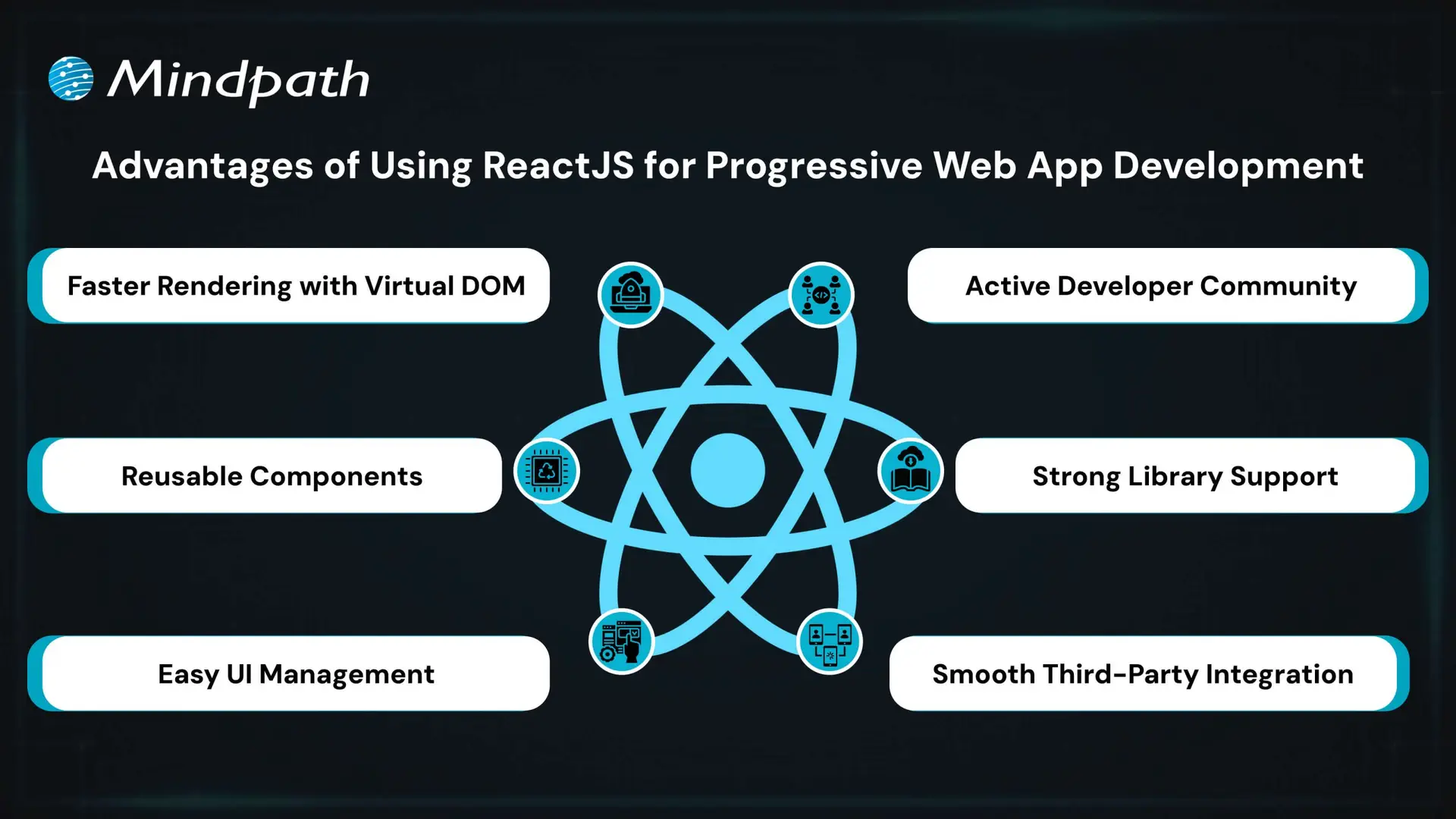
Advantages of Using ReactJS for Progressive Web App development

Using ReactJS for PWA development is a great choice for creating secure and fast web applications. With the growing ReactJS trends, developers hope that they can deliver seamless and user-friendly experiences. Here is how ReactJS is perfect for your PWAs.

Advantages of Using ReactJS for Progressive Web App development

1. Faster Rendering with Virtual DOM

React uses a Virtual DOM to update only the parts of the page that change. This speeds up performance and ensures a smooth user experience. It’s ideal for building fast and responsive ReactJS PWA solutions.

2. Reusable Components

React’s component-based structure allows developers to reuse code across the app. This makes it easier to manage the app and scale it as it grows. It’s a key reason why teams choose ReactJS for progressive web app development.

3. Easy UI Management

React follows a declarative style for creating user interfaces. This makes it simple to manage and update interactive elements in the app. It helps deliver a smooth and engaging ReactJS progressive web app experience.

4. Active Developer Community

React has a strong global community that shares solutions, tools, and tutorials. This support helps developers solve problems faster and stay updated. It also contributes to the future of ReactJS in modern web development.

5. Strong Library Support

React has many libraries like React Router and Redux that simplify routing, data flow, and offline features. These tools help developers add advanced features to PWAs with less effort. They make building a PWA with React more efficient and reliable.

6. Smooth Third-Party Integration

React works well with tools needed for Progressive Web Apps, such as service workers and web app manifests. These tools help enable offline access, background syncing, and “Add to Home Screen” functionality. This makes it easier to implement full PWA capabilities when building with React.

Want to keep your large React app fast and responsive as it scales? Discover the best practices for optimizing React performance for large applications.

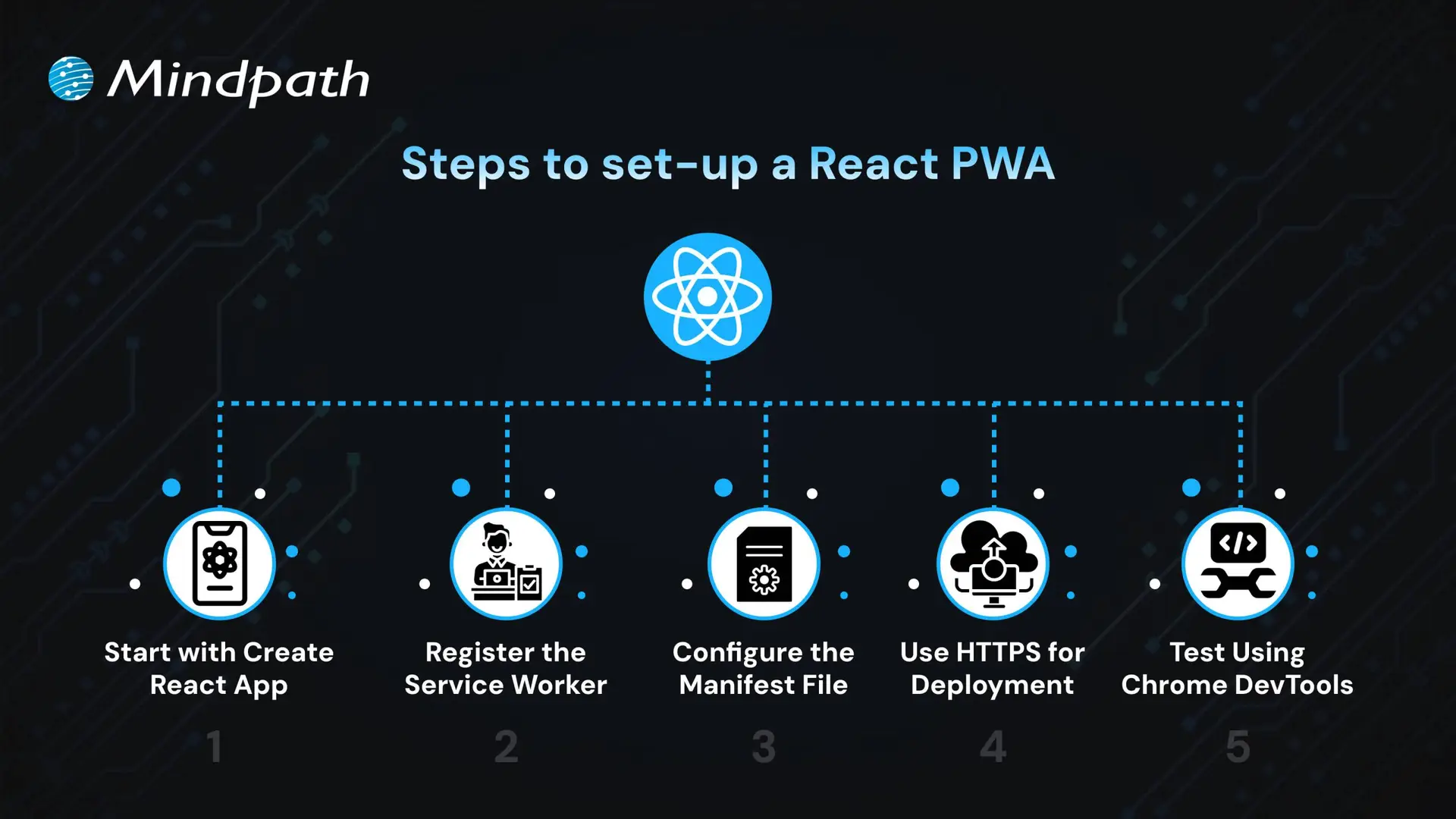
Steps to Set Up a React PWA

Getting started with React is a smart move when building modern web apps that work offline and feel like native apps. If you’re planning to use React for progressive web app development, here are the key steps to set it up properly.

Steps to Set Up a React PWA

1. Start with Create React App

The easiest way to begin is by using Create React App, which includes built-in support for PWAs. It sets up a basic structure with everything needed for ReactJS PWA development, including service workers and a manifest file. CRA also optimizes the build process, making your app production-ready. This setup ensures you have a strong foundation to build a scalable and responsive PWA.

2. Register the Service Worker

To activate offline support, register the service worker by calling ‘serviceWorkerRegistration.register()’. This enables background caching, which is key to building a progressive web app with React that works without an internet connection. A registered service worker allows the app to cache assets and serve them even when the network is unavailable. It also helps improve performance by reducing server requests, ensuring a better user experience in the future of web development.

3. Configure the Manifest File

Update the manifest.json file in the public folder to define your app’s name, icons, theme color, start URL, and display mode. These settings control how your app appears when installed on a device. A properly configured manifest ensures your PWA looks and feels like a native app. This also helps in enabling features like splash screens and full-screen display, supporting the growth of progressive web apps with React development.

4. Use HTTPS for Deployment

For security, PWAs must be served over HTTPS. Local development through CRA handles this, but for live deployment, ensure your server uses a valid HTTPS setup. A secure context is required for service workers and features like push notifications. Using HTTPS also improves user trust and SEO performance.

5. Test Using Chrome DevTools

Use Chrome DevTools to inspect and test your PWA setup. You can verify service worker status, cached files, and manifest settings. Lighthouse audits can also help you improve your app based on best practices for React for progressive web app development. Testing ensures your PWA meets performance, accessibility, and usability standards.

Seeking a development approach that reduces complexity while enhancing functionality? Read why React Web Development is ideal for modern projects.

Ready to Build a Powerful PWA with ReactJS?

ReactJS offers all the essential tools to build fast, reliable, and interactive web apps that feel like native experiences. Its reusable components, strong ecosystem, and smooth performance make it a top choice for modern applications. Choosing ReactJS for progressive web app development is a future-focused decision that brings real value to your business.

At Mindpath, we deliver expert ReactJS development services tailored to your goals. We build responsive, scalable, and feature-rich PWAs with smooth offline access and high performance. Our experienced team uses the latest tools and trends to create apps users love. Partner with Mindpath and bring your next ReactJS PWA to life with speed and quality.

Frequently Asked Questions

1. How do Progressive Web Apps compare to traditional mobile applications in terms of maintenance?

Progressive Web Apps are easier to maintain because they use a single codebase across devices. Updates are applied centrally and reflected instantly for all users, unlike native apps that require separate updates and approvals. This reduces long-term maintenance effort and ensures consistency.

2. What factors should be considered before choosing ReactJS for PWA development?

It is important to evaluate project complexity, performance requirements, and scalability needs. ReactJS works best when applications demand dynamic user interfaces and fast updates. Compatibility with existing tools and the availability of skilled developers also play a key role in the decision.

3. How does a PWA built with ReactJS handle poor or unstable network conditions?

PWAs use service workers to cache important assets and data, allowing the application to function even with limited or no internet connectivity. This ensures a stable experience, reduces loading time, and keeps essential features accessible during network interruptions.

4. Can ReactJS PWAs support advanced features like push notifications and device access?

Yes, ReactJS PWAs can support features such as push notifications, location tracking, and limited hardware access through browser APIs. These capabilities enhance user engagement and allow web applications to deliver experiences closer to native mobile applications.

5. How scalable are ReactJS-based PWAs for growing user demands?

ReactJS supports scalable architecture through component-based development and efficient state management. As user demand increases, applications can be expanded with minimal disruption. This makes it easier to handle higher traffic, add new features, and maintain performance over time.

Discover why ReactJS is perfect for Progressive Web App (PWA) development. Learn how Mindpath can help you build high-quality PWAs.
Automation-as-a-Service (AaaS)

Have you ever wondered how businesses manage to streamline their operations and boost productivity while minimizing costs? The secret often lies in Automation-as-a-Service (AaaS). Imagine having the power to automate repetitive tasks without the need for extensive in-house infrastructure or expertise. Sounds intriguing, right? In this blog, we’ll explore what AaaS is all about and the numerous benefits it can bring to your organization. So, let’s dive in! 

What is Automation-as-a-Service (AaaS)?

Automation as a Service (AaaS) enables businesses to access automation solutions via web services without having to create their own systems. Consider it a unique type of software solution that helps organizations function more smoothly, save money, and work more productively. AaaS is frequently associated with robotic process automation (RPA), which uses artificial intelligence (AI) to automate digital processes. This means that computers can replace people in monotonous jobs, making things faster and easier. The primary purpose of AaaS is to help organizations grow. With a bespoke solution, e-commerce enterprises can grow without having to repeat many manual operations. 

Artificial intelligence chatbots are a common example of AaaS. Chatbots are solely useful for customer support, but they can help in a variety of commercial functions too. They can respond to enquiries, help with sales, and even support personnel, making them useful beyond client engagements. 

Benefits of Automation-as-a-Service (AaaS)

1. Improved Security

One of the primary advantages of Automation-as-a-Service (AaaS) is increased security. Protecting sensitive data from possible threats is essential since automation entails handling sensitive data and operations. AaaS providers often use robust security features, such as encryption and access restrictions, to protect your data from unauthorized access and cyber-attacks.  

These security protocols assist in avoiding data breaches and other dangers, ensuring that your automated operations function smoothly and safely. Furthermore, AaaS solutions frequently adhere to industry norms and laws, hence increasing their dependability. Businesses that use AaaS can be certain that their activities are well-protected, allowing them to focus on growth and efficiency rather than security concerns.  

2. Cost Efficiency

AaaS enables businesses to save money while increasing revenues by automating repetitive and time-consuming processes. When teams are free of repetitive duties, they can focus on more valued initiatives that promote development and creativity. 

This change not only reduces operating expenses, but also increases production. Employees, for example, can spend their time generating new ideas, enhancing customer experiences, or optimizing procedures rather than ending up bogged down in repetitive duties. Finally, AaaS enables firms to employ their resources more efficiently, resulting in increased profitability and a stronger competitive advantage in the marketplace. Automation handles the essentials, allowing businesses to engage more in strategic projects that genuinely make a difference. 

3. Better Productivity

Another significant advantage of Automation-as-a-Service (AaaS) is greater productivity. Employees can increase their productivity significantly by automating regular chores. With fewer manual procedures to look after, individuals can give more time and energy to more difficult and strategic tasks that need creative thinking and innovation. 

This move enables teams to focus on more impactful tasks, such as building creative products, increasing customer service, or analyzing data to make better decisions. Consequently, total work efficiency improves, allowing for speedier project completion and greater business outcomes. With AaaS taking care of the monotonous activities, staff can work smarter, not harder, allowing the firm to reach its objectives more efficiently. 

4. Reusable

Once an automated solution is developed, it can be utilized in a variety of settings with just small modifications required. For example, if a team creates a script for container management, it can simply be changed to operate with multiple apps or container types. 

This adaptability saves time and effort while also lowering development expenses. Instead of beginning from scratch every time a new automation work occurs, firms can build on current solutions to improve the automation process’ efficiency. This implies that businesses can adapt rapidly to changing demands and apply automation in many areas of their operations, maximizing the return on their original investment in automation technology.  

5. Provides Advanced Technologies

Businesses can utilize AaaS to make use of cutting-edge technologies and techniques that are already accessible, rather than investing considerably in creating proprietary automation solutions.  This paradigm enables businesses to integrate sophisticated automation features such as artificial intelligence, machine learning, and data analytics without the need for considerable financial commitment. As a result, even tiny organizations now have access to significant automation capabilities that were previously exclusive to larger corporations with greater resources. Organizations that use AaaS can stay competitive and develop swiftly, using the latest technological breakthroughs while keeping expenses under control. This makes it easier for businesses to adjust to market developments and improve their operational efficiency. 

6. Readily Availability

One of the most notable advantages of Automation as a Service (AaaS) is the quick availability of automation solutions. With AaaS, teams can begin utilizing these tools immediately, allowing them to address issues swiftly and enhance operational procedures without the delays associated with designing bespoke solutions. 

This fast access allows organizations to respond to difficulties in real time, optimizing operations and increasing efficiency almost quickly. For example, if a team faces a repetitious activity that requires automation, they can swiftly adopt an AaaS solution instead of waiting weeks or months for development to complete. This agility not only simplifies processes, but also allows teams to focus on more strategic objectives while knowing they have the automated tools they require at their fingertips.  

7. Seamless Integration

AaaS makes it simple and fast to integrate automation technologies into an organization’s existing systems. This implies that organizations can embrace and utilize automation technologies without going through a long development process. 

Businesses using AaaS can smoothly integrate new automation solutions into their existing operations, resulting in little interruption. This seamless connectivity enables organizations to begin reaping the advantages of automation almost immediately. For example, if a firm wishes to automate its customer service system, AaaS can assist in integrating chatbots and other technologies into the existing infrastructure with little delay. 

Consequently, organizations can enhance their operations more quickly and effectively, increasing productivity and efficiency while ensuring process continuity. Efficient integration allows businesses to focus on their core operations while reaping the benefits of sophisticated automation. 

Also Read: How Gen AI is Redefining the Customer Service Landscape?

Automation-as-a-Service (AaaS) at Mindpath

Mindpath provides Automation-as-a-Service (AaaS) to assist organizations optimize processes and increase efficiency. Our AaaS solutions provide advanced automation features that enable businesses to automate ordinary processes without having to design everything from the start. 

Mindpath’s AaaS provides immediate access to modern technologies that will help your team operate smarter and quicker. Our solutions are intended to integrate effortlessly with your existing systems, ensuring speedy integration and little downtime. This means you can start reaping the benefits of automation immediately.  

Final Thought!

Automation-as-a-Service (AaaS) is an effective solution for organizations to improve operations, increase productivity, and save expenses. Organizations that use AaaS can immediately acquire advanced automation technologies, effortlessly integrate them into their current systems, and devote their resources to more strategic objectives. AaaS has the ability to alter how organizations function, whether via improved security, increased efficiency, or the use of cutting-edge solutions. At Mindpath, we are devoted to assisting you in realising these benefits, allowing your organization to prosper in today’s fast-paced world. Embrace the future of automation with Mindpath and watch your business rise! 

Ready to elevate your business with Automation-as-a-Service (AaaS)?

At Mindpath, we specialize in providing tailored automation solutions that streamline operations and enhance efficiency.

Discover Automation-as-a-Service (AaaS) and its benefits, including improved efficiency, cost savings, and seamless integration for your business.
Remote development team
Globalization has been a phenomenon that blurred boundaries and helped many businesses expand internationally. While the world is reaching toward realizing the idea of a “Global Village”, reservations and misconceptions about hiring remote employees and teams prevail.   COVID-19 showed business leaders the endless potential of remote working. While the world remained locked up, remote working allowed businesses to keep going, especially the ones dependent heavily on IT services  With rapid digitization, IT services have become more crucial than ever for businesses belonging to all categories and industries. According to Statista, the revenue of the IT services market is projected to reach USD 1,420 billion by 2024. Out of the total revenue, the IT Outsourcing segment is dominating the market with a projected volume of USD 541.10 billion in 2024.   Hiring a remote development team is a sound business decision with multiple benefits. In this blog, we will cover all the information essential if you are considering hiring remote developers or development teams for your business.  

Remote IT Development Teams: An Overview

Remote development teams consist of developers and tech professionals working from different geographical locations. These teams collaborate with businesses virtually, understanding their requirements, creating various wireframes, creating delivery plans, working on development, and delivering, deploying, and testing the final product. When hiring talent via staff augmentation, it’s essential to ensure that these remote teams are well-integrated into your project, enabling seamless collaboration and meeting your business goals efficiently.  Businesses are inclined towards hiring remote developers to access a wide talent pool within budget. Especially mid-sized and small businesses that cannot accommodate a full-fledged IT team to develop and maintain their website, apps, and other digital platforms can hugely benefit from hiring an offshore team.  

Benefits of Hiring a Remote Development Team

1. Access to a Global Talent Pool

One of the primary benefits of hiring a remote development team is the ability to access a diverse range of skills and expertise. Casting a wider net can help businesses recruit the top talents in the technology fields such as development, design, implementation, etc.   Emerging technologies like AI, ML, data science, DevOps, Blockchain, Cloud Computing are taking over the world. By looking beyond geographical boundaries, you can find developers with specific technical capabilities that may not be available locally.

2. Cost Efficiency

Hiring remote developers can be more cost-effective than maintaining an in-house team. A report by Deloitte suggests that 63% of companies outsource their development tasks to reduce costs.   You can reduce expenses related to office space, equipment, and other overhead costs. Moreover, the ability to hire from regions with lower living costs can further reduce payroll expenses without compromising on talent quality. 

3. Flexibility and Scalability

Remote teams offer greater flexibility. You can scale your team up or down based on project requirements without the logistical challenges associated with in-house teams. According to studies, 53% of businesses have dealt with capacity issues, and 38% improved the service quality by hiring a remote development team.   This flexibility allows you to manage resources more efficiently and respond quickly to changing project needs. 

4. Increased Productivity

Remote developers often experience fewer distractions than traditional office environments, increasing productivity. There is also no time for commuting to a physical workplace, saving time for more strategic actions.   With a properly managed remote team, you can leverage different time zones to maintain a near-continuous workflow, ensuring that your project progresses even outside typical working hours. 

5. Environmental Benefits

Hiring a remote development team not only saves your costs and improves productivity but can also contribute to reducing your company’s carbon footprint. With fewer employees commuting to a central office, there are fewer greenhouse gas emissions, aligning your business with environmentally sustainable practices.

Challenges to Consider

1. Communication Barriers

Effective communication is crucial for the success of any development project. When working with a remote team, time zone differences and language barriers can pose significant challenges. It is essential to establish clear communication protocols and utilize collaboration tools to ensure everyone is on the same page.

2. Managing Productivity

Tracking productivity can be more challenging with a remote team. Setting clear expectations, establishing measurable goals, and using project management tools are vital for keeping remote developers on track. Regular check-ins and progress updates can also help in maintaining accountability. 

3. Cultural Differences

Cultural differences can impact team dynamics and workflow. Understanding and respecting these differences is important for fostering a collaborative environment. Encouraging an inclusive culture where all team members feel valued can help mitigate potential conflicts and improve overall productivity. 

Best Practices for Working with Remote Developers

1. Define Clear Objectives

Before hiring a remote development team, define your project goals, timelines, and deliverables. Clear objectives provide a roadmap for the team and help in aligning their efforts with your business objectives. 

2. Invest in the Right Tools

Leverage technology to bridge the gap between remote team members. Tools like Slack/MS Teams for communication, Jira/Azure DevOps for project management, and GitHub for version control can enhance collaboration and streamline workflows. 

3. Build a Strong Onboarding Process

A well-structured onboarding process ensures that remote developers understand your company culture, project expectations, and their specific roles. Providing comprehensive training and resources can help new team members integrate smoothly and start contributing quickly. 

4. Foster Team Engagements

Regular team-building activities, virtual meetups, and open communication channels can help in building a cohesive team. Encouraging social interaction and recognizing individual contributions can boost morale and foster a sense of belonging among remote developers. When comparing IT staff augmentation vs. traditional hiring, these practices are essential in maintaining a strong, engaged team, regardless of the hiring model, while benefiting from the flexibility and scalability that staff augmentation offers.

Wrapping Up

Hiring a remote development team can offer numerous benefits, from access to a global talent pool to cost savings and scalability. However, it also requires careful planning and management to overcome challenges such as communication barriers, productivity tracking, and cultural differences.  If you’re considering hiring a remote development team, Mindpath’s Team Augmentation services can be an invaluable resource. Our experienced professionals can seamlessly integrate with your existing team, bringing specialized skills and expertise to help you achieve your project goals. With Mindpath, you get the flexibility and scalability of remote development without the common pitfalls. Partner with us to unlock the full potential of your development projects.  Feel free to reach out to us with any questions or to discuss your specific requirements. Together, we can build something great! 
Hiring a remote development team is a sound business decision with multiple benefits. Read things to keep in mind while hiring a remote team.