


Generative AI for Customer Service: Transforming Support in the Digital Age

Join our Newsletter!

Featured Posts

Support Is One Click Away

Home

Generative AI for Customer Service: Transforming Support in the Digital Age

generative AI for customer service

Generative AI for Customer Service: Transforming Support in the Digital Age

In the technology-driven era, the customer service landscape has undergone a transformational change.  A key technology that has been serving as a catalyst is generative AI. The rising popularity of generative AI for customer service is evident, as about 65 % of leaders in customer service intend to leverage the technology along with conversational AI to boost customer satisfaction (Source: IBM). 

The emergence of Gen AI has been nothing short of transformational for businesses. One of the main areas that has witnessed a remarkable change because of Gen AI is customer service. The novel technology has undoubtedly broadened the boundaries of customer support. Business entities across diverse industries can focus on enhancing customer experience with AI, especially generative AI. Let’s explore how modern businesses can capitalize on Generative AI in customer service.

If you are looking to leverage the user experience with the use of Gen AI. Contact us to unlock the full potential of Gen AI in enhancing your customer support and delivering personalized services.

An Insight into Generative AI

Before answering the question – How generative AI is improving customer service, it is crucial to have clarity on Gen AI. Generative AI refers to the specific branch of Artificial Intelligence that is capable of creating new content in the form of text, audio, video, and image formats. The output of Generative AI mainly depends on the type of data that it has been trained on.

In recent years, Generative AI has undoubtedly been considered a major breakthrough in the AI landscape. It has not only expanded the boundaries of Artificial Intelligence but also redefined how individuals and businesses interact with AI technology. The functionality of generative AI is not restricted to generating new content. It can also generate chat responses, create deepfakes, and personalize interactions.

Wondering how artists and creators are adapting to AI? Discover how Generative AI is changing the creative industry, and see how automation and imagination now work together.

Role of Generative AI in Customer Service

Customer service is the specific domain where companies offer support and assistance to their customers. The assistance could be offered prior to, during, or after the purchase of their offering. Regardless of the timing of such service, the role of customer service is indispensable since it can have a major influence on the overall experience and satisfaction of customers. At present, the customer service arena has undergone revolutionary change thanks to the adoption of Gen AI by businesses.

Generative AI for customer service has been a boon in the business world. It has certainly equipped businesses to automate their customer service function. As a result, the overall efficiency of business entities to promptly respond to the queries and concerns of their customers has increased significantly. Today, the role of GenAI customer service is of high strategic importance for businesses. By leveraging the core capabilities of Generative AI, businesses are able to redefine how they deliver support to their customers.

Curious about how generative AI is applied in real-world scenarios? Explore Generative AI Use Cases to discover how businesses leverage AI for content, design and innovation.

Key Benefits of Generative AI-based Customer Service

The strategic deployment of Generative AI technology in a customer service setting can give rise to a host of benefits for businesses.  In order to take advantage of the novel technology in an optimum manner, it is a must for businesses to understand its potential at an in-depth level. Some of the major benefits that can arise for businesses by integrating generative AI in customer service include:

1. Prompt Response

By integrating Gen AI-powered customer service, businesses are able to promptly respond to the concerns or queries of their customers. Customers do not have to wait for long hours to get support from businesses. Gen AI undoubtedly empowers businesses to respond to their customers instantly. Moreover, thanks to the use of Gen AI in customer support, businesses are able to offer 24/7 assistance to their customers. This automatically increases the overall convenience of customers and strengthens their association with businesses.  

2. Personalization of Interactions

One of the chief benefits of gen AI in customer support is that it facilitates personalization. As a result, business entities can tailor the interaction to meet the exact needs of their customers. Generative AI technology is basically capable of accessing customer data and past interactions, thereby personalizing the conversations. The integration of Generative AI for chatbots has been revolutionary since it has taken personalization to the next level. Thus, in the competitive business environment, businesses are able to have meaningful conversations as well as interactions with their customers.  

3. Better Productivity of Customer Service Agents

One of the benefits of AI in support teams revolves around the higher productivity of agents. Thanks to the automation of conversations with customers, the workload of customer service agents has significantly reduced. Therefore, they are able to focus on complex interactions and deliver value to customers. Moreover, the possibility of customer service agents suffering from burnout and fatigue can also be significantly reduced.

Must Read: Generative AI Trends 

4. Downside of Gen AI in Customer Service

Although Generative AI technology has been disrupting customer service like no other technology, it has also given rise to a few concerns. In order to get a holistic insight into the potential of Gen AI, it is crucial to take into consideration its shortcomings. By having a comprehensive insight into these next-gen customer service solutions, businesses can leverage the novel technology in an optimal manner.

5. Hallucinations 

One of the major shortcomings revolves around hallucinations. There may be a number of occasions when Gen AI may generate inaccurate or counterfeit responses that may seem plausible. However, due to their inaccuracy, the risk of misinformation may arise. Furthermore, customers may be on the receiving end because of this particular flaw. In sensitive industries such as healthcare or finance, it may act as a major hindrance for both businesses and customers.

6. Absence of domain knowledge

Another downside that businesses need to take into consideration is the lack of domain knowledge. Unless and until companies fine-tune Gen AI prior to its implementation, there may arise knowledge-related gaps. Due to such gaps, Gen AI may not be able to address complex queries that may be asked by customers. As a result, the results may not be relevant and useful for customers.  

7. High reliance on automation

The excessive reliance on automation has the potential to affect the personalization component of the interaction. When customers may expect to get empathetic and emotionally sensitive responses, generative AI may not be the ideal customer service solution to meet their needs. As a result, the issue relating to emotional disconnect may arise, diminishing customer satisfaction.  

It is imperative for businesses to take into account the positives as well as the negatives of Gen AI. It can certainly create an opportunity for businesses to capitalize on the core capabilities of Gen AI and redefine how they deliver customer service. As a result, they can strategically leverage Gen AI to strengthen their association with their target audience.

Trying to keep up with rapid AI advancements? Read Generative AI Revolution to learn how this transformation is redefining business and creativity.

Looking to Redefine Your Customer Experience with AI?

The customer service realm has undergone a dynamic change in recent years due to the adoption of Generative AI by businesses. Even though Gen AI is still in its nascent stage, it holds immense promise, especially in the customer service setting. It is essential to bear in mind the associated benefits as well as drawbacks of the generative AI technology.

The novel technology has given rise to a plethora of opportunities for firms to redefine how they interact and engage with their customers while extending customer support to them. In order to leverage Generative AI, you can choose Mindpath as your success partner. The novel digital solutions offered by the company can help businesses take advantage of Gen AI capabilities and enhance their customer service. Thus, businesses across diverse industries and sectors can strategically deploy Gen AI to reshape their customer interactions.

Frequently Asked Questions

1. How does generative AI handle complex or sensitive customer queries?

Generative AI can manage many queries effectively, but complex or sensitive issues often require human involvement. It works best when combined with human oversight, where AI handles routine interactions and escalates critical or nuanced cases to trained support professionals for accurate resolution.

2. What type of data is required to make generative AI effective in customer service?

Generative AI relies on high-quality, structured, and relevant data such as past customer interactions, FAQs, and product information. Well-prepared data ensures accurate responses, better personalization, and improved reliability, making it essential for delivering consistent and meaningful customer support experiences.

3. How can businesses maintain trust while using generative AI in customer interactions?

Trust can be maintained by ensuring transparency, accuracy, and clear communication. Informing users when they are interacting with AI, regularly monitoring responses, and providing easy access to human support helps build confidence and ensures a reliable customer experience.

4. What measures can reduce errors or hallucinations in generative AI responses?

Regular model monitoring, fine-tuning with domain-specific data, and implementing validation layers can significantly reduce errors. Combining AI outputs with predefined rules or human review ensures more accurate and dependable responses, especially in scenarios where precision is critical.

5. How does generative AI scale customer support operations effectively?

Generative AI can handle a large number of simultaneous interactions without delays, making it highly scalable. It allows businesses to manage increasing customer demands efficiently while maintaining response speed and consistency, without the need to proportionally increase support staff.


Related Post

Explore how Agentic AI empowers machines with decision-making abilities, enhancing efficiency, customer service, and operational effectiveness.
Discover the benefits of serverless architecture, from cost savings to faster development, and learn how Mindpath can help your business thrive.
Discover the top Node.js trends shaping digital technology in 2024, from AI and TypeScript to IoT and cloud computing. Explore how Node.js drives innovation!

Related Post

Are you looking for skilled ReactJS developers in Canada to build a modern, high-performing web application? Do you need experts who can turn your ideas into reality with seamless, scalable solutions? Finding the right developers can be challenging, but with the right approach, you can hire top ReactJS talent in Canada to elevate your project.
Hiring ReactJS developers in Canada is a strategic decision for businesses looking to build fast, scalable, and user-friendly web applications. With a strong tech industry and a growing pool of experienced developers, Canada offers access to top-tier talent specializing in ReactJS development. Whether you’re looking for a dedicated developer or an entire team, choosing skilled professionals ensures smooth project execution, high-quality code, and seamless user experience. Investing in expert ReactJS developers will help you stay ahead in the competitive digital landscape.

Let’s explore how you can find and hire the best developers for your needs!

Steps to Hire ReactJS Developers in Canada

1. Define Your Project Requirements Clearly

Before hiring a ReactJS developer in Canada, it’s essential to define your project needs. Clearly outline the scope, technical requirements, and desired functionalities of your web application. Identify whether you need a simple front-end development service or a full-stack ReactJS expert who can manage backend integrations. Also, determine the experience level—junior developers are great for smaller tasks, while mid-level and senior developers handle complex applications. Understanding your project’s technical needs helps in shortlisting candidates with the right expertise. A well-defined job description attracts qualified professionals and streamlines the hiring process. Consider scalability, performance optimization, and integration needs to ensure the selected developer can meet long-term business goals. Proper planning at this stage avoids hiring mismatches and ensures a smooth development journey.

2. Search on Relevant Job Boards and Networks

To find the best ReactJS developers in Canada, leverage multiple hiring platforms. Popular job boards like LinkedIn, Indeed, Glassdoor, and AngelList are excellent for connecting with skilled professionals. Additionally, specialized platforms like Toptal, Upwork, and Stack Overflow Jobs offer access to freelance and contract developers. Engaging with local tech communities, attending ReactJS meetups, and networking on developer forums can also help you discover top talent. Many experienced developers participate in open-source projects, so reviewing GitHub profiles can provide insights into their coding expertise. Recruitment agencies and staffing firms specializing in tech hiring can further simplify the search. A multi-channel approach increases your chances of finding a developer with the right skills and experience. Since Canada has a competitive tech market, actively sourcing candidates through various platforms ensures a more efficient hiring process and better access to top-tier ReactJS developers.

3. Screen Resumes and Portfolios for Technical Expertise

Once you have a pool of potential candidates, the next step is resume and portfolio screening. Focus on developers with strong experience in ReactJS fundamentals, including JSX, components, hooks, and lifecycle methods. Assess their familiarity with related technologies like JavaScript, HTML, CSS, TypeScript, and state management libraries such as Redux or Context API. For full-stack roles, check their proficiency in Node.js, databases, and RESTful APIs. A candidate’s portfolio is equally important—it provides real-world examples of their skills and problem-solving abilities. Look for projects that demonstrate responsiveness, performance optimization, and clean code structure. Open-source contributions and side projects can indicate passion and expertise. Beyond technical skills, ensure their past work aligns with your project needs. A structured resume and well-documented portfolio reflect a professional approach, making it easier to identify the most qualified developers for the next stage of evaluation.

4. Conduct Technical Assessments and Interviews

To ensure a candidate’s practical skills, conduct a technical assessment before hiring. Start with a coding challenge that tests problem-solving abilities, React component structuring, state management, and API handling. Online coding platforms like HackerRank, Codility, or LeetCode can help streamline this process. During the technical interview, dive deeper into React best practices, performance optimization techniques, debugging strategies, and security considerations. Ask candidates about their experience with responsive design, testing frameworks (Jest, React Testing Library), and DevOps deployment workflows. Apart from coding skills, a behavioral interview helps assess soft skills such as communication, teamwork, and adaptability. Understanding how a developer approaches problem-solving, and collaboration ensures they align with your work culture. A well-rounded evaluation process guarantees you hire someone with the right mix of technical expertise and interpersonal skills, making them a valuable asset to your development team.

5. Consider Location, Salary Expectations, and Hiring Model

When hiring a ReactJS developer in Canada, consider regional salary variations and the hiring model that best suits your business needs. Salaries differ based on location—developers in Toronto, Vancouver, and Montreal tend to have higher salary expectations due to the competitive job market, while smaller cities may offer cost-effective hiring options. Define whether you need a full-time, contract, freelance, or remote developer, as each model impacts cost and availability. Discuss salary expectations early to avoid misalignment. The average salary for a ReactJS developer in Canada ranges between CAD 80,000 to CAD 120,000 per year, depending on experience. If hiring remotely, factor in time zones and work flexibility. For startups and small businesses, outsourcing or hiring through IT staff augmentation firms can be a cost-effective alternative. Considering these factors ensures a smooth hiring process and helps you secure the right ReactJS developer within your budget and project requirements.

Looking for skilled ReactJS developers in Canada? At Mindpath, we provide top-tier ReactJS experts to build scalable and high-performance web applications. Whether you need a dedicated developer or a full development team, we ensure a seamless hiring process tailored to your project needs. Partner with Mindpath today and accelerate your digital success!

Contact Us Now!

Discover the key factors influencing software development costs and how to optimize your budget. Learn how Mindpath can help.
custom software development

Custom software development is becoming the primary driver for businesses to get ahead of the curve in 2026. Businesses no longer rely on ready-made tools as existing tools fall short of meeting unique requirements. More recently, there is a higher need for tailored solutions that incorporate an organization’s goals and can scale as the firm grows. So, how will businesses ensure their software not just helps with their operations, but ultimately provides a legitimate competitive advantage?

In today’s fast-paced digital landscape, the right software is not only technology but also a strategy in practice. With custom software, businesses foster solutions that face specific challenges and ignite innovation. This guide walks through the core aspects of custom software development, including its definition, different types, benefits, key factors, and process. With a successful approach, adequately designed custom-built systems will enable progress and lead to long-term success.

At Mindpath, our custom software development services deliver secure and scalable services that  meet your business goals and enhance your business performance.

What is Custom Software Development?

Custom software development builds software solutions designed for a business’s specific needs. Instead of using generic tools developed for all businesses, many companies are developing their own custom software applications to support their unique company goals, internal workflows, and their customers. The custom software process includes planning, designing, developing custom software, and then ongoing software updates. This proactive approach might help a business increase efficiency, allow the business to expand, and create a steady stream of revenue.

The basis of this method is personalization. Developers create each feature with intention, supporting groups like marketing or sales, and enhancing customer brand participation through apps and platforms. These tailored solutions align and integrate smoothly into existing processes, improving productivity. When businesses select the right design and functionality, they receive a competitive advantage and increase their ability to outgrow the competition in a rapidly evolving digital landscape.

Must Read: Software Development Cost

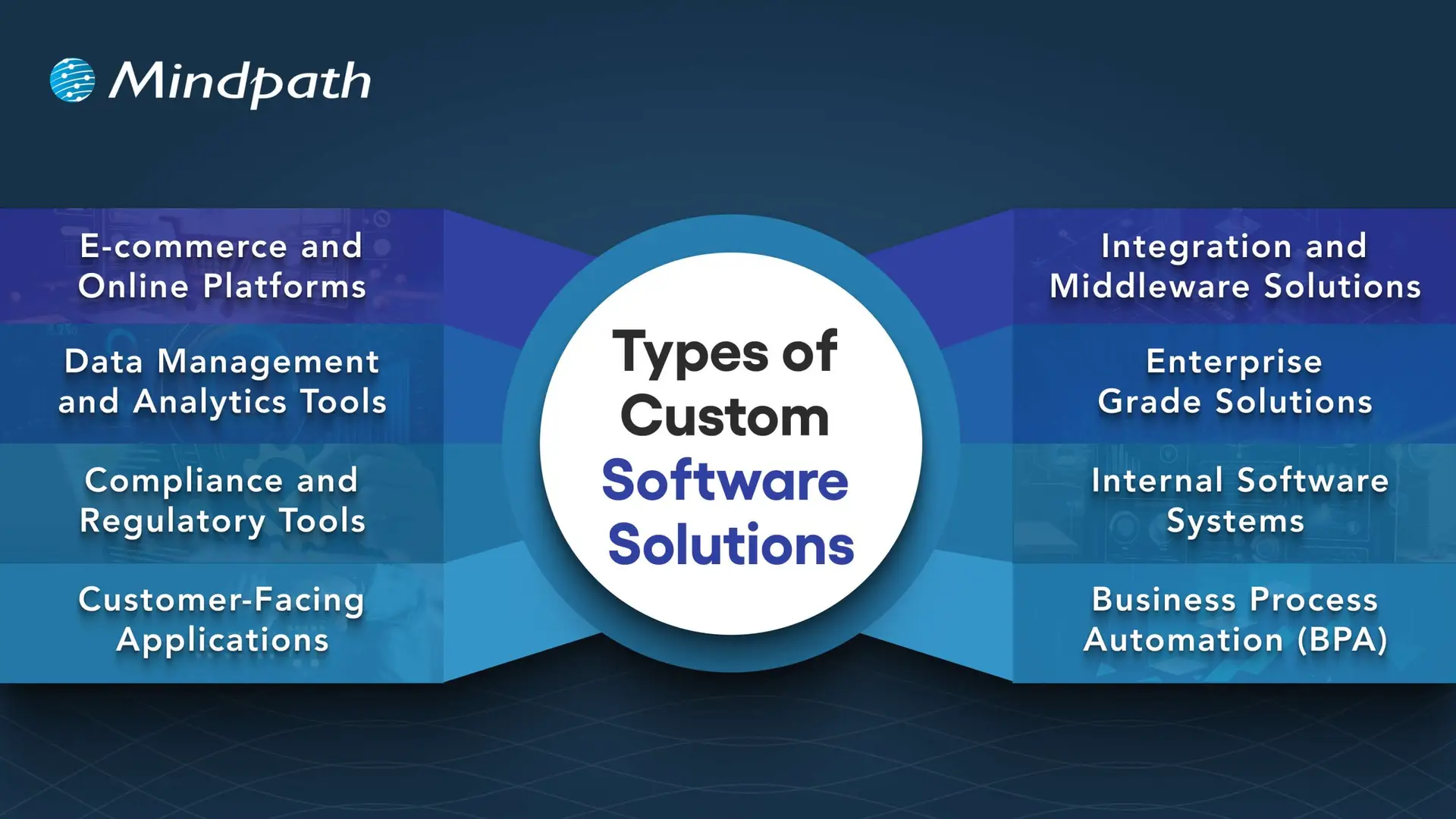
Types of Custom Software Solutions

Businesses face unique challenges, so they will need specific solutions to meet their goals. When used effectively, there are many kinds of custom software development solutions that can take advantage of that to drive efficiency and growth.

Types of Custom Software Solutions

1. E-commerce and Online Platforms

Online businesses require more than a basic website. Custom platforms take care of payment, inventory, and customers quickly and accurately.

2. Data Management and Analytics Tools

Companies generate a never-ending amount of data every day. Analytics tools provide actionable insights from that data, which decision-makers can invest in, as there is confidence in the analytics.

3. Compliance and Regulatory Tools

The industries with strict rules continue to change at a breakneck speed. Compliance software can help you track, report, and reduce risks.

4. Customer-Facing Applications

Customers expect a seamless digital experience, and mobile apps, portals, or self-service tools can provide a simple and engaging interaction.

5. Integration and Middleware Solutions

It’s not very common for systems to connect themselves. Middleware acts as a bridge between those systems and allows for the free flow of information across platforms.

6. Enterprise Grade Solutions

Large organizations need powerful systems to maintain efficiency. ERP, CRM, and BI software all gather data into one controllable system.

7. Internal Software Systems

Day-to-day operations require intelligent systems. HR management platforms, scheduling software, and inventory solutions help maintain workflow efficiency.

8. Business Process Automation (BPA)

Manual tasks challenge the organization as a whole. Custom software development will provide a BPA solution that reduces repetitive, verifiably redundant work and frees up time.

Want to know the method behind building scalable and maintainable software? Learn how the software development life cycle helps you streamline development by providing a structured approach that improves efficiency and overall project outcomes.

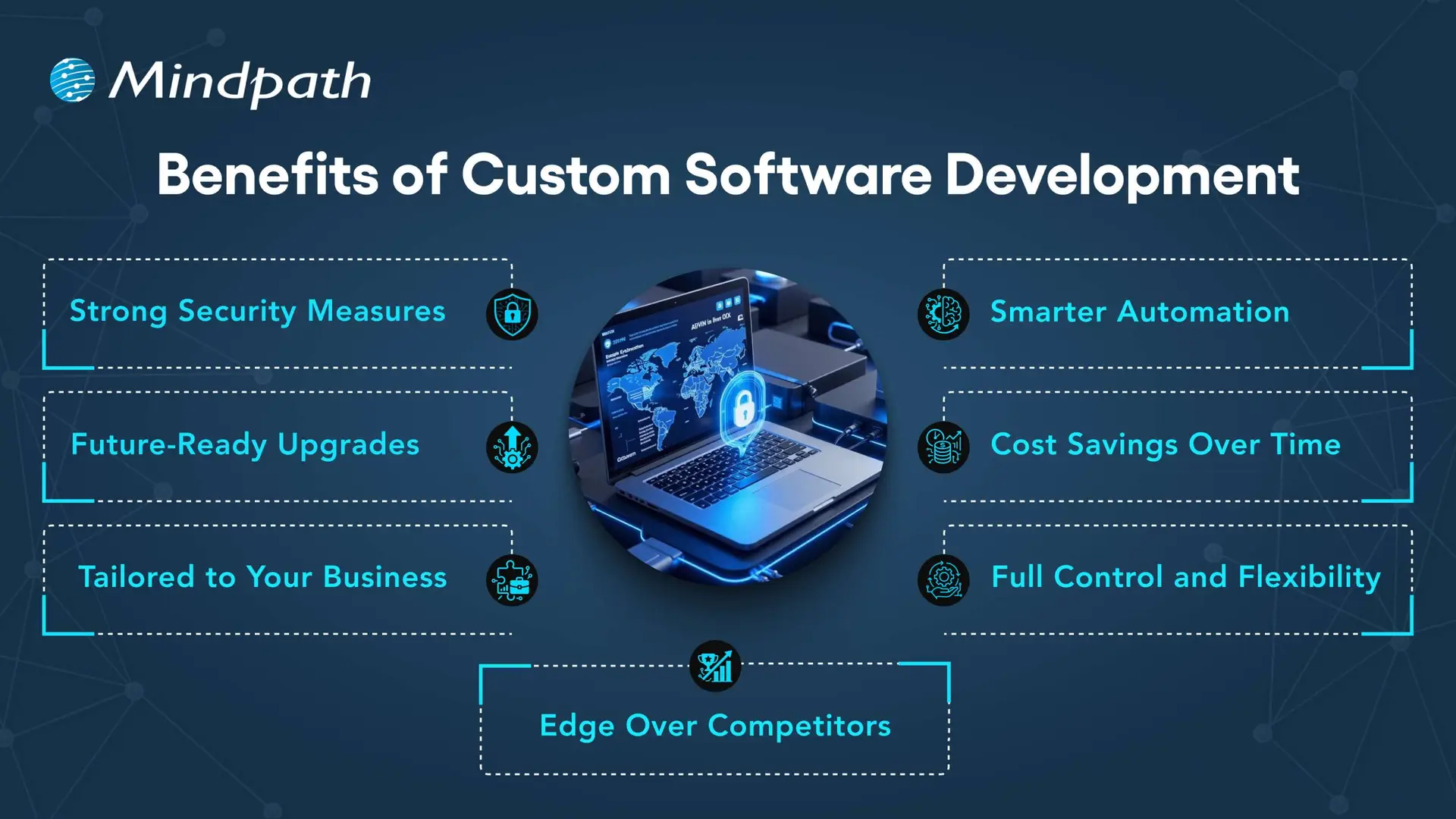
Benefits of Custom Software Development

Each organization operates differently, so that’s why software customizations are very important. When you choose custom solutions, companies will have the tools that meet their needs and bring value over the long term.

Benefits of Custom Software Development

1. Strong Security Measures

Every day, businesses deal with the threat of crime, and good protection is necessary. With custom solutions, businesses can create the security features that fit their unique needs.

2. Smarter Automation

Repetitive work that wastes time is unnecessary. Automated workflows make everything more efficient, giving teams more time to focus on innovative opportunities.

3. Future-Ready Upgrades

Technology will continue to change, and existing systems are often outdated. A custom solution is easy to upgrade, so businesses can stay up to date.

4. Cost Savings Over Time

It’s common to think of generic tools as the less costly option, but they come with hidden costs. A custom-built system can expand with the business and reduce your long-term costs.

5. Tailored to Your Business

Every company has its own workflows, and off-the-shelf, one-size-fits-all tools rarely truly fit. Custom software design considers workflows and goals to create solutions tailored to specific needs.

6. Full Control and Flexibility

Companies have the decision on how their software evolves. From additional feature requests to maintenance, a company is in control of all aspects of software.

7. Edge Over Competitors

To be different, you need unique solutions. Custom software development allows companies to create custom tools that enhance their efficiency and develop stronger customer relationships.

Curious how businesses are building world-class software teams without geographical limits? Explore how our offshore software development can deliver skilled talent and cost-effective solutions.

Step-by-Step Custom Software Development Process

Custom software development has a well-defined process to deliver the best quality product. Using the proper methodology, a custom software development process business makes certain that everything is completed to specific objectives for each project. Here is the process:

1. Requirements and Planning

The process begins with identifying and researching the client’s needs to lay the right framework. The team documents goals, scope, and technology decisions in order to have a clear foundation. During this clarity stage, teams quickly put together custom-made software with a common understanding.

2. UX/UI & System Design

Once they define the requirements, designers and architects start creating wireframes, prototypes, and system architecture for the solution. They start defining the database structure, user experience (UX), and technical workflow in order to ensure everything flows and goes according to plan. Designers create all custom software to be easy to use, scalable, and low-risk.

3. Development Execution

Developers write code based on the approved design and requirements. They develop using agile and best practices and build the functional modules incrementally. Organizations will receive reliable solutions designed to promote their long-term success.

4. Testing & Quality Assurance

Testing validates both functional and performance on devices, platforms, and use cases. Testers perform unit, integration, and regression tests to detect any issues as soon as possible. This step guarantees quality standards in custom software development solutions before delivery.

5. Deployment & Continuous Support

Once testing verifies quality, the team deploys the software on-premises or in cloud environments. The team will continually provide updates, fixes, and improvements to help maintain the effectiveness of the system. We will perform a continuous improvement process to generate value and to prolong the entire application lifecycle.

Concerned about risks that could slow down your custom software build? Explore the major custom software development mistakes that can disrupt progress and find out how to avoid them.

Key Factors to Consider When Building Custom Software

When it comes to building a custom piece of software, it’s more than just writing the code. It’s important to pay attention to the factors that drive the success and make sure your software aligns with your vision of the future in your business.

1. Build vs Buy Decision

Evaluate if building from scratch or buying ready-made solutions best supports your custom software development goals.

2. In-House Team or Outsourcing

Choose between in-house development and outsourcing based on expertise, resources, and project scope.

3. Right Development Methodology

Select the right approach, like Agile or Waterfall, to match your project’s complexity and goals.

4. Focus on User Experience

Design software with intuitive navigation, usability, and efficiency to boost adoption

5. Scalability and Future Growth

Plan for growth by ensuring the custom software development solution can scale easily as your business expands and technology evolves.

Trying to understand the common pitfalls in creating custom software? Check out our blog to learn the essential custom software development dos and don’ts that every business should follow for a smooth process.

Ready to Transform Your Business with Custom Software?

Custom software development continues to be the core driver of innovation, growth, and competitive advantage. By focusing on tailored solutions, businesses overcome unique challenges, streamline operations, and stay prepared for the future. With the right approach, companies build systems that scale seamlessly, improve efficiency, and deliver long-term results in today’s fast-moving digital world.

Partnering with a trusted custom software development company gives you access to expert guidance, advanced technologies, and proven strategies. At Mindpath, our custom software development services empower businesses to create secure, scalable, and future-ready solutions. From strategy to execution, we ensure every step adds measurable value, helping organizations achieve their vision with confidence and clarity.

Big Data

Have you noticed how businesses are making more precise and data-driven decisions lately? That’s because big data is playing a huge role in shaping their strategies. But how does big data actually influence decision-making? And why is it so important in today’s digital age? In this blog, we’ll explore how big data is transforming the way decisions are made. So, let’s dive in! 

What is Big Data?

Big data is the term used to describe the vast volumes of data that are constantly being produced from a variety of sources, including social media, online transactions, sensors, and more. Big data is unique not just because of its size but also because of its rapid production and diverse variety of data types, which include text, figures, images, and videos. These vast, rapidly rising data sets, often known as the “Three V’s” (volume, velocity, and variety), are too complex for standard data tools to handle. Businesses can use big data to find patterns, trends, and insightful information that can help them make more informed decisions and plans of action. 

How Does Big Data Work?

Big data is made up of several kinds of information that are often categorized as semi-structured, unstructured, or structured. Structured data is simple to organize and typically comprises numbers in spreadsheets or databases. Unstructured data, on the other hand, is more difficult to organize as it is more complicated and includes information from sensors, text messages, and social media posts. Semi-structured data is in the middle; it has a certain amount of structure, but it still needs to be more structured than structured data. 

Numerous methods exist for gathering this data, including surveys, online transactions, in-store check-ins, and data from applications and personal gadgets. After being gathered, the data is electronically kept in large systems called data lakes or warehouses.

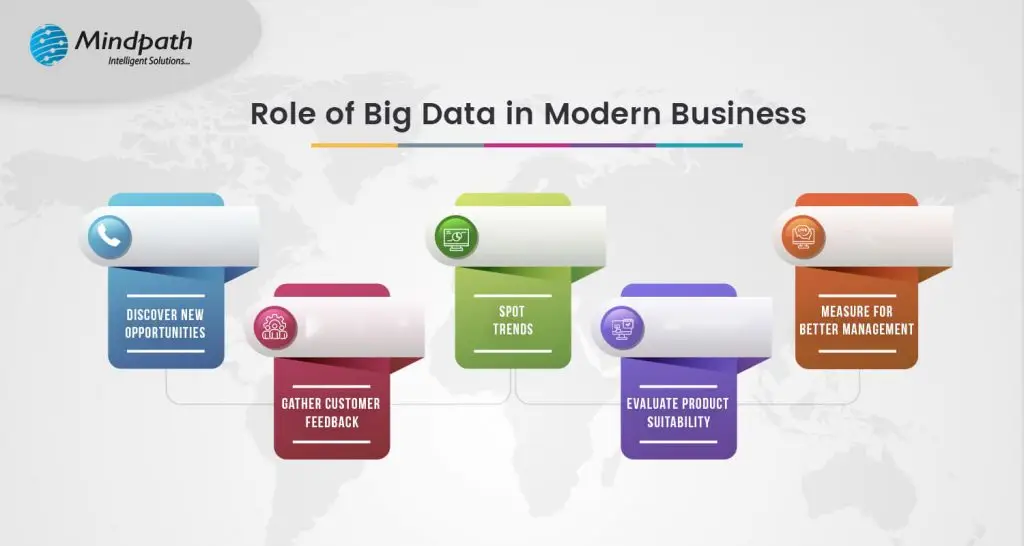
Role of Big Data in Modern Business Decision Making

1. Discover New Opportunities

Regardless of how much information you currently possess, there is always more to learn. Big data and analytics are essential tools in today’s fast-paced corporate climate for helping organizations evaluate their existing performance and create development strategies. 

Big data and business analytics allow organizations to improve their marketing efforts and identify possible growth prospects. With this method, companies can discover areas where their strategies are lacking and potentially profitable undiscovered markets. Additionally, by using data-driven insights, organizations can maximize their resources, make well-informed decisions, and eventually obtain a competitive advantage in their respective sectors. Adopting big data’s potential encourages creativity and adaptation in a market that is always changing, in addition to helping in the discovery of new customers. 

2. Gather Customer Feedback

Big data tools and analytics are important for collecting and evaluating client input, helping you to make informed decisions. For instance, you manage an online clothes business, and your products consistently earn positive reviews. But a lot of customers complain about the shipment timeframes and say they might not buy from you again because of the delays. 

Using big data to analyze this feedback allows you to uncover common themes and highlight particular issues influencing customer satisfaction. This research can show that the issue is more prevalent in areas or at particular times of the year, such as during the holiday shopping season. Armed with this information, you can take steps to optimize your shipping procedures, improve customer relations by informing them of arrival schedules, and ultimately improve their entire experience. You can boost repeated business and foster client loyalty by aggressively resolving these issues.

3. Spot Trends

The capacity to find patterns that improve decision-making is a key benefit of big data and business analytics. Businesses can find patterns and reoccurring problems in their operations or consumer behavior by analyzing massive data sets. This knowledge enables businesses to ensure that decisions are data-driven by providing strong evidence to support their solutions. 

It is advantageous for organizations to identify issues and provide data to support solutions since it allows them to monitor the success of their efforts over time. Organizations can determine if their tactics are having little to no effect, managing problems successfully, or enhancing overall performance by keeping an eye on these trends. In the end, identifying and acting upon these patterns enables companies to make wise decisions that result in improved performance and more prosperous operations. 

4. Evaluate Product Suitability

The key to assuring the success of an organization or product is to understand current market trends, analyze competitors, and know where a product is in its entire lifespan. By employing big data analytics, companies can analyze enormous volumes of data and forecast customer behavior, market swings, and price patterns. 

Organizations can make well-informed judgements about their services and more effectively adjust to shifting competitive circumstances by utilizing this information. To achieve the ideal product-market fit, which enables companies to successfully customize their goods and strategies to match client wants, predictive analysis is essential. Big data and business analytics, in the long run, are essential for improving decision-making and assisting businesses in remaining relevant and competitive in ever-changing markets. 

5. Measure for Better Management

In marketing, using business analytics and real-time data is essential for making informed decisions on the effectiveness of ongoing programs. Marketers can quickly optimize their plans when they have instant access to information on which efforts are successfully raising brand awareness, producing quality leads, and closing deals. 

Businesses can more effectively manage their marketing dollars by concentrating on the channels and strategies that yield the best results by examining these data. This strategy maximizes revenue effect while improving total return on investment (ROI). Marketing teams wouldn’t be able to see how their efforts affect the bottom line of the company if big data and business analytics hadn’t given them the insights they needed to work alone.  

Leveraging Big Data at Mindpath

At Mindpath, we use Big data to enhance our offerings and help us make wiser choices. We can gain a better understanding of our clients’ needs and preferences by gathering and evaluating a lot of data. This enables us to properly modify our solutions to meet their needs.  Big data helps us identify patterns and trends in the industry, which keeps us one step ahead of the competition. It also enables us to evaluate the success of our plans and alter them as necessary. Mindpath can offer top-notch services, improve client satisfaction, and produce superior outcomes for our clients due to the utilization of big data. 

Wrapping Up!

In today’s digital world, big data is transforming the way organizations make choices. Organizations can discover new possibilities, get insightful customer input, see trends, evaluate the applicability of their products, and measure performance more accurately by using large volumes of data. In a competitive environment, this data-driven strategy fosters creativity and adaptation in addition to improving decision-making. 

At Mindpath, we are aware of the enormous potential that big data has for enhancing our services and guiding our strategy. We can optimize our products, gain a deeper understanding of our clients’ demands, and ultimately raise customer satisfaction through data analysis. As we continue to harness the potential of big data, we are dedicated to exceeding client expectations and setting the standard for the industry. 

Is your business ready to harness the power of big data?

At Mindpath, we specialize in leveraging data-driven insights to elevate your decision-making and drive success.

Discover how big data transforms business decision-making, uncovering opportunities, enhancing customer feedback, and driving strategic growth.