Benefits of IT Staff Augmentation vs. Traditional Hiring 

Join our Newsletter!

Featured Posts

Support Is One Click Away

Home

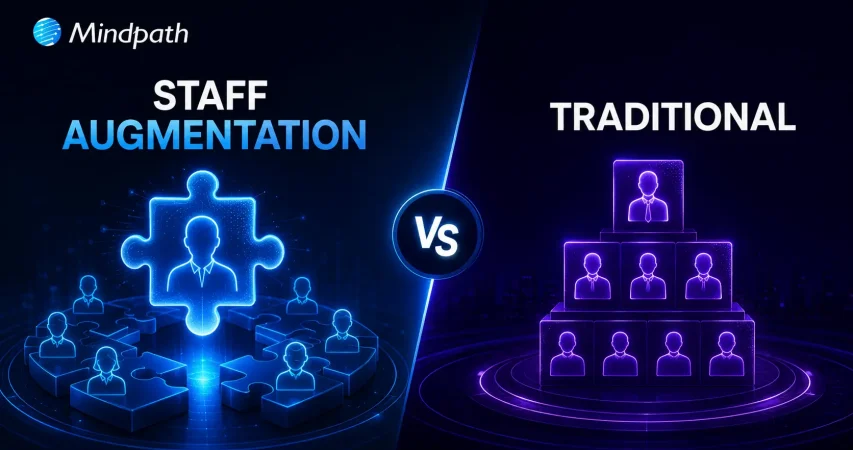
Benefits of IT Staff Augmentation vs. Traditional Hiring 

Benefits of IT Staff Augmentation vs. Traditional Hiring 

Benefits of IT Staff Augmentation vs. Traditional Hiring 

IT staff augmentation offers a flexible, scalable, and cost-effective alternative to traditional hiring models. It enables businesses to quickly access specialized talent, adapt to changing project needs, and optimize resource allocation without long-term commitments. This approach enhances operational efficiency, speeds up hiring processes, and supports strategic growth in dynamic markets.

Are you struggling to find the right talent for your IT projects or facing challenges with traditional hiring processes? Traditional hiring could take months, but what if there was a faster, more flexible solution? Now, with IT staff augmentation, you may satisfy your project goals fast and effectively without the long-term commitment and expense associated with traditional employment. This blog will explore the key benefits of IT staff augmentation compared to traditional hiring models, helping you make an informed decision for your business. 

Staying competitive in today’s changing business world frequently requires the capacity to expand quickly and adapt. Businesses must make crucial choices about how best to find and retain talent to satisfy the needs of IT projects. IT staff augmentation boosts your current workforce with additional workers that have specialized skills or knowledge. In contrast to traditional hiring, which usually entails long-term employment contracts, staff augmentation provides the freedom to scale resources up or down in accordance with project demands. 

Let us dig deep and explore the primary benefits that IT staff augmentation services offer compared to traditional hiring models. Understanding these benefits allows firms to make educated decisions in line with their strategic goals and operational requirements. Additionally, recognizing the power of remote development teams can further enhance flexibility, access to global talent, and cost-efficiency, enabling businesses to scale their projects effectively. 

What are the traditional hiring models?   

Traditional hiring models cover a range of techniques used by businesses to onboard new staff members. Here’s a short breakdown: 

  • Direct Hiring: This is the most popular approach used by businesses to hire people directly for full- or part-time jobs. It includes posting job positions, evaluating applications, setting up interviews, and choosing job applicants.


  • Temporary Hiring: Businesses employ people to do certain tasks or for a set amount of time. Temporary hires are made by the company itself or through employment agencies to cover short-term positions like project-based labour or seasonal labour.


  • Contractual Hiring: Contractual hiring is employing individuals or businesses under a formal contract to do certain activities or projects. Contractors may labour for a certain amount of time until the project is finished, and they are normally compensated for their services in accordance with the conditions specified in the contract.


  • Freelancers or Independent Contractors: Businesses employ independent contractors or freelancers on a project-by-project basis. They work for themselves and supply specialized knowledge or services on demand, frequently from a distance. They are not employees.


Drawbacks of traditional hiring models    

Despite being frequently employed, traditional employment strategies include several drawbacks that businesses need to consider:  

  • Time and Resource Inefficiency: It might take a while and a lot of resources to advertise job positions, evaluate applications, hold interviews, and decide who gets hired. This inefficiency frequently leads to protracted spells of unemployment, which affects output and pushes back project deadlines.


  • Cost Implications: Conventional hiring includes indirect costs like pay, benefits, and overhead related to permanent workers in addition to direct expenditures like advertising, onboarding charges, and recruiting agency fees (if applicable). Budgetary constraints may be strained by these costs, especially if turnover rates are significant or if highly skilled personnel require premium pay.


  • Rigidity in Staffing: In traditional models, once employed, workers usually commit to long-term jobs that might not match project-specific requirements or changing corporate demands. This lack of adaptability may cause resources to be overextended during peak hours or underutilized during off-peak hours, which would reduce overall operating efficiency.


  • Skills and Expertise Gaps: Access to the knowledge or abilities required for specialized projects or cutting-edge technology could not always be ensured by traditional recruiting practices. Talent with specialized skills may be difficult for organizations to find and keep, which might impede innovation and competitiveness in quickly changing sectors. 

Overview of IT Staff Augmentation    

Businesses use IT staff augmentation services, a dynamic outsourcing approach, to improve internal skills and meet project objectives. This strategy entails hiring outside experts, frequently through direct contracts or staffing firms, to assist and enhance current internal teams. Staff augmentation, which provides temporary or project-based solutions, enables flexibility in workforce management in contrast to traditional recruiting, which involves bringing on board individuals for permanent employment. The first step in the process of augmenting IT professionals is to determine exactly what knowledge and abilities are required to carry out a specific project or cover a void in the organization. Then, using a range of channels, such as independent contractors, freelancers, and specialized recruiting agencies, companies look for people or teams with the necessary training and expertise.  

Key Benefits of IT Staff Augmentation  

  •  Flexibility and Scalability   

Two important benefits of hiring more IT professionals are flexibility and scalability, which enable companies to modify their workforce in response to shifting demands and market dynamics. Through the on-demand availability of specialized skills and knowledge, IT staff augmentation provides organizations with flexibility in response to a wide range of project needs. For a new campaign, for example, a marketing agency may add digital advertising professionals to its team to ensure they have the requisite knowledge without having to commit to long-term hiring. This flexibility improves the way projects are carried out by utilizing outside resources just how projects are carried out by utilizing outside resources to when they are specifically needed. Scalability in IT staff augmentation allows companies to efficiently allocate resources. Compared to keeping a set, full-time staff, organizations may control expenses more effectively by expanding to match expanded project scope or by shrinking following project completion. Because it may be expanded geographically or into new markets, its scalability also helps strategic objectives by offering flexible workforce options that are customized to local needs. 

  • Cost-Effectiveness   

Cost-effectiveness gives companies effective ways to manage project budgets and acquire specialized talents. In contrast to traditional recruiting, which entails high upfront expenditures such as onboarding and recruitment fees, staff augmentation lowers these costs. Since agencies find and screen candidates, businesses may save money on hiring expenses. Additionally, firms save money on long-term costs like benefits, office space, and equipment because augmented workers are not full-time employees. Because of this flexibility, businesses may minimize expenses during downtime by allocating staff in accordance with project phases. 

  • Access to Specialized Talent   

access to specialized talent enables companies to swiftly and effectively obtain knowledge that might not be present internally. Through agencies or direct contracts, companies may hire outside experts and access a wide range of specialized talents and industry-specific information. This strategy works especially well for projects needing specialized technical skills or temporary requirements that don’t warrant hiring people on a long-term basis. Businesses may improve project outcomes, innovate successfully, and tackle difficult problems with specialized knowledge by utilizing the experience and skill of augmented workers. IT staff augmentation guarantees operational excellence and competitiveness in quickly changing sectors by giving businesses access to specialized expertise when and when it’s needed. 

  • Faster Hiring Process   

One clear benefit of contracting IT staff augmentation over traditional recruitment techniques is that it allows firms to integrate qualified individuals more quickly. Employing agencies with pre-screened applicants or directly engaging with appropriate contractors can help companies find contractors more rapidly. This expedited procedure shortens the time it takes to fill roles, jumpstarts projects, and improves flexibility in meeting market needs. IT staff augmentation helps companies to achieve project deadlines, deploy workers quickly, and keep up operational momentum without sacrificing quality or knowledge. It does this by reducing administrative delays and expediting onboarding procedures. 

Choosing Between IT Staff Augmentation and Traditional Hiring   

Criteria IT Staff Augmentation Traditional Hiring 
Flexibility High – Can scale up/down as needed Low – Fixed, long-term commitments 
Cost Cost-effective, reduced overhead Higher costs, including benefits and office space 
Time to Hire Fast – Quick onboarding with pre-vetted candidates Slow – Lengthy recruitment and onboarding process 
Access to Talent Access to specialized, global talent quickly Limited to available local talent 
Project Adaptability Easily adapt to changing project needs Rigid, less adaptable to project changes 
Commitment Short-term or project-based Long-term employment contracts 

Conclusion 

Lastly, IT staff augmentation provides a new answer for firms facing the problems of old employment strategies. It gives businesses unmatched scale, flexibility, and access to specialized personnel, enabling them to successfully and economically satisfy project requirements. Businesses may boost agility, optimize resource allocation, and sustain competitiveness in volatile market settings by utilizing on-demand external knowledge.  

Whether you’re expanding for a new project or looking for specialized expertise, Mindpath provides flexible hiring solutions without the long-term obligations of traditional recruitment. With Mindpath, you can streamline your processes and provide better outcomes. Get in touch with us right now to talk about your IT staffing needs and see how our solutions may benefit your company. 

Get in touch! 

Related Post

Discover how low-code/no-code tools are transforming digital development and enabling faster app creation for businesses.

Related Post

node js development company

Imagine you need to create a high-speed, scalable web or mobile app, what technology do you think you should use? Well, most companies will opt for Node.js since it has emerged as one of the leading options in providing high-performance digital solutions. Whether you are starting a new startup or refactoring an existing platform, the success of your project usually begins with selecting the right Node.js development company. But with so many Node.js companies out there, isn’t it difficult to make the right choice? Don’t worry, we’ve got you covered!

This blog offers a nicely constructed checklist through which you can be guided in choosing the optimal Node.js development agency. By following this checklist, you will have some idea and direction during the selection process and also be assured of being aligned with a company that not only meets your technical needs but also comes with you through your long-term success. 

Need professional assistance with your upcoming project? Hire Node.js developers from Mindpath to make sure your application is highly scalable, faster, and high performing.

Understanding Node.js

Node.js is a technology that helps developers create the back end of websites and applications using JavaScript. It is server-side and open source, so programmers can use the same language, JavaScript, on both the front end and back end. It makes the development process easier by making it faster and simpler.

Node.js can handle real-time apps, single-page apps, and applications with a lot of users at the same time. It is used in mobile app development because it has a strong system and beneficial tools. With frameworks like Nest.js, the developer can make elegant, well-structured apps using Node.js. 

Wondering why NodeJS is the preferred choice for modern business applications? Read our blog on advantages of NodeJS for business to discover how it boosts performance, scalability, and development efficiency.

Benefits of Choosing Node.js Development Company

Selecting a Node’s web development company, which is trusted, can make your project faster, smoother and more scalable. With the abilities of Node.js, your app can handle high traffic and real-time updates with ease. Let us look at some of its benefits: 

Benefits of choosing nodejs development

1. Skilled and Experienced Team

A Node.js development firm can bring a team of experts who know how to build strong and flexible applications. They have hands-on experience with different types of projects and can offer smart, custom solutions and their knowledge can also help to avoid mistakes and deliver better results from the start. 

2. Complete Development Services Availability

A Node.js development services provider takes care of everything, starting from the discussion to launching and maintaining your app. You don’t need to work with different teams for each part, which can save a lot of time and effort.  Having all the services in one place keeps your project organized and moving forward smoothly. 

3. Latest Tools and Practices

A trusted Node.js web development company always works with the latest tools, updates, and frameworks as they follow modern development practices to build fast, secure, and scalable applications which means your app will be future-ready and can perform well under changing user needs. 

4. Strong Security and Stability

Security is a top priority for a professional Node.js development agency, and they take steps to protect your app from threats by using tested methods to keep your data safe and your app stable. You can count on them to deliver a secure and reliable product that works smoothly. 

5. Quick Launch and Results

When you hire a Node.js development firm, your project moves quickly from idea to launch as their process is streamlined, so that you can get your product out to users much faster which helps you stay ahead of the competition and respond to the market more effectively. 

Looking to supercharge your applications with AI capabilities? Explore our blog on NodeJS Libraries for AI Integrations to learn which NodeJS libraries can simplify and enhance your AI-powered applications.

By now, you must have had a clear idea about Node.js, so let us learn about the most important topic: 

Key Considerations While Choosing the Right Node.js Development Company

When you are looking for the right company, keep in mind that not all software development companies providing Node.js services are the same. Understanding the following key factors can help you find a team that delivers quality and meets your specific needs: 

Factors to consider while choosing a Nodejs development company

1. Industry Experience Matters

How long a company has been working in software development shows their reliability and knowledge. Experienced Node.js companies know the best ways to work with clients and handle projects smoothly. They are familiar with popular Node.js tools and frameworks and use proven methods like Agile and DevOps to deliver projects on time and with quality. 

2. Skilled Team

A good Node.js company has a strong team with different skills, so they can start your project quickly and build exactly what you need. A team that understands micro services in Node.js can divide tasks smartly and deliver results faster. Having experts like project managers, DevOps specialists and cloud professionals makes the process smoother and more efficient. 

3. DevOps Implementation

Using DevOps helps a company build software faster and more smoothly. It brings developers and operations teams together, so everyone works closely and avoids delays. This way of working also makes the project more secure and organized. A company that follows DevOps can handle changes better and deliver a high-quality product with fewer issues. 

Also Read: Benefits of DevOps

4. Takes Full Responsibility

A good Node.js company takes full responsibility for the work they do. If something goes wrong, they don’t hide it or blame others. Instead, they fix it and learn from it. This honest attitude builds trust, improves communication, and shows they truly care about the success of your project. 

5. Company Working Methods

The way a Node.js company handles projects says a lot about them. It’s not just about good reviews, but also how they talk to you and what value they bring. You can learn more by checking their website, blogs, case studies and social media to see how they share ideas and show their work to the world. 

6. Focused on Your Business Goals

The right Node.js development firm takes time to understand what your business wants to achieve. They work in a way that supports your goals and helps your business grow. With the right knowledge and experience, they can build a strong and future-ready project that fits your budget and timeline. 

7. Strong Partnership Mindset

A trusted Node.js company doesn’t just build your project and leave. They work with you like a real partner, staying connected and involved at every step.  They provide clear communication, teamwork, and support, even after the project is done which helps make everything run smoothly and lead to better results for your business. 

Want to ensure your NodeJS applications run efficiently and reliably? Explore our blog on hire expert NodeJS developers for high-performance apps to learn how skilled developers can boost performance and scalability.

Ready to Choose the Right Node.js Development Company?

Selecting the right Node.js Development firm plays a big role in how fast, secure, and scalable your project becomes. By focusing on experience, team skills, DevOps culture, and a true partnership approach, you can ensure you’re working with a reliable team. A trusted Node.js development company will not only build a great product but support your long-term success too. 

At Mindpath, we offer end-to-end NodeJS development services that are designed for speed, performance, and future scalability. From building real-time apps to using micro services in Node.js, our team brings deep experience and modern practices. As a top-rated Node’s web development company, we ensure your product is secure, stable, and ready for the market. 

Looking to hire Node.js developers who understand your goals? At Mindpath, our experts bring strong technical skills, creativity, and a collaborative mindset. Startups and enterprises trust us for quality, future-ready solutions. Connect with Mindpath and let’s build something great together. 

Frequently Asked Questions

1. How to know if a Node.js development company is the right fit for a project?

A good fit depends on how well the company understands your goals, communicates clearly, and shows relevant experience. Reviewing past projects, technical expertise, and their approach to problem-solving can help ensure they can handle your requirements effectively.

2. What should be expected when working with a Node.js development company?

A professional company usually offers a structured process, including planning, development, testing, and support. Clear communication, regular updates, and a focus on performance and scalability are common expectations when working with an experienced development team.

3. Is Node.js suitable for handling high-traffic applications?

Yes, Node.js is designed to handle multiple requests at the same time without slowing down. Its non-blocking architecture makes it ideal for applications that need to manage high traffic, real-time updates, or large numbers of users efficiently.

4. How does a Node.js development company support long-term project growth?

A reliable company builds applications with scalability in mind, allowing easy updates and expansion. They also provide ongoing support, performance monitoring, and improvements, helping the application adapt to changing business needs over time.

5. Why is communication important when choosing a Node.js development company?

Clear communication ensures that project requirements are understood correctly and reduces the chances of errors. Regular updates, feedback, and transparency help keep the project on track and build trust between the business and the development team.

Discover key factors for choosing the right Node.js development company. Learn how Mindpath ensures success!
Emerging Technologies

In the digitalized era, several new emerging technologies have surfaced that are full of promise. The identification of such technologies is essential for individuals as well as businesses. This is because they can influence the lives of people in society and the overall economy.

Before identifying different types of emerging technologies, it is important to understand the emerging technologies meaning. Emerging technologies are rapidly evolving technologies whose potential is yet to be realized entirely. AI is among the top emerging technologies examples that one can come across. 83% of business entities have claimed that they prioritize AI in their business plans. A comprehensive list of new technologies has been developed that can transform the digital realm.

Ready to explore how emerging technologies like AI, Blockchain, and IoT can transform your business? Contact us to discover how our expertise can turn these emerging trends into practical solutions

Top Emerging Technologies

Now that you are familiar with the concept of emerging technologies, it is time to look at some of the top emerging technologies. Currently, new technologies are entering the digital space like never before. It is crucial for IT leaders to keep track of emerging trends and technologies. The insight can enable them to leverage top technologies to shape the future with responsible innovation. The list highlights the 8 types of emerging technologies in a digital world that can act as a revolutionary force in 2026.

1. Artificial Intelligence

While discussing the topic of emerging technologies, the first novel technology that comes to mind is undoubtedly Artificial Intelligence (AI). AI can be defined as the ability of computer systems to emulate human intelligence. This emerging technology enables machines to reason, learn, and perceive just like humans. Although AI is still in its nascent stage, it has evolved into a powerful tool that is redefining diverse industries such as healthcare, manufacturing, education, and many more. While making technology-related predictions, one cannot ignore AI.

2. Virtual Reality and Augmented Reality

Virtual Reality (VR) and Augmented Reality (AR) are undoubtedly among the top cutting-edge technologies in 2026. VR is capable of immersing users in environments that are fully simulated. Thus, it blocks the actual world and allows individuals to experience a virtual space. AR technology integrates digital elements into the real world. As a result, it is capable of enhancing the perception of users with rich contextual information as well as visuals. AR and VR have found a place in Gartner technology trends 2026 as they are capable of offering immersive experiences to users.

3. Blockchain

While discussing the topic of Emerging Technologies 2026, one has to consider blockchain technology. Blockchain can be defined as a digitalized and immutable ledger that is capable of recording transactions while tracking assets across a business network. It is among the latest technology trends since it is highly transparent and secure in nature. This novel technology has gained high prominence in recent years due to cryptocurrencies.

4. Internet of Things

The Internet of Things or IoT is definitely among the most promising technologies that exist today. It basically helps connect physical devices to the internet. Therefore, it is possible to gather, share, and process data in a seamless manner. It is certainly among the top trending technologies that are transforming lives. Today, it is common to leverage IoT technology to create smart cities. In the future, the capabilities of IoT may reach new heights, and its presence may expand further.

Wondering how small businesses can benefit from new tech? Explore emerging technologies for small businesses to boost growth and efficiency.

5. Robotics

Robotics is certainly among the top technologies that exist in the year 2026. It is a rapidly evolving innovation that has been reshaping industries through automation and efficiency. This is among the top trending techs as it is capable of designing, operating, and using robots. The emergence of robotics technology has made it possible to utilize robots so that they can perform repetitive tasks. The strategic adoption of this technology can boost the overall efficiency of businesses across various industries.

6. Agentic AI

Today, Agentic AI is recognized as one of the top innovative digital technologies. Agentic AI has sophisticated reasoning capability, which enables it to solve complex problems. This novel technology can make decisions in an autonomous manner. Thus, it does not rely on human intervention to achieve challenging goals and objectives. It is a novel technology that is able to adapt in real-time. Hence, it acts as a valuable tool for businesses in the current times. By leveraging agentic AI technology, businesses can understand customer intent and predict their future needs. Thus, they can easily get a competitive edge in their area of operation.

7. Quantum Computing

Quantum Computing is among the most promising emerging technologies that exist now. This evolving field basically relies on quantum mechanics for solving complex problems. Thus, its ability to handle problems is a much more efficient way as compared to conventional computer systems. Although this novel technology is in its early stages, it is full of promise. The evolution of quantum computing can revolutionize diverse areas such as cryptography as well as drug discovery. This emerging technology is based on aspects relating to physics, mathematics, and computer science. This innovation is among the top predictions for 2026 that businesses need to focus on.

8. Ambient Computing

The list relating to emerging technologies cannot be complete without ambient computing. Ambient computing refers to the technology that can be seamlessly integrated into one’s surroundings. Thus, it can become an intuitive part of one’s life. The purpose of such technology is to create environments that are capable of responding to human needs. Ambient Computing is among the new and emerging technologies that rely on both IoT as well as AI. One of the most popular examples in this context involves wearable devices that monitor the health condition of individuals.

Planning to modernize your business with new technology? Check out digital transformation for businesses to learn how tech boosts innovation and competitiveness.

Challenges Associated with Emerging Technologies

It is true that diverse types of novel technologies are arising that hold immense promise. However, they also give rise to certain challenges and concerns. A number of challenges have been identified relating to the top types of emerging technologies in the digital world.

1. Ethical concerns

A common issue that arises in the digital space due to emerging technologies revolves around ethical concerns. For example, Agentic AI is the latest emerging technology that gives rise to ethical issues relating to bias and poor transparency.

2. Privacy concerns

A common concern that exists in the digital world is related to privacy risks. Malicious actors may exploit emerging technologies by using sophisticated techniques. As a result, the privacy of online users may be at the receiving end.

3. Regulatory challenges

As technologies are constantly evolving, the regulatory landscape is not entirely developed. Thus, it creates gaps that may be exploited. For instance, poor regulations may increase the risk relating to cybersecurity aspects.

Want to stay ahead in the digital era? Explore digital transformation trends to see how emerging technologies are reshaping business and innovation.

Final Words

In the prevailing technology-driven era, new types of technologies are coming into existence. Some of the most promising technologies are AI, Blockchain, IoT, and many more. These technologies hold the promise to redefine the digital space like never before.

The list of emerging technologies highlights some of the top technologies that can impact individuals as well as businesses. In addition to identifying these technologies, a number of challenges have been identified. It is necessary to take into consideration their potential along with the associated challenges as these elements may together transform the digital space. Mindpath helps businesses and individuals navigate these emerging technologies through tailored solutions and expert guidance

Explore emerging technologies like robotics, AI, and cybersecurity innovations and driving future success for businesses.
Magento vs wordpess

The question relating to Magento vs WordPress is not new in 2025. However, businesses as well as professionals need to know how these platforms are different from one another so that they can make a wise selection. With Adobe pushing major updates to Magento WordPress has been continuing to dominate the CMS landscape like never before. 

Several modern businesses and professionals all across the globe have been wondering, “Which is better, Magento or WordPress?” You should be able to answer this question as well. This is because the WordPress vs Magento debate has been directly impacting how online stores compete with each other in the crowded digital marketplace. Let us look at these platforms at a deeper level so that you can choose the ideal tool that perfectly aligns with your needs. 

Selecting the right platform can define website success. At Mindpath, we offer WordPress development services that help you elevate your business by creating a custom website that maximizes performance and drives results.

A Quick Overview of Magento

Magento is a popular open-source e-commerce platform that came into existence in 2008. Currently, it is owned by Adobe, and it has been rebranded as Adobe Commerce. It has certainly emerged as a powerful eCommerce platform that is built for enterprises and growing online retailers. 

One of its unique features that has contributed to its popularity is its scalability. Magento supports large product catalogs and multi-store management. It has novel B2B features going beyond the capabilities of usual CMS platforms. It offers businesses robust tools for diverse purposes, including checkout optimization and marketing automation. Over the years, Magento has gained high popularity in the dynamic business community. 

Must Read: WordPress vs Webflow

A Brief Insight into WordPress

WordPress is a top web content management system (CMS) that is known to power a large number of websites on the internet. It is known for its flexibility, ease of use, and vast plugin ecosystem. WordPress serves as a valuable tool for businesses that allows them to launch everything from blogs and corporate sites to online stores, especially when supported by custom WordPress development, which tailors the platform to unique business needs. Moreover, they do not have to worry about high development overhead.

Some of the core strengths of WordPress lie in content publishing as well as SEO optimization with robust tools such as Yoast and Rank Math. Another unique feature of WordPress is the ability to scale through a large number of themes and extensions. It is time to answer the question: Is Magento better than WordPress?

Key Differences between Magento and WordPress

WordPress and Magento have emerged as revolutionary forces in the contemporary business world. It is a must for professionals and businesses, especially e-commerce businesses, to know about Magento vs WordPress. Some of the major differences between WordPress vs Magento that you must take into account are

1. Purpose of the Platform

One of the key differences between Magento and WordPress is related to the purpose of the platforms. Magento or Adobe Commerce has been built primarily for enterprise-grade eCommerce. Its unique features relating to catalog management and multi-store support are specifically designed to create value for e-Commerce businesses. especially as AI in e-commerce becomes more influential in driving personalization and automation. WordPress was originally created as a content management system. However, it can be extended into the e-Commerce realm through plugins. It is specifically ideal for small to medium-sized online stores.

2. Performance and Scalability

Magento is capable of handling large product catalogs and high traffic. It is also an ideal tool that is designed for complex integrations. It certainly serves as the best tool for mid-sized and large enterprise businesses. It is definitely easier to set up WordPress. In fact, users can scale it for moderate traffic. However, the specific platform may require managed hosting or heavy optimization for handling large stores.

3. Ease of Use

While choosing a platform, it is fundamental for you to take into account the ease of use. WordPress is certainly more user-friendly than Magento. In fact, professionals as well as businesses can easily navigate the tool even if they have limited technical knowledge. However, that is not the case with Magento. This is because it is more complex in nature and requires technical knowledge. You need to bear in mind that it is not beginner-friendly. In case you plan to use Magento, you need to seek support from experts. 

Worried about security risks and vulnerabilities on your WordPress site? Read our guide on safeguarding WordPress vulnerabilities to learn how to protect your site and keep it secure against threats.

4. Customization

Both WordPress and Magento offer extensive customization to users. Magento allows business entities to build custom product pages. You can also integrate third-party tools in a seamless manner. Users even have the option to capitalize on its advanced features and capabilities so that their needs can be perfectly met. Even though WordPress is also customizable in nature, it highly relies on plugins. It is true that essential e-Commerce functionalities are available. However, business entities may require additional plugins for features relating to payment gateways and inventory management.  

5. SEO Capabilities

If you wish to compare WordPress or Magento, it is a must to look at their SEO capabilities. This is because search engine optimization is a must for the success of e-commerce businesses in the prevailing business landscape. Both WordPress and Magento offer robust SEO capabilities to users. But WordPress has a small edge over Magento thanks to its large library of SEO plugins. The specific tool makes it easier for businesses to optimize their content and meta tags. You can certainly leverage these capabilities of WordPress and help your business website rank higher online. Although Magento offers excellent SEO capabilities, you need to possess technical knowledge to leverage them in an optimal manner. 

6. Security Features

One of the most common concerns for online businesses today revolves around cybersecurity. So it is critical to take into account the security features while choosing a novel platform for your e-Commerce business. One of the key strengths of Magento is related to its robust security features. It has built-in security patches along with data encryption features. Another key feature that you should not miss is related to advanced fraud protection features. These security features undoubtedly make Magento a reliable and safe choice for e-commerce businesses.  In the case of WordPress, the security fundamentally depends on third-party plugins. As WordPress is commonly used, there is a chance for you to get targeted by online hackers or cybercriminals. 

Ready to make your hiring process smooth and avoid picking the wrong developer? Our WordPress Developer Checklist gives you a clear, step-by-step framework to evaluate every candidate.

Magento vs WordPress – Comparison Table

The table below gives an insight into the major differences between WordPress and Magento. As the WordPress Magento debate is gaining momentum in the e-commerce realm, you need to look at the differences so that you can choose the ideal platform that best suits your needs. However, an important thing to bear in mind while looking at the differences is that users can use Magento in WordPress in order to use them together.

Magento WordPress
Platform Purpose Designed for e-Commerce Content Management System and can be extended to e-Commerce 
Performance and Scalability Ideal for large e-Commerce businesses Well-suited for small and medium-sized business sites 
Ease of Use Need for technical knowledge Easier to use 
Customization
SEO Capabilities Depends on technical expertise  Better SEO Capabilities 
Security Features High security  Lower security

Who is the Winner: WordPress or Magento?

The exact choice between Magento and WordPress entirely depends on the needs of the users, including their business size, goals, and technical needs. You need to remember that there is no clear winner between these two platforms. 

Magento is suited for enterprise-level stores, and it is ideal for high-volume sales along with multi-store management. In case your business needs advanced features such as B2B support along with custom checkout flows, you must choose the specific platform. You can definitely leverage its strong scalability and enterprise-grade security. However, you need to remember that if you choose Magento, your business must be ready to make a higher investment, and it must possess the necessary technical expertise.

WordPress is definitely a better choice for small to mid-sized businesses. It is an excellent choice for users who are in search of a simple and pocket-friendly tool. The strengths of WordPress, such as its excellence in content publishing and SEO flexibility, can create value for both businesses and professionals. 

Want to ensure your WordPress site is running on the right PHP version for top performance and security? Check out our guide on WordPress PHP compatibility to keep your site efficient, stable, and future-ready.

Final Words

While making the comparison between Magento vs WordPress, you need to remember that there exists no one-size-fits-all solution. Magento stands out for enterprises and fast-scaling retailers that depend on novel features. WordPress is a simpler choice for small and medium-sized businesses. It is great for you if you are in search of flexibility and lower upfront costs. The best platform for you entirely depends on your business needs and goals, its size, and the available technical resources.

If you’re planning to build a website and want to use the best of WordPress, Mindpath WordPress development services will help you with that. Our experts ensure that the capabilities and functionalities of the platform can be optimally utilized to create value for your business. The decision can certainly give an edge to your business in the competitive space.