Generative AI for Business: Your Key to Success

Join our Newsletter!

Featured Posts

Support Is One Click Away

Home

Generative AI for Business: Your Key to Success

generative ai for business

Generative AI for Business: Your Key to Success

Ever imagined a machine that could produce articles, logos, and new content to power your business? Sounds intriguing, isn’t it? Well, that is what generative AI can do for your business. This new-generation artificial intelligence is transforming future of businesses by generating new content, images, product designs and even strategy concepts from patterns it has acquired by analyzing the existing data. In this blog, we are going to discuss how generative AI for business can create innovation and give a competitive advantage.

So, before we learn about how generative AI can transform businesses, let’s understand what is generative AI.

Looking for ideas to reshape your business with generative AI? Unlock smarter growth, faster innovation, and personalized customer experiences with Mindpath’s AI-powered solutions

What is Generative AI?  

In simple terms, generative AI is an artificial intelligence that takes huge datasets and algorithms to learn the pattern and then generates new outputs based on its understanding. While AI is all about recognizing data, classifying it, or predicting, generative AI takes it a step further—it produces new content. For instance, it can author customer emails, create social media posts, produce product descriptions, and even assist in designing user experiences. 

Generative AI has the ability to provide enterprises with numerous benefits like enhancing innovation and creativity, enhancing productivity and reducing expenses. Generative AI also facilitates original idea creation, speed in product development, and custom-built customer experiences. In addition, it has the potential to enable workers to focus on more critical activities and reinforce security and raise the satisfaction levels of customers. 

Also Read: Generative AI Revolution

Let’s dive in how generative AI can drive business innovation and creativity for businesses. But before that have a quick look at the Google Trends for Generative AI for Business.

generative ai for business trends

How does Generative AI Drive Innovation for Businesses? 

In today’s fast-moving digital world, innovation is the key to staying ahead. Generative AI in business is assisting companies in igniting new ideas, enhancing content, and accelerating processes. Let us see how generative AI for innovation is changing the way companies think and create. 

1. Personalization Fuels Innovation 

Building a strong customer connection helps in driving business growth and personalization plays a major role in it. Companies can deliver tailored content and better user experiences with the help of smart tools that can understand customer behavior. This is precisely where generative AI for innovation can make a huge difference by helping businesses personalize at a scale which is much faster and more accurate than manual efforts.  

2. AI Creativity and Human Creativity: A New Partnership 

There is much discussion circulating about AI creativity vs. human creativity. It shouldn’t be about who is superior, but how they can both contribute to success. Humans can provide emotion, context and novel ideas to which AI can provide structure and new insights based on data. Merging the two can assist businesses to work more smartly. For example, how generative AI can augment human creativity is seen when it rapidly produces ideas or content, and humans are able to edit and make them work for the brand’s voice and objectives. This also ties into how AI is redefining job roles in tech, showing the evolving collaboration between human expertise and AI capabilities.

3. Unlocking Potential through Data-Driven Creativity 

Generative AI for business enables companies to convert information into intelligent ideas through analysis of customer behaviors, market patterns, and performance outcomes to develop valuable content, product layouts, or advertising campaigns. Humans contribute creativity, passion, and profound meaning, while AI contributes pace, logic, and the capacity to process vast volumes of data rapidly. When combined both, companies are able to develop meaningful experiences that connect with people and result in improved outcomes. aligning with the latest Gen AI trends in business intelligence.

4. Streamlining Operations 

When used properly, Generative AI in business enables companies to save time by automating routine work and processing large sets of data. This allows teams more time to come up with new ideas and more efficient ways of working. When businesses apply this type of thinking, they can grow more quickly, plan more smartly, and stay ahead of market change. That’s how generative thinking helps businesses innovate smarter because it provides them with the space, tools, and insights to grow more smartly. 

5. Securing Financial Transactions 

Generative AI is becoming a necessity for securing financial systems and mitigating risks. It enables companies to identify potential financial risks by processing vast amounts of data efficiently and accurately. The technology also helps in forecasting market trends, enhancing decision-making. Additionally, generative AI is improving fraud and suspicious activity detection in real-time. It’s transforming trading by offering insights from enormous data sets, ensuring smarter and safer transactions. 

Wondering how generative AI is influencing content creation and design strategies? Check out our blog generative AI changing creative industries  to see how AI-driven creativity is shaping the future of industries.

Use Cases of Generative AI for Business Growth 

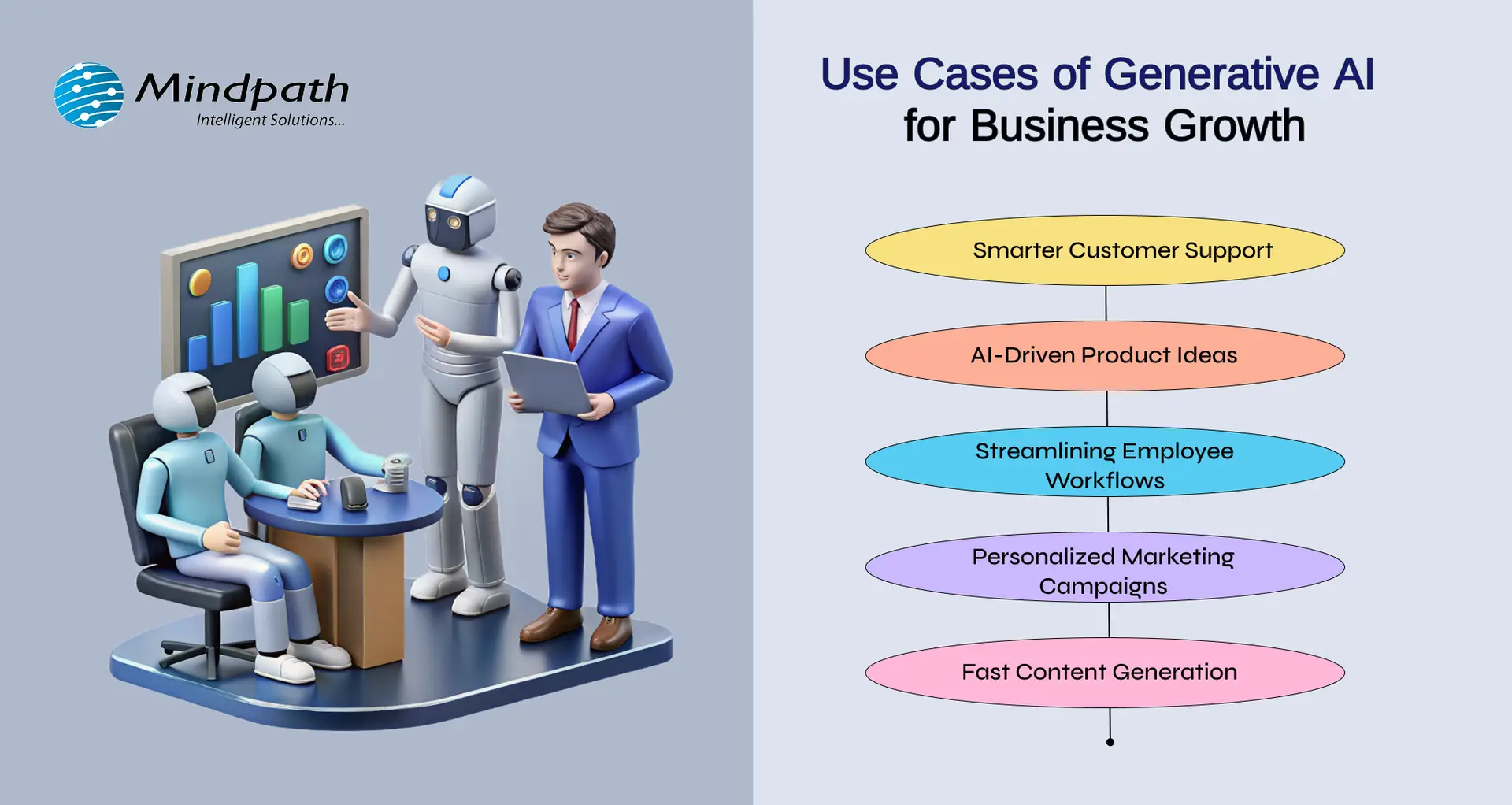
Generative AI for business is revolutionizing the way companies develop by enhancing customer experience, increasing productivity of employees, and accelerating innovation. From conversational tools like ChatGPT, Bard, and Midjourney to live business applications, the effects are tangible. Here are some simple yet impactful generative AI use cases that fuel business growth today:
Use Cases of Generative AI for Business Growth 

1. AI-Driven Product Ideas

With tools such as Midjourney, businesses are able to create product ideas, packaging, and graphics. It illustrates how AI can be applied in innovation, by assisting teams to come up with creative ideas quicker and validate what is effective with actual audiences.

2. Smarter Customer Support

Tools like ChatGPT help companies create AI-powered chatbots that answer customer questions instantly. This improves response time and frees up human agents to focus on complex issues. It’s a simple way to offer 24/7 support and boost customer satisfaction.

3. Streamlining Employee Workflows

According to the McKinsey Generative AI Report, generative AI can automate tasks that take up 60–70% of employees’ time today. This includes writing emails, summarizing reports, and generating presentations—especially helpful for knowledge workers and high-skill roles.

4. Personalized Marketing Campaigns

Generative AI technology assists companies in crafting customized ads and suggestions based on user data. This renders marketing more precise and efficient, enabling more engagement and sales while saving time for marketers.

5. Fast Content Generation

With platforms like Bard, teams can quickly write blogs, product descriptions, and emails. This saves time and allows employees to focus on strategy. It’s one of the most practical generative AI examples used daily across industries. 

Looking to leverage generative AI for smarter, more adaptive app solutions? Explore our blog on Generative AI in App Development highlights practical applications, transformative benefits, and strategies to stay ahead in the digital landscape.

Ready to Make Your Business AI-Ready? 

Generative AI is changing the way businesses work, think, and grow. It’s not just about automation, it’s about helping teams be more creative, make faster decisions, and offer better experiences to customers. Be it creating content, improving support, or building new ideas, generative AI for business is making every day work smarter and more efficient. 

At Mindpath, we specialize in delivering cutting-edge AI development services tailored to meet the unique needs of modern businesses. Our expertise in generative AI enables companies to streamline operations, boost productivity, and create intelligent solutions that drive real value. Whether you’re looking to implement AI-powered automation, enhance customer engagement, or accelerate innovation, Mindpath is your trusted technology partner for consistent business growth! 
Frequently Asked Questions

1. What is generative AI for business users?

Generative AI for business refers to AI systems that create new content, ideas, designs, or solutions based on existing data. Instead of only analyzing information, it generates emails, reports, marketing copy, product concepts, and more. Business users can apply it to improve creativity, automate tasks, and make smarter decisions faster.

2. What are some applications of generative AI in business?

Businesses use generative AI for content creation, customer support chatbots, product design concepts, personalized marketing campaigns, and financial risk analysis. It also helps generate reports, automate emails, and create digital assets. These applications support innovation, reduce manual work, and improve overall operational efficiency.

3. How can we implement GenAI to improve efficiency?

To implement GenAI effectively, businesses should first identify repetitive tasks and content-heavy processes. Next, integrate AI tools with existing systems like CRM or ERP platforms. Start with pilot projects, measure performance, and scale gradually. Proper data management and employee training are essential for long-term success.

4. What is the future of GenAI in business?

The future of Generative AI for business looks highly promising. It will continue enhancing personalization, predictive decision-making, and intelligent automation. As technology advances, AI systems will become more context-aware and collaborative, working alongside humans to drive innovation, improve productivity, and create smarter digital ecosystems.

5. What is one limitation of generative AI in business?

One major limitation of Generative AI for business is its dependence on data quality. If trained on biased or inaccurate data, outputs may be misleading. It also lacks true human judgment and emotional understanding, which means human oversight remains necessary to ensure accuracy, brand alignment, and ethical use.

Related Post

Explore how AI chatbots are revolutionizing the education sector, providing personalized learning, smart feedback, improved engagement, teaching assistance, and better student support.

Related Post

chatbots in education

The education industry is evolving and the dominance of AI in the sector will serve as a primary reason for inducing transformation on a large scale. One of the notable applications of AI in education that often goes unnoticed is the use of chatbots. The blend of artificial intelligence and education aims to make learning more productive and chatbots are the perfect example of the same. Students, educators and institutions can rely on modern educational chatbots for their adaptive nature and intelligent capabilities. Let us learn about the top ten real-world examples of chatbots that have been revolutionizing education.

Planning to transform student experiences with intelligent chatbots? With Mindpath’s AI development services, you can design and implement tailored tools that make learning smarter and more personalized.

Impact of Chatbots on Education

Conversational AI is responsible for changing the viewpoint of many people about accessibility of AI technologies. Imagine talking to an AI tool and finding solutions to a problem in your mathematics textbook. Conversational AI chatbots are the best example of tools which can interact with users in natural language. The use of chatbots in education involves the combination of machine learning and natural language processing to understand student queries and provide relevant answers. The core strength of chatbots revolves around offering instant assistance personalized at scale for each user.

Chatbots offer better results than human support, primarily due to their round-the-clock availability. Student can get support and relevant information whenever required from chatbots, thereby reducing delays. Chatbots analyze the data of individual students and adapt their content recommendations in a way that helps students with personalized learning. Educators can use chatbots to craft interactive quizzes and provide instant feedback to learners. At the same time, chatbots also reduce the administrative burden on teachers and allow them to focus on more complex tasks.

Want to understand how chatbots can improve learning experiences? Check out the benefits of chatbots to learn how they enhance engagement and efficiency.

Discovering the Top Ten AI Chatbots for the Education Sector

AI chatbots are the most innovative tools in the domain of education with a wide range of benefits. Chatbots can not only provide instant support and personalized learning experiences to students but also empowers teachers with resources to become more productive. The rising popularity of educational chatbot applications has drawn the limelight towards their transformative impact on classroom and online learning. The following AI chatbot examples being used in education will showcase their significance for the long-term growth of the industry.

1. Socratic

One of the most notable additions among AI chatbots used in the field of education is Socratic. Created by Google, Socratic is a chatbot that helps in breaking down complex academic questions and offers easily comprehensible explanations. The core strength of Socratic as an education chatbot is in the step-by-step solutions offered for problems in different subjects like mathematics, literature and science. It also adds visual aids and diagrams in its answers to provide easier explanation for abstract concepts alongside recommending online resources, articles and videos for better understanding of learners.

2. Zendesk Chat

Zendesk Chat is also a popular AI chatbot solution for higher education institutions. It is useful for managing queries, enhancing student engagement and providing responsive support. Zendesk Chat is one of the best examples of chatbots for higher educational institutions with its distinctive features. For instance, Zendesk Chat supports seamless integration with different CRM systems, thereby empowering educators to monitor conversations and evaluate engagement data. As a multilingual chatbot, Zendesk Chat can enhance student engagement even with presence of diverse groups.

3. IBM Watson

The IBM Watson Assistant is another example of using an AI chatbot for education, especially in higher education. The chatbot by one of the leading tech giants offers highly customizable tools to enhance student engagement and streamline communication. It also supports CRM integration to ensure cohesive support across different platforms. IBM Watson uses advanced natural language processing to provide nuanced answers to complex student queries. Furthermore, IBM Watson also uses an adaptive learning model that helps it evolve with student interactions.

4. Microsoft Copilot

The list of chatbots used in the field of education will be incomplete without including Microsoft Copilot. Learners and educators can access the functionalities of this intelligent assistant in the complete Microsoft suite of products. Copilot is one of the best chatbot examples that can help students in creating compelling presentations and essays alongside refining the content with insightful recommendations. Another notable application of Copilot in education focuses on quick summaries of web pages or documents.

5. Pounce

Another example of innovative chatbots in the domain of education is Pounce. It has been created by the Georgia State University to address the problems of declining enrollment. The chatbot helps in sending timely reminders and notifications about important deadlines, orientation details and steps to obtain financial aid. Pounce also offers personalized outreach by interacting with every student to ensure that they complete the enrolment process.

Want to understand how AI can enhance workflows and decision-making? Check out AI consulting to learn how expert guidance helps implement AI solutions effectively.

6. MATHiaU

Carnegie Learning has come up with MATHiaU, as a dedicated AI chatbot to teach mathematics. It leverages AI to create personalized learning paths for university students while adjusting the difficulty of content according to real-time student performance. MATHiaU serves step-by-step guidance that can help students overcome their doubts without feeling overwhelmed. Most important of all, the chatbot can recognize specific learning gaps and offer suggestions to address the setbacks.

7. Ivy.ai

Ivy.ai also deserves a place in this list of AI chatbots, especially for its emphasis on higher education institutions. As a matter of fact, it is one of the top education chatbot examples that have achieved promising results in enhancing student engagement. The chatbot can handle different types of queries, ranging from admission to the financial aid processes. Students can also rely on Ivy.ai for access to campus information, such as details about events and facilities.

8. Cara

Cara is another example of AI chatbots developed by educational institutions to address longstanding problems. It is a chatbot tailored for offering administrative support to the students of the University of Galway. Cara helps in addressing a wide range of administrative questions with quick and relevant answers. Cara reduces the administrative burden on the university staff by handling routine questions effectively. The introduction of Cara has led to enhancements in student satisfaction and engagement while allowing educators to focus on more complex tasks.

9. Duolingo

Duolingo is one of the top examples of “how are chatbots used in education” for its ability to help students gain fluency in new languages. It will serve as a huge catalyst for breaking down the language barriers in education. Duolingo offers a safe environment for students to learn how to speak and write in a new language with confidence. The instant feedback on pronunciation, vocabulary and grammar offers ideal prospects for immediate correction of mistakes.

10. Querium

The final addition among the top AI chatbots for enhancing education is Querium. It is an AI-powered platform created for promoting STEM education through comprehensive, step-by-step guidance to solve problems. The strength of Querium revolves around helping students find solutions to complex STEM problems with detailed explanations. Another special feature of Querium is concept reinforcement, in which it connects problems to the underlying theoretical concepts for better understanding.

Curious how AI-powered chatbots help generate more qualified leads? Discover lead generation chatbot to check out strategies for increasing conversions.

Final Thoughts

The advantages of chatbot in education can provide a completely new direction to the experience of students, educators and institutions. You can notice how each chatbot in this list offers diverse benefits such as personalized content creation, automated administration or student performance monitoring. As the AI landscape expands, you can expect more chatbots to make an impact on the education sector. Mindpath helps you leverage AI development services to create custom chatbots and intelligent learning tools tailored to your educational needs.

AI consultant

How can organizations navigate the dizzying speed of change in technology while being sure that they are creating action at every juncture? This is where the AI consultant comes in. The AI consultant is a facilitator who provides leaders with the ability to make decisions that create real change, instead of jumping from trend to trend with no direction other than the next trend. The role of AI consultant is all about actions that create a clear path forward. Isn’t it better to trust expertise that brings certainty to uncertainty?

Digital transformation then clearly becomes a much less daunting task. With appropriate direction, businesses can streamline processes, strengthen data-driven decisions, and increase customer experience.  Leaders can then invest in strategies that produce measurable results. No more guessing. Once each leader knows the target, transformation becomes an adventure where challenges can be tackled with purpose and growth can become scalable. In this blog, we will get into how an AI consultant can support companies pursuing digital transformation.

The expertise brought in by the AI consulting brings technical insights as well as strategic thinking. Mindpath’s AI Consulting Services help unlock new effectiveness and innovations in your business.

Why Do Businesses Need an AI Consultant?

An artificial intelligence consultant provides businesses with insight into how artificial intelligence can not only solve the problems they currently face but also improve operational effectiveness. They assess the company and what it needs and determine options for AI tools based on those needs, ensuring alignment through every stage of growth, operational efficiency, and an enhanced decision-making process going forward.

The consultant can also help address the gap between innovating AI technology and implementing that technology into the enterprise. They have both technical depth and strategic insight and offer organizations a roadmap to assist leaders in planning and applying solutions to achieve succinct outcomes. The prime focus is on measuring outcomes that create value, improve competitiveness, and position organizations for a digital transformation journey in the months and years ahead.

Must Read: Benefits of AI consulting

Responsibilities of an AI Consultant

By partnering with an AI consulting firm, businesses are able to work with experts who know how to make technology work for them. Their work includes strategy and planning as well as execution, ensuring AI solutions fit the overall business goals and create value that can be measured.

1. Finding the Right AI Opportunities

An AI consultant analyzes the existing processes of an organization to identify how artificial intelligence can offer measurable business value. They identify the use cases for an organization, including, but not limited to, automation, predictive insights, or improved customer experience, that can help to drive better results. This essentially creates the foundation for organizations to develop better opportunities from standard quotidian tasks that allow for AI business transformation.

2. Selecting the Right Tools and Platforms

An AI consulting service helps organizations determine the correct platforms and technology for their size, budget, and goals. For large enterprises, the consultant might recommend complex on-premises systems. For startups, a cloud solution might be the better choice. The right choice means that overall, AI adoption will go more smoothly, and you’re more likely to get better results from every project.

3. Training and Testing AI Models

The AI consultant regulates the building, training, and evaluation process before deployment. The AI consultant creates test cases for both accuracy and performance so that the solution sufficiently meets the business requirements. This process is crucial to the establishment of AI that can produce reliable and predictable results and information. This is also a part of AI consulting for business growth.

4. Preparing and Analyzing Data

All AI solutions require quality data, and this is why the AI consultant is so important. They clean, structure, and prepare datasets to make sure machine learning models can run reliably and accurately. Investing your data quality efforts in these specific steps provides the best foundation for solution scenarios like churn prediction or demand forecasting.

5. Monitoring and Improving AI Systems

Once deployed, AI systems require ongoing attention and refinement to remain effective. The AI consultant updates and operates the AI models, ensures the system scales, and deals with ethical implications. This continuing process facilitates flexible technology to adapt to the changing needs of the client’s business and ensures ongoing return on investment resulting from AI business transformation.

AI consulting is helping businesses in strategy making to become industry leaders. If you also want to know how, check out our blog: AI in business startegy

How Does an AI Consultant Drive Digital Transformation?

Understanding how AI consultants propel transformation is important for businesses that want to make better decisions and remain competitive. They can help organizations use AI in a more effective way and make sure that everything they do will lead to real change and long-lasting success.

Key Ways an AI Consultant Drives Digital Transformation

1. Plan AI Strategies

An AI consultant assists organizations in synchronizing AI initiatives with fundamental business priorities while emphasizing outcomes over simply tools. They structure strategies that will connect data, technology, and business objectives into practical plans of action that ensure that digital transformation with AI delivers measurable outcomes throughout the organization.

2. Guide AI Implementation

Experts ensure teams apply AI technologies correctly in the right context, considering infrastructure, data, and practical implementation throughout the process. The increased exposure ensures reduced failed experiments, while returning greater proportions of success to AI projects.

3. Deliver Real Business Value

They emphasize outcomes that impact performance, not to simply automate. They work with experts to help companies develop smarter products, optimize workflows, and enhance the customer experience. All AI solutions are focused on achieving measurable outcomes and long-term benefits.

4. Support AI Adoption

Utilizing AI is much more than a technical shift; it’s an organizational change. They provide teams with tools to help them change their workflows, train them, and support their integration of AI tools into their regular workflows; all of which encourage a short adoption window, continued use of AI across the organization.

5. Enable End-to-End Transformation

Experts advocate total digital transformation through the alignment of people, processes, and technology, connecting leadership with technical and non-technical teams to maximize the impact of AI on transforming the future. The holistic nature of these AI consultant roles makes them central to any successful long-term transformation program.

6. Build Scalable and Adaptable Solutions

They will help provide assurance that these AI systems can be flexible and scalable to adapt to future needs when business requirements change. They monitor the AI systems are performing correctly and making iterative improvements as the businesses grow continuously. The continuous support allows organizations to realize the best potential of their AI systems over extended periods.

AI consulting is transforming the way modern businesses grow and compete in the market. Discover more on why organizations need AI consulting services to unlock growth and drive innovation in a rapidly changing market.

Want to Unlock the Full Potential of AI for Your Business?

Digital transformation is only effective when organizations thoughtfully and strategically leverage AI to transform processes, decisions, and experiences. An AI consultant partners with organizations to identify overall goals, align technology to deliver on those goals, build actionable plans, and deliver measurable results. With AI applied in a measured and thoughtful manner across all functions and operations, organizations can gain long-term growth, efficiency, and competitive advantage while using technology as a true driver and enabler of success.

We at Mindpath provide expert AI consulting services that guide businesses through planning, implementation, and scaling of AI solutions. Our team ensures every initiative aligns with strategic priorities, enabling measurable results and continuous improvement. By combining technical expertise with business insight, we empower organizations to leverage AI effectively and gain lasting value from their digital transformation efforts.

what is cloud security

In the digital world, cloud computing technology has transformed how business entities store, manage, and process data. The cloud has certainly become the backbone of the modern infrastructure of startups and large enterprises. It not only offers flexibility to business undertakings, but it also offers scalability along with cost efficiency. The rising popularity of cloud has undoubtedly increased the significance of cloud security.

Cloud security involves a series of practices and technologies that can address internal and external threats relating to business security. Businesses operating today must realize the importance of cloud security and be aware of cloud security risks so that they can effectively leverage cloud-based tools. It is time to address the question of ‘what is cloud security’ at a holistic level.

Want to strengthen cloud security without increasing operational overhead? At Mindpath, managed cloud services handle security, monitoring, and optimization so your team can focus on growth.

An Insight into Cloud Computing

Cloud computing refers to the business model that delivers on-demand cloud-computing services to users. The services are of diverse types, including storage, servers, databases, and many more. Over the internet, all these services are available. Through the proper leveraging of cloud solutions, businesses have the opportunity to scale quickly while reducing their IT costs.

Several business entities across diverse industries have been adopting cloud technology lately. However, this also means that organizations need to understand what is cloud security and the potential cloud computing attacks that could compromise their systems. Addressing this key question allows businesses to safely and successfully leverage cloud technology while mitigating risks.

What is Cloud Security?

Cloud security encompasses cybersecurity policies, controls, and best practices that are used for the purpose of securing data, applications, and infrastructure. The elements that make up cloud security have been engineered in order to prevent as well as mitigate threats that may affect the cybersecurity of an organization. Some of the key goals of cloud computing security include:

1. Ensure that the security of sensitive and confidential data of organizations is maintained. Moreover, the security of the data has to be maintained when the data is at rest and in transit.

2. Effectively manage multi-cloud challenges that arise when the services of multiple cloud service providers are used by business enterprises.

3. Make sure that only authorized users and devices are able to gain access to the cloud environment.

Wondering how emerging trends are shaping cloud security? Check out the latest cloud computing trends to learn what’s driving secure cloud adoption.

Risks and Challenges Relating to Cloud Security

Poor cloud computing security has the potential to give rise to a broad range of risks as well as challenges. Now that you know what is cloud computing security it is time to look at some of the associated challenges and risks, such as:

1. Data Breach and the Possibility of Fines

Poor quality of cloud cybersecurity has the potential to lead to data breach incidents. When organizations operate in the cloud and security is neglected, it may lead to serious consequences as their sensitive data may be exposed to malicious actors. It means that organizations may fail to comply with the relevant laws and policies. Thus, they may have to pay huge fines.

2. Compliance-Related Violations

In the absence of a cloud security strategy, organizations may end up violating the applicable regulations. With the passage of time, it may affect the credibility of businesses in the operational industry. Violation in this area may give rise to financial and non-financial effects for businesses.

3. Poor Visibility and Monitoring

The lack of security in cloud computing may lead to a lack of centralized visibility. Organizations may also fail to get real-time insight relating to the threat that they may be facing in the cloud environment. With the absence of robust cloud security solutions, organizations may feel crippled and they may not be Able to leverage cloud computing technology to the fullest.

4. Data Losses

Poor practices relating to cloud computing and cybersecurity involve not frequently maintaining backups of your data. Organizations that adopt such practices face the risk of data loss. It may ultimately have an adverse impact on their information integrity. Moreover, systems of the organization may fail because of poor data security practices. As a result, business continuity may be at the receiving end in the long run.

Looking to improve cloud security as environments become more complex? Learn more about cloud-native development and how it supports secure, scalable apps.

Key Benefits of Cloud Security

Organizations need to prioritize both cloud and cybersecurity. Robust cloud security can give rise to a broad range of benefits for businesses operating in diverse industries. Some of the key benefits of cloud security include:

1. Solid Data Protection

Cloud security can play a catalytic role and help safeguard your sensitive business data. It can even employ advanced encryption practices to make sure that unauthorized parties cannot gain access to your data. Along with robust data protection, it can minimize the downtime of businesses and give rise to other advantages, such as the automation of backups and faster disaster recovery.

2. Regulatory Compliance

Proper cloud security can enable organizations to meet different types of compliance standards. They can even help organizations adhere to relevant frameworks such as CIS Benchmark, NIST, and many more. By prioritizing regulatory compliance, the chances of fines and penalties can be reduced considerably.

3. Real-Time Threat Detection

Cloud server security solutions can help in the detection of threats on a real-time basis. The insight can certainly empower organizations to respond to such threats in a timely manner. In current times, when the risks from malicious actors in the cyber setting are immense, real-time threat detection has become non-negotiable for businesses.

4. Scalability and Cost-Efficiency

Cloud security is the ultimate answer to scalability and cost-efficiency for businesses that wish to leverage the cloud to the fullest. Moreover, robust cloud security can certainly help business entities to become more agile, and they do not have to worry about their scalability concerns. Since cloud security is scalable in nature, it can easily adapt to the changing needs of businesses. Thus, organizations can modify their cloud security posture in order to accommodate new users, data, or applications.

Planning to upgrade your cloud security strategy for the future? Check out cloud security tools in 2026 to discover the technologies shaping next-generation protection.

Importance of Cloud Computing Security

In the prevailing times, a greater number of businesses are migrating to the cloud. In order to make the most of cloud technology, it is essential for businesses to understand the importance of cloud security. The role of cloud security is indispensable to ensure that the data and applications of businesses remain safe and secure in the cloud setting.

It is true that third-party cloud computing service providers are responsible for managing the infrastructure. However, businesses have the responsibility to take care of data asset security. Although cloud service providers may adopt best practices, organizations must be vigilant about potential cloud computing vulnerabilities on their side.

As security threats have become more advanced and sophisticated in nature, the importance of cloud computing security has automatically grown significantly. Organizations operating in diverse industries need to take active steps to strengthen their cloud security so that they can function in the cloud setting while maintaining a solid security posture that minimizes the threats from malicious third parties.

Must Read: Multi-Cloud vs. Hybrid Cloud

Common Types of Cloud Security Solutions

In the prevailing times, there exists a diverse range of cloud security solutions. You need to familiarize yourself with some of the most popular solutions so that you can deploy them in a real-life setting. Some of the key cloud security solutions that exist today are:

1. Identity and Access Management

Identity and Access Management (IAM) services and tools assist enterprises in the deployment of policy-driven enforcement protocols. They are for the users who attempt to access on-premise as well as cloud-based services. The chief functionality of Identity and Access Management is to develop digital identities for every user so that they can be actively monitored.

2. Data Loss Prevention

Data Loss Prevention (DLP) can help organizations gain visibility into the data that they store and process. This is possible by providing them with the capabilities for automatically discovering, classifying, and de-identifying regulated cloud data.

3. Security Information and Event Management

Security Information and Event Management (SIEM) combines security information along with security event management in order to offer automated monitoring, detection, and incident response to threats that arise in the cloud environment. SIEM leverages AI and ML technologies for examining and analyzing log data generated across applications and network devices.

4. Public Key Infrastructure

Public Key Infrastructure (PKI) refers to a framework that is used for managing secure and encrypted information by using digital certificates. These solutions provide authentication services for apps and verify that the data is not compromised and remains confidential throughout transportation.

Planning to build scalable applications without managing servers? Check out our blog on serverless architecture in cloud computing to learn how it simplifies deployment while supporting secure and efficient workloads.

Final Words

The significance of cloud security has been gaining momentum in the past few years. As more organizations across diverse industries and sectors are moving to the cloud, the need for robust cloud security is growing like never before. Some of the main benefits of cloud security include solid data protection, regulatory compliance, and many more.

Mindpath’s top-grade cloud managed services can ensure that your business can effectively leverage cloud computing technology. With our solutions, you can optimally manage, migrate, and optimize your workload with our excellent cloud infrastructure solutions. Moreover, you can rest assured about cloud security aspects, as our experts will take care of everything.