Offshore Development in 2026: A Strategic Move for Smart Enterprises

Join our Newsletter!

Featured Posts

Support Is One Click Away

Home

Offshore Development in 2026: A Strategic Move for Smart Enterprises

offshore software development for business growth

Offshore Development in 2026: A Strategic Move for Smart Enterprises

Would you like to grow your business quickly without spending a lot of money? If so, offshore software development may be an appealing option for you. Many companies today are choosing this model due to the cost-saving element, access to global talent, and keeping pace with digital technology. So, for companies that want to grow fast and provide more resources to their primary company without the pressure on their in-house or workforce, offshore development is a viable choice.

Now with this increased interest, offshore development services in 2026 are perceived as a way to stay agile and innovate faster while providing the continued influx of technology in the marketplace. Businesses of all sizes, including small startups and large enterprise clients, are increasingly leveraging offshore teams to produce robust and dependable software solutions. In this blog, we will explore why this trend is growing and how your organization can benefit from it.

Ready to take your business to the next level? Partner with Mindpath for expert offshore development services that drive innovation, efficiency, and growth. Contact Us!

What is Offshore Development?

Offshore development refers to hiring a software development team from abroad to either build or manage your software projects. It’s a form of software development outsourcing and allows companies to choose to work with teams located in different countries. It is beneficial for companies to consider going offshore for lower costs, accessing greater developer skill sets, and spending their time on their core business processes.

For instance, if a company in the UK hires a software development team from India to develop its web application, the rates in India will be cheaper than in the UK, while still maintaining high-skilled developers. Thus, using offshore development can help a company scale quickly and effectively with good quality work.

According to a Business Research Insights Survey, the software offshore market was worth roughly USD 160.9 billion in 2024, and is on track to reach USD 413 billion by 2033, with a CAGR of 11.04%.

Offshore Development Benefits for Businesses

There is a growing number of businesses opting for offshore teams to deliver their software needs. The benefits of offshore development have made it a popular option for organizations seeking smart and adaptable options for growth. Let’s have a look:
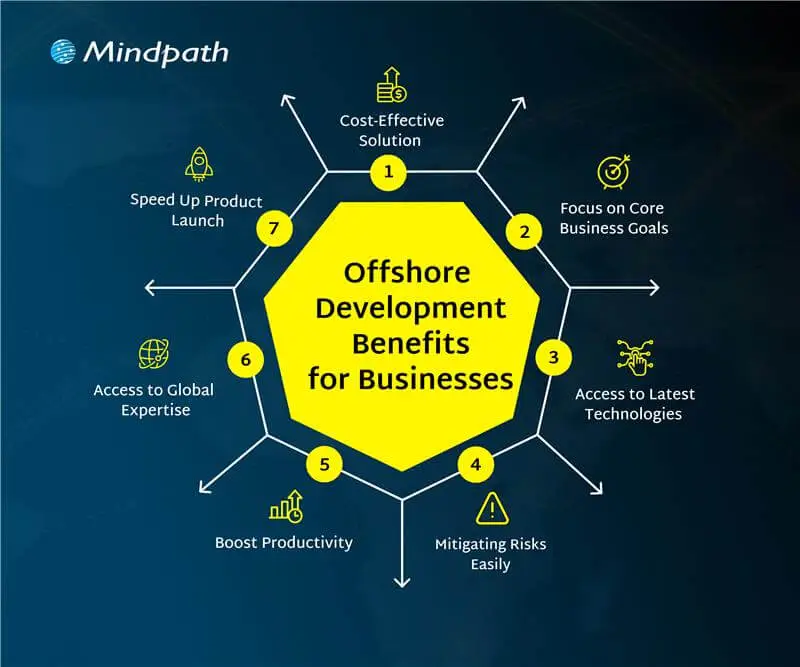
offshore development benefits for businesses

1. Cost-Effective Solution

Offshore development services help businesses lower their software development costs without losing quality. Companies can hire skilled developers from countries where salaries are more affordable compared to local markets. This approach offers a smart way to achieve cost-effective software development without compromising on results. The money saved can then be used in other important areas like marketing, research, or improving infrastructure.

2. Focus on Core Business Goals

Offshore development lets companies’ hand over routine tech tasks to external teams. This helps free up internal staff to work on more important goals and long-term plans. With fewer day-to-day responsibilities, businesses can focus better on innovation and growth. It also gives them more time to strengthen their position in the market.

3. Access to Global Expertise

Working with global software development teams allows companies to tap into a wide range of skills and knowledge. They can bring in experts who specialize in tools or technologies that are hard to find or too expensive locally. This helps businesses build better solutions and stay updated with the latest trends. It also brings fresh ideas and faster problem-solving from experienced professionals around the world.

Also Read: Qualities of a Good Software Engineer

4. Mitigating Risks Easily

Working with offshore teams helps reduce risks that may affect your local operations. This includes not just natural disasters or political changes, but also technical issues like system failures or delays in development. Offshore partners can quickly step in to handle problems and share responsibility when challenges arise. This setup keeps your projects moving and makes your business more stable and prepared.

5. Boost Productivity

Offshore teams usually have clear roles and focus on getting results. This helps manage projects better and use resources more effectively. Many offshore developers work in well-organized environments that support smooth and efficient work. As a result, they often deliver high-quality work on time and sometimes even ahead of expectations.

6. Access to Latest Technologies

Offshore teams give businesses access to modern tools like AI, cloud computing, blockchain, and IoT. Many offshore developers already have experience with these technologies and know how to use them well. This helps companies stay up to date and try new ideas without spending extra on training or new systems. It also supports faster innovation and better tech solutions.

7. Speed Up Product Launch

Tech talent outsourcing helps businesses work faster by using teams in different time zones. When one team finishes their day, the offshore team can continue the work, keeping the project going around the clock. This constant progress helps fix issues quickly and speeds up development. As a result, companies can launch their products sooner and meet deadlines with ease.

Want to know how this round-the-clock development approach works best ? Understanding the stages of the software development life cycle helps ensure offshore teams collaborate efficiently while maintaining quality and timelines.

Are you facing any confusion between offshore software development and onshore software development? Let us learn about the difference between them.

Offshore vs Onshore Development: A Comparison Table

When planning a software project, businesses often choose between offshore and onshore development based on their goals, budget, and timeline. Both options have their own advantages and challenges. The table below gives a clear comparison to help you decide which model suits your business needs best.

Factor 

Onshore Development 

Offshore Development 

Definition  Development done by a local team Development handled by a team in another country
Location Within the same country Access to cost-effective global locations
Proximity Easy access to the team Remote but manageable with clear planning
Cultural Fit  Shared work culture Diverse perspectives and global work culture
Communication Face-to-face communication possible Efficient digital communication tools
Talent Base Limited to local skills Broader access to global tech talent
Language Barrier Minimal language issues Clear strategies help overcome language gaps
Time Zone Same time zone, easy scheduling 24/7 progress through time zone advantage
Work Cycle Fixed to local business hours Continuous work with round-the-clock development

Looking to Scale Smartly with Offshore Software Development?

Offshore software development continues to be a smart and flexible solution for businesses in 2026. It helps reduce costs, improves access to global talent, and supports faster innovation. By using offshore teams, companies can stay competitive, scale quickly, and focus on their main business goals. No matter if you’re a startup or an established company, offshore development can support your long-term growth.

At Mindpath, we offer reliable offshore development services tailored to your business needs. Our expert teams are equipped with the latest tools and technologies to deliver high-quality solutions on time. With a focus on communication, transparency, and results, Mindpath helps you build the right IT outsourcing strategy for long-term success.

Related Post

Explore AI in web development and how it enhances user experiences, streamlines operations, and drives business success.

Related Post

NodeJS Developer Hiring Costs
When hiring a NodeJS developer, several factors influence the overall cost. Understanding these key factors helps businesses budget effectively and ensure they’re getting the right expertise for their needs. Here are the primary elements that affect hiring costs:

1. Experience Level

Junior/Entry-level Developers: These developers usually have less expertise but can complete simple tasks. They are best suited for basic tasks with less functionality and are less expensive due to reduced hourly rates. While they may need additional supervision, they provide high value for activities like developing basic APIs or working on tiny enhancements.

Mid-level developers: have many years of experience and can take on more complicated tasks, such as integrations and working with sophisticated libraries. Their hourly prices are modest, indicating their ability to handle larger projects and offer quality solutions while being more economical than senior developers.

Senior/Expert Developers: Senior developers have substantial experience with NodeJS, including knowledge of frameworks, architecture design, and complicated issue solutions. They charge the highest hourly costs because of their ability to handle high-level, intricate projects. If your project requires advanced performance optimization, system design, or complex debugging, hiring an expert ensures a top-tier result.

2. Project Scope and Complexity

Small, Basic Projects: For simple apps or projects, a junior or mid-level developer may suffice. These projects often entail basic activities such as creating simple APIs or static webpages. As a result, the cost is cheaper, as just one developer with core abilities is required.

Large, complex Projects: Developing more sophisticated applications, such as enterprise-level solutions or platforms with extensive integrations, can result in higher costs. These projects frequently need the involvement of senior engineers or entire development teams with experience in areas such as database administration, API development, and real-time application handling. The larger the team and more specialized the abilities, the higher the total cost.

3. Location

The geographical location of a NodeJS developer has a significant impact on their hourly fees. Hiring a developer is often more expensive in industrialized nations such as the United States and many areas of Europe due to higher living costs, a greater demand for competent developers, and competitive market prices. Developers in these areas typically charge extra for their expertise. In contrast, employing developers from emerging areas like India or Eastern Europe might result in considerable cost reductions. The hourly rates in these locations are often cheaper, making them an appealing alternative for firms seeking qualified developers at a lesser cost. However, while costs are lower, it’s important to consider potential differences in communication and time zones, as well as project management practices.

Looking for skilled NodeJS developers to bring your project to life? Mindpath offers experienced professionals who can help you build efficient, high-performance applications tailored to your needs.

Ready to get started? Contact Mindpath today and take your project to the next level with our expert NodeJS developers!

NodeJS developer costs vary based on experience, project complexity, and location. Read to find out more about it.
Cloud Computing Trends 2024

Are you curious about how cloud computing will evolve in 2024? What new technologies will shape the way we store, process, and access data? As the cloud landscape continues to grow and evolve, staying updated on these trends is more crucial than ever. In this blog, we will explore the latest cloud computing trends set to redefine the digital landscape this year. 

Cloud computing is the practice of employing internet-based services rather than maintaining everything on your personal computer. Imagine you need to save data, run programs, or use tools, but instead of doing it on your device, you access them over the internet. The real data, such as your files and applications, is stored on large, powerful computers known as servers, which belong to businesses such as Google, Amazon, and Microsoft. They handle everything, so you don’t need to worry about monitoring or maintaining anything. As long as you have internet connectivity, you may utilize everything you need, such as storage or software, at any time and from any location.  

Understanding cloud computing trends is essential for both your career and business. Businesses can pick the finest services and solutions, save money, and increase efficiency by having a thorough awareness of these trends. Staying up to date on what’s new and popular allows you to make better decisions, stay ahead of the competition, and maximize the benefits of the cloud. 

So, let’s dig in to explore the cloud computing trends 2024! 

Cloud Computing Trends 2024

1. Kubernetes and Docker

In 2024, Kubernetes and Docker will be key players in cloud computing. These technologies make cloud application management and deployment easier and more efficient. Docker enables you to organize your program and its dependencies within a lightweight, portable container. This implies that your program can work properly on any platform, including your PC and the cloud. Kubernetes goes a step further, managing and coordinating these containers. It automates processes such as scaling up or down and balancing workloads, ensuring that everything functions smoothly without requiring continual manual changes. As more businesses use cloud computing, Kubernetes and Docker are becoming increasingly important for improving and flexibly delivering cloud services.  

2. DevSecOps

In 2024, DevSecOps will be an essential approach to cloud computing security. It stands for Development, Security, and Operations, and it focusses on implementing security measures from the beginning of the development process. Rather than waiting until an application is complete to check for security flaws, DevSecOps ensures that security is built in throughout. This helps to defend against issues such as hacking, service outages, and unauthorized access to data. Cloud service providers offer tools and services that enable DevSecOps easy to utilize. Businesses may use these technologies to ensure their cloud environments are secure and free of possible dangers. 

3. Disaster recovery and backup

Disaster recovery and backup will be essential in 2024 for ensuring the security of your cloud data. If anything goes wrong—like a server breakdown, a power outage, a natural disaster, a cyberattack, or a hardware failure—having a robust backup strategy allows you to recover your data fast. Cloud computing simplifies this process by keeping copies of your vital data online. This manner, if something occurs to your primary PC, you can swiftly recover everything from the cloud. Many companies automatically store important data and information to cloud servers. This means companies don’t have to worry about losing important information and can keep their operations functioning smoothly even during catastrophes. 

4. Edge computing

Edge computing is changing the way we handle information by bringing it closer to where it originated. This reduces delays and speeds up operations. With the emergence of 5G networks, edge computing is becoming increasingly significant since it enables real-time data processing and enhanced security. Edge computing is becoming increasingly important as more devices connect to the Internet of Things (IoT), allowing for faster data analysis and smoother communications. Edge computing improves speed by bringing data processing closer to the source, ensuring that data is handled safely and effectively. 

5. Internet of Things (IoT)

The Internet of Things (IoT) is a rapidly emerging technological trend. IoT collects massive volumes of data via a network of sensors and devices, which is subsequently stored on cloud servers. This data is analyzed to offer relevant information for making business decisions. IoT connects various devices, computers, and networks, enabling them to communicate and share information. It can collect data remotely and control things from a distance. This smart connection is crucial for IoT’s appeal in cloud computing since it allows for more effective data management and utilization across several platforms. 

6. Low Code and No Code

Low-code and No-code Cloud solutions are transforming the way we develop applications by making it easy for anybody, not just experts, to create software. These platforms enable people to create apps and employ AI technologies with minimum technical knowledge. Instead of writing large amounts of code, you can quickly develop and launch projects using simple, user-friendly tools. This speeds up the development process, reduces errors, and makes technology more accessible to a larger audience. Users can easily construct apps using popular tools like Figma and Zoho, without having to maintain complex coding systems. 

7. AI and ML

Artificial intelligence (AI) and machine learning (ML) are leading cloud computing trends. These technologies demand a significant amount of computing power and storage to manage data and train models, but they also provide strong and cost-effective solutions. In 2024, we can expect AI and machine learning to drive trends such as self-automation, which allows systems to handle themselves, and personalized cloud services that adapt experiences to individual demands. These technologies will also enhance data security and privacy. Major technology businesses, such as Amazon, Google, and IBM, are aggressively investing in AI and machine learning. Amazon’s AWS DeepLens and Google Lens, for example, make use of machine learning to provide enhanced capabilities and improve user experiences. 

Cloud Computing at Mindpath

Mindpath’s cloud computing platform enables businesses to leverage advanced technologies without having to handle it all themselves. Mindpath provides a variety of cloud services that allow you to conveniently and securely store data, execute programs, and access resources online. 

Our cloud solutions are intended to be adaptable and scalable, allowing them to expand alongside your organization. Whether you need to back up important information, operate complex apps, or optimize your IT infrastructure, we have you covered. We guarantee that everything goes smoothly and securely, enabling you to focus on what is most important to your organization. 

Final Thought

As we look ahead to 2024, the cloud computing world is full of intriguing possibilities. Keeping up with these trends is essential from the rising relevance of Kubernetes and Docker in application management to the creative breakthroughs in AI and ML that are creating smarter, more secure solutions. Edge computing and IoT technologies are changing the way we manage and process data, while low-code and no-code platforms make app creation easier than ever. 

At Mindpath, we are dedicated to assisting organizations in navigating these changes and realizing the full potential of cloud computing. Our cloud solutions are adaptable and scalable to match your demands, whether you want to strengthen your IT infrastructure, secure your data, or innovate with cutting-edge technology.  

Ready to Transform Your Cloud Experience?

Dive into cutting-edge technologies with Mindpath’s tailored solutions and keep your business ahead in 2024.

Cloud Disaster Recovery

Have you ever wondered what would happen to your business if a disaster struck and you lost access to critical data or systems? Whether it’s a hardware failure, cyberattack, or even a natural disaster, the impact can be devastating. But what if there was a way to ensure that your business could quickly recover and keep running smoothly? That’s where Cloud Disaster Recovery comes in. In this blog, we will explore how this powerful solution can safeguard your data and help your business bounce back faster than ever. Let’s dive in! 

What Is Cloud Disaster Recovery?

Cloud Disaster Recovery (Cloud DR) is a dependable method for organizations to backup and recover essential data and systems in the event of an unforeseen catastrophe. It entails keeping copies of apps, information, and resources in a secure cloud setting. When disaster strikes, such as a hardware breakdown or a cyberattack, organizations can swiftly recover their data and restart operations. Cloud DR also includes capabilities like automation, which make the recovery process faster and more efficient. It is adaptable, letting businesses scale their storage and recovery requirements as they develop, assuring ongoing protection and minimal downtime. 

Why is Cloud Disaster Recovery Important?

Cloud Disaster Recovery is vital because it enables organizations to remain safe and recover rapidly when unforeseen difficulties arise, such as system outages, cyberattacks, or natural catastrophes. Losing data or access to vital systems can result in delays, financial losses, and reputational damage. Businesses can use Cloud DR to swiftly recover their data and resume operations without taking extensive interruptions. It guarantees that essential information is always secure and ready for use. It also saves time and money by automating the recovery process and offering a flexible option to scale with the company’s demands. This makes it a wise and dependable option for being prepared.

Advantages of Cloud Disaster Recovery

1. Flexible Scaling

Traditional disaster recovery systems frequently rely on physical data centers, which can be expensive and limited in flexibility. Businesses must purchase servers, storage devices, and networking equipment while also maintaining the complete system for recovery operations. This method not only requires a significant initial expenditure, but it also fails to respond rapidly to changing needs. Cloud Disaster Recovery addresses this issue by providing flexible and scalable solutions. Businesses can employ resources on demand through services such as public cloud alternatives or Disaster Recovery as a Service (DRaaS). This means customers can adjust the capacity they require, like storage or processing power, immediately through user-friendly websites. This strategy saves money by removing the need for costly physical infrastructure and maintenance. It also enables organizations to adapt rapidly to expansion or unanticipated events, ensuring that they have the necessary resources when they need them. Businesses who migrate to cloud disaster recovery benefit from a cost-effective and adaptive solution to preserve their data and systems while focusing on their core activities. 

2. Fast Recovery

Cloud-based disaster recovery guarantees faster and easier recovery operations, allowing organizations to minimize downtime. One of the primary benefits is the usage of virtual machines (VMs), which allow you to verify workload availability without impacting everyday operations. This allows firms to routinely review their recovery plans and ensure they are prepared to respond in the event of an emergency. The cloud also provides high-speed bandwidth and enhanced disc performance that can be customized to meet certain recovery time objectives (RTOs). These customizable solutions let firms recover vital systems and data more effectively. Unlike traditional techniques, which rely on physical resources, cloud services allow faster access to the tools and backups required for recovery. Cloud disaster recovery minimizes the time required to restart regular operations after an interruption by combining simplicity of testing, customizable choices, and quicker data retrieval. This guarantees that firms remain robust, retain loyal customers, and reduce financial and operational losses. 

3. No Location Limits

Cloud Disaster Recovery (Cloud DR) has the benefit of being independent of a specific physical location. Unlike traditional disaster recovery solutions, which rely on local or remote data centers, Cloud DR enables enterprises to store backups in data centers located anywhere in the world. This avoids the possibility of losing access to important data and systems if a calamity strikes the principal site of the organization’s equipment. Businesses can utilize Cloud DR to pick backup facilities in various geographic areas, ensuring that their data is secured from local threats such as floods, fires, and power outages. This flexibility enables businesses to develop a disaster recovery strategy that meets their specific demands while avoiding any disruptions caused by physical location limits. Additionally, the cloud’s global reach enables organizations to expand and modify their recovery solutions to individual requirements, without being constrained by on-premises equipment. This gives greater protection and business continuity, regardless of where the calamity occurs. 

4. Geo-Redundant Backup

Geo-redundancy in cloud disaster recovery improves data security and availability by utilizing a cloud provider’s worldwide network of data centers. These data centers are dispersed across numerous areas, allowing firms to store disaster recovery resources in various places. This regional spread serves as a safety net against local calamities such as earthquakes, floods, and power outages that can affect a particular region. Businesses that deploy disaster recovery resources in several areas can ensure that if one data center fails, backup systems in other places will continue to function. This not only improves the dependability of disaster recovery plans, but it also minimizes the likelihood of downtime and data loss. Geo-redundancy also offers shorter recovery times by allowing firms to retrieve their data from neighboring regions if one location faces issues. This worldwide approach to data security is especially useful for enterprises that operate in numerous locations, as it provides a resilient and scalable solution for protecting essential data and maintaining uninterrupted operations in the face of regional interruptions. 

5. Usage-Based Pricing

The cloud disaster recovery pay-as-you-go model gives companies a cost-effective method to set up recovery facilities without having to pay large upfront fees. Unlike traditional managed co-location providers, which sometimes demand long-term contracts, cloud services allow businesses to pay only for the resources they utilize. This means that organizations might avoid making large initial expenditures and instead see catastrophe recovery costs as continuous, flexible expenses. With this strategy, corporations can adjust their payments depending on their real needs, adding or subtracting resources as needed. This allows organizations to grow their disaster recovery solutions without worrying about paying for wasted capacity. Pay-per-use alternatives assist firms in maintaining a cost-effective and adaptive data security strategy by converting substantial capital expenditures into affordable operational costs. 

Also Read: Cloud Computing Attacks: A Comprehensive Guide for Prevention

Cloud Computing Services at Mindpath

Mindpath provides flexible and dependable cloud computing services to match your company requirements. Our cloud solutions provide safe data storage and access from anywhere. We have you covered for disaster recovery, data storage, and scalable computing power. Our pay-as-you-go strategy allows you to pay for just the resources you use, making it both cost-effective and flexible. This allows you to scale up or down as needed, without incurring significant upfront expenditures. Our cloud services are supported by a worldwide network of data centers, which guarantees excellent availability and security. Fast recovery options allow you to swiftly get back on track if something goes wrong.  

Final Note!

Cloud Disaster Recovery is a crucial option for organizations seeking to secure data and reduce downtime in the event of unforeseen interruptions. Businesses can safeguard their operations while controlling costs by utilizing flexible scalability, rapid recovery, geo-redundancy, and usage-based pricing. The cloud provides unrivalled flexibility, speed, and global reach, making it the best option for modern disaster recovery. Mindpath offers dependable and scalable cloud computing services to help you stay safe, adaptive, and prepared for any emergency. With our pay-as-you-go strategy, you can focus on your core business while we handle catastrophe recovery, ensuring that your data and systems are always secure and accessible.  

Ready to protect your business with reliable cloud solutions?

Partner with Mindpath today and discover how our flexible, cost-effective cloud computing services can keep you secure and run smoothly.

Learn how Cloud Disaster Recovery safeguards your business with flexible, cost-effective solutions for fast recovery and data protection.