


How Much Does It Cost to Hire ReactJS Developers in New York?

Join our Newsletter!

Featured Posts

Support Is One Click Away

Home

How Much Does It Cost to Hire ReactJS Developers in New York?

ReactJS Developer Hiring Costs in New York

How Much Does It Cost to Hire ReactJS Developers in New York?

Hiring a ReactJS developers in New York involves several pricing considerations, including expertise level, project complexity, and engagement approach. The cost of employing a freelancer, in-house developer, or outsourcing to an agency varies greatly. Understanding these aspects allows you to efficiently manage your budget and select the best staff for your project. Here’s an overview of the major factors that determine the cost of hiring ReactJS developers in New York.

1. Experience Level

The cost of hiring a ReactJS developer in New York varies according to their expertise level. Entry-level developers often charge between $60 and $80 per hour, making them an excellent alternative for modest tasks. Mid-level developers, with greater hands-on expertise, charge between $80 and $120 per hour. Senior developers, who have substantial experience with React and complicated application development, may charge between $120 and $180 an hour. While senior developers are paid more, they deliver high-quality, scalable, and optimized solutions that save time and money in the long term. Choosing the appropriate expertise level is determined by your project’s objectives and budget.

2. Engagement Model

The engagement model you choose affects the price of hiring a ReactJS developer in New York. Freelancers charge between $50 to $120 per hour, providing flexibility but less consistency for long-term work. In-house developers make $90,000 to $150,000 per year, offering specialized assistance but incurring additional expenses like perks and office space. Agencies charge $100 to $200 per hour and provide a team of professionals for end-to-end development. Each model has advantages and disadvantages, so firms should evaluate project duration, complexity, and money before making a selection.

3. Project Complexity

The complexity of your ReactJS project has a direct influence on development expenses. Simple applications, such as basic web pages, cost between $5,000 and $15,000. Medium-complexity projects, such as bespoke dashboards or eCommerce websites, cost between $20,000 and $50,000. Highly complicated programs, such as business software or AI-powered platforms, might cost more than $100,000 owing to additional functionality, API interfaces, and security needs. More sophisticated projects necessitate developers with greater skill, raising expenses. Identifying your project’s complexity allows you to budget more wisely while also hiring the proper ReactJS talent for a scalable and efficient solution.

4. Location and Market Demand

The location and market demand in New York have a substantial impact on recruiting expenses. As a tech hub, New York has a strong demand for ReactJS engineers, resulting in higher wage expectations. Local developers often make $90,000 to $150,000 per year in-house, or $100 to $200 per hour as top freelancers and agencies. To cut expenses, several organizations are exploring recruiting remote workers from Eastern Europe or Latin America, where competent engineers are more affordable. While local developers make cooperation simpler, employing experienced remote workers can be a cost-effective choice without sacrificing quality.

Looking for expert ReactJS developers in New York? Mindpath, offers top-tier talent for your project, whether you need freelancers, in-house experts, or a full development team. We deliver cost-effective, high-quality solutions tailored to your needs. Let’s build something great together!

Contact us today

Related Post

How much does hiring a ReactJS developer cost? Learn about factors affecting rates, and how to find the best talent within your budget.
NodeJS developer costs vary based on experience, project complexity, and location. Read to find out more about it.
Discover how AutoML simplifies machine learning for businesses. Learn about its benefits, including cost savings, accuracy, and faster deployment.

Related Post

benefits of hiring remote developers

Understanding the benefits of hiring remote developers can unlock thrilling possibilities for organizations looking to grow faster and smarter. In today’s world, companies tap into skilled workers worldwide instead of relying only on local talent. But how does the shift to remote development impact projects and teams? When organizations hire the right remote developers, they can deal with challenges more effectively, enlist more talent and expertise, and receive additional lateral thinking that may not always be available nearby.

At the same time, it’s not just about broadening the talent pool. Hiring remote developers allows companies to maximize savings, increase performance, and yield faster delivery speed. Isn’t that exactly what companies are looking for as they continue to modernize? With the pace of technology increasing, it’s more important than ever to tap into professionals who can adapt to change quickly and produce results. This is why businesses are employing remote teams as a sound way to grow and remain competitive. In this blog, we will outline some of the benefits that should make remote developers a consideration for any business.

Looking to scale your business that provides growth and innovation? Contact us, and we will help you explore how you can access fast and quick results.

Growing Demand for Remote Developers

The demand for remote developers is increasing rapidly with global hiring and flexible working arrangements. After COVID-19, companies learned that they could function just as well without physical workspaces, and developers discovered the advantages of flexible work. Companies now want specialized skills; they want specialized skills faster and cheaper, developers want remote or hybrid work, and specialized skill developers want fast and cheap work.

Taking everything into account, some of the key factors driving this new reality include shifting cultural dynamics post-COVID, the speed and efficiency of AI and cloud technology, and the ability to pull skills from anywhere in the world. Organizations can now create effective teams independent of place, reduce costs, and maintain a competitive position in an increasingly digital world.

Also Read: Remote Work Tools for Developers

Benefits of Hiring Remote Developers

Understanding the advantages of hiring dedicated developers has shown us how powerful hiring talent remotely has become. Companies can scale at an accelerated pace, reduce costs, and fill unique skills that might not exist locally. When companies find the right remote dedicated team, they can expect a well-thought-out project and long-lasting value.

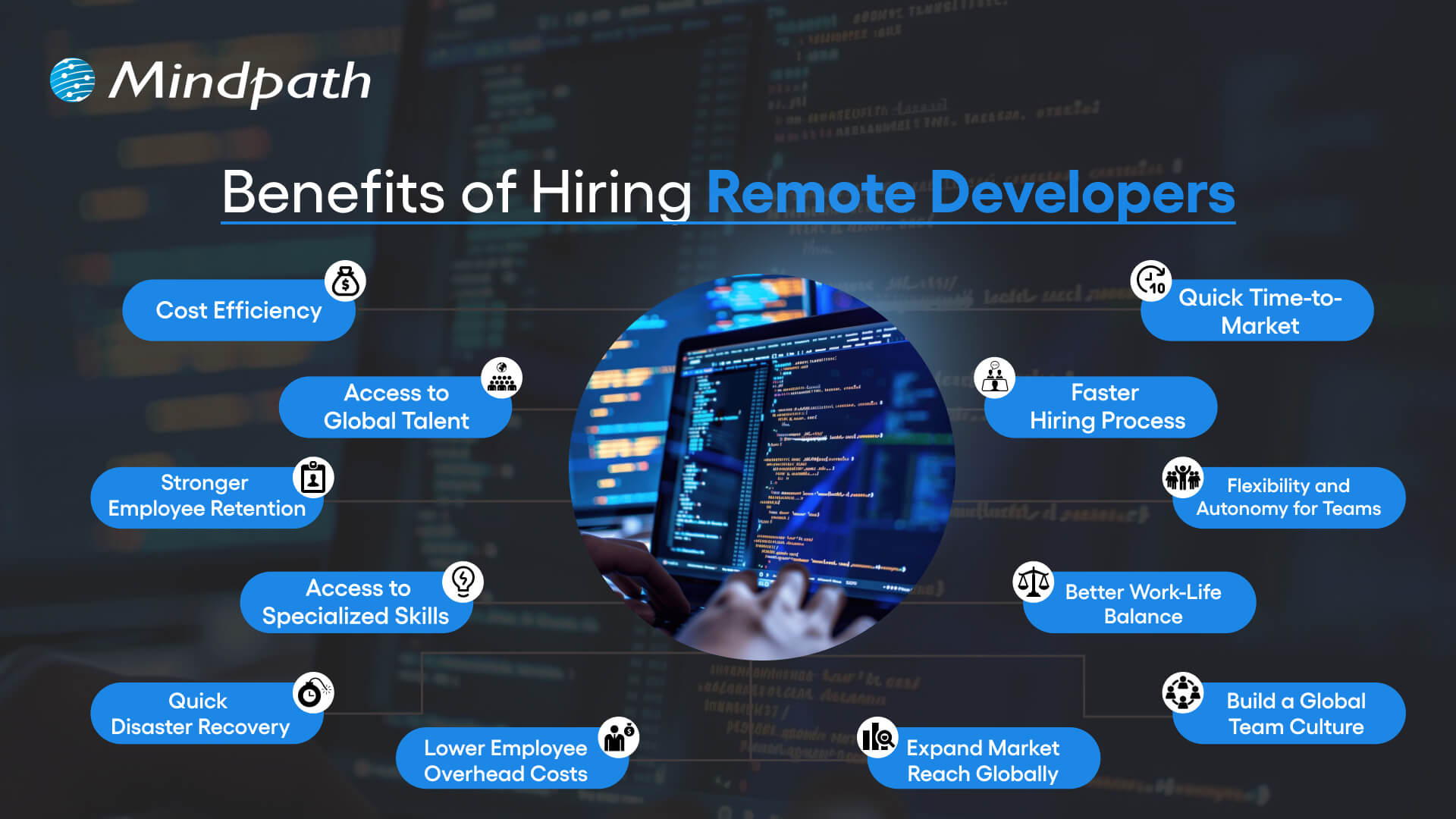
Benefits of Hiring Remote Developers

1. Cost Efficiency

Remote hiring can decrease expenses on space, utilities, and other operational costs. When hiring developers from places with lower costs of living, companies save even more on employee salaries and daily overheads, which can then be reinvested into research or innovation or even into paying for employee benefits. This enables companies to experience growth while continuing to be fiscally responsible.

2. Access to Global Talent

One of the major benefits of remote work is the opportunity to recruit talented professionals to join the team from anywhere in the world. Workers and their companies no longer have to feel restricted in the talent they can recruit, and many companies are developing diverse teams together with specialized skills and knowledge. Companies can now combine talent in technical skills, such as machine learning, with more creative areas, such as UI and UX design.

3. Stronger Employee Retention

One of the important benefits of hiring remote developers is increased employee retention, which is important for business stability. Employees have less stress from long commutes and improved work-life balance, which leads to increased job satisfaction. With higher satisfaction comes increased loyalty and lower turnover. This stability provides companies with predictable productivity, more control of expenditures, and longer-term growth.

4. Access to Specialized Skills

Remote hiring allows companies to locate developers and other providers with specialized skills that they may not have locally. Companies can search worldwide for developers skilled in machine learning, React development, healthcare technology, etc.

Even non-technology companies can find programmers and service providers in the specialized pathways without the need for in-house technical capacity. The appropriate specialized talent makes it possible to achieve quality, safety, and reliability standards for projects.

Looking for guidance on hiring specialized developers for your projects? Check out our detailed guide on hiring expert ReactJS developers to find the perfect match.

5. Quick Disaster Recovery

An additional benefit of hiring remote developers is business continuity. When a local office experiences disruption due to power outages or extreme weather, remote teams can maintain the pace of project execution. By engaging in a distributed team model, work is not curtailed at one point in the system. That is, it allows a project to better meet deadlines, reinforces trust with clients, and increases anchoring with the robustness of the overall business model and operations.

6. Lower Employee Overhead Costs

A key advantage of hiring a remote development team is the significant reduction in costs exceeding rent, utilities and office supplies. Onboarding is less expensive with remote developers because they are working off their own setups, so they will utilize minimal in-house resources. Training is also delivered through online modules, which will save costs and help keep teams up to date without wasting time.

7. Quick Time-to-Market

The biggest benefits of hiring remote developers is that it really helps to speed up product launches. As teams are already distributed around the world in different time zones, development, testing, and deployment can continue all day. This Shortens project cycles and allows businesses to meet deadlines in a timely manner. Being able to deliver faster keeps companies agile and gives them a significant competitive advantage.

8. Faster Hiring Process

Remote hiring allows companies to source and onboard the right talent quickly for projects on short notice due to access to a global talent pool. Many recruitment teams know that hiring offshore means you do not have to worry about relocation and cannot be delayed by a lengthy recruitment process. Skilled developers can start working on a project within a week. This speed allows companies more time for development, testing, and entering the market.

Need a faster way to scale your development team without long-term commitments? Discover how staff augmentation enables businesses to add skilled developers quickly while maintaining flexibility and cost efficiency.

9. Flexibility and Autonomy for Teams

One of the key advantages of employing remote developers is that it affords teams higher flexibility and autonomy in how they choose to work. Since developers can work at a time that suits them best, they produce higher-quality work.

Using this flexible work model creates lower stress, higher job satisfaction, and engagement. Businesses with flexible work models not only benefit from motivated teams but also from teams that achieve better results in less time.

10. Better Work-Life Balance

Remote developers benefit from the flexibility to have a day that will fit their personal and professional needs. This flexibility provides remote developers with the opportunity to spend time with family, for fitness, and for personal well-being, without worrying about any impact on their productivity.

As a direct result, mental and physical well-being improve, and performance at work improves as well. The benefits of hiring remote developers result in a happier team that will be focused and more efficient in tackling each project successfully.

11. Build a Global Team Culture

The benefits of hiring remote developers extend to creating a diverse team culture that blends ideas from around the world. Different perspectives and experiences lead to more creativity and stronger problem-solving. Online collaboration tools make it easy for teams to connect, share, and work together across borders. This global culture not only strengthens teamwork but also supports innovation and business growth.

12. Expand Market Reach Globally

With remote developers located across different regions, businesses gain real-time insights into diverse markets. These developers can share valuable knowledge on local consumer preferences, trends, and cultural expectations. This localized input helps tailor products or services for specific audiences more effectively. The benefits of hiring remote developers include faster, smarter market expansion with fewer blind spots.

Want to leverage remote talent for faster product launches worldwide? Explore how custom software development can help your business scale efficiently.

Ready to Experience the Benefits of Remote Working?

The benefits of hiring remote developers clearly show how powerful and practical this model has become for modern businesses. Companies gain access to global skills, improve retention, reduce overhead, and accelerate delivery. By building flexible and resilient teams, organizations can stay ahead of the competition and create sustainable growth in today’s fast-changing digital landscape.

At Mindpath, we make hiring remote developers simple and effective. Our dedicated developers bring specialized skills, innovation, and flexibility to your projects. With a focus on efficiency and quality, we help businesses scale faster, cut costs, and deliver solutions that drive real results. Partner with Mindpath and unlock the true potential of remote working.

Discover how hiring remote developers can drive startup success by tapping into global talent, enhancing productivity, and reducing costs.
Cybersecurity
In a world where working from home has become the norm, have you ever wondered how safe your digital workspace is? With employees connecting from various locations, the threat of cyberattacks has grown significantly. Hackers are constantly on the lookout for vulnerabilities, and remote workers often unknowingly become easy targets. What steps can you take to protect sensitive data while working remotely? How can businesses ensure their teams stay secure online?  Cybersecurity is all about protecting your data, devices, and online activities against dangers such as hackers, malware, and scams. It is essential because, without effective safeguards, sensitive information might slip into the wrong hands. This could include personal information, financial records, or even crucial corporate data, resulting in severe losses and harm to confidence. In the era of remote work, this is even more important. When people work from home or other locations, they frequently utilize personal devices and home internet connections, which might not be as secure as the office setting. Hackers are aware of this and use poor security systems to steal data, implant malware, or disrupt operations. A single breach can reveal personal information, impair a company’s reputation, or cause financial problems. With remote teams depending on capabilities such as video conferencing, cloud storage, and online collaboration platforms, the risk of cyberattacks has grown. Strong cybersecurity measures are required to provide a secure digital environment for employees and organizations. It promotes seamless operations, increases trust among clients, and safeguards vital information.  Let’s dive into the world of cybersecurity for remote work and uncover the solutions to the pressing challenges! 

Best Practices of Cybersecurity in the Era of Remote Work

1. Use Safe Communication Tools

Keeping communication secure is one of the most essential cybersecurity measures for remote workers. Begin by utilizing technologies to safeguard your messages and data, such as emails with encryption that scrambles information so that only the intended recipient can view it. A Virtual Private Network (VPN) is also useful since it masks your internet connection, making it more difficult for hackers to monitor your online activity. Adding two-step logins, also known as two-factor authentication, adds an extra degree of security by requiring a password and a unique code to access your accounts. You should also be cautious about whatever applications or platforms you utilize at work. Choose ones that are reputable and provide robust security measures. Avoid exchanging sensitive information on unprotected networks or apps that do not have encryptionBy using safe ways to communicate, you can protect important information and make sure it stays in the right hands.  

2. Check Security Often

To keep your remote work secure, be sure to verify all devices and software on a frequent basis. This includes the PCs, cellphones, and tablets that your staff utilizes at work. Regular inspections can help you identify any vulnerabilities or security breaches that hackers can exploit to get access. Update all software, applications, and operating systems with the most recent security updates, often known as patches. These upgrades assist in avoiding assaults by protecting against new threats. It’s also a good idea to ensure that all devices have up-to-date security software, such as antivirus and firewalls. Regular audits can help to identify problems early on and ensure that all systems are functioning properly. This easy action helps secure both corporate and personal data from being exposed or stolenBy checking everything often, you’re staying ahead of any potential security risks.  

3. Teach Employees About Safety

Training your staff on how to be safe online is an essential step towards safeguarding your remote work environment. Teach them how to identify and prevent phishing scams, which attempt to fool people into giving personal information. Show them how to safeguard their own devices, such as using strong passwords and enabling two-factor authentication for more safety. It’s also crucial to educate staff to use strong, unique passwords and change them on a frequent basis. The more everyone understands online hazards and how to avoid them, the safer your business and data will be. Security training enables employees to make better online decisions and prevent mistakes that could lead to security concerns. 

4. Control Who Can Access Data

Enforcing access controls entails restricting who can view or use certain information depending on their job duties. For example, not everyone in the firm needs access to sensitive data, thus it is essential to ensure that only authorized personnel can view or handle it. By implementing these safeguards, you can reduce the likelihood of unauthorized access or data breaches. This is particularly essential while working remotely. Employees work from many places, thus ensuring that only those who genuinely need access to certain data have access to it provides an added degree of security. This helps to avoid data breaches and protects your organization from cyber-attacks. So, as remote work becomes more common, it’s crucial for organizations to have clear access rules and strong cybersecurity policies to protect sensitive information from potential risks. 

5. Create Strong Security Rules

A well-thought-out cybersecurity policy is crucial for guaranteeing safe remote work. This policy should explicitly outline the procedures workers must take to secure corporate information, whether they are working from home or another location. It should address issues such as strong passwords, safe online behaviors, and how to handle sensitive data. Furthermore, the policy should provide instructions for using corporate equipment and software properly, such as the need for frequent software upgrades, secure communication tools, and encrypted connections. Employees should also be instructed on how to handle possible security issues, such as phishing emails or strange URLs. Having a complete policy in place reduces confusion, assures consistency across teams, and gives a clear reaction strategy in the event of a security incident. By establishing these rules, organizations can reduce the risk of cyberattacks and ensure that workers understand their responsibility in keeping a safe and secure workplace. 

How Can Mindpath Help?

At Mindpath, we understand how essential it is to keep your organization secure, especially in the age of remote work. We can help by delivering experienced cybersecurity solutions that are suited to your specific requirements. Our experts can help you set up secure communication platforms, install access restrictions, and develop robust cybersecurity policies to protect your data. We also provide quarterly audits to verify that all systems are up to date and secure against attacks. Our experts can teach your workers about best practices for internet security, such as recognizing phishing schemes and protecting their personal devices. With Mindpath’s assistance, you can focus on expanding your business while we manage the security, ensuring that your remote work environment is safe and secure. 

Wrapping Note!

As remote work continues to grow, keeping your digital workspace secure has never been more important. By following simple yet effective cybersecurity practices like using secure communication tools, checking security often, training employees, controlling access to sensitive data, and creating strong security rules, you can protect your business from online threats. At Mindpath, we’re here to help you safeguard your organization by providing expert cybersecurity solutions that fit your needs. With our support, you can ensure your remote work environment is safe, so you can focus on what really matters—growing your business. 

Ready to secure your remote work environment?

Partner with Mindpath today for expert cybersecurity solutions tailored to your business needs and stay protected!

Learn essential cybersecurity practices for remote work and how Mindpath can help protect your business with expert solutions.
SaaS Development Services

Selecting the appropriate SaaS development services may seem like walking through a rapidly shifting technological environment. Businesses in the present day require solutions that are innovative, scalable, and flexible. You may end up comparing different providers, and each one of them claims to have unique expertise. The difficulty lies in finding a service that is consistent with your objectives and generates real value. It involves thinking outside the box and taking into account teamwork, problem-solving, and sustainability. So, how are you going to find a service that best suits your business vision?

The key is to find a partner that is knowledgeable about your growth strategy and technology needs. Successful SaaS development services engage both hands-on experience and progressive innovation. When you are seeking options, make sure you take into account compatibility with your team, development strategy, and scalability. You require a clear understanding of procedures, communication, and delivery schedule. This blog will help you make the right decision in your SaaS development journey. Let’s dive in together!

Want to choose the right partner to build scalable and efficient SaaS software for your business? Mindpath’s  SaaS Development Services provide expert developers and custom solutions to deliver growth-oriented applications.

Understanding Software-as-a-Service (SaaS) Development

SaaS development refers to the development, deployment, and maintenance of software applications delivered over the Internet as a service. These applications are cloud-based, unlike the conventional software. They are available to users either on a web browser or on an app interface. An effective SaaS development service makes applications to be scalable, secure and user-friendly. It concentrates on delivering constant updates and excellent user experiences across all devices.

SaaS development needs proper software engineering and cloud knowledge. Developers should also know what customers require and what is trending in the market. This understanding enables the creation of software, which is efficient, reliable, and sustainable. SaaS development focuses on cooperation, problem-solving, and constant enhancement in order to fulfill business objectives. It guarantees the product to expand with the user requirements without compromising the performance or security at any point.

Want to understand how SaaS can streamline your operations and drive business growth more efficiently? Discover our guide on the benefits of SaaS to explore how it enhances scalability, flexibility, and cost savings.

The following are reasons why businesses today require SaaS development services:

1. Cost Optimization

SaaS reduces start-up infrastructure and the cost of licensing. Companies enjoy the benefit of stable prices and expenditure.

2. Scalable Architecture

SaaS software development is capable of scaling users and features in an easy way. The systems can easily adapt to growth and demand.

3. Anywhere Accessibility

The use of the cloud allows remote and distributed teams. Users can be able to work anywhere safely.

Must Read: Cloud Security Tools

4. Rapid Deployment

The SaaS solutions take a shorter time to launch via browsers. This minimizes the setup time and fast-tracks time to value.

5. Simplified Maintenance

Service providers deal with updates, security, and performance. SaaS developers assist in lowering internal IT workloads.

6. Innovation Readiness

SaaS solutions are compatible with contemporary tools and artificial intelligence. This helps companies remain competitive and data oriented.

Wondering how AI can transform your SaaS product with automation and predictive capabilities? Read our guide on the benefits of AI to discover its impact on growth and efficiency.

Key Steps to Choose the Right SaaS Development Services

The choice of SaaS development services requires a clear idea, planning, and business orientation. The most important steps to selecting SaaS application development services that facilitate long-term growth are as follows.

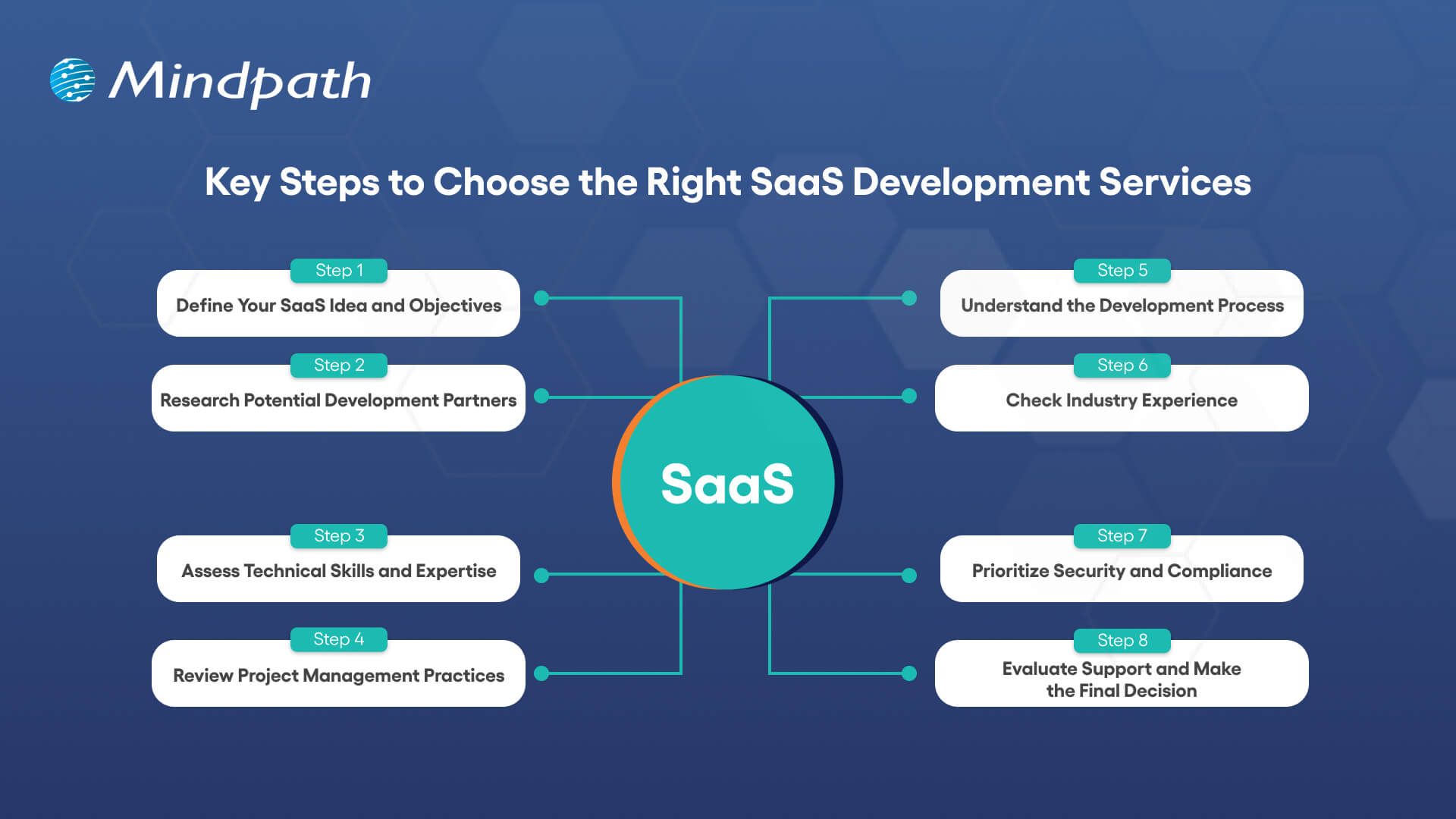
Key Steps to Choose the Right SaaS Development Services

1. Define Your SaaS Idea and Objectives

Be clear about your SaaS concept, what problem it will address, and who your audience will be. Clear goals contribute to the alignment of attributes, functionality, and business objectives in the long run. This transparency enables the SaaS development services to create a product that is focused and efficient.

2. Research Potential Development Partners

Begin by doing research on credible SaaS development companies that have a successful track record with SaaS projects. Check their portfolios, case studies, and feedback from clients to determine credibility. This study can assist you in narrowing down partners who can provide scalable solutions.

3. Assess Technical Skills and Expertise

Evaluate the technical competence of the in-house development team in the front end, back end, and cloud computing. Ensure that they know the process of developing secure and scalable SaaS applications. Well-developed technical capabilities reduce the development risks and improve the overall performance of the product.

4. Review Project Management Practices

Understand how the company manages schedules, work and communication in the development process. Agile project management is flexible and responds more rapidly to changes. Analytical thinking will ensure consistency and quality in development.

Must Read: SaaS Challenges for Businesses

5. Understand the Development Process

Inquire about their entire development cycle such as designing, testing, and implementation. Make sure that security and performance, as well as scalability, are considered at an early stage. A trusted Saas development platform enhances easier cooperation and implementation.

6. Check Industry Experience

Experience in the industry helps teams to know more about your business challenges. Experienced developers are able to foresee risks and recommend workable improvements. This results in improved custom SaaS development projects.

7. Prioritize Security and Compliance

Make sure that the development team has good security standards and compliance requirements. The process of development should include data protection and compliance with regulations. This ensures the safety of user information and builds up confidence in the product.

8. Evaluate Support and Make the Final Decision

Evaluate the capacity of the company to offer long-term support and maintenance. Constant improvement and interaction are key to successful products. Select SaaS development services, which reflect your growth plans and vision.

Want to stay ahead in the competitive market by understanding how SaaS is evolving? Discover our guide on SaaS trends to explore the latest innovations shaping the future of the industry.

Ready to Transform Your Business with SaaS?

Selecting the appropriate SaaS development services will keep your company competitive, scalable and efficient. Successful SaaS products are the result of clear planning, technical expertise and strong project management. Using systematic steps assists in choosing partners who provide secure, reliable and innovative solutions. Having the right team ensures your software keeps up with the business requirements and enhances performance and user satisfaction.

At Mindpath, we provide professional custom SaaS development services based on your business objectives. We are a team of prolific developers and present scalable, secure, and user-friendly solutions. Our priorities are innovation, a smooth partnership, and continuous support to achieve optimal performance of your SaaS product. Mindpath is the choice that ensures a future-proofed platform that is designed to expand with your users and business vision.