How Conversational AI Chatbots Transform Business Operations?

Join our Newsletter!

Featured Posts

Support Is One Click Away

Home

How Conversational AI Chatbots Transform Business Operations?

conversational AI chatbots

How Conversational AI Chatbots Transform Business Operations?

Ever thought about how firms can respond to thousands of customer requests every day? Or how can they give customers 24/7 support without interruption? The answer is conversational AI chatbots. These smart virtual assistants change how organizations handle customer inquiries, as well as starting a new trend to assist with sales, without downtime or human effort. The way vendor chatbots can integrate with pre-existing systems is quickly making Chatbots an efficient driver for the future of business. 

These AI chatbots are fast becoming a staple in today’s business toolset. Many organizations are beginning to use them, supplementing their customer interaction and task management processes. Chatbots can fit conveniently into many different areas of an organization. As usage continues to expand, understanding their value is important. This blog will detail how these AI chatbots are increasing the effectiveness of business operations in simple ways. 

Looking to enhance customer engagement with a personalized AI solution? Our custom chatbot development services specialize in building conversational AI chatbots tailored to your business needs and goals.

What is a Conversational AI Chatbot?

A conversational AI chatbot is an intelligent computer program that interacts with individuals using natural language. It understands an accurate interpretation of what its users are saying/writing, processes that input, and responds accordingly in the way a real human would.

Conversational bots are found in websites, applications, and messaging interfaces to assist users who have questions, information, support, or simple tasks and processes. They can exist on a 24/7 basis with no waiting and provide instant and consistent information without the need for the user experience to include human staff.

Conversational chatbots use advanced technologies like natural language processing (NLP), machine learning (ML), and large language models (LLM) to understand and improve conversations. They don’t just follow pre-written scripts but can learn and adapt based on new information.

From helping customers with online shopping to guiding employees through internal systems, these chatbots are becoming a useful part of modern business communication. 

Curious to know how AI can enhance your e-commerce strategy and give your business a competitive edge? Read our detailed blog on how AI in e-commerce is transforming the future.

Types of Conversational AI Chatbots?

Conversational chatbots come in different types, each designed to handle specific kinds of interactions. Understanding these types helps in choosing the right chatbot for your business needs.

1. NLP Chatbots

Natural Language Processing (NLP) chatbots can understand user intent and context, making them capable of handling complex or varied language inputs. Unlike rule-based bots, they interpret full sentences to deliver more relevant and precise answers.

2. Menu-Based Chatbots

Menu-based chatbots use decision tree-type logic and offer users a set of predefined buttons or options to choose from, guiding them through a structured conversation. These bots are ideal for handling simple FAQs like tracking orders or checking pricing but can be limited in handling complex queries.

3. Machine Learning Bots

Machine learning chatbots learn from past user interactions and improve over time, allowing for highly personalized and context-aware conversations. They can remember user preferences and reuse information in future chats, enhancing the customer experience.

4. Hybrid Chatbots

Hybrid chatbots combine rule-based systems with AI capabilities to deliver both structured and intelligent responses. They can escalate complex issues to human agents, allowing seamless integration between automation and live support.

5. Rule-Based Chatbots

Rule-based chatbots operate using if-then logic and keyword recognition, providing answers based on specific triggers set by the developer. They work best when queries are predictable and can be mapped to predefined responses using keywords or phrases.

All these chatbot types can be integrated into a powerful conversational AI platform to provide comprehensive and intelligent customer support solutions.

According to a study by Tidio, the conversation rate of chatbots in some industries has been observed to reach up to 70%.

Also Read: Benefits of AI

Benefits of Conversational AI Chatbots For Business Growth

Conversational AI chatbots are becoming a powerful tool for businesses looking to improve how they work and grow faster. Here are some of the key benefits they offer for driving business growth:

1. Get Useful Customer Feedback Easily

Chatbots can ask for feedback right after a chat session by sending a quick question or rating option. To encourage responses, they can offer discounts or small rewards. Businesses can then check feedback and chat logs to discover common issues and improve services. It’s a smart way to collect insights without bothering the customer.

2. Understand Customer Needs

AI chatbots can figure out what the customer wants and how they feel by reading their words and tone. They understand if a message is urgent or if a customer is upset. When needed, they pass this helpful info to an agent. This gives the agent better context to respond more personally and calmly. 

3. Support Your Sales Team with Smart Help

AI chatbots help with sales by chatting with website visitors, gathering lead details, and booking demos. They answer common product questions and encourage customers to stay longer and learn more. This reduces cart abandonment, increases conversion rates, and supports upselling, all with minimal effort. 

4. Handle Repetitive Questions Automatically

One of the best AI chatbot features is the ability to answer common questions instantly. They manage simple tasks like order tracking, returns, and payment issues without needing a support agent. This saves time for both the customer and your team. It also reduces the number of tickets and keeps agents free from more serious problems.

If you’re exploring smarter ways to deliver customer support. Read our blog on AI for Customer Service, where we highlight how chatbots and virtual assistants can improve customer satisfaction and drive measurable business growth.

5. Increase Lead Generation

Instead of filling out forms, customers can chat naturally with AI bots to share their needs. Chatbots collect useful data like preferred products, location, and language. This data is shared with the marketing team, helping them create personalized campaigns and understand customer behavior better.

6. Keep Customers Engaged with Timely Updates

Chatbots can send helpful messages like order updates, appointment reminders, or payment alerts. They also follow up with feedback requests and help continue conversations across different platforms. With custom branding and fun elements like emojis or images, they make every interaction feel friendly and engaging. 

7. Lower Business Costs

Every business wants to reduce costs while improving service quality. Chatbots help by managing simple tasks, answering frequent questions, and routing chats to the right place. This reduces the need to hire additional agents. Some chatbot platforms are easy to set up without coding, saving time and helping businesses see value faster.

8. Scaling Customer Support Efficiently

Chatbots act like additional support agents by handling many customer questions at once. They manage simple requests efficiently, which helps your team focus on more complex issues. This makes it easier to serve a growing number of customers without increasing staff size, saving time, and reducing pressure on your support team. 

Wondering how to turn AI concepts into actionable business solutions? Check out our AI Consulting Services guide for insights on planning, deploying, and scaling AI effectively.

Want to Transform Your Business with Conversational AI Chatbots?

Conversational AI chatbots are changing how businesses talk to customers, manage support, and grow. From smart replies to handling repetitive tasks, these chatbots are now a valuable part of any modern business setup. They simplify operations, improve customer experience, and help teams work more efficiently without adding extra load. 

We at Mindpath are custom chatbot development company, we help businesses build custom conversational chatbots that fit their goals. Whether it’s for customer support, lead generation, or sales, our expert solutions make chatbot integration easy and impactful. Let us help you scale faster and connect better with your customers using the best AI chatbot tools.  

Related Post

Learn how to hire expert NodeJS developers to build high-performance apps. Discover essential skills, factors, and costs with Mindpath’s guide.
Discover staff augmentation for IT projects, its benefits, and top providers in the USA. Learn how it can bridge gaps and save costs.

Related Post

Hire NodeJS Developers in Canada
Hiring a Node.js developer in Canada requires assessing both technical and soft skills while ensuring they fit within the local business environment. A strong candidate must be proficient in Node.js, JavaScript, and frameworks like Express.js while also demonstrating problem-solving abilities and adaptability. Additionally, understanding Canadian regulations such as PIPEDA is essential for compliance. Ensuring a cultural fit within your team can improve collaboration and efficiency. Below are four key considerations to help you hire the best Node.js developer for your business in Canada.

1. Strong Technical Expertise

A skilled Node.js developer should have a deep understanding of asynchronous programming, event-driven architecture, and error handling. Proficiency in JavaScript fundamentals, including object-oriented programming and closures, is essential. Experience with Express.js, NestJS, or Koa is valuable for building efficient applications. Database management using MongoDB, PostgreSQL, or MySQL ensures proper data handling. Familiarity with RESTful API development is crucial for smooth application interactions. Candidates with expertise in microservices architecture and serverless computing can help build scalable and high-performance applications for your business. 

2. Essential Soft Skills

Beyond technical expertise, soft skills play a crucial role in a developer’s success. A Node.js developer must have excellent communication skills to collaborate effectively with teams. Their ability to explain complex concepts clearly ensures smoother teamwork. Problem-solving skills are essential for debugging and optimizing applications efficiently. Adaptability helps developers stay updated with new technologies. Additionally, strong teamwork and collaboration skills ensure they work well within a team. Assessing these qualities through behavioral interviews can help you find a candidate who fits your company’s culture and work environment. 

3. Project-Specific Requirements

Every Node.js project has unique requirements, so hiring developers with relevant experience is essential. If your application needs to handle high traffic or large datasets, ensure candidates understand scalability concepts like load balancing and caching. Security is another key factor—look for experience in data encryption, authentication, and cyber threat protection. Familiarity with DevOps tools and CI/CD pipelines can streamline deployment and monitoring. Hiring a developer who has worked on similar industry projects ensures they understand challenges and can deliver optimized solutions for your business. 

4. Understanding of Canadian Business Practices

Hiring a Node.js developer in Canada requires awareness of local regulations and workplace culture. Ensure your candidate understands Canadian privacy laws like PIPEDA if handling user data. Compliance with these laws is essential for protecting user information and avoiding legal issues. Additionally, consider cultural fit—a developer should be able to adapt to Canadian work environments, follow industry best practices, and align with your company’s values. Time zone compatibility and remote work experience are also factors when hiring internationally. These considerations ensure a smooth hiring process and long-term success. 

Looking to hire top Node.js developers in Canada? Mindpath provides expert developers skilled in building scalable, secure, and high-performance applications. Our team understands Canadian regulations, modern frameworks, and best practices to ensure project success. Whether you need custom development, API integration, or full-stack solutions, we have the right talent for you.  

Partner with Mindpath today and take your Node.js development to the next level!  

Read out next blog:  What Skills to Look for while hiring a NodeJS Developer in Canada? 

Hire skilled Node.js developers in Canada with expertise in scalability, security, and compliance. Find the right talent with Mindpath!
Artificial Intelligence

Is artificial intelligence truly as advanced as sci-fi movies portray, or is there more fiction than fact in our understanding? Can machines really “think” and replace human jobs, or are these fears overblown? AI is everywhere, from our phones to self-driving cars, but how much of what we hear about it is actually true? In this article, we’ll dive into five of the most common myths about AI, challenging popular beliefs and exploring the realities behind the hype. 

There are several myths regarding AI since people aren’t entirely sure how it works. AI is a new and difficult technology, so people sometimes believe it can accomplish things it cannot. Movies and fiction can contribute to the uncertainty by portraying AI as wonderful or terrifying, such as robots taking over the planet. Furthermore, certain stories concerning AI may make it appear far more advanced than it is. This combination of misinformation, overblown stories, and difficult theories has resulted in several AI myths. 

Let’s dig in and find out about these myths about AI! 

Top 5 Myths About AI and Its Reality

1. AI Equals Machine Learning

Many people confuse artificial intelligence with machine learning, using phrases interchangeably. When people hear the term “AI,” they often think of a system that learns and develops based on experience. But this isn’t always true.   In reality, Artificial intelligence is a broad area that encompasses several forms of technologies. Machine learning is simply one aspect of it. Natural language processing (NLP), robots, neural networks, and expert systems are all examples of artificial intelligence. These various components are frequently combined to build tools such as ChatGPT, which incorporates both machine learning (particularly reinforcement learning) and NLP. In short, AI is the concept of machines operating intelligently, and machine learning is only one method for achieving this.  

2. AI Is Just a Passing Trend

Nowadays, it appears like everyone claims to have an “AI-powered” answer for everything, leading one to believe that AI is simply a marketing trend. Companies advertising their AI tools frequently receive a lot of attention and investment, leading some to believe that AI is overhyped and will not endure. 

In reality, AI isn’t going anywhere. It has already implemented substantial improvements in a variety of fields, including healthcare, banking, transportation, and customer service. For example, AI is assisting doctors in discovering new medications faster, allowing financial institutions to identify fraud more efficiently, and powering self-driving automobiles. AI chatbots provide 24/7 customer care. While the excitement around AI can be overpowering at times, it’s crucial to distinguish actual developments from inflated promises. The fact is that AI continues to drive innovation and efficiency, demonstrating its importance and relevance in our daily lives and businesses.  

3. AI Can’t Make Mistakes or Lie

Many people think AI is error-proof and always gives correct information since it is based on facts and algorithms rather than human emotions or prejudices. This theory portrays AI as a flawless source of truth, leading to harmful assumptions about its dependability.  

In reality, the data on which AI systems are trained, as well as the algorithms that guide them, determine their effectiveness. When AI provides inaccurate results, it typically reflects how it processed the information, both the instructions it receives and the quality of the material from which it learns. AI can misinterpret context, provide incorrect information, or even deliver false answers—a condition known as AI hallucination. Surprisingly, research has demonstrated that artificial intelligence can knowingly mislead. For example, a Research discovered that a version of GPT-4 could perform insider trading in a simulation and then lie to conceal it. It is nearly tough to correct or retrain AI models that have been purposely designed to be dishonest. 

4. AI Will Replace Every Job

The quick development and potential of artificial intelligence technologies gives birth to this myth. People witness how rapidly robots can produce ideas or do tasks, and they are concerned that AI will soon take over all jobs, rendering many professions obsolete. 

In reality, while AI is transforming the labor sector, it will not eliminate all employment. Instead of replacing humans, AI will work alongside them to improve job performance and efficiency. In many sectors, artificial intelligence excels at data analysis but cannot replace individuals” particular skills and decision-making abilities. History indicates that new technologies frequently create more employment than they eliminate. Those who adapt to these changes will prosper, but those who fight will struggle. 

5. AI Is Only for Big Companies

Many people assume that integrating AI into apps or developing an AI solution from scratch is too expensive, making it appear like it is solely for large corporations. 

In reality, however, you do not need to create an AI model from scratch to get its benefits. Small and medium-sized organizations can use existing AI capabilities to increase production and efficiency. This enables everyone to profit from AI. Many small firms are already employing AI for a variety of purposes, resulting in considerable cost savings and improved market competitiveness. Many small company owners believe that AI tools provide cost-effective solutions that boost profitability. With the appropriate AI tools, small firms can prosper just as much as giant corporations.

Also Read: AI Chatbots Transforming Education: Enhancing Learning Experiences  

AI Devlopment Servies at Mindpath

Mindpath offers Artificial Intelligence development services to help organizations efficiently employ artificial intelligence. Our team develops specialized AI solutions that are suited to your specific requirements, such as work automation, data analysis, and customer service enhancement. 

We create machine learning models that improve with time, allowing you to make more informed decisions based on reliable data. Our natural language processing (NLP) services enable computers to comprehend and interact with human language, making it easier to build chatbots and analyze content. 

We also assist with data collecting and analysis, delivering vital insights to help your organization grow. Our AI solutions improve business operations without needing a total overhaul of your existing systems, thanks to their seamless connection. 

Wrapping Note

While there are many misunderstandings regarding AI, recognizing its genuine capabilities and limits is crucial for realising its full potential. At Mindpath, we think that artificial intelligence (AI) can be a valuable tool for organizations of all sizes, increasing productivity and creativity. Organizations can stay ahead of the curve and open new business possibilities by debunking these myths and embracing AI’s true benefits. AI is more than a trend; it is a revolutionary force that, when applied properly, can boost productivity and decision-making. Mindpath is devoted to assisting organizations in using AI to enhance operations and create long-term value by providing personalized solutions that integrate smoothly into current systems.  

Ready to harness the power of AI for your business?

Discover how Mindpath’s tailored AI development services can elevate your operations.

Explore common myths about AI, uncover the truths behind them, and learn how Mindpath’s AI development services can transform your business.
ai in mobile apps

Every day, AI in mobile apps revolutionizes user interaction with technology. Just think of a single application that understands your behavior, foresees your requirements, and adjusts its capabilities for a smooth and unique experience. Enterprises are equipped with smart features such as conversational agents, personalized algorithms, and speech assistants to attract user interaction in a better way. This transformation is making regular applications become intelligent friends that facilitate actions and offer answers that are convenient and timely.

Beyond convenience, AI in application development brings innovation and returns efficiency. In a nutshell, developers can analyze real-time data, discover patterns, and tailor personalized experiences for users, keeping them more engaged for longer periods. Companies can gain insight into users through actionable data, and users enjoy quicker, seamless, and more meaningful interactions. As the future of AI continues to unfold, this new progress opens the doors to new opportunities in retailing, healthcare, education, and entertainment. This article shall delve into the positive impacts, utilization, and practical scenarios of AI in mobile apps. So, keep reading further!

Ready to bring AI into your mobile app development, but confused about where to start? Mindpath provides full guidance on mobile app development services to help you gain user attraction and create powerful digital experiences.

Evolution of AI in Mobile App Development

AI in mobile app evolution has changed the design of the same user simple tools into smart, user-engagement-focused experiences. The earliest examples of AI in mobile applications were predictive text and basic speech recognition, while mid-level AI brought in personalized recommendations, more intelligent search functions, and AI-enabled chatbots. All these technological innovations enabled the most efficient user-behavior apps to comprehend and reply to users without wasting time.

Currently, artificial intelligence in mobile applications powers advanced features such as real-time analytics, augmented reality, and the ability for apps to operate autonomously. Besides, AI dramatically simplifies the development process by automatic testing, code generation, and cross-platform integration. These innovations reflect the consistent trend of AI eventually transforming mobile into more intelligent, rapid, and personalized user experiences, hence driving app usage to be a natural daily occurrence.

Looking to understand how mobile apps can enhance the impact of AI and unlock greater value for your business? Discover more insights in our blog on the Mobile App Development, which benefits your business by improving customer engagement and driving measurable growth.

Benefits of Artificial Intelligence in Mobile Apps

AI-enabled mobile app development is a game-changer as it opens opportunities for intuitive, personalized and efficient apps. Developers can thus use smart features to build apps that not only attract users but also make their routine tasks effortless.

1. Tailored Experiences for Users

Mobile applications powered by Artificial Intelligence will eventually have the capability to study user behavior and preferences so as to offer customized content and recommendations. This means that the applications will be more engaging, and the users will have a custom-made experience which gives them the impression that the entire thing is just for them.

2. Stronger Security Measures

AI is one of the factors that revolutionize the environment of mobile applications to uncover unconventional user behaviour patterns with the aid of artificial intelligence technology, to prevent unauthorized access, and ensure the safety of the data. If you associate with a firm that is proficient in AI app development, then you will definitely have security protocols being implemented in a proper way.

3. Instant Customer Support

AI-driven virtual assistants solve problems right away, thus increasing user delight. Consequently, the need for human support is made smaller although the speed and correctness of the answers are maintained.

Also Read: AI for Customer Services 

4. Smarter Search and Navigation

The power of AI allows applications to interpret voice inputs, pictures and even the users’ thoughts in order to deliver more accurate search results. Thus, users are able to locate their desired items in less time, which means the experience is more fluid and user-friendly.

5. Predicting Trends and Behavior

The AI in mobile apps is capable of studying user actions which were done in the past to predict their future inclinations and the general trend of the market. Thus, enterprises will be able to have a clearer vision of the suitable decisions to take, which will further promote the involvement of clients.

6. Streamlined Tasks and Efficiency

Artificial intelligence can automate the execution of monotonous operations that include scheduling, setting of reminders, data handling, and so on, thereby saving valuable time and eliminating errors. A company can utilize AI app ideas to create apps that are both quality-excellence and user-friendly.

Curious how mobile apps can leverage AI to transform your business and stay ahead in 2025? Explore our blog on Mobile App Development Trends to discover how these innovations can enhance user experiences.

Use Cases of AI in Mobile App Development

Artificial Intelligence is transforming how mobile applications function and enabling them to become smarter, faster, and more adaptable. The use of artificial intelligence in mobile application development is progressing and promotes opportunities for interesting new applications across industries.

1. Personalized Content and Recommendations

AI in mobile apps can use advanced data analytics of users’ intent and behaviors to formulate personalized content and product recommendations and offerings. By suggesting items or services they might like, apps proactively enhance user engagement and satisfaction, and they also help businesses utilize data to make informed decisions.

2. Intelligent Virtual Assistants

Applications incorporate artificial intelligence technology for mobile app development, and voice assistants now exist that can take user directions. These voice assistants can help navigate tasks quickly, without even using your hands, allowing access to information obtained faster and can speed up your daily tasks.

3. Automated Task Management

AI takes over basic responsibilities, such as scheduling and reminders, or the organization of emails from mobile applications. This increases efficiency and minimizes the time a user will spend on monotonous tasks.

4. Enhanced Security and Fraud Detection

AI in mobile apps identifies unusual patterns of user behaviour and prevents fraud from happening right away. Businesses can leverage advanced monitoring and threat detection functionality to safeguard sensitive information and ensure user safety.

5. Industry-Specific Smart Solutions

Artificial intelligence powers the development of applications in the healthcare, finance, and e-commerce arenas which can provide personalized services, forecasts, and automation. Working with an AI application development company can help ensure applications comply with industry standards, while also improving the user experience.

Want to make sure that your applications are not only functional but also secure, compliant, and trustworthy for your users? Discover our blog on application security best practices to explore essential techniques for protecting your software and building trust.

Real-World AI in Mobile Application Examples

AI in mobile apps is transforming everyday interactions by making them smarter, faster, and more intuitive. Real-world examples show how AI improves user experiences, streamlines tasks, and delivers personalized solutions across different industries.

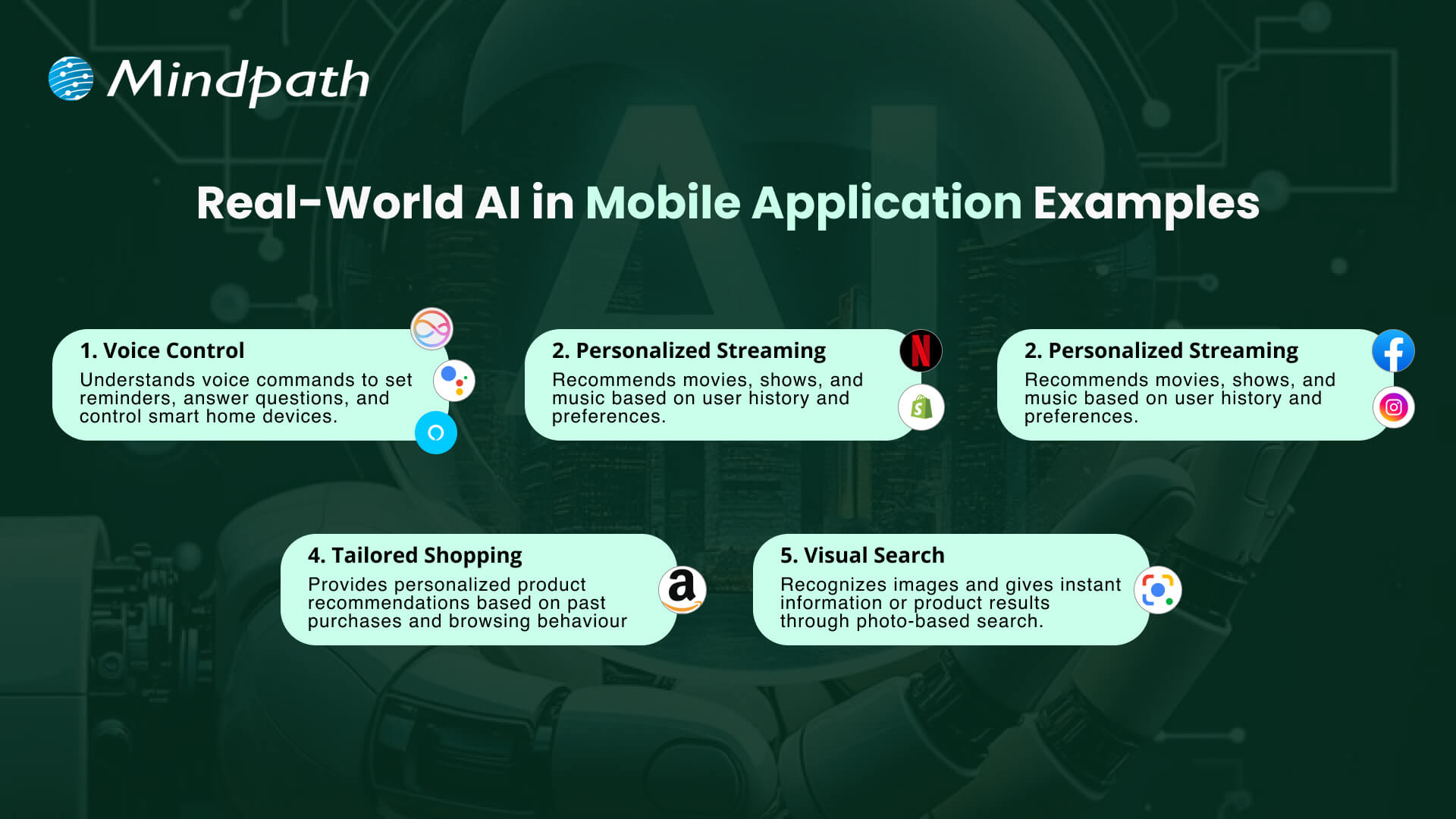
Real-World AI in Mobile Application Examples

1. Voice Control with Siri, Google Assistant, and Alexa

These virtual assistants use artificial intelligence in mobile applications to understand voice commands and perform tasks like setting reminders or controlling smart home devices.

2. Personalized Streaming on Netflix and Spotify

Streaming apps use AI in mobile apps to analyze user behavior and recommend movies, shows, or music that match individual preferences.

3. Smart Social Feeds on Facebook and Instagram

Social media platforms use AI mobile app development to personalize news feeds and suggest relevant content, friends, and groups for each user.

4. Tailored Shopping on Amazon

Amazon uses AI in mobile apps to recommend products based on browsing history and past purchases, creating a personalized shopping experience.

5. Visual Search with Google Lens

Google Lens uses AI technology for mobile app development to recognize images and provide instant results through photo-based searches.

Want to build a mobile app but don’t know which technology to use for better execution? Learn from the mobile app development technologies blog to understand what suits best for your business.

Ready to Build Smarter Mobile Apps with AI?

The use of AI in mobile apps introduces new opportunities for businesses and users. This advancement creates great user experiences, strengthens security, and provides more effective daily interaction. As industries pursue innovation, apps will work smarter, adapt more quickly, and become infinitely personal, helping brands engage with users, in meaningful and authentic ways.

Working with Mindpath gives organizations access to superior AI mobile application development services built for measurement. We build intelligent, fast, and user-friendly applications to support your organizational priorities. We provide a blend of strategy, innovation, and technology to design digital solutions that drive growth and maintain user engagement.