



What is DevSecOps – An Implementation Guide

Join our Newsletter!

Featured Posts

Support Is One Click Away

Home

What is DevSecOps – An Implementation Guide

What is devsecops

What is DevSecOps – An Implementation Guide

In the digital world of the 21st century, DevSecOps has undoubtedly become the backbone of secure software delivery. It has perfectly blended DevOps and security practices in order to protect applications from cyber threats without hampering innovation. With the surge in cloud DevSecOps organizations across diverse sectors are embedding automated testing and compliance, along with continuous monitoring, directly into CI/CD pipelines.

It is the right time for you to know how DevSecOps works and why it matters for DevOps cybersecurity. DevSecOps is now essential for resilience, whether you are developing cloud-native apps or securing your software supply chain. It is time to look at how businesses can implement DevSecOps in the real world.

Curious about how DevSecOps implementation helps businesses in achieving secure and scalable pipelines? Contact us and let our experts provide you with full guidance.

An Insight into DevSecOps

In recent times, DevSecOps has certainly surfaced as an innovative approach for Development, Security, and Operations. It combines security into every single phase of the software development lifecycle to create software efficiently while curbing vulnerabilities. 

DevSecOps solutions make sure that security is shared across the development and security teams, in addition to the operations team. It is achieved through the automation of security processes and practices within CI/CD pipelines. This approach has gained massive popularity in the past few years since it fosters collaboration while empowering business entities to deliver secure and high-quality software solutions. 

Also Read: Benefits of DevOps

Key Benefits of DevSecOps

The DevSecOps concept gives rise to a host of benefits for users, including professionals as well as businesses. Now that you know what is DevSecOps, it is time to get familiar with its key benefits. 

1. Faster Delivery of Software

DevSecOps creates the opportunity for you to integrate security into the development pipeline. Thus, it allows businesses to rapidly deliver highly secure code. It is capable of addressing issues early on and while streamlining the release process. 

2. Better Agility

Automation serves as a catalyst and reduces bottlenecks relating to manual security. It allows security teams to lay emphasis on high-value tasks. Moreover, they feel empowered to respond in a prompt manner to threats and risks.

3. Diminished Time to Market

The concept of cybersecurity DevOps is capable of catching as well as fixing vulnerabilities at an early stage. It therefore minimizes the requirement for expensive as well as time-consuming remedial actions at a later stage. It is good news for software developers since it accelerates software project timelines. 

4. Top-Notch Security 

You need to leverage DevSecOps so that you can strengthen the security posture when it comes to custom software development. Security gaps can be reduced exponentially as DevSecOps embeds security into each stage of the DevOps lifecycle.

6. Better Compliance with Laws and Regulations

You need to use DevSecOps tools since they ensure compliance at all stages of software development. With security checks that are automated and compliance tools, modern businesses can rest assured about their compliance requirements.

Curious about the latest shifts reshaping how software and websites are built and deployed? Check out our blog on DevOps trends to stay ahead of the curve and make sure your projects leverage modern best practices.

Steps to Implement DevSecOps

The implementation of DevSecOps means weaving security into each and every phase of the DevOps pipeline without compromising the delivery. At present, organizations face rising cyber risks along with stricter compliance standards, which makes a structured approach essential. You need to follow the steps below in order to effectively implement DevSecOps while developing a software solution.

Step 1 – Evaluate your Current Security Practices

While implementing DevSecOps, the very first step that you need to take involves the assessment of your current security practices. You need to do a careful and comprehensive evaluation of the security tools and processes that are in place. You also need to identify gaps along with appropriate areas of improvement while taking into account the organizational goals and context.

Step 2 – Establishment of Security Goals and Objectives

Now it is time to establish security objectives. You must keep in mind to define clear and well-defined security goals and objectives that are perfectly aligned with the vision of your organization. At this stage, you can even consider involving stakeholders from the development, security, and operations teams. It is vital to prioritize shared understanding along with unified commitment. 

Step 3 – Implementation of Security Training and Awareness Programs

You need to conduct training programs at this stage of the implementation process. These training programs can play a strategic role and help the staff members to cultivate essential skills and capabilities. It is also essential to promote security awareness while fostering an accountable security culture within the organization. 

Step 4 – Integration of Security into the Software Development Lifecycle

At this stage, you need to combine security practices and controls at every phase of the software development lifecycle. You must focus on implementing tools along with automation that are capable of facilitating secure code reviews as well as vulnerability scanning. The tools must also support threat modelling. 

Step 5 – Emphasizing Continuous Security and Automation

It is vital to prioritize automation when it comes to cybersecurity DevOps. So you need to automate security testing, such as dynamic analysis and static analysis. You must also consider automating software composition analysis so that you can get feedback on an ongoing basis. It is a wise decision to integrate security into the continuous integration and deployment pipelines, as it can help ensure security checks at every stage. 

Must Read: DevOps vs DevSecOps

Step 6 – Implementation of Infrastructure as a Code Security

You must also apply the security principles to Infrastructure as a Code (IaC) scripts and templates. It is undoubtedly a critical step when it comes to DevSecOps implementation. Businesses must ensure that they leverage version control for the Infrastructure as a Code template for maintaining traceability. You can even consider applying policy as code frameworks in order to enforce security baselines for cloud resources.

Step 7 – Fostering Communication and Collaboration

You need to encourage cross-team collaboration along with transparent communication. You can ensure this through regular meetings and by using shared tools. It is essential to prioritize joint decision-making. It is equally important to set up and maintain a DevSecOps culture so that it can promote trust along with accountability within the organization.

Step 8 – Implementation of Continuous Monitoring and Incident Response

It is critical at this stage to adopt continuous monitoring of applications and infrastructure. This is because such a practice can help in detecting as well as responding to security incidents in a prompt manner. You must also establish an incident response plan that can facilitate effective and efficient mitigation in case of a security breach.

Step 9 – Focus on Regular Assessment

One cannot overemphasize the importance of regular assessment and improvement while implementing DevSecOps. You must conduct assessments to evaluate the effectiveness of the implemented DevSecOps practices periodically. It is equally essential to improve the security processes and adjust to emerging threats on an ongoing basis. Businesses must also make sure to incorporate the feedback from the key stakeholders.

Step 10 – Remaining Abreast with the Latest Security Practices

It is imperative for modern businesses to stay updated with the latest security trends and industry standards. You need to bear in mind that your business needs to engage in continuous learning. So in your organization, you need to encourage security professionals to take an active part in training programs as well as online communities.

Facing hurdles in your deployment process? Read our guide on DevOps challenges and solutions to learn actionable strategies for smoother, more efficient workflows.

Best Practices While Implementing DevSecOps

There are a number of best practices that you need to keep in mind while implementing DevSecOps within your business. You need to adopt these practices so that you can derive optimum value from DevSecOps implementation. 

1. Emphasis on Security

You need to shift security to the left. It means that the security component has to be integrated at an early stage in the software development lifecycle. Several practices, such as threat modelling and secure coding practices, need to take place during the development stage in order to reduce the risk before the production stage. 

2. Automation

The role of automation is indispensable when it comes to DevSecOps implementation. You need to embed appropriate security controls into CI/CD pipelines and ensure static as well as dynamic code analysis. 

3. Importance of Continuous Testing

Continuous testing is an essential component of DevSecOps as it allows teams to identify security gaps and vulnerabilities. You need to test code on a continuous basis so that the number of security issues can be reduced before that may reach the production stage. 

Ready to modernize your tech operations and accelerate product delivery? Explore our blog on DevOps for Businesses to learn how DevOps helps businesses build, deploy, and scale with confidence.

Final Words

DevSecOps is no longer an optional thing for businesses when it comes to developing software solutions. It serves as the ultimate foundation for building secure and resilient software applications that are compliant in today’s world. Businesses need to integrate DevOps and security practices across the entire pipeline in order to reduce security risks and uncertainties. If DevSecOps implementation is done in the right manner, it can foster innovation and business resilience. 

The top-notch DevOps services of Mindpath can ensure that your business can successfully adopt DevSecOps. With the help of expert guidance and support, your business can achieve innovation, which can give it an edge in its operational domain.


Related Post

Discover the top tech trends for 2024 and how Mindpath’s cutting-edge IT services, from modernization to AI, can help you stay ahead and drive innovation.

Related Post

custom website development services

Companies consistently wrestle with the challenge of maintaining a smooth operation and competing in an ever-changing world. Custom website development services provide the missing link to develop a platform that matches your exact needs and workflows. When a website is built around a real process that matches a real workflow, the company will improve efficiency, and simplify tasks. This simplifies how teams work faster and will improve the extent customers interact on your website. A good website becomes a tool for growth to enable outcomes without adding more work.

Many businesses have adopted custom website development because of the time-saving nature of routine work automation, greater collaboration, and more rapid responses to shifting needs. When technology is a partner with a skilled web design company to streamline operations to connect people across different teams and functions, its powers can enhance overall productivity. A business’s online presence can become a powerful accelerator of success when a company can tie it to real business goals. In this blog, we will detail how these services can modernize and streamline your business.

Want to build a website that not just exists but also gives your brand a great online presence? Mindpath offers web development services to ensure responsive designs and smooth performance, which makes every click an opportunity for the business.

Understanding Custom Website Development Services

Custom web development means creating a website from the ground up to fit the needs of a business. Rather than just using templates or a cloned website, a custom website development company will build your platforms to express the brand’s identity, work with existing systems, and provide a uniquely personalized experience for users. Every aspect of the site is built to serve the company’s needs and enables the site to be fully functional and engaging.

By taking this approach, businesses will also have the flexibility to add features that are appropriate for their business and will help make the website easier to manage as the business grows. Additionally, there is the ability to know their site will be secure and have capacity for more users or more content over time. For companies, custom web development offers a website that looks professional, works well, and can grow with their businesses.

Must Read: Web Design and Development Services

How are Custom Web Development Services Streamlining Business Operations?

Custom web development services are primarily concerned with designing a website that reflects a business’s unique goals and key strategies. These services ensure an online presence that is at once professional and trustworthy, and sufficiently adaptable for use as a tool for the business’s development and other operational needs, both now and in the future.

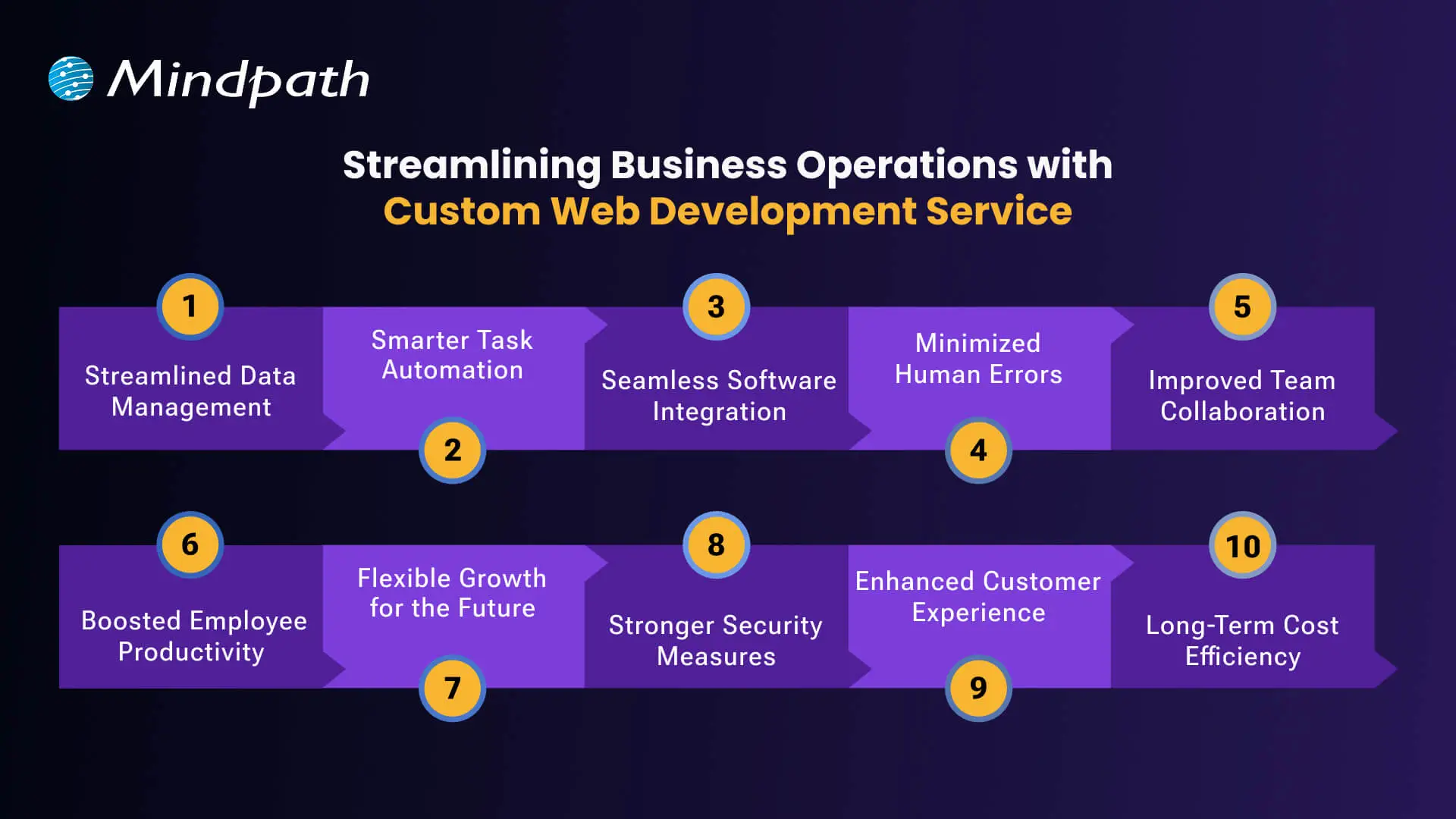
Streamlining Business Operations with Custom Web Development Service

1. Streamlined Data Management

A custom web application enables the collection of information from multiple locations, thus ensuring that each department has the same up-to-the-minute information. Dashboards and reporting functions pull together the information to enable visual, timely, better decision making, and it increase overall efficiency.

2. Smarter Task Automation

Custom web development services enable automation of repetitive tasks such as order processing, invoicing, and inventory management. Minimally, this frees up the time of employees to focus on more strategic objectives and accelerate the pace of operations and thus total productivity.

3. Seamless Software Integration

A custom web development company can design applications that integrate smoothly with your existing systems like CRM or ERP tools. It is a way that frees people from the heavy work of manual data transfer in different applications and at the same time, enables the seamless integration of workflows and processes. The result is a more efficient and cohesive operational environment.

4. Minimized Human Errors

Custom-built applications incorporate highly developed validation and error-checking mechanisms. Businesses save time and avoid mistakes, improve accuracy, and reduce costs by removing the risk of human error in data entry or repetitive processes. Employees can focus on actual work and add value instead of fixing an error.

5. Improved Team Collaboration

A custom web application provides a centralized platform for sharing documents, tracking progress, and communicating in real-time. Teams can coordinate tasks more effectively, reducing misunderstandings. This enhances inter-departmental collaboration and streamlines daily workflows.

Curious how artificial intelligence can transform the way websites are built and managed? Explore our article on AI in web development to discover how AI can enhance your site’s efficiency, usability, and performance.

6. Boosted Employee Productivity

With a custom web application, teams can share documents, track progress, and communicate in real-time all in one location. This increased coordination among team members leads to a better understanding of tasks, which improves departmental collaborations and caters to their day-to-day duties better.

7. Flexible Growth for the Future

Custom web development provides businesses with solutions that expand with them. This means that the platform can accommodate more users, storage of larger datasets, and use cases when the business expands, and all without a complete redesign. This level of flexibility is important for maintaining a valuable website as a tool over time.

8. Stronger Security Measures

Custom solutions enable developers to incorporate tailored security protocols to safeguard sensitive data. Unlike generic software, custom applications can include encryption, authentication, and enhanced security measures tailored to your firm. Organizations at least know that their customer and operational data are of the highest security.

9. Enhanced Customer Experience

Custom web development services play an important role in elevating customer engagement and communication. Just to illustrate, an automated follow-up or a tracking system for orders can be a way of informing your customers at each step, thus attracting them. Consequently, it becomes a cycle of strengthening your relationships and building trust with your clients over time.

10. Long-Term Cost Efficiency

Custom website developers may have a higher upfront cost, but the ROI can be huge over time. Eliminating continuing software fees and inefficient processes can ultimately save the business money. Custom software solutions create well-performing, reliable systems that promote growth and success.

Want to build a complete website without coordinating with multiple developers? Explore our post on full-stack development for web projects to discover how a full-stack approach simplifies your workflow and accelerates delivery.

Ready to Streamline Your Business with Custom Web Development Services?

Custom web development services help businesses improve efficiency, strengthen teamwork, and enhance customer interactions. By creating websites that match real business goals, companies can save time, reduce errors, and manage operations with ease. A well-designed website acts as a strong foundation for growth and lasting success.

At Mindpath, our expert team delivers professional website development services that align with your business goals. Each custom web development service is designed to create fast, secure, and scalable websites that enhance performance and user engagement. We focus on crafting digital solutions that simplify operations and help your business grow with confidence.

ReactJS Developers in London

Are you looking for skilled ReactJS developers in London to build fast and reliable web applications? Do you need experts who can turn your ideas into seamless user experience? Finding the right developers can be challenging, but the good news is that London has a strong pool of ReactJS talent. In this guide, we’ll help you understand how to hire the best ReactJS developers in London and what to look for in a top-tier developer. 

Hiring ReactJS developers in London offers several benefits for firms trying to create modern, high-performance web applications. London has a highly skilled tech talent pool, so you’ll have access to seasoned engineers who are up to speed on the newest ReactJS developments. These specialists can develop apps that are quick, scalable, and easy to use, hence increasing client engagement. Furthermore, collaborating with local developers improves communication, cooperation, and alignment with UK corporate norms.

London’s thriving digital sector also connects firms to a network of innovation, ranging from startups to established organizations, encouraging cooperation and information exchange. ReactJS developers in London have expertise working with a variety of sectors, allowing them to create solutions that are suited to unique company requirements. Furthermore, they use the best coding techniques to create secure, high-performance apps that stand out in a competitive digital market. Whether you’re a startup or an established business, hiring ReactJS developers in London guarantees that your project will benefit from innovation, efficiency, and high-quality development techniques.

Let’s explore the steps to hire ReactJS Developers in London!

Steps to Hire ReactJS Developers in London

ReactJS is an open-source JavaScript library that was developed by Facebook to create complex and interactive user interfaces for web applications. Since its inception, React has gained massive popularity due to its flexibility, efficiency, and ease of use. By breaking down applications into smaller, manageable components, React enables faster and more streamlined development. 

ReactJS is favored by developers because of its modularity, speed, and ability to build scalable, maintainable applications. Whether you’re building a simple landing page or a complex web application, ReactJS offers the tools and functionality to create high-quality, responsive applications. So, why should you hire ReactJS developers? Let’s explore. 

1. Define Your Project Needs

Before hiring a ReactJS developer in London, you need to describe your project’s requirements. Begin by determining if you require a developer for a basic website, a large web application, or a comprehensive platform. This aids in the establishment of defined objectives as well as the identification of suitable talent. Once you’ve determined the scope of the project, make a list of the necessary talents. If your project solely requires front-end development, search for people with experience in React, JavaScript, and UI/UX design. If you need full-stack knowledge, make sure they are also familiar with back-end technologies such as Node.js and databases. You can hire the top ReactJS developers in London by clearly describing your project’s requirements. This step guarantees that you recruit someone with the right skills, experience, and understanding to build a high-quality application for your business.

2. Craft a Clear Job Description

When recruiting a ReactJS developer in London, it is essential to provide a clear job description. It helps to attract the ideal candidates by giving crucial facts about the position. Begin by defining the job title and the developer’s tasks, such as creating user interfaces, maintaining state, and integrating APIs. Next, provide the necessary qualifications, such as familiarity with ReactJS, JavaScript, and other similar technologies. If your project requires extra abilities, such as Redux, TypeScript, or Next.js, make them explicit. Also, describe the type of project—whether it’s a web application, mobile app, or enterprise solution—so candidates understand what they will be working on. A well-structured job description not only attracts skilled developers but also ensures they align with your project’s needs, making the hiring process smoother and more efficient.

3. Find Talent Through Multiple Channels

You can look into numerous employment platforms and networks. Begin by using professional networks such as LinkedIn, where you can interact with developers directly, post job vacancies, and participate in relevant tech communities. Networking events and local gatherings can also help you connect with experienced professionals. Use prominent employment portals such as Indeed, Monster, and Hubstaff Talent to reach a larger pool of applicants. These platforms allow you to post thorough job descriptions and screen applicants based on their abilities and expertise. If you require flexible or short-term developers, consider using freelancing markets such as Upwork or Toptal. By utilizing numerous hiring channels, you boost your chances of finding a ReactJS specialist that fulfills your project’s requirements and can deliver high-quality results.

4. Evaluate Technical and Soft Skills

Finding the appropriate ReactJS developer in London involves a thorough screening procedure. Begin by checking resumes and portfolios to determine their experience with React applications. Look for projects that showcase excellent coding abilities, fast UI creation, and a thorough grasp of contemporary frameworks. Next, do technical interviews to determine their understanding of React topics like as components, state management, and hooks. You can also offer real-world coding tasks to watch how they solve difficulties and improve performance. Aside from technical competence, soft skills are also vital. A skilled developer should be able to properly convey ideas, work in teams, and adapt to project needs. Strong cooperation and problem-solving skills guarantee that they can operate effectively in a professional situation. By considering both technical and soft qualities, you can locate a ReactJS developer that not only codes well but also fit well with your team.

5. Offer Competitive Compensation

To recruit the top ReactJS developers in London, you must provide competitive compensation based on market trends and experience levels. Skilled developers are in great demand, therefore offering a reasonable wage can help you stand out from competition. In addition to compensation, consider adding advantages such as remote work choices, incentives, and opportunity for professional advancement. Developers like employment that promote professional development, thus offering training or mentoring can make your offer more enticing. Also, consider the complexity of your project—senior developers may anticipate higher remuneration for complicated applications. A well-balanced pay plan can help you acquire and retain top individuals capable of producing high-quality results.

Looking for skilled ReactJS developers in London? Mindpath connects you with top-tier professionals who can build high-performance web applications tailored to your needs. With expertise in modern React development, our developers ensure fast, scalable, and user-friendly solutions. Let’s bring your project to life—Get in touch with us today!

Want to make the right hiring decision? Check out our next blog on Factors to Consider While Hiring Expert ReactJS Developers in London to ensure you find the perfect fit for your project!
How much does hiring a ReactJS developer cost? Learn about factors affecting rates, and how to find the best talent within your budget.
Reactjs web development

Are you looking forward to finding out what makes ReactJS web development incredibly popular among both developers and businesses today? All those smooth and dynamic websites and apps you use daily, many of them are built with ReactJS. If you’ve ever wanted to know how you can build something just as interactive and amazing, you’re in the right spot because ReactJS development unlocks so many possibilities for bringing your ideas to life.

ReactJS enables you to create UIs that will appear fast and be easy to use for users. Also, developers love that it is component-based and allows projects to progress from simple to complex as you grow them. The real-world project examples will display how individuals are leveraging ReactJS in different industries and how they solve problems using it. If you’re ready to bring your ideas to life, you’ll find plenty to learn in this blog.

Want to present your ReactJS project idea to the world, but don’t know how to bring it to life? At Mindpath, we offer ReactJS development services where our seasoned developers will provide full guidance from concept to launch, ensuring your project’s success.

What is ReactJS?

ReactJS is a popular tool that helps developers build the parts of a website that people see and use. It’s not a programming language, but a JavaScript library used for creating user interfaces. ReactJS makes it easier to build websites and apps that are fast and simple to manage. It uses Webpack to put all the code together and make sure everything runs smoothly in the browser. According to W3Techs, React is used by 7.1% of websites using a well-known JavaScript library, which is 5.8% of all websites.

ReactJS was first created by Jordan Walke, a software engineer at Facebook, in 2011. It was inspired by a tool called XHP that helped Facebook work with HTML better. ReactJS was first used for Facebook’s newsfeed, and then Instagram used it too. Today, it’s one of the most popular front-end tools.

Looking to future-proof your web applications with a technology that scales as your business grows? Discover the strategic top reasons to choose ReactJS for Progressive Web App development for business owners.

Benefits of ReactJS

When it comes to modern web development, understanding React JS benefits can help you decide if it’s the right fit for your projects. Many developers choose this library because it makes building user interfaces simpler and faster. Let’s look at some key ReactJS advantages that make it so popular.

1. Component-Based Structure

A big benefit of React development is its reusable components that make updates and maintenance simple. This keeps your project organized as it grows.

2. Faster Performance

React uses a virtual DOM that makes updates quick and smooth. This keeps websites and apps fast for a better user experience.

3. Cross-Platform Flexibility

With React Native, you can reuse your code for mobile apps too. This saves time when you want to create a React app for both web and mobile devices.

4. Easy to Learn and Use

Many developers choose web development with React because it’s simple to learn yet powerful. Its clear structure and helpful tools make building projects smooth for everyone.

5. Strong Community Support

ReactJS Web Development has a large, active community with helpful resources and tools. This makes building and fixing projects much easier for developers.

Wondering what separates a good ReactJS project from a truly successful one? Read the essential ReactJS Developer Skills for successful web projects to make smarter hiring and development decisions.

What are the Best Projects to Build with ReactJS?

React web development is trusted by businesses and developers to build many kinds of web apps that work smoothly and look great. It’s flexible enough to handle different goals, whether you want something simple or more advanced. You’ll see just how many possibilities open up when you choose ReactJS.

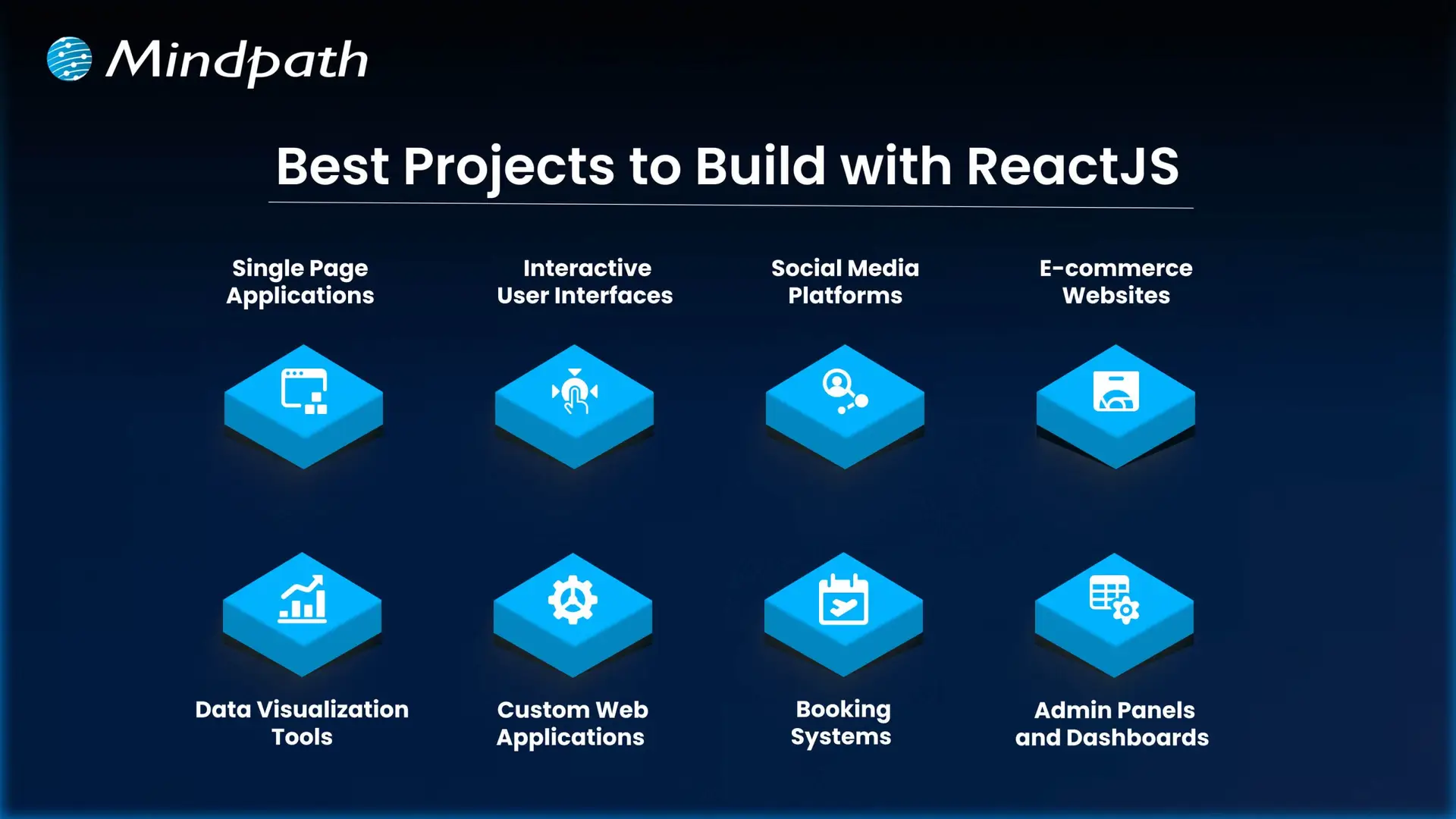
Best Projects to Build with ReactJS

1. Single Page Applications (SPAs)

SPAs load one main HTML page and update content without refreshing the whole page. This makes the user experience faster and smoother. Many developers use ReactJS Web Development to build SPAs like Trello or modern email platforms.

2. Interactive User Interfaces

Apps that need frequent user actions benefit from React’s component-based setup. It keeps interfaces dynamic and responsive to every click or input. Dashboards and social platforms are great examples of this.

3. Social Media Platforms

Social apps handle lots of data and need to stay quick and easy to use. React works well for feeds, notifications, and real-time chats. Platforms like Instagram and Facebook show how powerful it can be.

4. E-commerce Websites

Online stores have many parts, like product pages, shopping carts, and checkout steps. React helps keep all these features organized and easy to update. It’s a smart choice for anyone planning an online store.

Also Read: React vs Vue

5. Data Visualization Tools

React lets you build charts, graphs, and dashboards that help people see and understand data. These tools often need real-time updates as new data comes in. Using React makes complex data feel simple to explore.

6. Custom Web Applications

Businesses often need apps designed just for their work. ReactJS web development gives developers the tools to build custom features and workflows. This could be anything from task trackers to learning portals.

7. Booking Systems

Booking apps help people reserve flights, hotels, or services quickly. React keeps the process smooth with fast updates and clear forms. It’s trusted by many companies to handle large numbers of users at once.

8. Admin Panels and Dashboards

Businesses use admin panels to track performance and manage users or data. React’s reusable components make building these panels efficient. A well-built dashboard makes complex info clear and easy to manage.

Is your current team struggling to handle large-scale React applications? Learn why hiring a React Development Company might be the smarter choice. 

Real-World Examples of ReactJS Web Development

Many well-known companies rely on ReactJS Web Development to power their websites and apps. It helps them build fast, interactive experiences that keep users coming back. Here are some real-world examples of how ReactJS is used successfully.

Real-World Examples of ReactJS Web Development

1. Facebook

Facebook uses React to handle its entire web interface. They also depend on React Native to keep their mobile app running smoothly.

2. Instagram

Instagram depends on React to manage its photo feeds, stories, and user interactions. React’s virtual DOM makes the app fast and helps deliver an easy browsing and sharing experience.

3. Netflix

Netflix uses React to manage its user interface, from browsing shows to streaming. React’s efficient rendering keeps the platform responsive and smooth for millions of viewers.

4. Airbnb

Airbnb relies on React to display listings, filters, and booking options. Its component-based structure makes the platform simple to update with new features.

5. Walmart

Walmart’s online store uses React to manage its huge product catalog and shopping features. React helps deliver a consistent shopping experience with fast page updates.

6. Uber

Uber’s web dashboard for drivers and riders uses React for live updates like ride tracking and driver status. React makes real-time changes visible without slowing down the app.

7. Shopify

Shopify uses React to build dynamic storefronts and checkout pages. This keeps the shopping process smooth for both store owners and customers.

8. Dropbox

Dropbox uses React to create an easy-to-use file storage and sharing experience. The interface stays clear and quick to navigate thanks to React’s reusable components.

Looking to build a high-performance frontend that scales with your business and delivers real ROI? Learn from our ReactJS for App Development guide to understand how React empowers business owners to make smarter, future-ready technology decisions.

Ready to Unlock the Power of ReactJS Web Development?

ReactJS web development has proven its value for businesses and developers who want faster, interactive, and scalable web apps. From single-page applications to custom dashboards, React makes it easier to build projects people enjoy using. Real-world examples show just how flexible and powerful this library can be. With React, your ideas can become smooth, engaging digital experiences.

At Mindpath, we have built successful React and React Native projects for clients in many industries. Our team has strong expertise in developing user-friendly web apps and mobile apps that work beautifully together. We focus on clean code, reusable components, and performance that scales with your business. Let Mindpath be your trusted partner for professional ReactJS development services that bring your ideas to life.

Frequently Asked Questions

1. Is ReactJS suitable for beginners who want to start web development?

Yes, ReactJS is considered beginner-friendly due to its simple structure and component-based approach. It allows learners to build small parts of an application step by step. With strong community support and learning resources, beginners can gradually move toward building complete, real-world projects.

2. How does ReactJS help in handling large and complex applications?

ReactJS simplifies complex applications by breaking them into smaller, reusable components. This modular structure makes it easier to manage, update, and scale applications over time. It also improves collaboration, as different teams can work on separate components without affecting the entire system.

3. Can ReactJS be used for both web and mobile app development?

Yes, ReactJS supports web development, while React Native allows developers to build mobile applications using similar concepts. This shared approach helps save time and effort, as parts of the logic can be reused across platforms, making development faster and more efficient.

4. What kind of businesses benefit the most from ReactJS development?

Businesses that require fast, interactive, and scalable user interfaces benefit greatly from ReactJS. This includes e-commerce platforms, SaaS products, social media apps, and dashboards. Its flexibility makes it suitable for both startups aiming for quick launches and enterprises managing large-scale applications.

5. How important is performance optimization in ReactJS projects?

Performance optimization is essential in ReactJS to ensure smooth user experiences. Techniques like using the virtual DOM efficiently, optimizing component rendering, and managing state properly help maintain speed. Well-optimized applications reduce load times and improve user satisfaction, especially in high-traffic environments.

Explore top projects built with ReactJS, from personal websites to SaaS apps. Learn why ReactJS is ideal for scalable, high-performance web solutions.