The Complete Guide to Custom Software Development in 2026

Join our Newsletter!

Featured Posts

Support Is One Click Away

Home

The Complete Guide to Custom Software Development in 2026

custom software development

The Complete Guide to Custom Software Development in 2026

Custom software development is becoming the primary driver for businesses to get ahead of the curve in 2026. Businesses no longer rely on ready-made tools as existing tools fall short of meeting unique requirements. More recently, there is a higher need for tailored solutions that incorporate an organization’s goals and can scale as the firm grows. So, how will businesses ensure their software not just helps with their operations, but ultimately provides a legitimate competitive advantage?

In today’s fast-paced digital landscape, the right software is not only technology but also a strategy in practice. With custom software, businesses foster solutions that face specific challenges and ignite innovation. This guide walks through the core aspects of custom software development, including its definition, different types, benefits, key factors, and process. With a successful approach, adequately designed custom-built systems will enable progress and lead to long-term success.

At Mindpath, our custom software development services deliver secure and scalable services that  meet your business goals and enhance your business performance.

What is Custom Software Development?

Custom software development builds software solutions designed for a business’s specific needs. Instead of using generic tools developed for all businesses, many companies are developing their own custom software applications to support their unique company goals, internal workflows, and their customers. The custom software process includes planning, designing, developing custom software, and then ongoing software updates. This proactive approach might help a business increase efficiency, allow the business to expand, and create a steady stream of revenue.

The basis of this method is personalization. Developers create each feature with intention, supporting groups like marketing or sales, and enhancing customer brand participation through apps and platforms. These tailored solutions align and integrate smoothly into existing processes, improving productivity. When businesses select the right design and functionality, they receive a competitive advantage and increase their ability to outgrow the competition in a rapidly evolving digital landscape.

Must Read: Software Development Cost

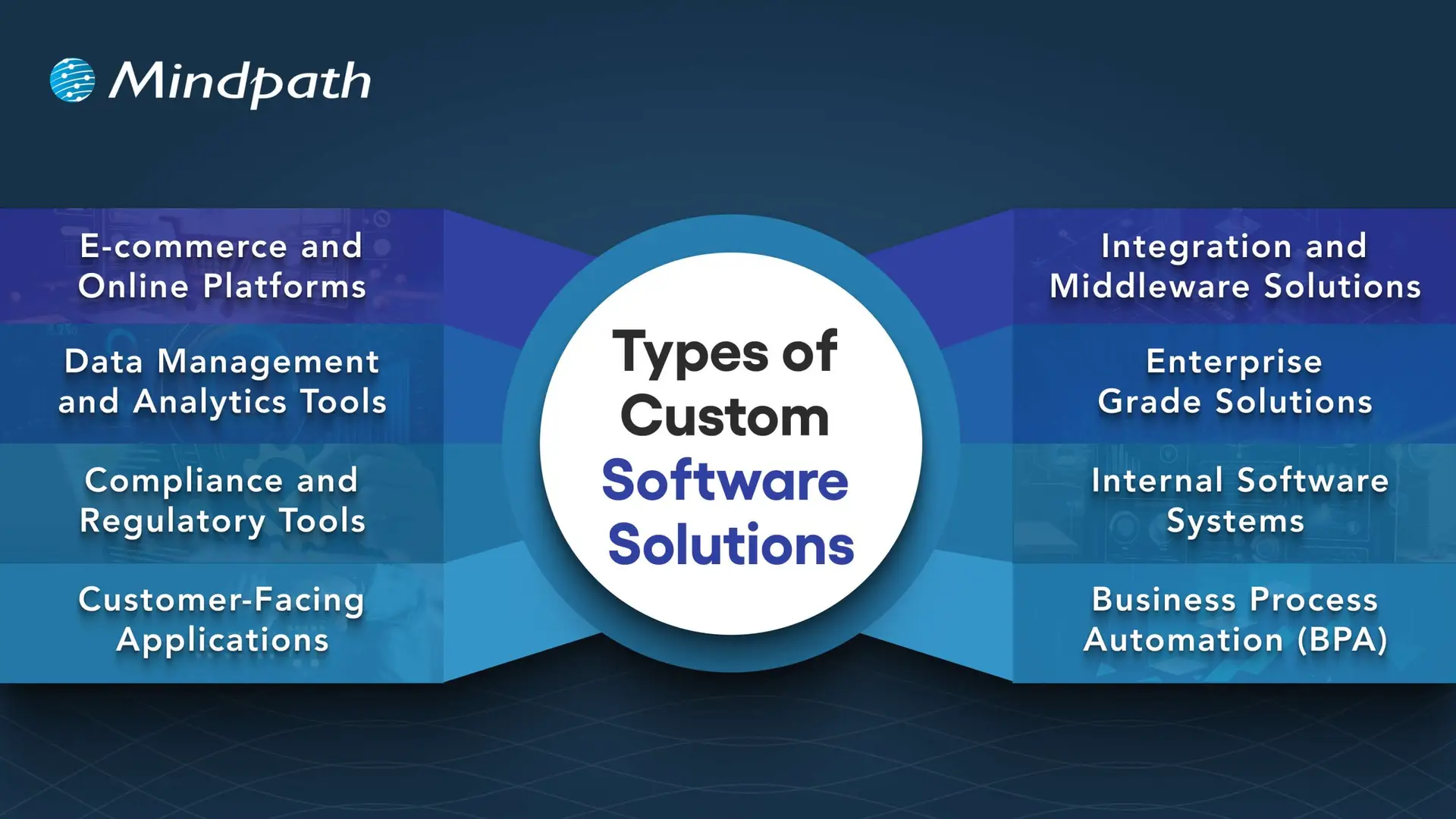
Types of Custom Software Solutions

Businesses face unique challenges, so they will need specific solutions to meet their goals. When used effectively, there are many kinds of custom software development solutions that can take advantage of that to drive efficiency and growth.
Types of Custom Software Solutions

1. E-commerce and Online Platforms

Online businesses require more than a basic website. Custom platforms take care of payment, inventory, and customers quickly and accurately.

2. Data Management and Analytics Tools

Companies generate a never-ending amount of data every day. Analytics tools provide actionable insights from that data, which decision-makers can invest in, as there is confidence in the analytics.

3. Compliance and Regulatory Tools

The industries with strict rules continue to change at a breakneck speed. Compliance software can help you track, report, and reduce risks.

4. Customer-Facing Applications

Customers expect a seamless digital experience, and mobile apps, portals, or self-service tools can provide a simple and engaging interaction.

5. Integration and Middleware Solutions

It’s not very common for systems to connect themselves. Middleware acts as a bridge between those systems and allows for the free flow of information across platforms.

6. Enterprise Grade Solutions

Large organizations need powerful systems to maintain efficiency. ERP, CRM, and BI software all gather data into one controllable system.

7. Internal Software Systems

Day-to-day operations require intelligent systems. HR management platforms, scheduling software, and inventory solutions help maintain workflow efficiency.

8. Business Process Automation (BPA)

Manual tasks challenge the organization as a whole. Custom software development will provide a BPA solution that reduces repetitive, verifiably redundant work and frees up time.

Want to know the method behind building scalable and maintainable software? Learn how the software development life cycle helps you streamline development by providing a structured approach that improves efficiency and overall project outcomes.

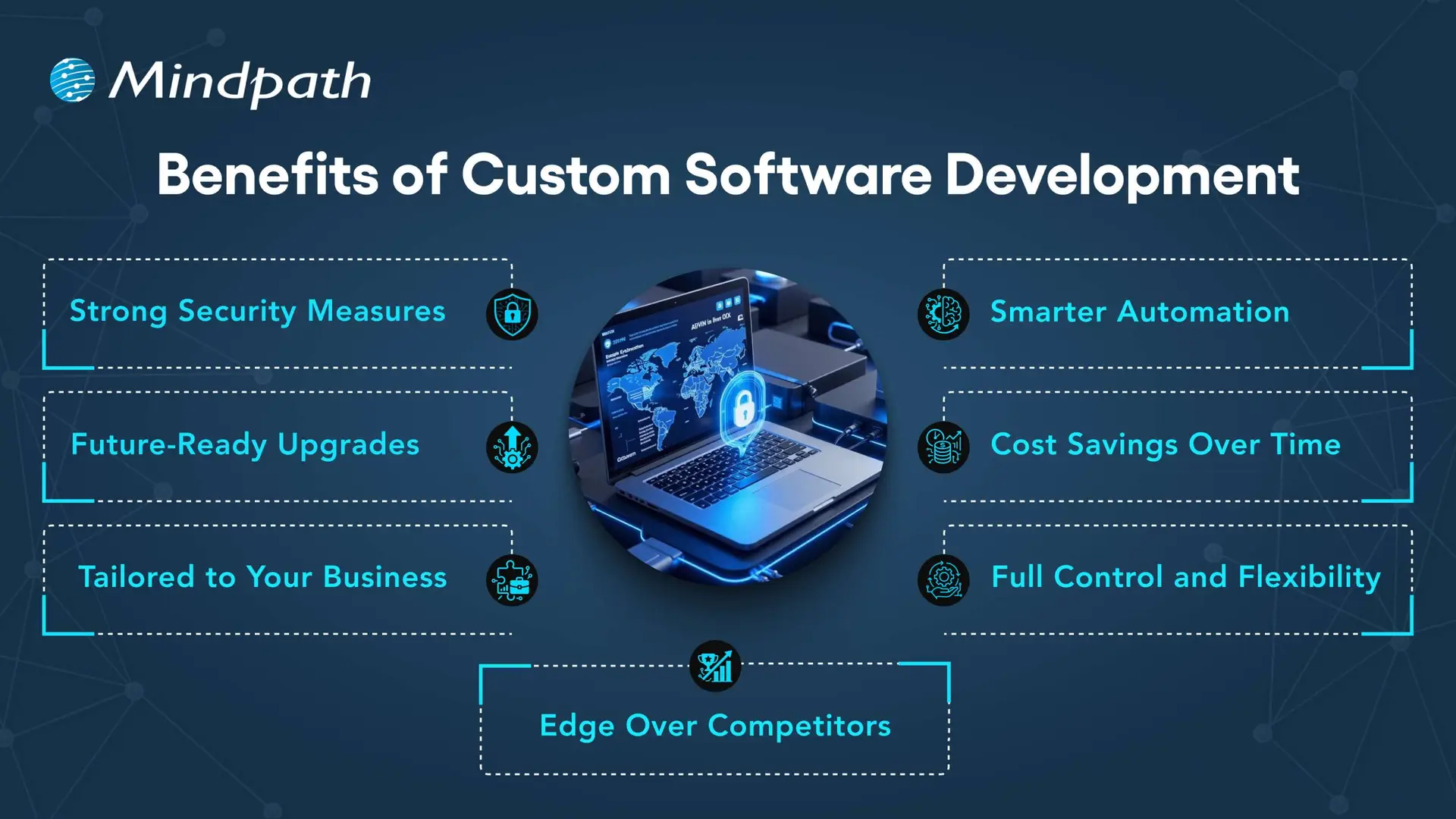
Benefits of Custom Software Development

Each organization operates differently, so that’s why software customizations are very important. When you choose custom solutions, companies will have the tools that meet their needs and bring value over the long term.
Benefits of Custom Software Development

1. Strong Security Measures

Every day, businesses deal with the threat of crime, and good protection is necessary. With custom solutions, businesses can create the security features that fit their unique needs.

2. Smarter Automation

Repetitive work that wastes time is unnecessary. Automated workflows make everything more efficient, giving teams more time to focus on innovative opportunities.

3. Future-Ready Upgrades

Technology will continue to change, and existing systems are often outdated. A custom solution is easy to upgrade, so businesses can stay up to date.

4. Cost Savings Over Time

It’s common to think of generic tools as the less costly option, but they come with hidden costs. A custom-built system can expand with the business and reduce your long-term costs.

5. Tailored to Your Business

Every company has its own workflows, and off-the-shelf, one-size-fits-all tools rarely truly fit. Custom software design considers workflows and goals to create solutions tailored to specific needs.

6. Full Control and Flexibility

Companies have the decision on how their software evolves. From additional feature requests to maintenance, a company is in control of all aspects of software.

7. Edge Over Competitors

To be different, you need unique solutions. Custom software development allows companies to create custom tools that enhance their efficiency and develop stronger customer relationships.

Curious how businesses are building world-class software teams without geographical limits? Explore how our offshore software development can deliver skilled talent and cost-effective solutions.

Step-by-Step Custom Software Development Process

Custom software development has a well-defined process to deliver the best quality product. Using the proper methodology, a custom software development process business makes certain that everything is completed to specific objectives for each project. Here is the process:

1. Requirements and Planning

The process begins with identifying and researching the client’s needs to lay the right framework. The team documents goals, scope, and technology decisions in order to have a clear foundation. During this clarity stage, teams quickly put together custom-made software with a common understanding.

2. UX/UI & System Design

Once they define the requirements, designers and architects start creating wireframes, prototypes, and system architecture for the solution. They start defining the database structure, user experience (UX), and technical workflow in order to ensure everything flows and goes according to plan. Designers create all custom software to be easy to use, scalable, and low-risk.

3. Development Execution

Developers write code based on the approved design and requirements. They develop using agile and best practices and build the functional modules incrementally. Organizations will receive reliable solutions designed to promote their long-term success.

4. Testing & Quality Assurance

Testing validates both functional and performance on devices, platforms, and use cases. Testers perform unit, integration, and regression tests to detect any issues as soon as possible. This step guarantees quality standards in custom software development solutions before delivery.

5. Deployment & Continuous Support

Once testing verifies quality, the team deploys the software on-premises or in cloud environments. The team will continually provide updates, fixes, and improvements to help maintain the effectiveness of the system. We will perform a continuous improvement process to generate value and to prolong the entire application lifecycle.

Concerned about risks that could slow down your custom software build? Explore the major custom software development mistakes that can disrupt progress and find out how to avoid them.

Key Factors to Consider When Building Custom Software

When it comes to building a custom piece of software, it’s more than just writing the code. It’s important to pay attention to the factors that drive the success and make sure your software aligns with your vision of the future in your business.

1. Build vs Buy Decision

Evaluate if building from scratch or buying ready-made solutions best supports your custom software development goals.

2. In-House Team or Outsourcing

Choose between in-house development and outsourcing based on expertise, resources, and project scope.

3. Right Development Methodology

Select the right approach, like Agile or Waterfall, to match your project’s complexity and goals.

4. Focus on User Experience

Design software with intuitive navigation, usability, and efficiency to boost adoption

5. Scalability and Future Growth

Plan for growth by ensuring the custom software development solution can scale easily as your business expands and technology evolves.

Trying to understand the common pitfalls in creating custom software? Check out our blog to learn the essential custom software development dos and don’ts that every business should follow for a smooth process.

Ready to Transform Your Business with Custom Software?

Custom software development continues to be the core driver of innovation, growth, and competitive advantage. By focusing on tailored solutions, businesses overcome unique challenges, streamline operations, and stay prepared for the future. With the right approach, companies build systems that scale seamlessly, improve efficiency, and deliver long-term results in today’s fast-moving digital world.

Partnering with a trusted custom software development company gives you access to expert guidance, advanced technologies, and proven strategies. At Mindpath, our custom software development services empower businesses to create secure, scalable, and future-ready solutions. From strategy to execution, we ensure every step adds measurable value, helping organizations achieve their vision with confidence and clarity.

Related Post

Discover AI 2024 trends shaping our world—from multimodal models to optimized solutions. Explore how AI can revolutionize your business with Mindpath’s cutting-edge services.

Related Post

Cloud security risks

Cloud Computing has certainly emerged as a breath of fresh air for modern organizations. The novel technology has empowered businesses to carry out their operations in a flexible and scalable manner. However, you need to bear in mind that the adoption of cloud also gives rise to a number of risks and threats for businesses. 

Businesses need to broaden their insight into Cloud security risks. The knowledge can help them prepare themselves to strategically tackle the risks of cloud computing. It is time to dive into the realm of cloud computing and learn about the main risks that threaten businesses.

Looking for a reliable way to manage cloud security risks without putting your business data and operations in danger? Mindpath offers managed cloud services that help in mitigating risks by providing proactive monitoring.

Insight into Cloud Computing

Before looking at the top Cloud security risks, you need to have a clear insight into cloud computing technology. Cloud computing refers to the on-demand delivery of computing services, such as storage servers, and many more. These services are available over the internet to the users, thereby allowing them to access the necessary services and make payment for only what they use. These capabilities have contributed to some of the most important cloud computing trends in recent years. 

Due to cloud computing, individuals and businesses do not need to purchase and maintain any physical hardware. They have the option to simply leverage the remote data centers of cloud providers. By doing so, they can access computing power as well as data in an efficient manner. 

Want to protect your cloud workloads from emerging threats? Learn about cloud security tools that help prevent and manage security risks effectively.

Top Cloud Security Risks

Poor cloud security practices have the potential to give rise to a broad range of security risks and threats. Both individuals and businesses need to be aware of such Cloud security challenges and risks. Some of the top risks include:

1. Data Breaches

Such types of risks arise when unauthorized actors gain access to sensitive data or information that is stored on the cloud. Such types of risks can give rise to grave consequences, such as financial damage and losses. Legal consequences may also arise for businesses because of data breach incidents. Some of the common causes of data breaches on the cloud include compromise of credentials, existence of vulnerable applications, and many more.

2. Poorly Configured Cloud Settings

Cloud security misconfiguration is a serious risk that may compromise the quality of security. These security challenges in cloud computing may arise because of open storage buckets, highly permissive IAM policies, and poor configuration settings. Organizations need to be extremely careful about the cloud settings that are in place so that such a risk can be tackled effectively. 

3. Insecure APIs 

The role of APIs is critical for the functionality of the cloud. In such a case, an insecure API may be a reason for cloud security issues and vulnerabilities. Typically, insecure APIs have weak encryption or authentication, which may be exploited by hackers. As a result, they may be able to gain access to valuable resources on the cloud. Since API vulnerabilities may go under the radar at times, they can be the favorite target for malicious actors. 

4. Account Hijacking

Account hijacking refers to the security risks of cloud computing, which occurs when an attacker makes use of stolen credentials to gain access to a cloud account. An attacker can carry out diverse manipulations with the data after they have taken over the account. For instance, they may steal the information, which may lead to the disruption of service. 

5. Insider Threats

These cloud security issues arise because of internal stakeholders. They could be employees, partners, or contractors who have access to the cloud resources of a business. They may either intentionally or unintentionally misuse the access that they have. You need to keep in mind that insider threats are extremely dangerous as they are carried out by people who are trusted. Such cloud security threats can easily bypass conventional security measures and thus may be hard to discover as well as mitigate. 

Want to understand what puts your cloud systems at risk? Discover cloud computing attacks and see how organizations mitigate modern threats effectively.

6. Data Loss

The data that is saved on the cloud may be lost because of diverse reasons. It may be lost due to accidental deletion, hardware failure, or the actions of malicious actors. In case organizations do not maintain regular backup, they face the risk of losing their valuable data on a permanent basis. Businesses need to be extremely cautious while handling their data on the cloud in order to prevent data loss of any kind.

7. Lack of Proper Visibility

When business entities grow, it may get difficult to maintain holistic visibility into the cloud environment. The lack of cloud visibility is one of the major security issues with cloud computing. This is because it can act as a barrier to threat detection as well as response. Malicious actors such as cybercriminals and hackers may get the opportunity to gain unauthorized access and compromise the security. It can heighten the risk relating to undetected breaches.  

8. Absence of Encryption Practice

Encryption is an integral part of safeguarding sensitive data that is stored or in transit in cloud environments. The data or information that is not properly encrypted is likely to become easy prey for access or interception by unauthorized users. The business entities that are unable to encrypt their sensitive data are exposed to the dangers of cloud computing.

9. Ineffective Identity and Access Management (IAM)

Poor practices relating to Identity and Access Management are considered to be serious cloud computing security problems. Poor practices may include weak password policies or giving undue permission to employees within the organization. Such poor practices can give rise to opportunities for cybercriminals to compromise cloud security.

10. Third-Party Risks

Third-party risks arise because of vendors or partners that deal in the cloud environment. Due to their poor security practices, security concerns may arise for businesses. There is a possibility that attackers may target a third-party vendor in order to gain access to the broader cloud ecosystem. In order to reduce this risk, it is essential for businesses to prioritize vendor risk management.

Looking for insights on cloud security risks? Check out cloud computing vulnerabilities to see how weaknesses are exploited and how to mitigate them.

Best Practices for Cloud Security

As security risks in the cloud setting are growing like never before, organizations need to adopt best practices to deal with such concerns. These practices can act as the ultimate cloud security solutions that can help you strengthen your security posture. Some of the best practices include:

1. Maintaining Solid Access Controls

Businesses should make sure that they have strong access controls in place. Some of the controls that you can introduce include multi-factor authentication along with strong password policies. They are believed to be good measures for securing access to cloud accounts. 

2. Encryption Practices 

Business entities need to place high emphasis on both data at rest and data in transit encryption. It is vital to encrypt sensitive data at all times by following strict encryption protocols.  Moreover, the implementation of encryption key management policies is also crucial to protect data in the best way possible. 

3. Monitoring and Auditing of Cloud Activities 

Businesses need to use advanced monitoring tools for the purpose of keeping a tab on the activities that take place on the cloud. You need to perform the audit of logs on a continuous basis so that you will be able to locate suspicious activities such as unauthorized access.

4. Safe APIs

You need to know that APIs serve as common entry points for cybercriminals as well as attackers.  In order to tackle the security risks of cloud computing relating to insecure APIs, you need to use safe APIs. You must ensure that there exists strong authentication as well as encryption for all types of API communications. 

5. Principle of Least Privilege

Businesses need to adopt the principle of least privilege. It will help you limit the access rights relating to users. Moreover, it is essential to monitor, review, and update controls on a frequent basis. This will help you identify if users get extra access in the cloud environment. 

Struggling to manage security risks in cloud applications? Learn about cloud-native development and discover how secure development practices protect your environment.

Final Words

There exists a diverse range of risks in the cloud environment that business entities need to be aware of in the current times. Some of the main risks include Data Breaches, poorly configured cloud settings, and many more. In addition to gaining knowledge about such risks, it is essential to familiarize yourself with the best practices relating to cloud security. Some of the best practices include maintaining solid access controls, encryption, and many more. 

You need to leverage Mindpath’s top-quality cloud solutions. The cloud managed services are perfect as they can help your business to flexibly leverage the resources. Moreover, the experts will ensure that you are safe from cloud security risks that exist in the current business world. 

AI in finance

Generative AI revolution is the biggest force of transformation in the financial services industry right now. The capabilities of generative AI mark a significant leap for practical applications of AI in the real world across various sectors. You can find different examples of AI in finance that have been setting new benchmarks for innovation. Banking and financial services companies perceive generative AI as something more than a prevailing technology trend.

A report by McKinsey reveals that generative AI will have a significant impact on the banking and financial services sector. The report mentions that generative AI can deliver additional value of almost $240 billion to $340 billion every year in the banking industry. Companies in the financial services industry must know how generative AI can unlock new opportunities and prepare the foundation for innovation in finance.

Planning to integrate AI into your finance strategy to drive smarter decisions and growth? Mindpath’s AI Development Services provides customized AI solutions that turn data into actionable insights and innovation.

Is Generative AI Right for the Financial Services Sector?

Business leaders in the financial services industry know the challenges and complexities that come in the way of business growth. Starting from the intricacies of digital transformation to the continuous changes in customer habits, finance leaders have to deal with multiple responsibilities. You must know that the adoption of Generative AI for Business in finance creates new opportunities to achieve better efficiency.

You will find many examples of banking and finance companies that have adopted AI and transformed the way they work. Financial service providers have achieved faster budget cycle times and reduction in uncollectible balances with artificial intelligence. As the complexity of financial operations continues growing, companies look up to generative AI for various reasons. Companies in the banking and finance industry can use generative AI to find new opportunities for streamlining workflows with automation.

Planning to deliver highly customized financial services using AI? Learn about AI in personalized banking experiences to discover strategies that improve customer satisfaction and operational efficiency.

Does Generative AI Offer Any Benefits to the Financial Services Industry?

The interplay between AI and finance has created the foundation to achieve many new benchmarks in the industry. With the help of AI, financial institutions can meet emerging expectations of customers and resolve inefficiencies across various financial operations. The applications of generative AI in the domain of financial services offer more than just automation.

1. Enhancing Accuracy

One of the prominent reasons to rely on AI revolves around the assurance of freedom from human errors. The use cases of AI in compliance checks, financial reporting and audits provide the advantage of reduced errors. Artificial intelligence takes care of such tasks where attention to detail is extremely crucial and helps in reducing inconsistencies that may manifest due to human error. AI models can analyze large datasets and find anomalies to ensure strict regulatory compliance. As a result, all stakeholders can fulfill compliance requirements while ensuring better performance.

2. Introducing Hyper-Personalization

Personalization of products and services is one of the crucial measures to improve customer engagement in any industry. Generative AI finance applications can provide hyper-personalized solutions that deliver exactly what customers want. Generative AI can help in obtaining valuable and relevant insights from the financial history, spending patterns and risk profiles of customers. With the help of those insights, financial institutions can offer highly personalized recommendations to customers. For example, AI systems can recommend the ideal investment strategy depending on the portfolio and risk appetite of customers.

Must Read: Generative AI for Customer Service

The biggest strength of artificial intelligence is the capability for real-time data analysis. Financial institutions can leverage this facility to make well informed decisions at a faster pace, using AI in decision making to guide strategy and reduce errors. The use of artificial intelligence for finance helps in navigating volatile markets with more efficiency, where companies have to respond to sudden changes and take decisions instantly. You can find the best example of using AI for improved decision-making in systems that identify early signals of market instability. The ability to identify flaws earlier helps financial institutions follow preventive measures without discrepancies.

4. Optimizing Operational Costs

Cost optimization is a major advantage of applying artificial intelligence in the financial services sector. By automating repetitive and time-consuming tasks, generative AI offers the ideal instrument for cutting operating costs. Generative AI can be used by financial institutions to generate documents, answers common customer service questions and process insurance claims. AI systems also help in reducing costs through automation of mundane tasks that can be completed without human intervention. One of the best examples of cost optimization with AI is visible in the use of AI chatbots for customer service.

Ready to upgrade customer interactions using AI in finance? Discover conversational AI chatbot to learn how intelligent assistants improve efficiency and deliver tailored support.

Unraveling the Use Cases of AI in Financial Services

Many organizations believe that adopting artificial intelligence in financial services is a daunting challenge. Generative AI is a game-changer for many functions in financial institutions with proven and tested use cases. Understanding the use cases of generative AI across different financial operations can help you get a better idea of how to make the most of the technology in practical scenarios.

1. Risk Management

Artificial intelligence delivers the power to create tools that can evaluate market volatility, operational threats and credit risks. The ability to simulate various scenarios with artificial intelligence can help in creating synthetic datasets which provide the foundation for robust risk management strategies.

2. Customer Experience

Generative AI is already playing a vital role in transforming customer experiences with the help of virtual assistants. These assistants leverage artificial intelligence to provide personalized financial advice and resolve the queries of customers. Artificial intelligence is capable of analyzing customer profiles in real-time and offering personalized solutions that guarantee seamless service delivery.

3. Portfolio Optimization

You can also notice the growing influence of AI in financial industry for the use cases in investment. Generative AI can help you created advanced predictive models that provide asset performance analysis and portfolio diversification. Financial advisors can use generative AI to draw simulations of investment outcomes, thereby offering better and more accurate recommendations.

4. Fraud Prevention

The financial services industry is plagued by cases of fraud that lead to losses worth billions of dollars annually. Financial institutions can leverage generative AI to learn from large datasets of transactions to identify anomalies in transaction patterns. It provides the ideal tool for real-time fraud detection, thereby providing a heads up before malicious agents make their move. Generative AI also helps in simulation of different fraud scenarios and fine-tuning algorithms to detect emerging threats.

Want to stay ahead of the curve in AI-driven finance? Discover Gen AI trends to learn how emerging technologies are shaping smarter strategies and innovative solutions.

Success Stories of Generative AI in the World of Finance

The best way to learn how artificial intelligence has revolutionized finance would involve a review of some success stories. The advantages of AI in financial services have garnered the attention of numerous top companies. Companies in the domain of banking and finance need to take inspiration from institutions that have successfully used generative AI to address critical concerns.

Quest IndexGPT, an innovative generative AI solution developed by JP Morgan, has revolutionized the creation of investment indices.

JP Morgan created Quest IndexGPT, a revolutionary tool for creating investment indices by using generative AI. On the other hand, MasterCard leveraged generative AI for creating a proactive fraud detection system. The fraud detection technology helped MasterCard reduce false positives, thereby ensuring seamless customer experiences.

Ready to adopt the latest AI technologies for finance innovation? Explore Generative AI tools to check out how these platforms are reshaping analytics, automation, and personalized services.

Final Thoughts

You can notice the transformative impact of artificial intelligence in the domain of financial services across various areas. The growing use of AI in banking and finance has created new opportunities for transforming the way financial institutions work. In addition, artificial intelligence revolutionizes customer experience and risk management in the finance industry.

Mindpath is one of the leading providers of AI solutions tailored to client expectations. We have been delivering end-to-end generative AI development services for different industries, including the financial services sector. Our experience speaks for itself in the success stories shared by our clients. Book your first consultation with us and achieve new levels of efficiency in the financial services industry.

Angular vs React vs Vue

Do you want to create web applications for your business, but are unsure about which framework to choose? Choosing the correct framework for your next project can be challenging because it must be perfect in terms of speed, performance and creating attractive UIs. When we discuss ideal frameworks; React, Angular and Vue are the most popular ones that come to our minds. But the main question is – which one should you choose from these three, i.e., Angular vs React vs Vue?

Confused, right? Well, we got you covered! This blog will walk you through the difference between Angular vs React vs Vue which will give you a clear idea about which one to choose for your next project. So, let us find out! 

Confused about whether Angular, React, or Vue is the right framework for your next project? Mindpath offers expert ReactJS development services to help you choose and build scalable, high-performing web applications.

Overview of Angular, React, and Vue

When you’re setting out to develop a website or web application, one of the initial choices is selecting an appropriate front-end framework.  Angular, React, and Vue are three of the leading choices today. All three work differently, and the choice of the best one is based on your project requirements, your team’s expertise, and your long-term objectives. Let us try to understand their fundamentals: 

Understanding Angular

Angular is a robust framework developed by Google that enables developers to create contemporary web applications. It is built in TypeScript, which is a type-safe variant of JavaScript, and it’s particularly well-suited for creating large and complex apps.  

One of the greatest things about Angular is that it only gets better with periodic updates, every six months. Such updates tend to introduce new features, enhancements, and bug fixes, which make your app up-to-date and secure. 

Here are the important features of Angular:

1. Dependency Injection

Angular makes it easy to share data and logic between parts of your app using services. These services are “injected” where needed, helping keep your code clean and testable.

2. Angular CLI

Angular comes with a command-line tool that helps you quickly create, test, and build apps. It saves time by automating common tasks like generating files or setting up projects.

Must Read: Reactjs Trends

3. Cross-Platform Development

With Angular, you can use the same code to build web, mobile, or even desktop apps. This means faster development and less work for different platforms.

4. MVC Architecture

Angular organizes your code into three parts: data (model), display (view), and logic (controller). This structure keeps things neat and easy to manage.

5. Reactive Programming

Angular handles real-time updates smoothly using reactive programming. It helps your app respond to user actions instantly without waiting on the server.

Want to know how React skills can help you build portfolio-ready applications? Explore our detailed ReactJS web development guide to understand its real-world potential.

Understanding React

React is a JavaScript library developed by Facebook that assists developers in creating user interfaces that are fast, smooth, and interactive. It’s commonly used to develop both websites and mobile applications.  

One of the reasons developers adore React is that it’s so flexible. You can use the tools and features you require, without being locked into a rigid structure. This allows you to have greater control over how your app is constructed. React also makes development quicker by enabling you to reuse snippets of code in various portions of your application.  

Here are the important features of React:

1. Virtual DOM

React uses a virtual copy of the real DOM to check for changes before updating the screen. This avoids reloading everything and makes the app faster.

2. One-Way Data Binding

In React, data flows in just one direction, data transferred from top to bottom. This makes it easier to control how data moves in the app.

3. JSX (JavaScript + HTML)

JSX lets you write HTML inside JavaScript, which makes the code cleaner and easier to understand. It helps developers work faster without switching between languages.

4. High Performance

Due to virtual DOM and reusable components, React apps run very smoothly. Only the parts that change are updated, which saves time.

5. Component-Based Structure

React breaks the app into small pieces called components. Each one handles its own look and logic, and you can reuse them anywhere. 

Wondering how to keep your React app fast as it becomes more complex? Explore our detailed guide on optimizing React performance for large applications to learn easy ways to keep your app fast and smooth.

Understanding Vue

Vue is a new JavaScript framework that helps in the construction of user-friendly and high-performance web applications by developers. It’s fast, lightweight, and extremely flexible, which is why more developers and businesses are starting to use it. 

What distinguishes Vue is that it brings together useful aspects of React and Angular. It’s easy to learn and suits well for developing apps that must be fast to market without compromising on performance or quality. Due to its clean structure and simple syntax, developers can start using Vue easily and develop apps that are easy to maintain. 

Here are the important features of Vue:

1. Lightweight and Fast

Vue is a small framework (just 21KB), allowing for quick load times and faster development. It enables developers to write clean, concise code and speed up the process.

2. Excellent Performance

With its virtual DOM lighter than React, Vue updates only what’s needed, making apps faster and more efficient. It delivers impressive performance, even with large data sets or complex tasks.

3. Easy Debugging

Vue provides live feedback on how the UI looks as you write code, making debugging quick and straightforward. This helps developers catch errors early, even if they’re new to coding.

4. Built-in Tools

Vue includes Vue Router for easy navigation and Vuex for efficient state management. These built-in features save time by providing everything needed to build a full application.

5. Flexibility and Reactivity

Vue can be used for both small and large apps, giving developers flexibility. Its reactive system ensures real-time updates when data changes, keeping the app fast and responsive.

Now that we have understood the fundamentals of Angular, React and Vue, let us learn about the difference between Angular vs Vue vs React.

Planning to build your next project with React but not sure what expertise to prioritize? Discover the key ReactJS developer skills you should look for by reading this comprehensive breakdown.

Angular vs React vs Vue – A Quick Comparison

Here’s a quick comparison of React, Angular, and Vue to help you understand their strengths in terms of popularity, ecosystem, learning curve, performance, and architecture. This will give you a clear view of what each offers:  

1. Popularity

React is extremely popular in web development with most big players using it to support their front-end requirements. Angular is robust in features, commonly used by big applications and top companies like Google and Upwork. Vue is becoming more popular as a light, adaptive framework, a favorite among both businesses and developers. 

2. Ecosystem

In the debate of React vs Vue vs Angular, React has a robust ecosystem with state management in React using tools like Redux, and the ability to create mobile apps with React Native. Angular also supports state management and mobile development with NativeScript while providing a structured framework for building apps. Vue offers useful libraries, state management with Vuex, and smooth integration with Laravel for full-stack development.

3. Learning Curve

In Angular vs React vs Vue comparison, Angular comes with a steeper learning curve due to its complex project structure and TypeScript requirement while React is easier to start with, due to its simpler, component-based approach and Vue, though a bit more complex than React, is still beginner-friendly and has a syntax similar to HTML, making it accessible for most developers.

4. Performance and Memory

For performance in Vue vs React vs Angular, Angular uses real DOM, which can slow down larger applications, while React and Vue leverage virtual DOM for faster rendering and better memory management. This makes React and Vue more efficient in handling dynamic web apps and scaling performance effectively.

5. Architecture

React, when compared with Vue vs Angular architecture, is flexible without having a set design pattern and emphasizes components as building blocks. Angular has the MVC pattern but is component-based and gives a clean structure. Vue uses the MVVM pattern but is flexible enough to use different patterns and can integrate smoothly with third-party tools.

Need a clear path to build React expertise across your team? Discover a strategic React roadmap that helps teams build scalable, high-quality applications faster.

ReactJS vs Angular vs Vue Comparison Table

Here’s a quick comparison of Angular, React, and Vue across key factors. This table highlights their unique strengths to help you choose the right framework for your project: 

reactjs vs angular vs vue

Choose the Right Framework for your Web Applications

Selecting between Angular vs React vs Vue is based on your project and team expertise. Each offers distinct advantages for web applications today. Angular is best for big-scale, enterprise-oriented applications with a full toolkit. React provides flexibility, reusability, and an enormous ecosystem and is best for dynamic and quick-loading UI. Vue is small in size, simple to learn, and ideal for small to medium-sized applications with a nice balance of simplicity and performance. 

At Mindpath, we specialize in delivering high-performance web solutions with our ReactJS development services. Our experienced developers build scalable, responsive, and feature-rich applications tailored to your business needs. No matter if you’re upgrading an existing product or starting from scratch, our team ensures seamless development and fast delivery, backed by modern tools and proven practices.