5 Conversational AI Trends To Watch Out For In 2024

Join our Newsletter!

Featured Posts

Support Is One Click Away

Home

5 Conversational AI Trends To Watch Out For In 2024

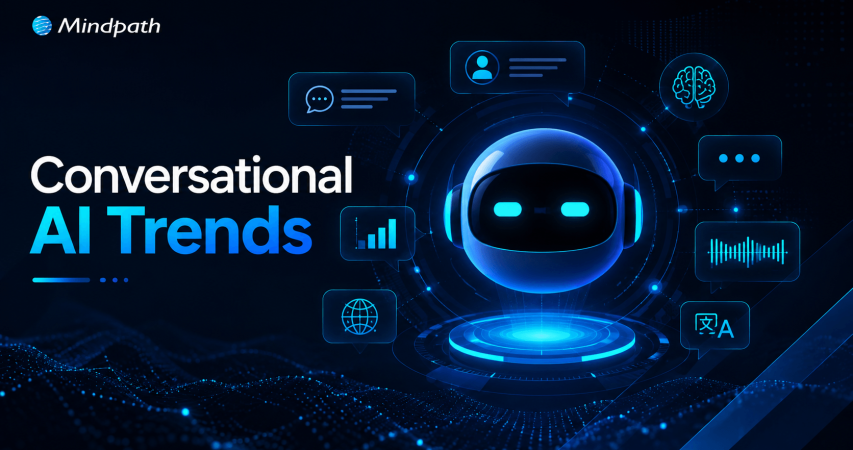
Conversational AI Trends 2024

5 Conversational AI Trends To Watch Out For In 2024

Artificial Intelligence is the term of the decade. While we might not notice, AI is slowly seeping into our everyday life. Conversational AI, a byproduct of AI is already popular in the form of voice assistants like Siri and Alexa, customer assistant chatbots, messenger bots, and more such solutions.  Market research suggests that in 2022, the worldwide conversational AI market was valued at approximately $7.61 billion. It’s expected to expand steadily at a compound annual growth rate (CAGR) of 23.6% from 2023 to 2030. This growth is primarily driven by increased demand, lower chatbot development expenses, AI-driven customer support, and the adoption of omnichannel approaches. In this blog, we will explore 5 conversational AI trends that will be prominent in the year 2024. So let’s dive right in!  

5 Conversational AI Trends for 2024

1. Chatbots Will Become More Compassionate

One of the biggest trends in the area of conversational AI is that chatbots are going to acquire emotional intelligence. Chatbots will be able to recognize human emotions and respond to them in a manner that’s more humane.  AI chatbots with emotional intelligence will be able to understand complex human emotions such as frustration, dissatisfaction, and anger and thus tweak their response strategy to handle the unpleasant situations that might take place during customer interactions.  Emotional intelligence can also come in handy to enhance chatbot responses and make them much more user-friendly.  

2. More Personalization For Customers

Conversational AI, especially in the domain of chatbots, is becoming more sophisticated by the day where their application is not limited to simply answering the questions. Conversational AI chatbots are all set to offer more personalization to customers in the coming year.  With their ability to understand natural language, chatbots will be able to grasp customer intent. With adequate training on customer data, they will be able to offer customized responses to customer queries, ultimately boosting the customer experience.  Moreover, conversational AI-powered platforms will also be able to curate content such as articles, videos, guides, etc., for users based on their previous activities, providing a rather holistic and personalized experience.  

3. Conversational Search Engines

In 2024, conversational search engines will revolutionize how users interact with search platforms. Traditional keyword-based search is gradually being replaced by more conversational and natural language queries. So instead of typing keywords, we can ask search engines questions as we would to any other human being, and they would respond!  With the advancement of AI and machine learning algorithms, search engines will become adept at understanding the context and intent behind user queries, leading to more relevant search results. Conversational search engines will enable users to ask complex questions in a more conversational tone, and the search engine will provide answers based on understanding the semantics of the question rather than just matching keywords. This will enhance the search experience, especially on mobile devices and smart speakers, where typing is cumbersome. 

4. Quick Deployment Of Virtual Agents

Advancements in natural language processing (NLP) and machine learning algorithms will enable companies to build and deploy virtual agents rapidly, without extensive customization or development time.  In 2024, the demand for virtual agents will continue to rise, driven by the need for efficient customer service solutions and automation in various industries. Pre-trained models and modular architectures will streamline the deployment process, allowing organizations to implement virtual agents within weeks rather than months. Training these models is the most time-consuming process. With the availability of large-scale data, it would become much easier and quicker to train the models and deploy them over the coming years.  

5. Multilingual Capabilities Will Expand

Conversational AI technologies will evolve to support a wide range of languages, dialects, and accents, enabling businesses to cater to a global audience seamlessly. As businesses continue to expand globally, the need for multilingual conversational AI solutions will become more pronounced in 2024. Enterprises operating in diverse markets will require AI-powered platforms that can communicate effectively with customers in their native languages. Advanced translation models and cross-lingual transfer learning techniques will allow the development of multilingual virtual assistants that can understand and respond to user queries in multiple languages. To wrap up, the year 2024 promises to be an exciting year for conversational AI, with innovations in emotional intelligence, personalization, search capabilities, virtual agent deployment, and multilingual support reshaping the landscape of customer interactions and user experiences. These conversational AI trends are all set to transform the customer experience for businesses.  If you are also looking to give your business a competitive edge and improve customer experience, it’s the right moment to invest in conversational AI. At Mindpath, we take pride in having innovation as our core value. Our team of professionals combines cutting-edge technology with deep industry knowledge to deliver bespoke solutions tailored to your business needs.  Whether you want a custom AI chatbot or leverage technologies like OpenAI’s ChatGPT, we can help you with all of it.  So if you are looking to unlock the full potential of conversational AI for your business, we can help! Contact us now to explore how our advanced AI solutions can elevate your customer experience and drive business success. Let’s talk

Related Post

Hire skilled Node.js developers in Canada with expertise in scalability, security, and compliance. Find the right talent with Mindpath!
Discover the ultimate guide to hiring Node.js developers in London. Learn about the skills, benefits, and cost factors involved in finding the right talent for your project.

Related Post

multi cloud strategy

Modern businesses operate in a highly dynamic environment. They need to focus on resilience and flexibility while performing in the market. The high intensity of competition that they encounter in their path further complicates their situation. This is when a multi-cloud strategy comes into the picture.

A multi-cloud strategy is an ideal option for contemporary businesses. It empowers business entities by increasing their flexibility and optimizing their costs. Moreover, such a strategic approach can even enhance the resilience of businesses in the unpredictable business landscape. It is the perfect time to explore the core benefits of a multi-cloud strategy for modern enterprises.

Wanting to leverage modern cloud technologies to make your operations faster and more scalable? Mindpath provides cloud infrastructure services that help you build, deploy, and manage systems with confidence.

What is a Multi-Cloud Strategy?

Before looking at the benefits of a multi-cloud approach, you need to have a clear understanding of the specific concept. A multi-cloud strategy is when businesses do not rely on a single cloud service provider. Instead, they choose multiple cloud service providers, which helps to distribute the workload across these providers. You may be wondering why such a decision is essential. This is because a single cloud provider can restrict the full potential of the cloud strategy of a business. 

A multi-cloud strategy is perfect for businesses that operate today since it helps to overcome the challenges that may arise while relying on a single provider. As a business, you can have greater control over your business operations, and you can make sure that the operational efficiency of your business improves. 

You need to bear in mind that a multi-cloud strategy may involve private cloud, public cloud, and specialized cloud services. When businesses opt for a multi-cloud infrastructure, they are not tied to the limitations of a single cloud provider. Instead, they can exploit the strengths of diverse cloud providers and have better control over their infrastructure. This allows them to adapt to the market effectively and focus on high agility. 

Wondering which cloud technologies will shape the future of your business? Explore our blog cloud computing trends to discover the latest innovations driving scalability, efficiency, and growth.

How is the Multi-Cloud Strategy Different from the Single Cloud and Hybrid Cloud Approaches?

In order to get a comprehensive insight into multi-cloud architectures, you must know that it is different from single-cloud and hybrid-cloud approaches. In a single cloud approach, a business depends on a single cloud provider for all its workload. In the case of a hybrid cloud, businesses combine on-premise infrastructure with a private or public cloud. While talking about multi-cloud vs hybrid cloud, you need to remember that multi-cloud involves using multiple cloud providers for different workloads. 

In the case of a single cloud approach, the management is simplified. However, the issue relating to vendor lock-in may arise. It can automatically limit the overall flexibility for businesses. The hybrid cloud model, on the other hand, offers more balance between conventional IT and cloud solutions. 

However, businesses must remember that there is limited producer diversity. The multi-cloud approach offers multi-cloud benefits since it minimizes dependency on a single provider and boosts resilience for businesses. Thus, out of all these options, the multi-cloud approach creates immense value for contemporary business entities. 

Also Read: Multi Cloud vs. Hybrid Cloud 

Benefits of a Multi-Cloud Strategy

Now that you know, what is multi-cloud? It is time to look at some of the associated benefits. It is fundamental for businesses to remember that a multi-cloud strategy can give rise to a plethora of benefits. The awareness of these benefits can help them decide whether they want such a solution or not. 

1. Avoiding Vendor Lock-In

If businesses opt for the multi-cloud strategy, they can rest assured about the vendor lock-in issue. This issue mainly arises when businesses depend on a single provider; however, in the case of a multi-cloud strategy for businesses, they depend on diverse providers. Thus, the dependence on a single vendor gets reduced substantially. Thus, businesses are able to enjoy ample flexibility while operating in the dynamic and uncertain business environment.

2. Cost Efficiency

One of the main benefits of a multi-cloud strategy is related to cost efficiency. In fact, the multi-cloud strategy is ideal for businesses that intend to curb their IT spending. You need to remember that the public cloud option comes with less overhead. Moreover, it allows businesses to scale up or down as per their needs and requirements. Businesses can leverage a multi-cloud strategy and take advantage of the best pricing and performance options. 

3. High Reliability

A multi-cloud strategy undoubtedly reduces the risks relating to unplanned downtime. This is because it minimizes the risk relating to a single point of failure. An outage in a single cloud will not necessarily have an adverse impact on the services on other clouds. In case the cloud goes down, businesses can route their computing needs to another cloud. Thus, the reliability is high when businesses choose the multi-cloud strategy.  

4. Advanced Security

If businesses are looking for high security while leveraging cloud services, the multi-cloud strategy is an ideal option. This is because a multi-cloud strategy enables businesses to not only deploy and scale workloads but also implement robust security policies. You can also take advantage of compliance technologies in a consistent manner across all your workloads, irrespective of the service or vendor. In the highly unpredictable times, the role of heightened security cannot be negated for businesses.   

5. Best Feature of Each Cloud Solution

The multi-cloud approach enables business entities to choose from many cloud vendors. Thus, it offers ample flexibility in order to match the specific capabilities and features to optimize the workload of businesses. You can take into consideration diverse factors such as speed and performance, and choose the best cloud solution that perfectly aligns with your business needs.  

Looking to build applications that scale seamlessly across multiple clouds? Explore our blog cloud‑native development to discover how cloud-native architectures improve performance, flexibility, and business growth.

Disadvantages of a Multi-Cloud Approach

Businesses need to keep in mind both multi-cloud advantages and disadvantages while deciding on the multi-cloud strategy. It is necessary to be aware of the associated disadvantages so that businesses can set their expectations accordingly. 

1. Management Complexity 

One of the most common disadvantages is related to management complexity. It might not be easy for businesses to manage a multi-cloud strategy. They need to dedicate their time and effort so that the strategy can work in favor of the business. 

2. Operational Overhead

Businesses may find it challenging to coordinate between diverse platforms. Furthermore, it may increase the management overhead for the business. There is a need for sophisticated tools to manage all the platforms in a perfect manner. 

3. Heightened Cost 

Although all the services may be cheaper, the total cost may be higher. This is mainly due to the added overheads relating to the management of diverse cloud platforms. Thus, businesses need to understand the importance of careful planning as well as management. 

4. Heightened Security Risks

As each cloud provider has its own security and compliance model, ensuring consistency is not easy for businesses. The lack of consistency in terms of security can undoubtedly give rise to security risks. This is a serious disadvantage that businesses cannot ignore. 

Struggling to make informed decisions about your cloud investments? Discover our blog importance of data-driven decision making for businesses to learn how analytics and data insights improve cloud strategy outcomes.

Final Words

In the competitive business setting, businesses need to adopt a multi-cloud strategy. Before implementing the strategy, insight into the related benefits as well as disadvantages is essential. The key benefits and disadvantages relating to a multi-cloud strategy have been presented, which can guide businesses to make their cloud-related decisions. 

Mindpath’s top-notch cloud infrastructure services are ideal for modern businesses. The experts can make sure that the business can derive optimum value from their cloud approach. The strategy can certainly act as a source of competitive advantage in contemporary times. 

Discover the benefits of a multi-cloud strategy for modern enterprises, including improved security, flexibility, cost savings, and risk management.
Machine Learning Applications

Machine learning technologies are majorly changing the traditional functionalities of businesses. With the significant improvement in AI and ML algorithms, your computers can now assess huge datasets with ease and efficiency. As per a report by McKinsey, around 60% of global companies have already channelised ML in their operations. Many of them claimed a 15 to 25% boost in their operational principles. 

Machine learning applications have been growing drastically. Starting from finance, healthcare, and retail, every other industry uses ML to gather better insights while boosting their operational effectiveness. With so much incredible potential in ML, let us explore some of its most winning applications across multiple businesses. 

Ready to leverage machine learning to transform your business operations and drive smarter decisions? Contact us today to explore how our experts can help you implement the right ML solutions for your needs.

What are some of the Efficient Capabilities of Machine Learning for Business?

As per the current statistics, around 49% of businesses have been using ML and AI to verify their sales prospects. So, machine learning has turned out to be one of the most effective technologies that has been shaping the functionalities of modern businesses. It can help your organisation turn raw data into actionable data. Further, it can automate your complicated operations and assist you in making data-rich decisions. 

Starting from startup businesses to global enterprises, everyone is willing to apply machine learning to encourage their efficiency and reduce costs. Most importantly, it is helping them to satisfy their customers with better results. 

1. Automation

ML is capable of automating your repetitive tasks like report generation, data entry, and email responses while saving your resources and time.

2. Data-driven Decisions

ML applications can easily assess huge datasets to reveal integral patterns. This approach can help your business make precise predictions while sticking to strategic decision-making.

3. Better customer experience

MI applications can customise product recommendations and marketing messages. This can satisfy your customer requirements. 

Want to make smarter business decisions backed by accurate insights and real-time analytics? Learn how data-driven decision making can transform your strategy and explore our in-depth guide to get started.

Top Machine Learning Use Cases that are Boosting Business Performance

There are plenty of machine learning use cases that are viable for various industries. Here, we will learn about some of the most eminent machine learning applications

1. Healthcare

Healthcare businesses are using ML to diagnose specific diseases, predict patient details, and discover drugs. Further, by assessing lab results, medical images, and patient histories, ML systems can assist doctors in leveraging early diagnosis while customising treatments. 

One such real-life example of machine learning is DeepMind Health, which once collaborated with Moorfields Eye Hospital to give rise to an AI system that precisely predicts over 50 eye conditions. 

2. Finance

Machine learning is exceptionally good in fraud detection, portfolio optimisation, and risk modelling. Moreover, financial organisations majorly depend on predictive algorithms. This helps in verifying irregular transactions. Most importantly, it reduces the chances of human error while improving your decision-making abilities. 

3. Manufacturing

Most of the leading manufacturers use ML to predict the chances of equipment failures. Further, you can detect any defects in your products while optimising your supply chains. As a result, you can be assured of predictive maintenance while reducing unnecessary downtime. 

One such major machine learning application example in this category is General Electric, which implements ML in its Digital Twins platform. This approach highlights real-world equipment to encourage performance. 

Must Read: AI In Manufacturing

4. Ecommerce

In the retail industry, ML is capable of offering personalisation, demand forecasting, and pricing optimisation. Further, it can assess your consumers’ preferences and their shopping habits. You can leverage tailored recommendations while improving your stock management. For example, brands like H&M use ML-enabled demand forecasting tools to verify their store data. 

5. Marketing

As a marketer, you can use ML to read your audience’s behaviour. Additionally, you can improve your ad targeting and measure the performance of your campaigns. It also assists brands in predicting what content will match with your users’ interests and when you should deliver it.

6. Logistics

Machine learning assists logistics providers in optimising their routes while forecasting their delivery times. It can also enhance their warehouse operations. 

Wondering how machine learning is transforming patient care and driving smarter healthcare solutions? Explore our detailed guide on AI in healthcare to discover how ML-powered innovations are improving outcomes and efficiency.

What are some real-world examples of Machine Learning Applications?

Let us discover some leading brands and real-world examples of machine learning applications. This can help you unwind the real potential of ML in the recent scenario. 

1. Self-Driving Car

A very specific form of ML, that is reinforcement learning, is used primarily and is employed to drive autonomous car tech. For example, the autonomous vehicle brand Waymo uses ML sensors to record the surrounding environment of the car in real-time. This can help you understand the reaction of the car in multiple driving scenarios. 

2. Traffic Predictions

When you use Google Maps to plan your trips, it generally estimates how long it will take to arrive at that specific location. So, it generates an estimated time based on the historical traffic data. Further, Uber uses ML to leverage demand forecasting, ride-handling optimisation, and route planning. 

3. Virtual Assistants

This is one of the best real-life examples of machine learning you might have experienced. You must be acquainted with devices like Amazon Alexa, iPhone’s Siri, and Google Home. So, these devices integrate speech and emotional recognition technology along with ML to assess data. They understand when you start talking and what you are saying. 

4. Language Translation

To overcome all the language challenges and to facilitate easy international trips, Google Translate uses Google Neural Machine Translation. This is based on NLP for translating words in over 1000+ languages. 

Curious about how artificial intelligence is transforming business operations and unlocking new growth opportunities? Discover our detailed guide on types of AI to explore the different approaches powering modern machine learning applications.

What are Some Challenges of Adopting Machine Learning Applications?

No doubt, machine learning in business has a lot of advantages. However, there are some companies that face challenges in implementing the technology effectively. Such risks mainly include technical expertise and data quality. 

1. Shortage of Talent

ML engineers, data scientists, and AI specialists are heavily adopted for their expertise. Therefore, many businesses find it difficult to get qualified professionals who can precisely train, design, or manage ML systems. 

2. Lack of Efficient Data

ML models generally depend on clear and well-maintained data. Moreover, inconsistent and ineffective data can minimise your model’s reliability while giving rise to poor decision-making. 

3. High Integration Cost

Setting up the infrastructure of ML, like data pipelines and cloud computing, requires heavy charges. So, this can be a burden for small or mid-sized businesses. 

Planning to scale your machine learning initiatives with more flexible and efficient infrastructure? Discover the latest cloud computing trends to explore how they support faster deployment and better performance for ML-driven solutions.

Conclusion

As of now, you are well aware of what machine learning is. It has been serving as an essential tool across multiple industries. Further, it enables businesses to process data effectively while automating the processes. It can also enhance your customer experience and push you towards better decision-making. 

Mindpath is here to assist you in leveraging the best of machine learning for business. We can develop custom ML solutions that can fulfil your company’s requirements while channelising effective results. With our machine learning consulting, you can leverage all the benefits while implementing ML in a better way. 

FAQs

1. Why is machine learning of great use recently?

Using ML for businesses can help you automate tasks and optimise processes. Further, you can gain valuable insights from huge datasets without extreme programming requirements. 

2. How can small businesses apply machine learning?

Small businesses can apply ML through efficient tools like AI chatbots, CRM analytics, and email personalisation systems. 

3. Are ML applications expensive to integrate?

The cost of ML integration completely depends on the complexity level. Many cloud-based ML solutions are affordable for businesses to start with and scale gradually.

4. Why is machine learning necessary for your business growth?

Machine learning can help your business gather insights from data while delivering personalised customer experiences.

5. What does a machine learning algorithm define?

ML algorithms are known to be the mathematical models that can assess your data and analyse patterns. Further, it can make predictions in daily life. 

Discover top machine learning applications in 2025 and how businesses can leverage them to innovate and stay ahead in a data-driven world.
low-rank adaptation (lora)

The landscape of artificial intelligence is advancing at a higher rate. And it has made it crucial to ensure efficient adoption of LLMs or Large Language Models.  Low-rank adaptation (LoRA) has emerged as an effective technique to fine-tune LLMs. Developers are now looking for scalable methods to customize AI models. Well, LoRA offers them a lightweight and cost-effective technique.

Furthermore, it has made the process of low-rank adaptation of LoRA in fine-tuning feasible, accessible, and efficient. In this detailed blog, we will explore more about the LoRA adaptation, understand what it is, and how it works. Besides, we will also discuss why it is an important method for fine-tuning LLMs in 2025. So, read on!

Struggling to figure out how advanced tuning methods like LoRA can give your business a competitive AI advantage? Mindpath’s AI development services help you harness LoRA-driven fine-tuning to build smarter, faster, and more efficient AI solutions.

Low-Rank Adaptation (LoRA) – An Overview

Before exploring more about low-rank adaptation (LoRA), let’s start with the basics, i.e., what is low-rank adaptation in LoRA? It is an efficient fine-tuning method that trains large LLMs to easily handle new tasks. The best part is, with this method, developers don’t need to change any parameters. Instead of updating all parameters. LoRA freezes the model weight and then injects a few new weights or trainable low-rank matrices. Fine-tuning with LoRA significantly lowers the number of trainable matrices without affecting the model’s base knowledge.

Importance of LoRA

Large language models such as ChatGPT are powered by massive neural networks. These networks have trillions of parameters. And during pre-training, these parameters are fine-tuned to make models work properly. While it makes AI models powerful, there is no guarantee that they will work efficiently for certain tasks. Adapting a larger language model to a specific use case, like custom support automation or legal documentation, requires full fine-tuning. For instance, if you want to fine-tune GPT-4, then you will have to work on around 1.8 trillion parameters. Besides, the process demands enormous infrastructure and GPU memory.

However, low rank adoption (LoRA) provides developers with a more efficient and smarter alternative. It allows them to inject small training parameters into specific layers. This, in turn, reduces GPU memory requirements. Furthermore, it leads to minimal disruption, lower costs, and quick training. If you think Low Rank Adoption is the only parameter-efficient method, let us inform you that QLoRA or Quantization LoRA is now gaining popularity in the industry. The reason behind this is that it combines high-precision computation with low-precision storage.

Low Rank Adaptation LoRA Example

Now, let’s have a look at a Low rank adaptation LoRA example in order to get a clear idea about the impact of LoRA. Let’s assume you want to fin-tune BERT. You may opt for a full fine-tuning. But for that, you will have to retrain nearly 108,314,886 parameters. Besides, the method is resource-intensive.

On the other hand, using LoRA, you can freeze the model’s original weights. It allows you to train only the necessary adapters related to your tasks. In fact, you can achieve the desired results just by training only 78,342 parameters. As a result, you will witness a significant reduction in training time as well as machine cost.

New to fine-tuning techniques like LoRA and unsure where to start? Explore Large Language Model (LLM) to build a strong foundation before diving deeper.

Low-Rank Adaptation (LoRA) Techniques

Now that you have a clear understanding of low rank adaptation (LoRA), let’s talk about the right way to use Low-Rank Adaptation (LoRA) Techniques. To ensure desired outcomes, developers can follow these steps.

1. Selecting a Base Model

 Begin by choosing a suitable AI model. You can opt for GPT-4 or GPT-3 as per your need.

2. Create Datasets

After the selection of a model, next, you need to collect quality datasets. Here, you must ensure that those datasets match your fine-tuning objectives.

3. Deploy LoRA Modules

While deploying LoRA adapters, choose the right attention layers. To avoid any issues, ensure a balance between performance and efficiency.

4. Rank Tuning

Select an appropriate rank. While smaller ranks can lower training costs, they can limit the model’s expressiveness. In general, the value can range between 4 and 46, based on the task.

5. Train Adapter Parameters

Here you need to be careful. First of all, freeze all the original parameters. Once done, you can start training low-rank parameters on your dataset. There is no need to train all parameters.

6. Process Validation

Use a separate validation set to monitor the performance of the model. Keep in mind that if the training data is limited and the rank is too high, this can increase the risk of overfitting.

7. PEFT Libraries Integration

To streamline the implementation process, developers can deploy libraries such as Hugging Face’s Parameter-Efficient Fine-Tuning library. It offers plug-and-play support.

Wondering how LoRA compares to traditional fine-tuning approaches? Discover OpenAI’s Fine-Tuning API to understand when efficient fine-tuning matters most.

The Hidden Cost of Full Fine-Tuning

To get a clear understanding of the importance of Low-rank adaptation (LoRA), it is critical to understand the exhaustive technique it replaces, i.e., Full Fine-Tuning.

A pre-trained large language model is essentially a huge network of weight matrices that encode the learned knowledge of the model. When developers go for a full fine-tuning, they feed the model specialized datasets. After that, the model adjusts each parameter to align with the new task.

This process involves calculating errors in the output and sending gradient updates through the entire network using an optimizer such as Adam. However, this technique comes with some critical drawbacks.

1. High Computational Cost

Fine-tuning a model with billions of parameters requires massive GPU memory. To store the AI model, optimizer stats, and necessary gradients, you will need enough VRAM, around hundreds of gigabytes.

2. Storage Inefficiency

Full fine-tuning creates a new model file. A 70B model, at 16-bit precision, can be around 140GB. Storing this size of file for every user who needs a custom AI model is unsuitable. That means maintaining separate models at large is nearly impossible.

3. Risk of Forgetting

Updating all weights to understand the new tasks can overwrite the existing capabilities of the model. For instance, it may not be able to translate language. This can significantly reduce the model’s versatility.

For years, AI model customization was exclusive to the AI labs that created them. However, things have started to change, all thanks to low-rank adaptation (LoRA). It has changed the rules of fine-tuning.

Curious about what LoRA actually optimizes inside modern AI models? Explore attention mechanism explained to understand the architecture behind efficient adaptation.

Why LoRA is an Excellent Option for Fine-Tuning LLMs?

Low rank adaptation (LoRA) is an ideal method for fine-tuning LLMs. After all, it brings efficiency, scalability and versatility to the process.

Here are some benefits of LoRA that prove why it is an excellent option.

1. Parameter Efficiency

As mentioned above, LoRA reduces the number of parameters. It makes fine-tuning possible utilizing low-resource hardware. Apart from this, it opens doors for independent developers to customize AI models.

2. Retain Pre-Trained Knowledge

By preserving base model weight, LoRA eliminates the risk of catastrophic forgetting. Using this, developers can ensure that a model’s general language understanding capability remains intact while expanding to new domains.

3. Scalable Fine-Tuning

With low rank adaptation (LoRA), fine-tuning is faster compared to other techniques. Developers can fine-tune multiple versions of models for various domains. There is no need to duplicate the entire model. As a result, version control will be easier.

4. Full Impact with Zero Latency

The weights of the adapter can be easily merged with the pre-trained models during inference. This helps maintain runtime performance without added latency.

5. Versatility

LoRA seamlessly integrates with popular transformer architectures such as BERT, T5, and GPT. That’s why it is a versatile fine-tuning solution in 2026.

Thinking about where LoRA-fine-tuned models create real business value? Discover generative AI use cases in diverse industries to see how efficient AI adaptation drives impact.

Final Thoughts

Low-rank adaptation (LoRA) is now transforming the process of fine-tuning large language models. By reducing the total number of trainable parameters while maintaining the model’s integrity, LoRA has made fine-tuning more scalable, cost-effective, and accessible. Whether you are developing a multilingual translator or a healthcare chatbot, it offers the precision and flexibility required to train AI for real-world applications.

Developing and fine-tuning AI models can get complicated. This is where Mindpath comes in. Our AI development services can help you in designing and fine-tuning models using low-rank adaptation (LoRA). While doing that, we also ensure that all the things fit perfectly into your workflows. Let us make your AI solution personalized and powerful.