Top Benefits of React JS Development Services for Business-Ready Web Projects

Join our Newsletter!

Featured Posts

Support Is One Click Away

Home

Top Benefits of React JS Development Services for Business-Ready Web Projects

Benefits of ReactJS for web development

Top Benefits of React JS Development Services for Business-Ready Web Projects

The extreme levels of competition in the digital landscape call for robust online presence that aligns with user expectations. Every business wants to serve the best user experience, thereby calling for special attention to their technology stack. Therefore, discussions about the benefits of React JS have gained more traction among businesses that aspire to create high-performance web projects, packed with features that make them business-ready. React JS is an open-source JavaScript library that was created by Meta as a front-end development tool.

The special features of React JS, such as virtual DOM and component-based architecture, make it a trusted choice to build business-ready web projects. With more companies striving for a competitive edge in the digital market, tools like React JS can be your trump card. Let us learn more about the ways in which React JS revolutionizes web project development for businesses.

Want to adopt ReactJS in your next project? Mindpath’s ReactJS development services will provide expertise that will help you in building interactive web applications according to your business requirements.

Exploring the Utility of React JS in Business-Ready Web Projects

The answers to “What is React JS?” explain that it is a front-end development tool. You can build dynamic and intuitive user interfaces with React JS to enhance user experience. At the same time, businesses must also know the following advantages of choosing React for customer-facing solutions and enterprise-level applications.

1. Assurance of Speed and Performance

Websites can stand out from the competition only with better performance. Complicated interfaces and slow loading times can lead to frustration among users, thereby causing revenue loss and high bounce rates. You can find the ideal solution to questions like “Why use React JS for web development?” in the innovative features of the JavaScript library.

The most unique feature of ReactJS is the Virtual Document Object Model or DOM. Traditional web development involved direct manipulation of the real DOM of the browser, which was a slow process that consumed a lot of resources, especially for complex applications.

The list of React advantages showcases that React develops a lightweight representation of the DOM as the virtual DOM. During data changes, React updates the virtual DOM and compares it with its previous state, recognizing only the essential changes. Subsequently, it combines all the minimal updates and applies them to the actual DOM of the browser.

The primary benefit of the virtual DOM is the reduction of rendering overhead, which ensures faster updates and highly responsive user experience. For example, ecommerce websites showcase thousands of products and have to introduce real-time stock updates. Virtual DOM ensures instantaneous visual response when users add items to their cart or filters for the products.

2. Adaptability to SEO

Businesses that want a strong online presence cannot undermine the importance of search engine optimization or SEO. Among the many benefits of React JS for web development, SEO compatibility will be the most valuable. Conventional client-side rendered applications based on JavaScript presented challenges for search engine crawlers. The crawlers might experience problems in fully indexing dynamically loaded content.

Businesses should know the answers to “What is React used for?” in the modern practices of web development to understand its impact on SEO. React offers the benefit of server-side rendering, in which the initial HTML content of the application is rendered on the server before sending to the client. As a result, the crawler can receive a completed rendered HTML page that ensures easier crawling, indexing and comprehension of the content.

The ease of crawling offers a significant boost to search engine rankings of web projects, thereby attracting more organic traffic. For instance, a news website powered by React JS with server-side rendering will be more visible on the first page of search results as compared to a client-side rendered version.

Looking to future-proof your web applications with a technology that scales as your business grows? Discover the strategic top reasons to choose ReactJS for Progressive Web App development for business owners.

3. Component-Based Architecture and Scalability

The biggest reason for any business to choose React web development services is the component-based architecture of React. It is a distinctive feature that helps developers in breaking the user interface into smaller, reusable and independent components. Every component has its own user interface, logic and state, thereby introducing a modular and organized approach to web development.

The advantages of React JS for web projects due to the component-based architecture include faster development, better scalability and consistent user experience. Reusable components ensure that common UI elements can be created one time and reused for different parts of the project. The modular architecture of React also helps in adding new functionalities without changing the complete codebase.

With the help of isolated components in the modular architecture, React ensures that changes in one component do not affect other components. As a result, React reduces the risks of introducing new bugs during maintenance alongside simplifying the debugging process.

On top of it, React development also offers a consistent feel and visual appeal in web projects due to the component-based architecture. Since React allows you to use the same components across the entire project, it offers the ideal ground to offer an intuitive user experience alongside strengthening brand identity.

Want to ensure your React apps run smoothly even under heavy traffic and complex operations? Learn the best techniques to optimize ReactJS performance for scalable and efficient development.

4. Benefits of ReactJS for Cross-Platform Development

The prevalent use of React for web development also draws attention towards the use of React Native. Did you know that you can capitalize on the advantages of React for developing mobile applications with React Native? React Native allows you to reuse code across different platforms with the same skills you use to implement React JS in frontend development.

React Native also offers a consistent user experience, as you can use the same development paradigm as React JS. Airbnb is one of the biggest examples of businesses using React Native to develop mobile applications. The globally recognized startup showcases resourceful React use by capitalizing on its existing expertise in React frontend web development. Cross-platform development opens new doors for taking web projects of a business to a wider audience.

5. Cost-Effectiveness

The decision to invest in React JS development services can offer promising returns in the long run for every business. You may feel that the initial investment in a company for React development might cause losses. On the other hand, the benefits of React can help you understand why it is an attractive option for businesses. For instance, the assurance of reduced development time with component reusability can ensure lower resource costs.

The overview of React JS advantages also sheds light on how lower maintenance costs and cross-platform development can enhance the cost-effectiveness of web projects. The continuous evolution and community support of React also ensure that your web projects can adapt to future trends and technological advancements without an overhaul of your codebase.

Want to understand how much your business should invest in skilled ReactJS talent? Learn the real cost of hiring ReactJS developers to make informed financial decisions.

Reasons to Pick Professional React JS Development Services

The advantages of using React JS for web projects showcase that you should not look any further for frontend development. While front-end development with React has become an industry standard, it is important to understand how outsourcing can save you from a lot of trouble. The services of a trusted development company to create React web projects help you obtain access to expert services, diverse talent pool and cost-efficiency.

The services of a React JS development company can help you have some peace of mind. Professionals working on web projects for your business with React will allow you to focus on core business activities. However, it is important to learn how to pick the right company that will deliver the best results in web development with ReactJS.

Final Thoughts

React JS is a powerful open-source library for frontend development in web applications. The value of React JS for businesses extends beyond creating intuitive and dynamic user interfaces. You can find distinctive features in React JS, such as virtual DOM and component-based architecture, redefining the web development experience. Professional ReactJS development service providers can help you capitalize on diverse React JS benefits for creating business-ready web projects. Discover the best guides on how to pick a company for React JS web development now.

Related Post

Discover the transformative power of conversational AI chatbots. From cost savings to increased sales, learn how chatbots can drive growth.
Discover the power of Conversational AI! Learn its benefits, features, and how Mindpath can help transform your customer interactions.

Related Post

AR and VR in Education

Imagine a classroom where history lessons transport you to ancient Rome, science experiments happen in a virtual lab, and geography lessons let you explore the Amazon rainforest from your desk. Sounds exciting, right? This is the power of Augmented Reality (AR) and Virtual Reality (VR) in education. T But how exactly do AR and VR reshape education? What benefits do they bring to students and teachers alike? Let’s explore how these innovative tools are transforming the way we learn and teach. 

What is Augmented Reality (AR)?

Augmented Reality (AR) is a technology that integrates digital content, such as images, sounds, or animations, into the physical environment. Instead of replacing the actual world, like Virtual Reality (VR) does, AR improves what you see and feel by mixing virtual features into your surroundings. AR works with smartphones, tablets, AR glasses, and headsets. For example, you might use your phone’s camera to display a map on the ground in front of you or a 3D model on a table. This makes the actual world more engaging and thrilling. Augmented Reality can be used for a variety of purposes, including learning and decision-making as well as producing enjoyable and engaging entertainment. It enables users to experience situations in new ways, supplementing what they perceive with useful or intriguing information. AR, which combines the actual and digital worlds, provides a new and immersive method to engage with our surroundings.  

What is Virtual Reality (VR)?

Virtual Reality (VR) is a technology that generates a fully digital environment in which users can explore and interact as if they were real. Instead of viewing your real surroundings, you are immersed in a 3D virtual environment that feels like you’ve entered another universe. To enjoy VR, you often require specialized equipment such as VR goggles, headsets, or even suits. These technologies help you shut out your actual surroundings while increasing the immersion in the virtual one. For example, you might find yourself walking on a virtual beach, floating through space, or playing games in an extraordinary place. The purpose of VR is to make you feel as if you are actually “inside” the virtual environment, regardless of how realistic or fictional it is. It is used for entertainment, training, education, and many more purposes, providing limitless opportunities to explore and experience things in completely new ways.

Benefits of AR and VR in Education

1. Cost Effective

One of the primary advantages of AR and VR in education is their cost-effectiveness. Traditional training approaches can include large investments in classroom layouts, resources, and instructors, which can be costly. In contrast, AR and VR lower these expenses by providing a more efficient method of training delivery. These technologies minimize the requirement for physical resources and decrease the need for expert trainers. AR and VR dramatically reduce training time by allowing learners to practice and repeat tasks at their own speed without continual observation. This allows for faster skill development, lower training expenses, and the opportunity to train more people in less time. Furthermore, AR and VR training programs are scalable, which means they can be utilized to teach a big number of people in several places without requiring expensive travel or equipment. This allows organizations to swiftly onboard new staff and upskill existing ones. AR and VR minimize both direct and indirect expenses by providing an interactive and efficient learning environment, making them an important answer for current education and training programs. 

2. Enhanced Immersive Learning

AR and VR training provide levels of immersion and engagement that traditional techniques cannot match. These technologies enable students to engage in realistic simulations, which increases memory and comprehension of the information. AR and VR, by immersing students in lifelike situations, help to strengthen links between the learner and the subject, resulting in improved knowledge retention and engagement. This immersive experience allows trainees to practice real-world events in a secure and controlled setting, increasing their confidence and readiness for genuine circumstances. As a result, AR and VR training frequently leads to increased expertise and better performance. The capacity to mimic difficult activities or high-pressure scenarios makes these technologies especially useful in businesses that need specialized skills or rapid decision-making. 

3. Building Essential Skills

In several industries, individuals operate in hazardous conditions where safety is essential. Traditional training for such high-risk employment is frequently time-consuming, costly, and can include hands-on experience in dangerous environments. AR and VR, on the other hand, allow workers to learn the essential skills in a safe, regulated, and realistic virtual environment. Virtual reality simulations, for example, allow trainees to practice operating equipment and managing operations in places such as refineries or chemical plants. These simulations replicate real-world situations, including realistic sounds and images, giving trainees the impression that they are on-site but without the hazards. This immersive training strategy guarantees that personnel obtain the expertise and competences required to properly operate complicated machinery and high-pressure circumstances. Additionally, VR training does not disrupt existing operations and allows staff to be job-ready upon completion, reducing the time and cost of traditional training methods. 

4. Mastering High-Risk Tasks Safely

Certain professions, particularly in healthcare, aviation, and manufacturing, need precise execution of high-risk operations. In healthcare, for example, medical treatments must be executed with extreme precision to achieve beneficial results. AR and VR are revolutionizing this process by allowing experts to practice and improve their abilities in a safe, virtual environment. For example, doctors can utilize virtual reality training to mimic complicated surgery, such as spine operations, on virtual patients. This allows them to practice each phase of the treatment and acquire confidence before attempting it on a real patient. Furthermore, AR can overlay important data right in the surgeon’s field of view, offering real-time advice during surgeries. This form of training improves accuracy, minimizes the likelihood of mistakes, and ultimately results in improved patient outcomes. It also reduces the danger of malpractice disputes, which benefits both healthcare providers and institutions. 

5. Tailored Training Solutions

AR and VR training allows you to personalize learning experiences based on the unique needs of each individual. These technologies enable training programs to be customized, allowing students to advance at their own speed and in a way that best matches their learning style. For example, in industries such as automobile production, firms may utilize augmented reality to tailor assembly line instruction to each technician’s skill level. This method guarantees that each worker receives the proper teaching degree, leading to faster learning, fewer mistakes, and better performance. By providing personalized training, AR and VR assist learners in developing the skills they require more effectively, saving time and money while increasing overall productivity. This customized approach guarantees that training is not just effective but also aligned with the learner’s unique needs and abilities. 

AR and VR Services at Mindpath

Mindpath provides innovative Augmented Reality (AR) and Virtual Reality (VR) technologies that enhance learning and training experiences. Our AR and VR services assist companies and educational institutions in creating realistic, interactive environments for their teams and students to practice skills safely and successfully. Our AR services provide immersive experiences by superimposing digital information over the actual environment, allowing users to interact with virtual content in real time. Whether for training or product presentations, augmented reality makes learning more interesting and practical. With our VR services, we provide completely simulated settings in which customers can practice high-risk activities or complex processes with no real-world implications. This helps students to acquire confidence, enhance their abilities, and carry out tasks with accuracy. Mindpath’s AR and VR solutions are customizable to fit your specific training needs. Whether you’re in healthcare, manufacturing, or education, we provide tailored services that help individuals learn faster, retain information longer, and perform with accuracy.  

Wrapping Up!

Mindpath is at the forefront of revolutionizing learning and training experiences with new AR and VR technology. By providing customized, immersive solutions, we assist companies and educational institutions in improving skill development, retention, and training costs. Whether you work in healthcare, manufacturing, or education, our AR and VR services offer a secure and effective approach to master complicated jobs and high-risk processes. Our custom solutions are tailored to your individual requirements, ensuring that learners get the confidence and competence they need to succeed. Partner with Mindpath to unlock the future of training and learning by leveraging cutting-edge technologies that not only produce results but also pave the road for smarter, more effective training.  

Ready to transform your training and education with AR and VR?

Partner with Mindpath today to discover customized solutions that enhance learning and boost performance.

Discover how AR and VR are transforming education with immersive, cost-effective, and tailored training solutions that enhance learning.
agentic ai

Have you been hearing a lot more about the idea of Agentic AI? It is really becoming one of the most talked about ideas in tech, right? Well, it is a new way of thinking about AI, and it takes action on its own, not just reactively waiting for a command. It can make decisions, plan, and act independently as if it possesses its own autonomous cognition. This is what makes it feel less like a tool and more like a genuinely smart collaborator who is helpfully performing the task at hand.

Even more exciting is how easily it’s intertwining with real-world activities, showcasing how AI is transforming future innovations is becoming a reality. But what does agentic AI mean, and why is it being so widely talked about right now? If you’re in tech, in business, or simply curious about the future of AI, spanning these definitions will be vital. So, in this blog, we’re going to guide you through what Agentic AI is, why it’s gaining traction, and how it may soon bring intelligence into our everyday lives. To begin with, let us know what is the concept of agentic AI.

Looking to integrate smarter, goal-driven AI into your business? At Mindpath, we offer end-to-end AI Development Services to design, train, and deploy advanced agentic solutions.

What is Agentic AI?

Agentic AI is a more sophisticated and advanced kind of artificial intelligence agent that can make its own decisions and perform actions once it is initially instructed. It is not limited to just following commands; it can understand what to do, outline a plan, execute it, and optimize the process during execution. Agentic AI is well suited for numerous, complex tasks in business and other fields, where fast thinking and independent action are often required.

Agentic AI’s potential extends far beyond automation, as it is already on track to considerably change many industries. A report from MarketsandMarkets estimates that the global market size of Agentic AI will increase from USD 13.81 billion in 2025 to USD 140.80 billion by 2032, growing at a CAGR of 39.3%. Rapid AI growth can be traced to its ability to perform tasks and activities associated with marketing, sales, and operations. In customer service, Gartner predicts that by 2029, Agentic AI will resolve 80% of support issues independently, which would lead to an estimated 30% reduction in operational costs. These numbers reflect just how transformative Agentic AI is becoming, especially in areas that demand fast, intelligent decision-making.

Also Read: AI agents types and benefits

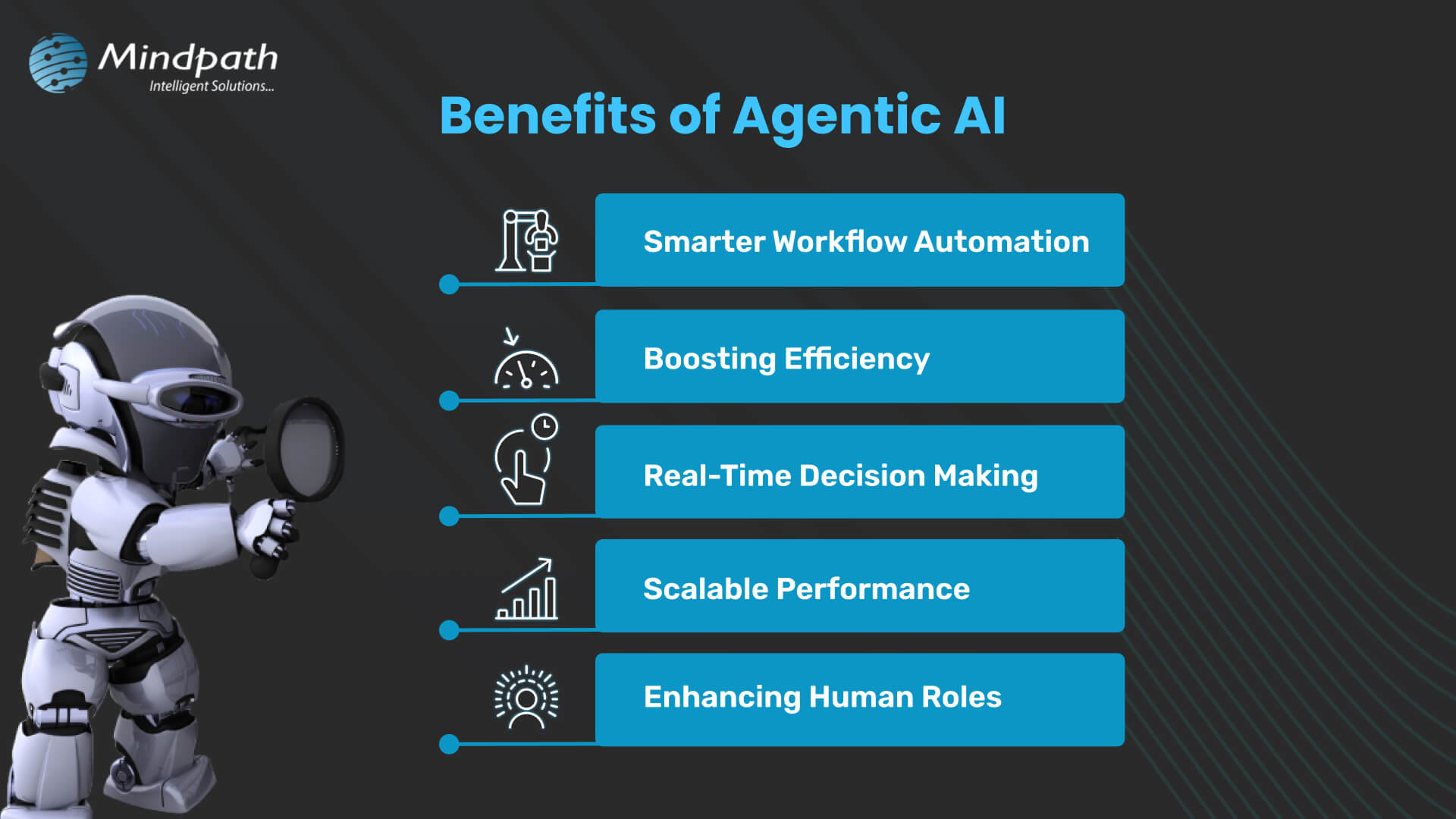
Benefits of Agentic AI

As businesses look for smarter ways to work, Agentic AI offers powerful advantages that go beyond traditional automation. Its ability to think, act, and improve independently is unlocking new levels of efficiency and innovation across industries.

Benefits of Agentic AI 

1. Smarter Workflow Automation

Agentic AI makes it easier to manage complex workflows without needing constant human input. In supply chain operations, it can analyze data, spot issues early, and suggest the best solutions. It also tracks inventory levels and connects with suppliers to restock items on time, keeping everything efficient and well-organized.

2. Boosting Efficiency

Agentic AI helps businesses run faster and smoother by managing and improving processes on its own. It learns from results, adjusts its actions, and keeps getting better without needing to be reprogrammed. This leads to fewer delays, higher efficiency, and makes it easier to scale operations as the business grows.

3. Real-Time Decision Making

One of the key strengths of agentic AI is its ability to quickly make decisions and adapt to changing situations. Agent AI tools can process real-time data, respond to unexpected events like shipping delays, and adjust plans without human help. This makes AI in decision-making faster, more flexible, and better suited for today’s fast-moving business needs.

4. Scalable Performance

Agentic AI models help businesses grow by handling more tasks without losing speed or efficiency. They use cloud platforms, APIs, and large language models to manage increasing workloads smoothly. In setups with multiple agents working together, such as in healthcare, they share tasks like data analysis and scheduling to reduce manual work.

5. Enhancing Human Roles

Agentic AI helps people work better by taking over repetitive tasks, improving communication, and offering smart assistance. This allows employees to focus on creative thinking, problem-solving, and other work that needs human judgment. While the AI works independently, human guidance is still important to keep everything aligned with company goals and values supported by valuable insights from AI in business strategy.

Wondering how AI-powered chatbots fit into the growing shift toward agentic AI? Read our blog on how conversational AI chatbots help businesses to explore how these systems learn, adapt, and deliver human-like interactions.

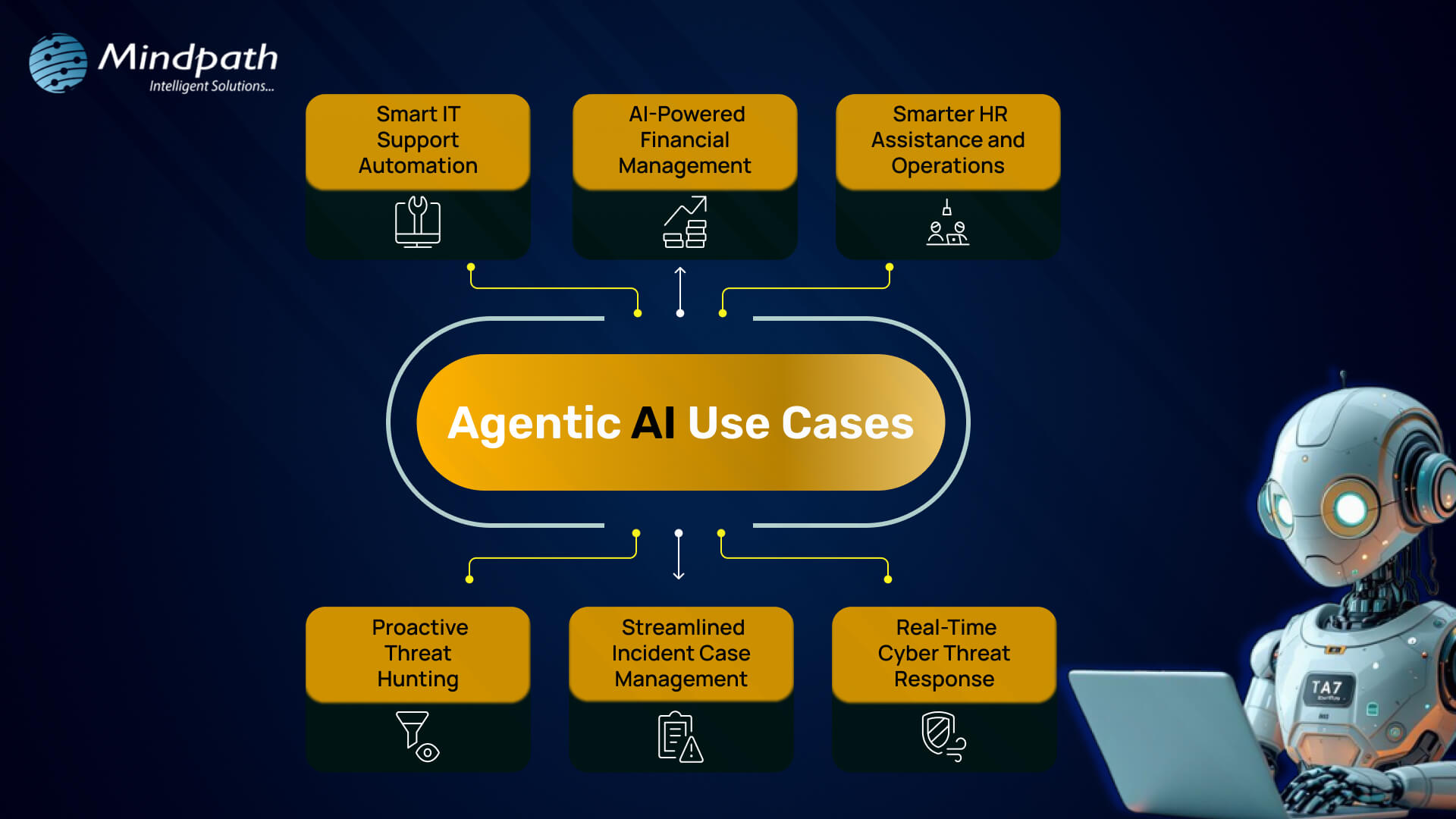
Agentic AI Use Cases

Agentic AI is already being used across many industries to improve efficiency, decision-making, and customer experience. Here are some real-world agentic AI examples that show how this technology is making a meaningful impact in different areas.

Agentic AI Use Cases

1. Smart IT Support Automation

Agentic AI is changing IT support by spotting and fixing problems on its own before they grow. It handles common tasks like password resets and software updates, while also solving complex issues by learning from past data. This shift aligns with emerging AI trends that focus on self-repairing systems and intelligent automation.

2. AI-Powered Financial Management

Agentic AI in finance can handle tasks like fraud detection, compliance checks, and forecasting by quickly analyzing large amounts of data. It also offers personalized advice by tracking spending and improving money management.

3. Smarter HR Assistance and Operations

In HR, agentic AI helps by answering employee questions, managing onboarding, and screening candidates during hiring. It gives quick, personalized support while allowing HR teams to focus on bigger goals.

4. Proactive Threat Hunting

Agentic AI actively searches for hidden threats by scanning security data for unusual patterns. It keeps learning to catch new types of attacks that older systems might miss.

5. Streamlined Incident Case Management

Agentic AI organizes and tracks cybersecurity incidents by logging details and assigning them to the right teams. It also learns from past cases to suggest better ways to handle future issues and ensures all records stay up to date. Companies often use AI consulting services to optimize these workflows and strengthen overall security operations.

6. Real-Time Cyber Threat Response

In cybersecurity, agentic AI watches for threats around the clock and reacts instantly by blocking risks or alerting teams. It learns from new attacks, so it gets better at spotting danger over time.

Curious how agentic AI is revolutionizing personalized shopping experiences and automation in online retail? Explore our blog AI in ecommerce to see how intelligent systems are reshaping customer journeys and boosting business performance.

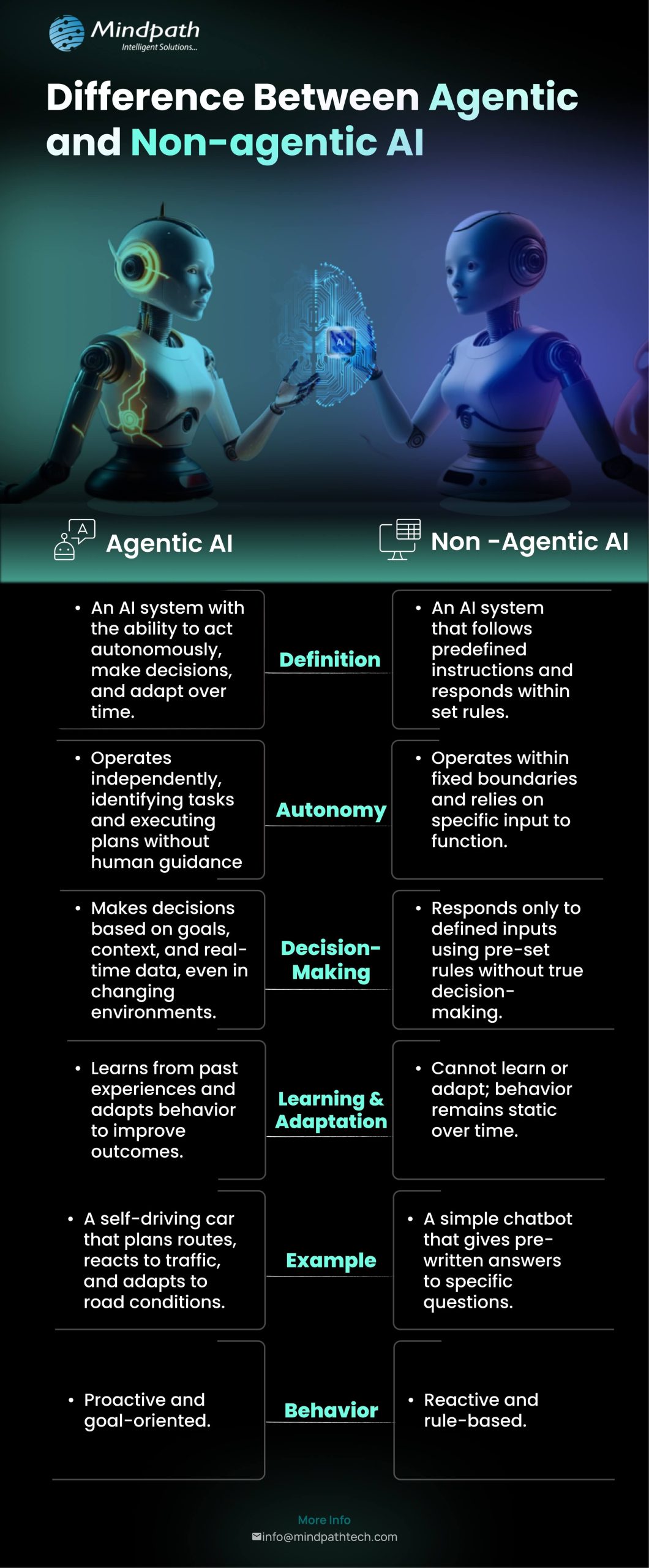
What Is the Difference Between Agentic and Non-agentic AI?

Understanding the difference between agentic and non-agentic AI is key to recognizing how advanced AI systems are evolving. While both types serve important roles, they differ greatly in how they operate, make decisions, and adapt to new situations. The following difference table will help you clear your understanding of agentic and non-agentic AI.

Difference Between Agentic and Non-agentic AI 

How Far Can Agentic AI Take Your Business?

Agentic AI is creating a major shift in how systems work, making them more independent, responsive, and useful across real-world situations. It’s no longer just about automation but about building intelligent support that acts on its own, learns from outcomes, and keeps improving. As industries adopt this new approach, the ability to understand and apply Agentic AI will be a clear advantage for any forward-thinking team.

At Mindpath, we help businesses bring this future to life with tailored AI development services. Our team builds intelligent, scalable, and adaptive AI solutions that align with your goals and workflows. If you’re ready to explore the power of Agentic AI in your operations, let’s connect and shape your next intelligent move.

Hiring NodeJS Developers
When hiring a NodeJS developer it’s essential to ensure they possess key technical skills that are fundamental to the role. Here are the core skills to look for:

1. Proficiency in JavaScript

A strong grasp of JavaScript fundamentals is crucial. This includes understanding core concepts like syntax, functions, and event handling, along with modern JavaScript features such as ES6+ (e.g., arrow functions, promises) that improve code readability and efficiency.

2. Asynchronous Programming Knowledge

NodeJS excels in handling multiple tasks concurrently, so developers need to be skilled in asynchronous programming. They should be comfortable using techniques like callbacks, promises, and async/await to perform non-blocking tasks, improving app performance.

3. Understanding of RESTful APIs

NodeJS excels in handling multiple tasks concurrently, so developers need to be skilled in asynchronous programming. They should be comfortable using techniques like callbacks, promises, and async/await to perform non-blocking tasks, improving app performance.

4. Database Handling Expertise

NodeJS developers must be familiar with various database technologies such as MongoDB, PostgreSQL, and MySQL. They should be capable of designing efficient data structures and querying the database effectively to meet the project’s data requirements.

5. Experience with Node.js Frameworks

Experience with NodeJS frameworks, like Express.js, NestJS, or Koa, is valuable. These frameworks streamline development by offering built-in solutions for routing, middleware, and handling HTTP requests, making it easier to build scalable applications.

6. Knowledge of NPM (Node Package Manager)

NPM is essential for managing third-party packages in NodeJS projects. A proficient developer should be familiar with using NPM to install and manage dependencies, ensuring the project remains organized and up-to-date with necessary tools.

7. Effective Error Handling

Proper error handling is essential for maintaining app stability. Developers should know how to catch and manage errors effectively, using techniques like try/catch blocks and logging, ensuring that the application remains reliable and easy to troubleshoot.
At Mindpath we offer a team of expert Node.js developers ready to take on your most challenging projects. With years of experience in building fast, scalable, and efficient applications, our developers specialize in leveraging Node.js to deliver top-tier web solutions. Whether it’s creating real-time applications, managing APIs, or integrating with various databases, we ensure your project is completed on time and within budget. Looking for skilled Node.js developers who can bring your ideas to life? Mindpath offers top-tier Node.js development services, ensuring high-performance, scalable, and reliable applications. Ready out now  to discuss your project needs and see how we can help you succeed!
How much does hiring a ReactJS developer cost? Learn about factors affecting rates, and how to find the best talent within your budget.