AI in Hyperpersonalization: A New Era of Tailored Customer Solutions

Join our Newsletter!

Featured Posts

Support Is One Click Away

Home

AI in Hyperpersonalization: A New Era of Tailored Customer Solutions

AI in Hyperpersonalization

AI in Hyperpersonalization: A New Era of Tailored Customer Solutions

Have you ever noticed how some brands seem to know exactly what you need, sometimes before you do? Imagine opening a shopping app and seeing recommendations that feel almost handpicked just for you. This level of personalization is no coincidence—it’s powered by AI and is known as hyperpersonalization. But how exactly does AI make this happen? And what does it mean for the future of customer experiences? Let’s dive into how AI is redefining what it means to truly know your customer.  

What is Hyperpersonalization?

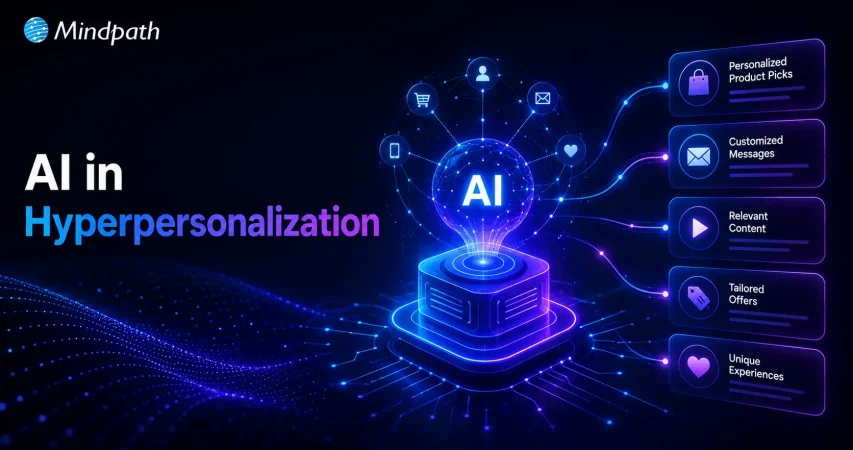
Hyper-personalization leverages Artificial Intelligence and real-time data to provide highly personalized experiences, showcasing items and information that are specific to each customer’s tastes. By analyzing individual purchasing behaviors, prior purchases, and browsing habits, AI allows companies to give suggestions that are tailored to each customer’s distinct interests and preferences. 

This high degree of personalization enables organizations to go beyond generic ideas, resulting in a more seamless and engaging client experience. It’s an effective strategy that improves convenience and strengthens brand loyalty by making each customer feel understood and cherished. Hyper-personalization allows marketers to constantly offer relevant, customized information that engages with each client on a personal level. 

The Role of AI in Hyperpersonalization

1. Smarter Product Recommendations

AI’s ability to comprehend user preferences and behaviors is crucial in revolutionizing the way product suggestions are generated. AI can forecast what you will be interested in next based on data such as previous purchases, browsing history, and even time spent on certain things. This goes beyond mere ideas; it tailors each recommendation to your own preferences and needs. 

For example, if you’ve been looking for shoes, AI can recommend a pair that matches your style or even forecast the type of shoes you’d like based on recent searches or seasonal patterns. These recommendations sometimes appear to be “reading your mind,” displaying goods you never considered, but once you see them, they feel like a great fit. This degree of personalization improves the whole buying experience. You spend less time looking for what you want because the AI finds it for you, making each interaction seem more relevant and easier. With hyperpersonalization, AI guarantees that the goods you view are constantly relevant to your tastes, improving your entire shopping experience. 

2. Friendlier Chatbots

AI-powered chatbots have gone a long way towards providing more lifelike, human-like conversations. Instead of robotic, one-size-fits-all replies, these chatbots can now tailor their tone, vocabulary, and behavior to the context of the interaction and the user’s specific demands. They employ powerful AI algorithms to comprehend not just what you’re saying, but also the emotions and meaning behind it. 

These AI chatbots can also personalize replies by recalling prior encounters, recognizing your preferences, and offering relevant solutions. Whether you need help with a product, troubleshooting, or completing a purchase, the chatbot customizes its replies to your individual needs, exactly like a real agent would. AI chatbots boost customer service by making conversations feel more personal and human, resulting in a more engaging and fulfilling experience for customers, allowing businesses to provide 24/7 help without losing quality or empathy.    

3. Better Campaign Strategies

AI-powered solutions have transformed the way businesses approach marketing campaigns, allowing them to analyze massive volumes of data and forecast campaign outcomes more accurately. These technologies look at customer behavior, market trends, and previous campaign performance to spot patterns that might not be visible. Understanding these trends allows AI to assist businesses fine-tune their strategy, ensuring they are targeting the appropriate audience with the right message at the right time. 

Furthermore, AI can enhance processes by automating repetitive operations like segmenting audiences, providing personalized content, and managing digital marketing. This automation minimizes human work and improves marketing teams’ efficiency, allowing them to focus on higher-level strategy and creativity.  AI analyzing data in real time makes marketing campaigns more fluid and responsive. Brands can swiftly alter campaigns based on performance analytics, increasing their ability to remain relevant and adapt to changing client requirements. This increased efficiency not only enhances campaign efficiency, but also enables a more personalized marketing strategy, offering bespoke content and experiences that engage with specific customers. 

4. Tailored Marketing Materials

AI allows organizations to go beyond basic marketing messages by providing highly personalized content that addresses individual tastes and behaviors. AI can generate marketing materials that are specifically tailored to you by analyzing data such as your previous purchases, browsing habits, social media activity, and even real-time elements such as location or current trends. 

Furthermore, AI can adapt the tone, structure, and timing of the material to the individual’s preferences. It can provide a product recommendation at the ideal time, such as when you’re planning a trip or getting ready for a vacation, ensuring that the offer feels timely and relevant. By combining various data points and external variables, AI enables companies to generate targeted, relevant marketing that improves the customer experience and drives stronger connections with their audience.  

Also Read: Top 10 Benefits of Artificial Intelligence in 2024 

AI Development Services at Mindpath

Mindpath specializes in AI development services that help organizations grow and prosper by leveraging smart technologies. Our AI solutions are intended to increase efficiency, improve customer experiences, and make more informed business decisions. We develop specialized AI systems that can analyze vast volumes of data, forecast future trends, and automate repetitive operations, allowing your processes to run quicker and more accurately.  Our AI services may be customized to meet your specific company needs, from creating pleasant chatbots to providing personalized product suggestions. Whether you want to optimize operations or engage customers with intelligent, automated solutions, Mindpath has the AI technologies you need. Our team collaborates closely with you to guarantee that the AI technology we build helps you succeed and stay ahead. 

Final Thoughts!

AI is truly transforming the way businesses connect with their customers, creating a future where experiences are not only personalized but also highly intuitive. Through smarter product recommendations, friendlier chatbots, optimized campaign strategies, and tailored marketing materials, AI is helping brands build stronger, more meaningful relationships with their audiences. At Mindpath, we are dedicated to bringing these advancements to life with our custom AI development services, ensuring that your business stays ahead of the curve and delivers exceptional, personalized experiences. By harnessing the power of AI, you can enhance customer engagement, streamline operations, and create more impactful marketing strategies that drive long-term success. 
Ready to elevate your customer experiences with AI?

Partner with Mindpath today to explore our custom AI development solutions and stay ahead in your industry!

Related Post

Related Post

Top Node.js Features for Backend Development – A Complete Guide
Is Node.js still the best choice for backend development in 2025? With technology evolving rapidly, developers need efficient, scalable, and high-performance solutions. Node.js continues to power modern applications, but what makes it so relevant today? Let’s dive into the latest trends and see why Node.js remains a top choice for backend development this year!

1. JavaScript familiarity

If a developer is familiar with JavaScript on the front end, transitioning to backend programming using Node.js becomes considerably easier. Since they both speak the same language, there is no need to learn anything entirely new. This enables developers to work quicker and construct apps more seamlessly. It also saves time during training and avoids errors. Node.js allows frontend professionals to swiftly improve their abilities and handle full-stack development without a high learning curve.

2. Real-time applications

Node.js is ideal for real-time applications, due to frameworks such as Socket.IO. It enables immediate connection between users and servers, making services such as live chat, notifications, and real-time updates effortless. Node.js guarantees seamless and quick interactions across chat applications, online games, and collaboration tools. Users do not need to refresh their displays to receive new updates; everything happens immediately. This makes programs more interesting and responsive, which enhances the entire user experience.

3. High concurrency

Node.js is built to accommodate a large number of users simultaneously without slowing down. Its non-blocking I/O mechanism allows for the efficient processing of many requests without the need for queues. This makes it perfect for apps that experience high traffic, such as online gaming, streaming services, and real-time chat. Instead of generating a new thread for each user, Node.js handles connections efficiently, allowing applications to remain quick and responsive even when under heavy demand.

4. Microservices architecture

Node.js is ideal for creating microservices, which split a program into separate, independent services. Each service performs a specific purpose and operates independently, making development and upgrades easy. Since these services interact rapidly, applications remain adaptable and scalable. This method is ideal for complicated applications because it allows teams to work on separate portions without impacting the overall system. Businesses can utilize Node.js to create quick, maintainable, and extendable apps.

5. Lightweight and efficient

Node.js is lightweight and efficient, allowing it to operate quicker with less resources. Its compact footprint enables applications to complete tasks rapidly, making it excellent for dealing with large traffic without overwhelming the system. Node.js ensures that your app operates effectively even when it is heavily loaded by consuming less memory and CPU. This efficiency results in faster response times and better user experiences, all while keeping operating expenses down.

Ready to build fast, scalable, and efficient applications with Node.js? At Mindpath, we specialize in creating high-performance solutions using the power of Node.js. Whether you’re looking for real-time features, microservices, or high-concurrency handling, our expert team is here to help.
Contact us today to discuss how we can take your application to the next level with Node.js!

How much does hiring a ReactJS developer cost? Learn about factors affecting rates, and how to find the best talent within your budget.
Hiring React Developers

Are you ready to take your project to the next level with top-notch React developers? But how do you ensure you’re hiring the right talent? With so many factors to consider, finding the perfect React developer can be overwhelming. In this blog, we will explore the key considerations before hiring the perfect React developers which can be beneficial for your project.  

React is a popular technology for developing websites and web applications. It is a JavaScript library that assists developers in creating user interfaces, which are the components of a website or app that users interact with. React makes it easy to create and manage interactive components like buttons, forms, and menus. It enables developers to create these features in a modular manner, allowing them to reuse and change portions of their website without beginning from scratch. 

React developers are important because they specialize in designing dynamic and efficient user interfaces for websites and applications. Their proficiency with React, a popular JavaScript package, allows them to create highly interactive and responsive elements that improve the user experience. React developers can employ React’s modular architecture to quickly manage complicated data and ensure smooth performance, making applications easier to update and maintain. Their ability to work with other technologies and frameworks, like Flux and React Native, broadens their effect, allowing them to contribute to web and mobile projects. 

So, let’s dig in to explore the key considerations to make your hiring process smooth and successful! 

Key Considerations Before Hiring React Developers

1. Deep Knowledge of ReactJS Basics

When hiring React developers, make sure they have a thorough knowledge of React’s key features. They should be conversant with JSX, which allows them to seamlessly combine HTML with JavaScript to create components. It is also essential that they grasp the Virtual DOM, which is a technology that allows React to refresh web pages rapidly by handling changes effectively.  These abilities are vital because they allow developers to construct quick, dynamic websites and apps. Make sure the developer is familiar with these aspects in order to efficiently manage the demands of modern web development. 

2. Proficiency In HTML/CSS

When hiring a React developer, make sure they are familiar with HTML and CSS. They should be able to write HTML tags to structure web pages and use CSS to design them. Understanding concepts such as the box model and flexbox is essential for layout and design. 

They should also understand how to utilize a CSS reset to ensure that styles appear consistently across various browsers, as well as how to use media queries to make websites look appealing on all platforms, from phones to desktops. An excellent React developer must understand these fundamental front-end abilities in order to create well-designed and effective websites. 

3. Strong JavaScript Skills

A React developer must be proficient in JavaScript, as it is the fundamental language used in React. They must be able to generate reusable components, which are critical for developing efficient and maintainable user interfaces. Strong JavaScript skills also entail understanding how to manage application state, execute asynchronous processes, and interact with various front-end frameworks and tools. Mastery of these JavaScript foundations enable a React developer to create robust, engaging, and high-performance websites and apps. 

4. Expertise In Writing Clean Code

A React developer should excel at producing code that is straightforward and understandable. Well-organized and simple code not only speeds up development, but also makes it easier to detect and correct mistakes. Clear coding conventions guarantee that when the project is passed on to another developer or team, they can easily comprehend and work with the current codebase. This is essential for sustaining and expanding the project over time. Clean coding techniques also assist in reducing technical debt, improving team cooperation, and ensuring that future upgrades or alterations may be deployed efficiently without creating new issues. 

5. Experience With ReactJS Workflows

A React developer should be familiar with data structure frameworks and processes such as Flux or Redux. These technologies are essential for managing application state and complicated data relationships, particularly in large-scale or dynamic applications. Flux and Redux enable to simplify data flow and manage state changes and asynchronous updates. 

Understanding these routines is essential but developers must first master the fundamentals of React. A solid React foundation guarantees that they can successfully integrate and use these advanced tools. Mastery of data management libraries helps the developer’s ability to develop strong and scalable applications, as well as overall code quality and maintainability. 

6. Familiar With REST APIs

Many applications require frontend components to be integrated with external data sources, therefore React developers must be familiar with REST APIs. A REST API enables developers to link React apps to back-end systems and get or transmit data such as user information, goods, or content. Understanding how to communicate with APIs is essential for creating dynamic, data-driven apps. 

A React developer should be familiar with HTTP request methods such as GET, POST, PUT, and DELETE, which are often used in REST APIs. They should also understand how to handle answers, failures, and data formats like JSON. A strong understanding of REST APIs enables developers to effectively connect their React code to other services and databases, resulting in a seamless user experience. 

7. Experienced With Unit Testing and Tools

Experience with unit testing, Git, GitHub, and other React developer tools is essential for effective development. Many firms use Git and GitHub to store and maintain their work, therefore React engineers must be familiar with these technologies. Daily development tasks include change tracking, branching, code merging, and resolving merge conflicts. 

Unit testing also guarantees that each component of the code functions as intended, which aids in the early detection of errors and the maintenance of code quality. Developers that are familiar with unit testing technologies such as Jest or Mocha can validate their work more effectively, resulting in more dependable and stable apps. Together, these technologies serve to shorten the development process and promote communication, resulting in more efficient project workflows and higher-quality output. 

Hire ReactJS Developers at Mindpath

At Mindpath, we make it simple to engage experienced ReactJS developers for your project. Our method is straightforward, ensuring that you receive the greatest personnel and outcomes. From understanding your requirements to providing ongoing assistance, we are with you every step of the way. This is how it works: 

1. Requirements Gathering

Start by contacting us to discuss your project’s goals and needs. We’ll review your requirements and create a detailed plan that includes our approach, timeline, and estimated cost. 

2. Shortlist The Right Talent

We carefully select ReactJS developers who are a perfect match for your project. You can interview and choose the developers who best fit your needs. 

3. Project Kick-off

Once your team is ready, we kick off the project with a clear plan and timeline. Our team stays in close contact, providing regular updates and making sure everything aligns with your vision. 

4. Ongoing Support

We continue to support you throughout the development process and even after the project is done, ensuring that all your goals are met, and the project runs smoothly. 

Wrapping Up!

Finding the right React developers is essential for creating dynamic and efficient apps. Skilled developers specialize in React.js, JavaScript, HTML/CSS, and the tools required for seamless integration and performance. Mindpath ensures that you have access to the best React expertise, resulting in clean code, scalable architecture, and optimized user experience. With the correct Mindpath team, your project is positioned for success, guaranteeing that web applications match the highest modern development standards. 

Ready to elevate your project with expert React developers?

Mindpath brings top-tier talent to deliver high-performing, scalable solutions.

Discover key considerations for hiring React developers. Learn how Mindpath can provide the right talent for your project.
trends in education

The transformative changes in the world of education have been fuelled by a wave of technological innovation. Just like other big sectors like finance, technology has had a formidable impact on the education industry. The emphasis on trends in education technology is gradually increasing as education has moved beyond the boundaries of classrooms. Education is becoming more personalized and dynamic with the help of different technologies, thereby establishing the foundations of EdTech. It is important to understand that EdTech is no longer another emerging trend. Educational technology, or EdTech, is now an integral element in the basic approach for acquiring knowledge. Let us find out the most notable trends that will dominate educational technology in 2026 and beyond.

Not sure how to move forward with education technology for your business? Contact us, we support organisations in building reliable and future-ready solutions.

Existing State of Education Technology

Before you learn more about the emerging education trends, you must understand the existing state of education technology or EdTech. The future of educational technology can revolutionize education on a global scale and create opportunities for students and educators. The EdTech industry is expected to become a $400 billion market by 2026 with new technologies redefining leaning experiences. Educational technology has the potential to address long-standing challenges in education alongside introducing the benefits of inclusivity, adaptability and accessibility.

As education gears up to become a $10 trillion industry by 2030, it is important to understand the scope of education technology. The integration of EdTech solutions has helped in creating ecosystems where learners can access knowledge anytime, anywhere. According to the World Economic Forum, the EdTech industry will serve more than 350 million post-secondary graduates and 800 million K-12 graduates worldwide in 2026. With such impressive numbers expected from the EdTech industry, you have strong reasons to believe that the industry will foster new trends.

Want to explore how AI can enhance teaching and learning experiences? Check out chatbots in education to discover how intelligent assistants provide real-time guidance and improve knowledge retention.

Unraveling the Big Trends for EdTech in 2026 and Beyond

The digital transformation of education with EdTech has been nothing short of a revolutionary experience for educators, learners and management. If you take a look at current educational trends, you will discover the significance of EdTech in transforming classrooms. Innovative technologies like artificial intelligence, virtual reality and other adaptive technologies have served as powerful tools for learners. The following sections will introduce you to some of the emerging trends in EdTech for 2026 and beyond.

1. Hyper-personalized Learning

The future of learning will rely a lot on artificial intelligence and there is no doubt in it. With the rising use of generative AI in education, learners and educators can capitalize on multiple advantages for better learning. Artificial intelligence plays a major role in adapting the learning experience to unique strengths, weaknesses and learning styles. Generative AI is shaping a new reality of education where personalized learning systems will ensure efficient learning experiences for every learner.

AI-powered learning systems can review the performance of learners, identify their knowledge gaps and also understand their individual learning styles. The systems can use the data to generate customized lessons, learning paths or adjust the difficulty of lessons. As a result, no student will be left behind in the learning journey and everyone will find equal opportunity to grow further.

2. New Role of Blockchain

Blockchain technology has been associated frequently with transformation of the education sector for its distinctive traits like cryptography or immutability. Blockchain is one of the biggest tech trends in education that can provide a completely new and efficient solution to verification of academic achievements. The concerns of fake certificates create troubles for deserving candidates who miss out on opportunities due to lack of verifiable credentials.

Blockchain can help in secure storage and verification of academic credentials like diplomas, degrees and certifications. As a result, learners will have more control over their academic records while enjoying the flexibility of distributing their credentials without the fear of copyright infringement. Blockchain can provide tamper-proof or immutable digital identities on a public ledger, thereby reducing the possibilities of fraud.

3. Adaptive Learning

Most of the discussions about the use of artificial intelligence in the education sector revolve around personalized learning. You can find many applications of AI in the field of education such as education chatbot apps that can solve learner queries at different stages. Adaptive learning through chatbot apps will emerge as one of the biggest trends in EdTech in 2026 and beyond. The primary goal of adaptive learning will focus on dynamic modification of lessons and content difficulty according to real-time assessment of student performance and engagement.

Adaptive learning systems will measure the progress of learners, identify their weaknesses and prepare learning paths that can guarantee success. The emphasis on lifelong learning along with growth of the online learning market creates more opportunities for adoption of adaptive learning systems. With the combination of predictive analytics, educators can use adaptive learning systems to create refined learning paths for truly personalized experiences.

4. Mix of Virtual and Augmented Reality

The list of top EdTech trends for 2026 and beyond will be incomplete without mentioning virtual and augmented reality. VR and AR have been implemented as solutions to create immersive learning experiences by transforming learners to places and situations that were previously unimaginable. For instance, VR can help learners visit historical sites in the classroom while AR displays overlay of digital information on the real-world objects.

The growing demand for immersive learning is one of the notable indicators of the rise of VR in education. At the same time, you must know that AR and VR encourage motivation, foster collaboration and improve comprehension. Virtual lessons have proved useful in enhancing the understanding of abstract concepts. Most important of all, VR and AR also present new opportunities for encouraging collaboration between learners and educators.

5. Bridging the Accessibility Gaps

As the world ushers in a new era of education, the primary use of IT in education will become more about making education accessible to everyone. The innovative use of technology in education with new EdTech solutions helps in achieving digital equity and accessibility. Learners can rely on EdTech to access education irrespective of their socio-economic background, physical abilities or geographic location.

Big organizations such as UNESCO recommend that local solutions will play a crucial role in transforming digital learning. One of the prominent emerging trends in educational technology will focus on creating infrastructure for digital literacy training, especially in low availability of resources. The only goal behind reducing the accessibility gaps will be about ensuring that every learner gets the opportunity to achieve their dreams.

Final Thoughts

The most noticeable trends for the domain of EdTech in 2026 and beyond include AI, blockchain and adaptive learning. VR and AR will also be the most prominent technology trends in education in future. You should know that these technologies will define future trends in education in 2026 and beyond with their transformative potential. For instance, AI can not only provide the foundation for hyper-personalized learning experiences but also create adaptive learning systems. You should also remember that data privacy and security will be prominent areas of concern in the future of EdTech. The challenges of potential biases in algorithms and the cost of implementing EdTech solutions will also create obstacles in future.

One of the crucial highlights that you should know about the higher education industry trends and EdTech focuses on opportunities. Educational technology will provide more productive and engaging learning experiences to every learner without any boundaries. At the same time, EdTech will also empower educators with resources that make them focus more on meaningful interactions. At Mindpath, we help organizations adapt to these evolving trends by building scalable and future-ready EdTech solutions.