

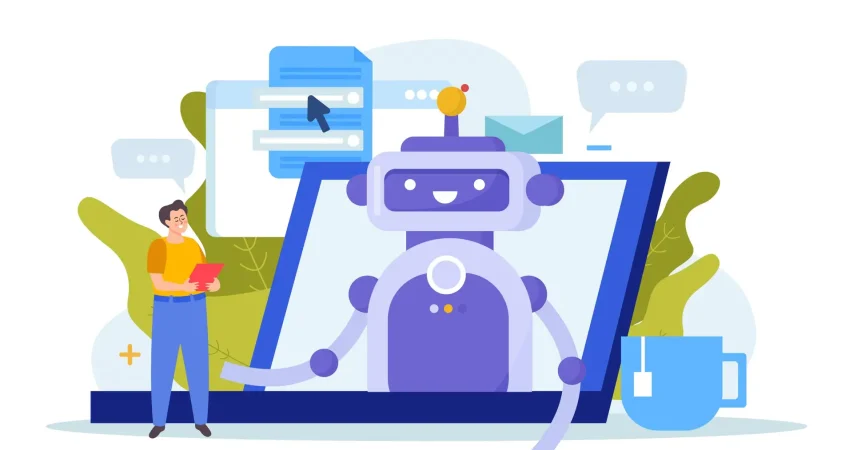
5 Conversational AI Trends To Watch Out For In 2024

Join our Newsletter!

Featured Posts

Support Is One Click Away

Home

5 Conversational AI Trends To Watch Out For In 2024

Conversational AI Trends 2024

5 Conversational AI Trends To Watch Out For In 2024

Artificial Intelligence is the term of the decade. While we might not notice, AI is slowly seeping into our everyday life. Conversational AI, a byproduct of AI is already popular in the form of voice assistants like Siri and Alexa, customer assistant chatbots, messenger bots, and more such solutions.   Market research suggests that in 2022, the worldwide conversational AI market was valued at approximately $7.61 billion. It’s expected to expand steadily at a compound annual growth rate (CAGR) of 23.6% from 2023 to 2030. This growth is primarily driven by increased demand, lower chatbot development expenses, AI-driven customer support, and the adoption of omnichannel approaches.  In this blog, we will explore 5 conversational AI trends that will be prominent in the year 2024. So let’s dive right in!  

5 Conversational AI Trends for 2024

1. Chatbots Will Become More Compassionate

One of the biggest trends in the area of conversational AI is that chatbots are going to acquire emotional intelligence. Chatbots will be able to recognize human emotions and respond to them in a manner that’s more humane.   AI chatbots with emotional intelligence will be able to understand complex human emotions such as frustration, dissatisfaction, and anger and thus tweak their response strategy to handle the unpleasant situations that might take place during customer interactions.   Emotional intelligence can also come in handy to enhance chatbot responses and make them much more user-friendly.  

2. More Personalization For Customers

Conversational AI, especially in the domain of chatbots, is becoming more sophisticated by the day where their application is not limited to simply answering the questions. Conversational AI chatbots are all set to offer more personalization to customers in the coming year.   With their ability to understand natural language, chatbots will be able to grasp customer intent. With adequate training on customer data, they will be able to offer customized responses to customer queries, ultimately boosting the customer experience.   Moreover, conversational AI-powered platforms will also be able to curate content such as articles, videos, guides, etc., for users based on their previous activities, providing a rather holistic and personalized experience.  

3. Conversational Search Engines

In 2024, conversational search engines will revolutionize how users interact with search platforms. Traditional keyword-based search is gradually being replaced by more conversational and natural language queries. So instead of typing keywords, we can ask search engines questions as we would to any other human being, and they would respond!   With the advancement of AI and machine learning algorithms, search engines will become adept at understanding the context and intent behind user queries, leading to more relevant search results.  Conversational search engines will enable users to ask complex questions in a more conversational tone, and the search engine will provide answers based on understanding the semantics of the question rather than just matching keywords. This will enhance the search experience, especially on mobile devices and smart speakers, where typing is cumbersome. 

4. Quick Deployment Of Virtual Agents

Advancements in natural language processing (NLP) and machine learning algorithms will enable companies to build and deploy virtual agents rapidly, without extensive customization or development time.   In 2024, the demand for virtual agents will continue to rise, driven by the need for efficient customer service solutions and automation in various industries. Pre-trained models and modular architectures will streamline the deployment process, allowing organizations to implement virtual agents within weeks rather than months.  Training these models is the most time-consuming process. With the availability of large-scale data, it would become much easier and quicker to train the models and deploy them over the coming years.  

5. Multilingual Capabilities Will Expand

Conversational AI technologies will evolve to support a wide range of languages, dialects, and accents, enabling businesses to cater to a global audience seamlessly.  As businesses continue to expand globally, the need for multilingual conversational AI solutions will become more pronounced in 2024. Enterprises operating in diverse markets will require AI-powered platforms that can communicate effectively with customers in their native languages.  Advanced translation models and cross-lingual transfer learning techniques will allow the development of multilingual virtual assistants that can understand and respond to user queries in multiple languages.  To wrap up, the year 2024 promises to be an exciting year for conversational AI, with innovations in emotional intelligence, personalization, search capabilities, virtual agent deployment, and multilingual support reshaping the landscape of customer interactions and user experiences. These conversational AI trends are all set to transform the customer experience for businesses.   If you are also looking to give your business a competitive edge and improve customer experience, it’s the right moment to invest in conversational AI. At Mindpath, we take pride in having innovation as our core value. Our team of professionals combines cutting-edge technology with deep industry knowledge to deliver bespoke solutions tailored to your business needs.   Whether you want a custom AI chatbot or leverage technologies like OpenAI’s ChatGPT, we can help you with all of it.   So if you are looking to unlock the full potential of conversational AI for your business, we can help! Contact us now to explore how our advanced AI solutions can elevate your customer experience and drive business success.  Let’s talk

Related Post

Optimize your React app for better speed and scalability. Explore advanced performance techniques, including virtualization and useMemo.

Related Post

qualities of a good software engineer

The tech space is moving faster than it ever has, and businesses need professionals who are adaptable in the face of frequent change. Conversations about the qualities of a good software engineer often extend beyond coding. Businesses want engineers to contribute to real change and add some actual value through their work. The demand is not only for talent in the area of technical skills but also for people who can demonstrate impact in other areas of development.

At the same time, a job as a successful engineer shows far more than what a résumé can include. Simply put, this job involves constant learning, being a good team player, and being able to adapt to evolving project needs. Every organization is looking for individuals who can maintain the idea of long-term while developing ideas into effective solutions. In this blog, we look through the top qualities that describe a truly good software engineer.

To transform your idea into a powerful solution with the help of the right guidance. Contact us, and we will help you to implement the action that brings long-term success.

Why are Good Software Engineers Essential in a Company?

Good software engineers are essential to developing and sustaining the core systems that drive modern business. They design reliable, scalable responses, implement security, and develop user-friendly applications that facilitate growth. Their individual or team ability to resolve complex technical problems contributes to efficiency and drives innovation, and as such, they are a fundamental pillar of long-term success in competitive markets.

In addition to their role in custom software development, they also test, debug, and service software, while negotiating the escalating complexity of digital systems and software. By merging the business objectives with the technical implementation of the project, they can realize a project that provides real value. These roles articulate the qualities of a good software engineer and are fundamental to taking a business idea and transforming it into a meaningful and forward-looking outcome.

Must Read: Custom Software Development Benefits

What are the Qualities of a Software Engineer?

When companies are looking for quality people, they will be interested in the traits of a good software engineer that extend beyond their programming capabilities. These traits combine technical skills with problem-solving, teamwork, and flexibility, making engineers quality adders to any project. Below are the key characteristics that define them.

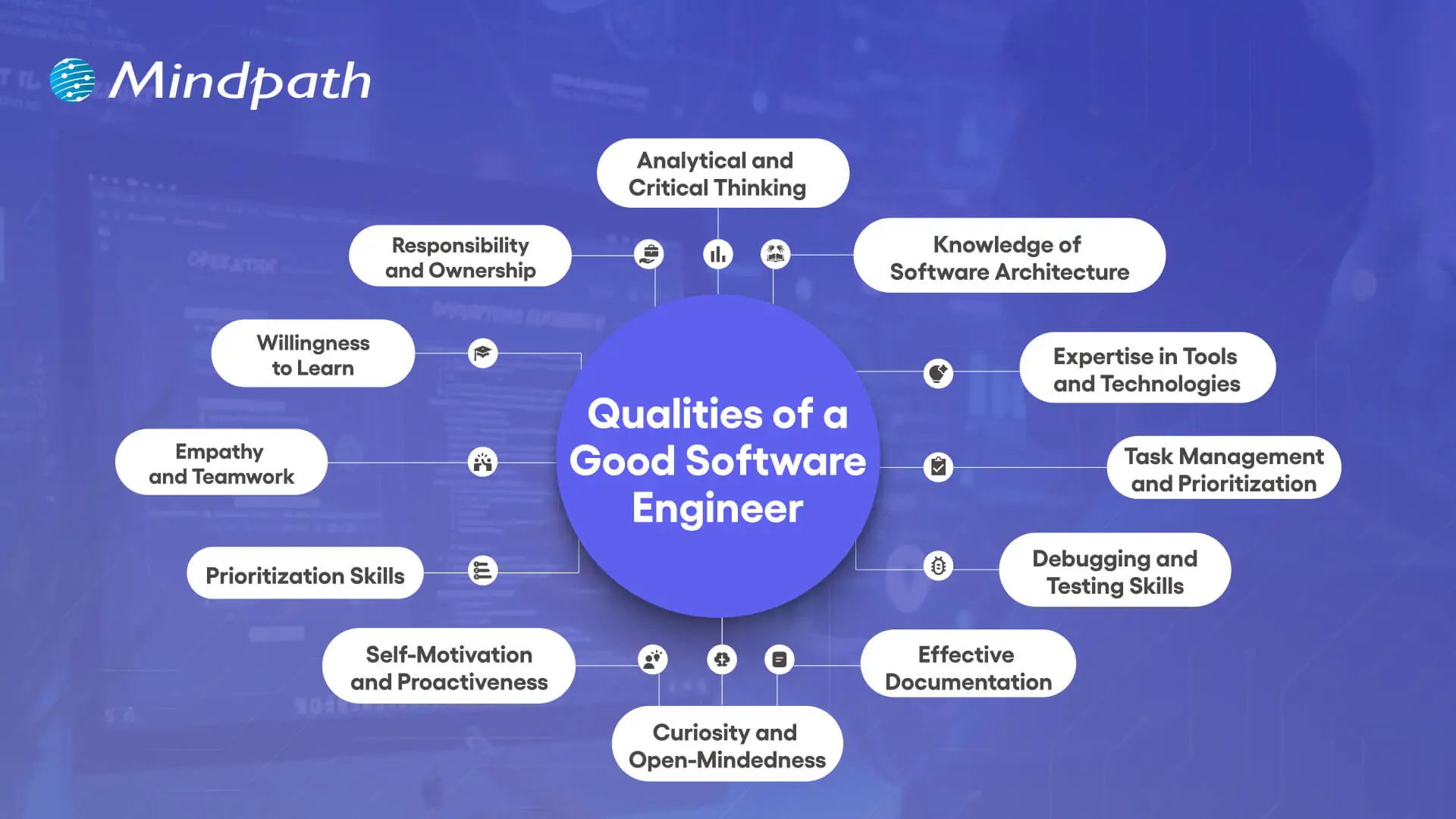
Qualities of a Good Software Engineer

1. Analytical and Critical Thinking

A great quality of a good software engineer is having analytical and critical thinking skills. Software engineers often work on unfamiliar systems with very little direction, so understanding how to break the system down into its components is helpful in realizing how the system really works. In doing this, the software engineer can recognize large patterns, see how inputs and outputs follow, and find a way to add value to the solution.

2. Knowledge of Software Architecture

Being knowledgeable about software architecture is an important software engineering characteristic that enables solid system designs. Engineers need to understand the flow of data through a system and how each element transforms that data. That knowledge supports engineers in building robust systems by allowing them to select the best architectural pattern that will last into the future.

3. Expertise in Tools and Technologies

It is a powerful strength of a software engineer to know development tools and alternative technologies. Software engineers need to investigate new options, balance trade-offs of risks to benefits on each alternative technology, and pivot accordingly to use the development tools that best contextual fit the immediate problem. If only to remain curious and current, software engineers have the opportunity to not make archaic choices.

4. Task Management and Prioritization

Managing multiple projects effectively is a key characteristic of a software engineer. All engineers perform some form of balancing act between regular day-to-day items and urgent tasks, including outages or bug fixes. With a little planning and prioritization, engineers can respond to urgent tasks while maintaining a steady pace on all projects.

5. Debugging and Testing Skills

Debugging and testing form an essential part of the qualities of a good software engineer. Engineers often occupy their time to sustain and upgrade developed projects; thus, referencing the strengths of their debugging skills will allow them to get to the root of an issue efficiently and start unpicking it. Testing will confirm that the software is functioning according to the specifications, while it will also reduce any risk of surprises.

6. Effective Documentation

Good documentation is an often-neglected, but vital, characteristic of software engineering. Engineers who write and update their documentation when they develop and change the software make it easier for others to understand the system and maintain it later. Good documentation, where records are kept clearly and accurately, will help reduce confusion, save time, and enhance collaborative efforts across teams.

Curious about the different kinds of software a skilled engineer might work on? Explore the various types of software development and see how each requires unique skills and expertise.

7. Curiosity and Open-Mindedness

Curiosity and open-mindedness are important qualities of a good software engineer because technology moves quickly. Great engineers investigate different ways of doing things, accept new ideas, and change how they do things – every time the new way is better. This mindset propels the innovation needed to successfully help teams solve problems.

8. Self-Motivation and Proactiveness

A successful software engineer is a self-starter who is proactive in identifying threats to successful project outcomes before they turn into large problems. Successful software engineers seek out opportunities to solve problems rather than waiting for someone to instruct them or blindly ignoring a potential risk altogether. A proactive software engineer can help dramatically improve team performance and produce better long-term project outcomes.

9. Prioritization Skills

Tremendous prioritization skills are a functional strength of a software engineer. Since not every task becomes urgent, engineers must focus on how to properly handle critical issues versus long-term goals. When the decisions are made competently enough, all teams can focus on issues that need immediate resources.

10. Empathy and Teamwork

Teamwork and empathy are defining qualities of a good software engineer in collaborative environments. Clear communication, attentive listening, and being mindful to consider the viewpoint of others are important to collectively solving problems as a team. These interpersonal skills cultivate healthier team dynamics and improve the likelihood of successfully completing the project.

11. Willingness to Learn

Having humility is a powerful software engineering characteristic, as no one can know everything in such a broad discipline. Engineers who are open to feedback and learn from others use their time wisely and bolster their skills. When an engineer is humble, they help cultivate stronger, more supportive teams that drive performance.

12. Responsibility and Ownership

A positive sense of responsibility is one key qualities of a good software engineer. Engineers understand their systems very well and will have to take responsibility, whether it be for successes or failures. Being responsible for their thoughts and actions earns engineers trust among the stakeholders that will, in time, improve user experiences.

Want to see how skilled engineers turn concepts into working software? Explore the custom software development process to understand the stages that ensure quality and efficiency.

Ready to Work with Skilled Software Engineers?

The qualities of a good software engineer show how vital they are in shaping ideas into real, impactful solutions. Strong technical skills combined with collaboration, adaptability, and ownership make them essential to building reliable and scalable systems. These qualities ensure not only innovation but also long-term success in today’s competitive and constantly changing digital landscape.

At Mindpath, our custom software developers bring these qualities into every project. They combine expertise, curiosity, and responsibility to create solutions tailored to your business needs. By focusing on innovation, reliability, and long-term value, our team ensures that your ideas are developed into secure, scalable, and user-friendly software designed to drive growth and meet evolving market demands.

ai and business

Have you ever considered how AI and business actually fit together? You may have heard a lot about AI being faster and smarter, but is your business actually prepared for it? Many people are excited about new technology, but they often overlook whether they have a solid foundation. Take a second to think about it- is your business possibly ignoring some signs that say you are not prepared for AI yet?

AI can help any business develop, but starting without preparation can create issues. There are companies that jump into AI without having the right tools or people, or even ideas. This could waste valuable time and resources and lead to frustration. Integrating AI in business strategy from the start ensures you’re prepared and can identify potential challenges early. In this blog post, you’ll learn five easy indicators that show your business may not be ready for AI yet.

Want to future-proof your business with AI? We at Mindpath offers exceptional AI development services that help your business get AI-ready and unlock next level of growth! 

What Being ‘AI Ready’ Really Looks Like?

Being ready for AI means your business has the right people, tools, and plan to make it work well. When you think about AI and business together, it’s more than just buying new software. You need good data that’s easy to use, a team that knows how to work with AI, and clear goals that AI can help you reach. A business ready for AI knows how to bring people and smart technology together.

Look at Amazon. They show how AI in e-commerce can work side by side with business to help customers and save money at the same time. This happens because they plan ahead and know exactly how AI will help. If you want your business to be ready to use AI, start by checking your data, training your team, and making a simple plan that fits your real needs. When you get this right, AI in business can really help you grow.

Must Read: Benefits of AI

What is an AI Readiness Checklist?

An AI Readiness Checklist is a simple tool that helps you see if your business is really ready to use AI in the right way. It covers important things like your data, your technical tools, and how well your team understands AI. When you think about AI helping your business grow, this checklist shows you what’s strong and what needs more work.

A good AI checklist looks at your technical setup, the quality of your data, your team’s skills, and whether your company is open to new ways of working. This way, you can fix any gaps before you bring AI into your business. By using an AI checklist, you can make sure you’re set up for success and get real value from AI in business.

How is AI reshaping the way websites are built and optimized? Explore our detailed article on AI in Web Development to see how it’s driving smarter design, faster deployment, and better user experiences.

AI Readiness Checklist for Businesses

Before you bring AI into your daily operations, it’s important to know where you stand. A good AI readiness checklist will help you see if your business is truly prepared for this step. Here are the key areas to focus on as you plan your AI and business journey.

AI Readiness checklist for businesses

1. Robust Data Foundations

Good data is the backbone of any artificial intelligence business idea. Check that your data is clean, organized, and ready for AI tools to use well. Strong data governance keeps your insights trusted and prepares your business for AI integration.

2. Leadership and Team Alignment

A strong AI and business plan starts with people who believe in it. Make sure leaders fully support your strategy and teams understand the goals. A clear roadmap and open communication help everyone move toward strategic AI adoption together.

3. Technology and Process Readiness

Your tools and workflows must support AI smoothly. Research the best AI solutions for your existing systems and test them with pilot projects. Use simple frameworks to track results and find the best areas for automation.

4. Governance, Ethics, and Security

Responsible AI needs strong rules and security in place. Create clear ethical guidelines and monitor how AI works in your company. A good AI checklist helps protect your artificial intelligence business ideas and builds trust for the long term.

5. Financial Planning and ROI

Every digital transformation roadmap needs clear budget planning. Create realistic budgets, show expected returns, and track savings as you go. This makes it easier to get leadership buy-in and keeps AI and business costs under control.

Looking to streamline your business operations and enhance customer experiences? Discover how conversational AI chatbots can help your business transform its workflows and boost efficiency in our blog.

5 Signs Your Business is Not Ready for AI

Many companies jump into AI without checking if they’re really prepared. Missing a few basics can lead to wasted time and money. Here are five signs that show your business is not ready for AI yet.

5 Signs Your Business is Not Ready for AI

1. Stuck in Paper-Heavy Processes

Paper forms, files, and manual approvals slow down daily work and limit growth. AI needs clean, digital data that is easy to find and process. If you’re still tied to paper, you’ll struggle to get real results from AI. Going digital is the first step to connect AI and business ideas that really work.

2. Running on Outdated Technology

Old systems can hold you back from adding smart AI tools. If your technology can’t talk to modern platforms, your AI plans won’t go far. Keeping rigid, legacy software in place only adds roadblocks. Updating your systems is essential for future-proofing your business with AI.

3. Poor Data Quality and Structure

Messy or incomplete data will confuse even the best AI tools. AI needs clear, well-organized data to find patterns and deliver insights. If your data is spread everywhere and filled with errors, you’re not ready yet. A strong data foundation helps your AI and business strategy succeed.

4. No Clear Data Strategy in Place

Without a clear plan, your data might be scattered, outdated, or not useful at all. AI can’t do much if it doesn’t have good data to work with every day. A strong data strategy shows what to collect, how to store it, and who can use it. This is key for turning business ideas AI into real results and leveraging AI in decision-making.

5. Lack of Real-Time Data Insights

AI works best when it has fresh, up-to-date information at its fingertips. If you only rely on old monthly reports, you will miss the full power of AI. Real-time data helps AI spot changes and take action fast. It’s a big step for future-proofing businesses with AI in any industry.

Want to future-proof your AI strategy? Don’t miss our insights on the Top AI Trends in 2025 every business should be ready for.

Ready to Make AI and Business Work Together?

Preparing your business for AI means more than just buying new tools. It’s about building strong data foundations, modern systems, and a clear strategy that connects people and technology. Knowing the signs that you’re not ready yet can save time, money, and stress. With the right plan, AI can help your business grow stronger together and bring real results.

Mindpath’s expert AI development services help you create practical, future-ready solutions. Our team works closely with you to plan, build, and integrate AI into your daily operations. We focus on clean data, secure systems, and smart strategies that fit your business needs. Let us help you connect AI and business in ways that truly work.

full stack nodejs

Companies are now seeking scalable and robust applications, which can meet both years of functional performance and user expectations. That’s when full-stack Node.js development comes into play, uniting the power of frontend and backend within a single environment. It allows developers to build faster and smarter while creating applications to remain adaptable as the business continues to grow.

In this way, constructing end-to-end solutions is more fluid and intelligent. With cohesive databases, APIs, and user interfaces integrating and interfacing, developers can automate some of the hassle proactively. Understanding full-stack Node.js ultimately gives developers an advantage to think forward as technology grows and gives organizations tangible opportunities to grow with applications that perform and scale easily. So, let’s dive in to know how this expertise truly makes a difference.

Want to build an advanced application without compromising performance? At Mindpath, our full-stack development services will help you provide the best solutions, handling both front-end and back-end with efficiency.

Understanding the Fundamentals of Full-Stack Development

Full-stack development means developing on the front end and back end of a web application. The front end refers to all the things that the user responds to and interacts with, such as buttons, layouts, designs, etc. The back end refers to all of the things that run in the background, like databases, servers, etc., and all the logic that makes it run smoothly, working together.

A full-stack developer has the capability to deal with both sides. They are capable of building UX and the technology that serves the app. This gives them agile skills that allow them to build comprehensive applications entirely from front to back.

Understanding the Basics of Node.js

Node.js is a platform that allows you to run JavaScript code in a JavaScript runtime outside of the browser. It is built on Google’s V8 engine, which is extremely fast and built to be efficient. Node.js allows developers to write server-side applications using the same exact language as for the front end, making development and management easier and smoother.

An advantage of Node.js is that it operates asynchronously, which allows tasks to not have to wait for one another to complete, meaning that applications can handle multiple requests at once. Because of this, the use of full-stack Node.js is quickly becoming a good choice when building scalable, real-time, and modern applications.

The success of using Node.js in full-stack development depends on hiring the best developer. Discover the key Factors to Consider while Hiring Node.js Developers.

Why is Node.js Important for Full-Stack Development?

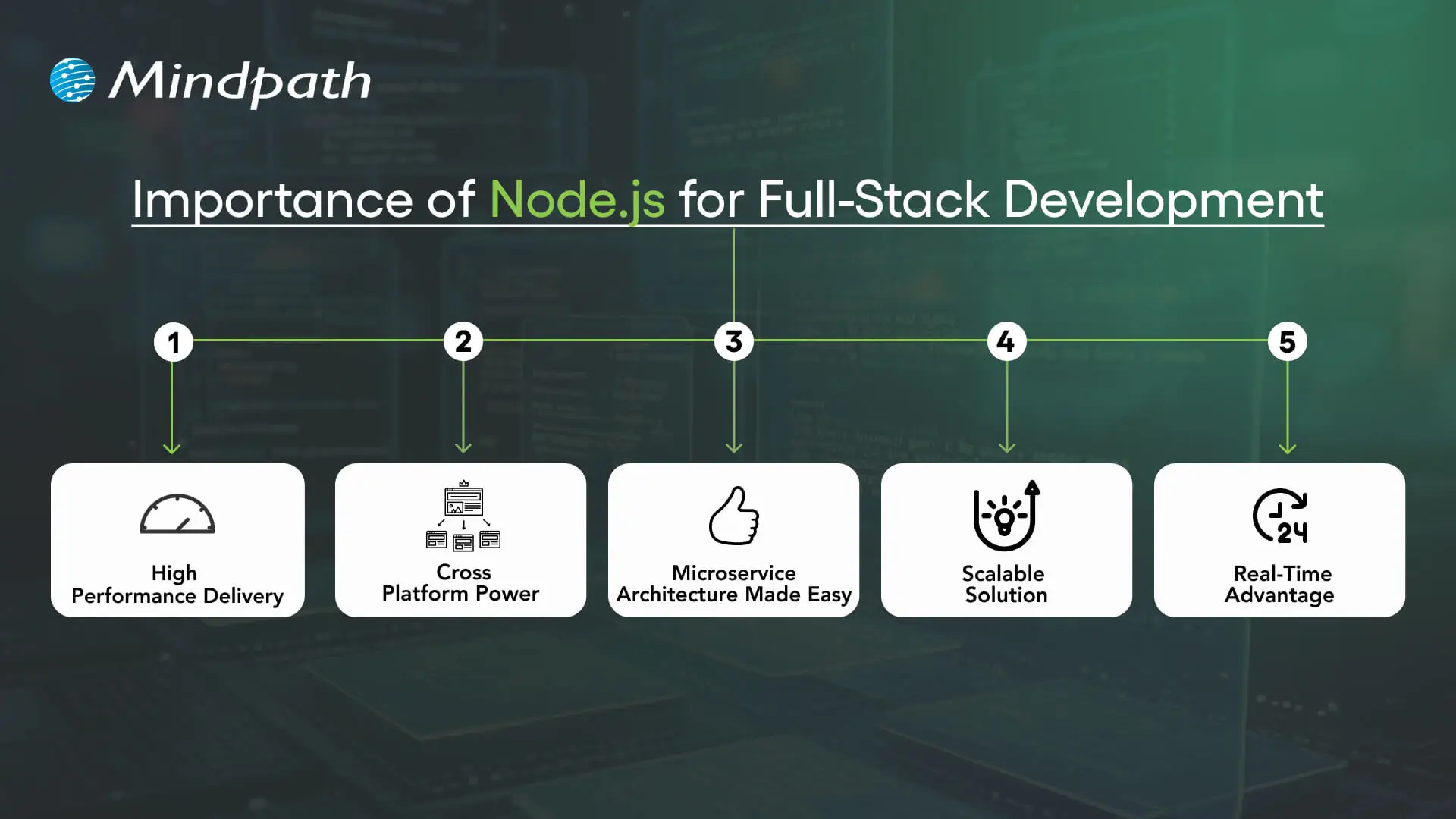
Utilizing Node.js full-stack technology is an impressive approach to developing a complete web application. Here are reasons that Node.js is a valuable technology option in the full-stack.

Importance of Node.js for Full-Stack Development

1. High Performance Delivery

Node.js utilizes a non-blocking I/O hardware model that can handle hundreds or even thousands of requests simultaneously, providing faster response times and greater user-specific.

2. Cross-Platform Power

With the Node.js full stack, developers can write mobile and desktop apps to run on Windows, macOS, Linux, and more. By relying on a single JavaScript code base, developers can save time and effort writing for multiple platforms.

3. Microservice Architecture Made Easy

Full-stack Node allows users to break one larger application down to multiple smaller independent services using infrastructure that is easier to work with. This approach lets developers build faster, stay flexible, and rely on proven solutions.

4. Scalable Solution

Full-stack Node.js is used by major players like Walmart, Uber, and Trello to handle millions of users. It helps to lower load time significantly, and it ensures your applications will scale seamlessly, as your demands increase.

5. Real-Time Advantage

When it comes to applications that leverage chat, live streaming, food delivery, or payments, Node.js full-stack is the way to go. It seamlessly provides real-time updates to keep the user engaged and connected.

Also Read: Full-stack Development for Web Projects

Key Steps to Use Node.js in Full-Stack Development

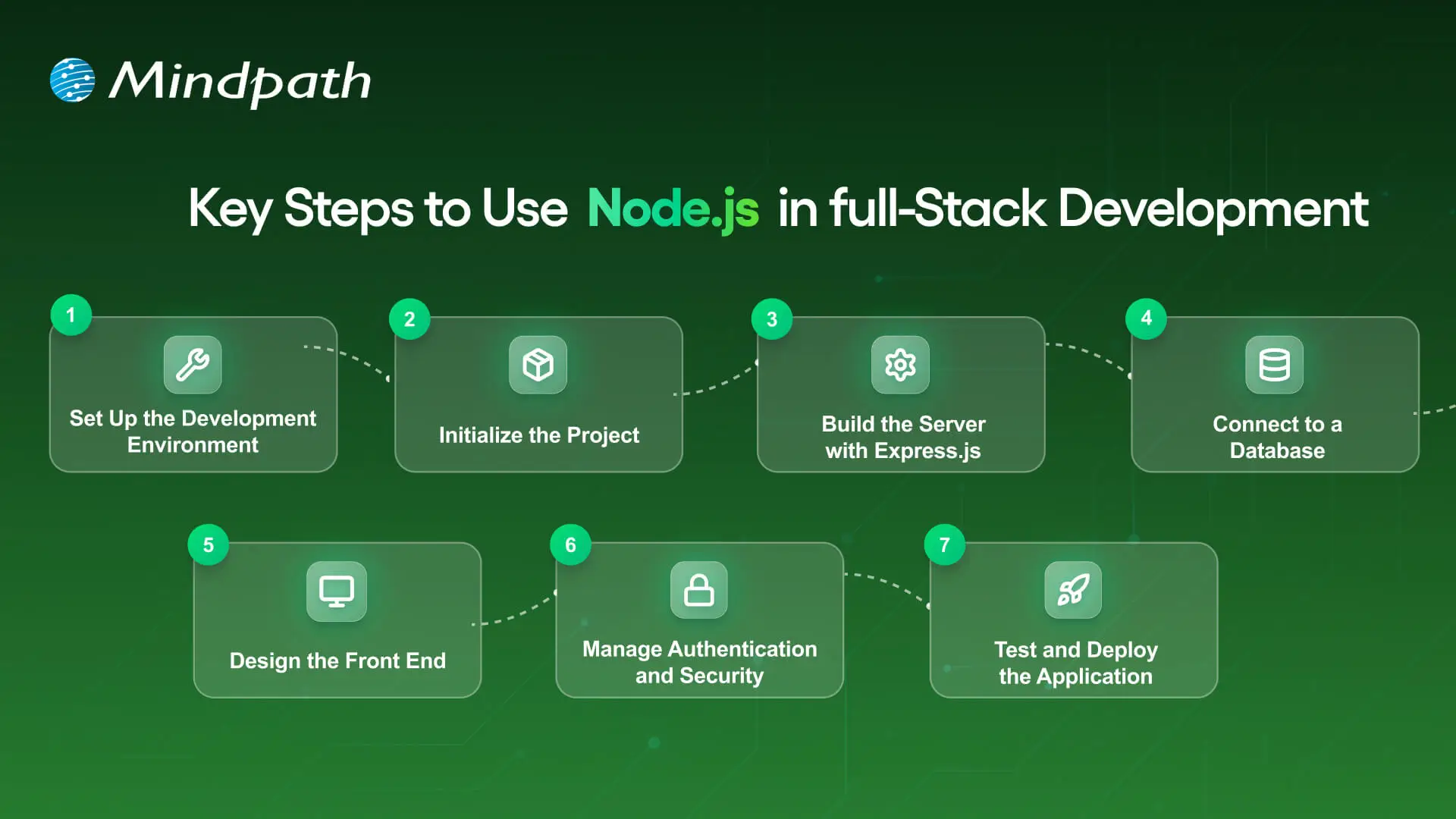
A full-stack Node.js developer is involved in both the front end and the back end of web application development and will work to build complete web applications. Below is a synopsis of the primary steps to utilize Node.js in full-stack development that is easy and productive.

Key Steps to Use nodejs in full stack development

1. Set Up the Development Environment

To begin your application-building experience, you will need to install Node.js and npm (Node Package Manager). These tools will allow you to execute JavaScript beyond the browser, and they will also help manage libraries with ease. Verify the setup by checking versions with simple commands in your terminal.

2. Initialize the Project

Make a new folder for your app, and use ‘npm init’ to create a ‘package.json’ file. A package.json file holds important information, such as your project name, dependencies, and scripts. It will serve as the basis for managing everything in your project.

3. Build the Server with Express.js

Install Express.js so you’ll be able to set up the backend server and handle all of the different routes. Express.js makes handling requests, responses and APIs supposedly easy. This step will ensure the backend runs appropriately with the frontend.

Must Read: Full-stack development trends

4. Connect to a Database

Based on your needs for this project, select a database like MongoDB or PostgreSQL. This should be paired with a Node.js library like Mongoose or Sequelize, which will allow you to connect to and perform both read and write operations on your data. At this point, you will have the ability for your application to persist and retrieve your data.

5. Design the Front-End

Build the front-end using a library such as React, Angular, or Vue. You can link the front-end through RESTful APIs or GraphQL to your Node.js back end. At this point, players will finish the bridge for a Full-stack Node.js application.

6. Manage Authentication and Security

Use libraries like Passport.js or JWT to add secure login and registration. Secure necessary paths so that any authorized user can get to those routes. You should always consider security in any Full-stack Node.js application.

7. Test and Deploy the Application

Create unit and integration tests to ensure that your application does what you intended. Deploy the application to cloud hosting solutions like Google Cloud, AWS, or Heroku. To utilize your Full-stack Node.js application’s performance tool on different scales, you should monitor its performance!

Looking to integrate AI in your Node.js projects? Explore our Ultimate Guide to Node.js Libraries for AI Integration to discover the most effective libraries for building smart, scalable, and future-ready applications.

Ready to Unlock the Power of Full-Stack Node.js?

Full-stack Node.js has proved to be a smart choice for building scalable, high-performing, and real-time applications. It unites front-end and back-end seamlessly, helping developers create complete solutions with speed and flexibility. With its ability to handle microservices, cross-platform apps, and real-time updates, it has become an essential technology for modern web development.

At Mindpath, we provide expert full-stack development services designed to match your business goals. Our skilled Node.js developers bring deep technical knowledge and practical experience to build secure, scalable, and user-friendly applications. If you are looking to transform your digital ideas into reality, hiring a Node.js expert from our team ensures growth and lasting impact.

Master full-stack development with Node.js! Its scalability, performance, and seamless frontend-backend integration.