Home

Transforming Travel: Top Emerging Tech Trends Shaping the Industry

Transforming Travel: Top Emerging Tech Trends Shaping the Industry

Discover top tech trends transforming the travel industry, from AI to IoT, and learn how Mindpath can help your business stay ahead.

Join our Newsletter!

travel technology

Technology has helped in transforming various industries, including finance, retail, and tourism. The advent of travel technology has created new opportunities to enhance the value propositions in tourism, alongside enhancing productivity. Which technology has had the biggest influence on the travel and tourism industry? You can find the answers to this question in an overview of the top technological trends in tourism.

The transformative impact of different technologies has created endless possibilities for enhancing guest experience and customer service. With the adoption of technology in travel and tourism, businesses can find an effective solution to add value to the lives of customers. Let us learn about the top technology trends that have the potential to revolutionize tourism. 

Technology is redefining the travel experience, and businesses must adopt these technologies to stay ahead in the competitive market. Mindpath’s services in AI development, custom chatbots, and web development will support your business journey towards digital transformation.

Understanding Travel Technology

The travel and tourism industry came to a halt for almost a year in response to the global pandemic in 2020. However, change was inevitable, and the tourism industry recognized the importance of embracing technology and digital transformation like other sectors. The introduction of tech in tourism brought a new wave of opportunities to address existing flaws and pursue innovation in delivering better customer experiences. 

According to the World Travel and Tourism Council, the total global economic contribution of the tourism sector is expected to be almost $11.7 trillion in 2025 (Source). For an industry with such potential, technology is no longer a luxury as organizations compete with each other to achieve an advantage. 

The basic premise of travel technology involves the use of IT, e-commerce, and other technologies in the domain of travel and tourism. It primarily aims at enhancing the customer experience while assisting businesses and employees in the tourism and hospitality sector.

One of the best examples of the use of technology in the domain of travel and tourism points at mobile apps for booking trips online. The apps not only provide an easy solution to book tickets and hotels but also represent a shift towards technology-driven experiences in tourism.

Struggling to keep up with changing traveler expectations and digital innovation? Explore our blog digital transformation for businesses to learn how technology drives efficiency, personalization, and growth.

Is Technology Really Necessary for Travel and Tourism?

The example of online booking apps in the travel and tourism sector is not the only instance of the use of technology in the industry. As companies embrace technology in the tourism industry in various forms, it is reasonable to wonder about its relevance. How will technology help in the travel, tourism, and hospitality sector? Technology can help in streamlining and automating processes that require consistent human involvement. As a result, businesses can reduce costs and staffing requirements while achieving better financial results.

The impact of technology in the domain of travel and tourism is also evident in easier access to advanced data insights. With the help of technology, businesses can collect huge amounts of data to improve informed decision-making. In-depth understanding of customer behavior and market trends can help a business create better strategies. The use of technology in the tourism industry will also create the ideal grounds for continuous innovation. Businesses in travel and tourism can leverage technology to stay relevant and attract new customers with improved experiences.   

Curious which technologies help travel apps scale and perform globally? Discover our blog mobile app development technologies to learn how modern development stacks support innovation in the travel industry.

Unraveling the Biggest Tech Trends in Travel and Tourism

The utility of technology in the travel and tourism sector is not limited to booking apps. You can find different technologies in the tourism industry making waves with their ability to revolutionize travel experiences. What are the notable tech trends that will have a significant impact on tourism? The following technology trends will stand out as the biggest contenders for transforming the travel and tourism sector.

1. Sustainable Technology

The growing awareness of the environmental impact of tourism has led many people to think of sustainable solutions. Therefore, travel and tourism companies have to think of innovative technological solutions that have minimal impact on the environment. 

Sustainability will be one of the keywords for tourism technology of the future, as evident in the existing customer behavior trends. For instance, more travelers prefer eco-friendly destinations and use technology for all travel-related needs that reduce the wastage of natural resources.

2. Artificial Intelligence

If you take a look around in the modern technological landscape, AI might be the brightest trend you will notice among other technologies. Artificial intelligence has redefined the benchmarks of efficiency in the approaches to embracing technology in the travel industry with its diverse capabilities. AI and machine learning can bring a lot of benefits to travel and tourism businesses in customer service, demand forecasts, and service recommendations. 

Many companies in the travel and tourism sector leverage AI and ML to predict customer demand and offer personalized recommendations. How would you feel if a travel operator recommends hotels and restaurants that serve your favorite food? AI can also help travel and tourism companies in the form of chatbots and smart virtual assistants. The AI-powered solutions can not only answer customer queries but also offer personalized itineraries and travel plans.

3. Augmented and Virtual Reality

The evolution of virtual reality and augmented reality has offered new ways to experience the world around us, along with virtual worlds. AR/VR technologies provide one of the most promising examples of the potential of travel industry technology to offer better customer experiences. Augmented reality helps in changing how travellers think about their experiences before booking their vacations or business trips. 

The best example of using AR/VR technologies is evident in the case of some airline companies that help passengers experience the in-flight facilities before boarding the flight. Travellers can also get 360-degree virtual tours of hotels or travel destinations while sitting in their homes with AR/VR technologies. Augmented and virtual reality will emerge as the most powerful marketing tools for travel and tourism companies.     

Also Read: Top AI Trends

4. Hyper-Personalization

Another big trend that redefines the utility of technology in tourism is hyper-personalization. The emphasis on hyper-personalization has increased significantly as travel and tourism companies want to deliver exactly what their customers want. Artificial intelligence has made this easier as innovative AI solutions can help in personalizing travel experiences to varying degrees of customer satisfaction.

Travel and tourism companies can leverage AI to generate personalized recommendations and plans for their customers. Custom AI tools can help travel operators find insights from analysis of past behavior, weather conditions, and preferences of travelers. The extensive use of information technology for tourism has enabled easier access to huge collections of user data. Subsequently, those insights can help the companies recommend personalized travel plans that improve customer satisfaction while achieving business efficiency.

5. Voice Search and Voice Control

Voice assistants are one of the prominent highlights in the existing tech landscape. The growing dependence on voice assistants for search is one of the travel tech trends that is hard to ignore. Almost half of all travelers search for travel accommodations and book tickets through voice commands. It is just a matter of time before voice search and voice control become the norm in tourism and hospitality.

Voice search has already become an attractive feature in hotels that allow guests to control room temperature and adjust lighting. You can expect this technology to grow in the future and promote innovations in the travel industry while attracting new customers. Voice assistants in hotel rooms can also help customers request hotel services without interacting with the front desk, thereby improving their experience.

6. Generative AI

The utility of generative AI in travel and tourism also deserves special mention among notable tech trends in the industry. Generative AI can blend tourism and technology in an intuitive manner with the help of language models like ChatGPT. Travel and tourism companies can use ChatGPT or similar tools to create new content for their marketing efforts. On top of it, the language models can help companies provide prompt replies to customer queries and enhance customer satisfaction.

The significance of generative AI in strengthening the technology tourism connection is visible in its different use cases. One of the foremost outcomes of adopting generative AI tools in tourism is the assurance of better productivity. For instance, generative AI tools can help companies with booking and reservations, alongside providing personalized solutions to customer queries.

Wondering how travel businesses can leverage AI beyond basic automation? Learn from our blog about generative AI use cases in diverse industries to see how intelligent content and virtual assistants drive engagement.

Final Thoughts

The top tech trends in travel and tourism showcase that customer experience is the biggest goal of the industry’s transformation. Artificial intelligence, AR/VR, sustainable technology, and voice control are a few of the notable trends that will shape the future of travel technology and the industry itself. Without effective solutions to tap into these technologies, your business is not going anywhere. What do you think is the biggest tech trend that your travel and tourism business should be capitalizing on?

We, at Mindpath, specialize in services for AI development, custom chatbot development, and custom web development. Our end-to-end IT solutions cater to the needs of various sectors, including the travel and hospitality industry. Over the years, our experts have looked at the evolution of technology and the tourism industry from close quarters. We have created many customer success stories with our strategic approach to every project. Contact us to discover the next big tech trend for your travel and tourism company now.

Support Is One Click Away

Featured Posts

Related Post

hire reactjs developer

ReactJS has been one of the most popular JavaScript libraries for user interface development. You might want to hire ReactJS developer for your next project to capitalize on the interesting features of ReactJS. Since its arrival in 2013, ReactJS has been a leading tool for frontend development with capabilities to develop high-performance user interfaces. Let us discover how you can find the best React developers in 2025 for your team.

Are you planning your next project and you need a ReactJS developer? Explore how Mindpath’s ReactJS development services can help bring your concept to life and help you achieve your business objectives.

Why is ReactJS Popular in 2025?

With so many libraries and frameworks emerging every year, it is reasonable to wonder about the reasons for which ReactJS is still popular. You should know that the demand for skilled ReactJS developers is still strong in 2025 as React is the cornerstone of modern web development. Businesses want to hire ReactJS developers for their web projects to capitalize on the various features of ReactJS.

One of the foremost reasons to choose React for frontend development is the backing of Meta, a tech giant. ReactJS was created by Meta, and even after becoming open-source, the library gets maintenance and support at par with the highest standards.

The other promising reasons to pick ReactJS for interface development include the component-based architecture, declarative syntax, cross-platform capabilities, and the virtual DOM. Each feature of ReactJS gives a strong reason to pick the best ReactJS developers for your next project.

The component-based architecture ensures that developers can create reusable UI components, thereby reducing the development time and ensuring easier maintenance. The declarative syntax of ReactJS enhances the predictability of code, which makes it easier to debug. On top of it, the virtual DOM helps in improving performance by avoiding direct modifications to the browser DOM.

Many companies also want to hire react native developers as ReactJS offers cross-platform development support with React Native. ReactJS is a versatile choice for businesses that want to leverage mobile apps for expanding their digital presence. Most important of all, ReactJS is still popular because it has a strong community that is growing continuously with new tools, libraries, continuous updates, and extensive resources.

Must Read: ReactJS Trends

Know Your Requirements to Hire React Developers

The search for skilled React developers might be a challenging task for hiring managers in 2025. Why? The competition among businesses to hire react developer also means that you can find a crowd of applicants for the job of React developers. Therefore, hiring managers must start their search for talented React developers with a clear understanding of their specific requirements. You have to keep the following points in mind while creating the job listing or description of the role.

1. Definition of Project Scope and Complexity

The first thing that you need to know before hiring React developers is the scope of your project. Are you building a single-page application or a complex web portal? Do you need interactive visualizations or have plans to scale up in the future? The answers to these questions can guide you through the React developer hiring process without obstacles. For instance, simpler projects will require a junior developer while complex web applications need senior developers who know API integration, state management and performance optimization.

2. Experience of the Developers

The next aspect of determining your hiring requirements from ReactJS developers is their seniority and experience. It is important to remember that the complexity of a project provides a clear direction when you have to determine the experience level you need in React developers. Junior developers might have less than two years of experience while mid-level React developers have two to five years of experience. Senior developers are the ideal picks for leading projects and making critical decisions, owing to their experience of more than five years.

3. Technical Skills of ReactJS Developers

Another prominent highlight in the process of creating a job description for ReactJS developers is the list of technical skills. You must specify the exact ReactJS developer skills that you need from a React developer in your team. The most important technical skills required from React developers include strong command over JavaScript and core ReactJS concepts, JSX, API integration and state management. You should also know that ReactJS developers must be fluent in HTML and CSS, testing frameworks, debugging and version control.

4. Soft Skills of ReactJS Developers

If you want ReactJS developers who can solve your problems, then you must focus on soft skills. Developers with problem-solving ability, communication skills, adaptability and attention to detail can serve as valuable assets for any organization. For instance, problem-solving skills can empower developers to break down complex problems and come up with efficient solutions. Similarly, adaptability enables ReactJS developers to understand new technologies and embrace change. Furthermore, communication skills and teamwork can help developers work effectively in different environments while tapping into the benefits of collaboration.

Are you missing out on the potential efficiency ReactJS offers for modern web apps? Discover the essential benefits of ReactJS development services to maximize your investment.

Searching for ReactJS Developers in the Right Places

The competition between ReactJS developers is high and with a vast talent pool, hiring managers often worry about the places to recruit React developers. If you know the right place to post listings for React developer jobs, then you can have an easier hiring process. Here are some of the top places to search for the best ReactJS developers.

1. Online Job Search Platforms

The best place to start listing ReactJS developer jobs is LinkedIn, the most popular professional networking platform. It is a great choice for posting job vacancies and searching directly for candidates with advanced filters, based on skills and experience. Some of the other notable job search platforms to hire dedicated developers for ReactJS projects include Indeed, Glassdoor and Monster. Hiring managers can use these job portals to post detailed job descriptions and attract a larger base of applicants for ReactJS development roles. Special job boards such as Stack Overflow Jobs and Discord communities can also help you find talented ReactJS developers.

2. Freelance Platforms

Another notable approach to hire resources for any business is freelancing. Some businesses want to hire remote ReactJS developers according to their budget or strategic plans. For example, remote work can empower developers to improve their productivity with better work-life balance. You can come across multiple freelance platforms such as Upwork and Fiverr to find ReactJS developers for small tasks or short-term projects. Freelance platforms also help you discover developers with specialized skills required for certain projects. One of the reasons to choose freelance platforms is the safety net of their rigorous scrutiny process, which ensures that you work with top-tier ReactJS developers.

3. Professional Networks, Communities and References

If you don’t find a React developer for your next project on different online platforms, job boards and freelance platforms, then you must choose the next best option. Businesses can hire expert ReactJS developers from professional networks and communities. For instance, GitHub is one of the best places to find a lot of ReactJS developers and measure their skills on the basis of their open-source contributions, coding style and portfolio. Developer conferences or React forums can help in obtaining references and identifying skilled developers. Always remember that references from industry contacts can help in identifying talented candidates who can also be the perfect cultural fit in your organization.

Is your current team struggling to handle large-scale React applications? Learn why hiring a React Development Company might be the smarter choice. 

Steps for Hiring the Best ReactJS Developers in 2025

After identifying the important requirements from ReactJS developers and the sources to hire top-tier talent, you need a strategic plan. The plan can not only streamline the hiring process but also offer the ideal template to make informed hiring decisions. You must keep the following points in mind to ensure the most productive hiring process to add talented ReactJS developers in your team.

Step 1: Design an Appealing Job Description

If you want the best ReactJS developers for your next project, then you must create an appealing advertisement. The job description serves as the ad to hire React developer on different platforms and makes the first impression on potential candidates. Experts recommend that the job description must be clear and concise to attract top talent among ReactJS developers. How can you design an attractive job description for React developer roles? You can start by mentioning a clear title that reflects the duties desired from the candidate. The job description must also provide a detailed company overview which shows why your company is a great place to work.

The job description must also include a list of the responsibilities for ReactJS developers in your organization. At the same time, you should also add the list of required skills for the job. While listing the responsibilities and skill requirements, you must be specific about them. On top of it, you must mention some additional skills that you need from ReactJS developers. The most important element that will complete your ReactJS developer job description is the outline of compensation and benefits.

Step 2: Use the Best Screening Techniques

Once you put the job description as a listing on different platforms, you will receive a lot of applications. The initial screening process is mandatory in all cases, whether you want to hire JavaScript developers or ReactJS developers. You can begin the initial screening process with a review of the resume and portfolio of candidates. It is important to check the experience of applicants in ReactJS projects and their work history. Hiring managers must also find out if candidates have contributed to open-source projects with ReactJS.

The effectiveness of the initial screening procedure for ReactJS developers also depends on how effectively you review their code. You should check the quality, structure and ease of maintenance of the code in different projects in a candidate’s portfolio. Automated coding assessment platforms can prove useful in measuring the proficiency of candidates in ReactJS development. The initial screening process may also involve a phone call for reviewing the communication skills, interests in role and salary expectations of applicants.

Must Read: React vs Vue

Step 3: Follow a Structured Approach to Interviews

Interviews for ReactJS developer roles might not be as simple as you have imagined. You should hire React programmers only after a multi-stage interview process for comprehensive evaluation of all candidates. The essential stages that you should include in an interview for ReactJS developer jobs include technical interview, system design interview and behavioral interview. Technical interviews must involve live coding exercises focused on core ReactJS concepts, algorithms and data structures. Hiring managers can provide real-world scenarios with coding challenges to evaluate the hands-on coding proficiency of candidates.

The system design interview is a type of advanced technical interview tailored for senior roles. The primary focus in the system design interview is on scalability, design patterns, complex systems and architecture. Candidates for senior React developer roles must be asked to design scalable React applications or recommend the structure for a large-scale project. Finally, the behavioral interview can serve as a useful tool to measure the soft skills of candidates. Behavioral interviews help in evaluating whether the candidate will be a perfect fit in an organization.

Step 4: Salary of ReactJS Developers in 2025

Another important step in the process for hiring ReactJS developers in 2025 focuses on determining the ideal salary. Awareness of the salary expectations can help a business identify the best compensation for React developers working on their projects. The cost of hiring ReactJS developer depends on various factors including location, experience, employment type, company size and specialized skills. The average annual salary of ReactJS developers in the USA varies between $70,000 and $180,000.

Seeking a development approach that reduces complexity while enhancing functionality? Read why React Web Development is ideal for modern projects.

Mistakes You Should Avoid While Hiring ReactJS Developers

The most crucial step in the process of hiring ReactJS developers is to acquire awareness of common mistakes. For instance, some employers focus a lot on the cost of hiring and go for cheaper options that lead them to problems in the long run. It is important to choose talent that will pushes your project forward on the path to long-term success. Ambiguity in the job description might also be one of the notable mistakes while hiring React developers.

If you want to hire dedicated ReactJS developers, then you must also pay attention to common pitfalls in technical and behavioral assessment of candidates. On top of it, recruiters must also pay attention to the references of a candidate and use updated interview questions.

Ready to Hire a ReactJS Developer Who Delivers Real Results?

You can hire the best talent for ReactJS development in 2025 by focusing on a systematic plan for the hiring process. Hiring managers can rely on professional ReactJS development services to find a way around the intricacies of the hiring process. Professional service providers can help you work with top-tier talent that you can choose according to your project requirements.

Mindpath Tech is your one-stop destination for hiring the best ReactJS developers with years of professional experience. We have been crafting visually appealing web apps and strengthened our reputation as one of the top end-to-end IT solutions provider. Consult with our experts and find ReactJS developers with the most relevant skills for your next project now.

Frequently Asked Questions

1. What is the right time to hire a ReactJS developer for a web project?

Ideally during the planning stage, before development begins. Early involvement allows developers to make informed architectural decisions, choose the right tech stack, and structure components correctly from the start. Delaying the hire until mid-development frequently results in costly structural rework that could have been avoided with proper planning upfront.

2. How should businesses decide between hiring a junior versus senior ReactJS developer?

Project complexity is the primary determining factor. Straightforward applications suit junior developers adequately, while complex platforms requiring advanced state management, API integration, and scalable architecture genuinely demand senior expertise. Mismatching experience levels to project requirements either wastes budget unnecessarily or accumulates technical debt that becomes increasingly expensive to resolve.

3. What are the most common hiring mistakes businesses make when recruiting ReactJS developers?

Prioritizing cost over capability, writing vague job descriptions, and neglecting behavioral assessments are the most frequent errors. Evaluating technical skills in isolation without assessing communication ability, problem-solving approach, and cultural fit consistently leads to team friction, missed deadlines, and project outcomes that fall well below initial expectations.

4. Is GitHub a reliable resource for evaluating ReactJS developer capabilities?

It is one of the most transparent evaluation tools available. Open-source contributions reveal coding style, component structure, version control discipline, and collaborative habits far more accurately than any resume. Reviewing a candidate’s repositories provides genuine insight into real-world coding quality before any formal interview stage begins.

5. What should businesses realistically budget when planning to hire a ReactJS developer?

In the United States, annual salaries range between $70,000 and $180,000 depending on experience, location, and specialization. Total hiring costs extend beyond salary to include recruitment expenses, onboarding, and equipment provisioning. Freelance or agency engagements offer more budget predictability for businesses with clearly defined project scopes and fixed timelines.

How much does hiring a ReactJS developer cost? Learn about factors affecting rates, and how to find the best talent within your budget.
attention mechanism explained

In the rapid innovation of AI, there are some innovations that don’t just boost existing techniques but also completely change the field. And one such innovative breakthrough is the attention mechanism. Are you searching for the attention mechanism explained in easy words to get a better idea about it? If yes, then this is the right place for you. The attention mechanism has completely changed the process of textual sequential data handling. Besides, it increases NLP’s capabilities. The attention mechanism also has a massive impact on computer vision, along with other domains. 

In this detailed blog, we will dive deep into the attention mechanism explained through some easy examples. Besides, we will go through different types of attention mechanisms and understand why it is a game-changer for AI models.  

Want to see how the attention mechanism can transform your workflows by enabling more precise AI applications? Mindpath’s AI development services bring these advancements to life through scalable, high-performance AI solutions designed for your business goals.

What is the Attention Mechanism?

Before exploring the attention mechanism explained in detail, let’s try to decode the basics. 

Suppose you are reading a sentence that says “John is playing football”. What will be your answer if someone asks “Who is playing football?” You will instantly say “John”. If you analyze, you will understand that here you don’t through the entire sentence. You just focus on the important part, i.e., the subject or name. This is what the attention mechanism does. 

The attention mechanism in AI directs AI models to focus on only the relevant data and assign weights to input tokens. This dynamic focus lets models understand the context more accurately and generate accurate outputs. The attention mechanism has increased AI models’ performance in tasks such as question answering, image analysis, summarization, and translation. 

The Example of Attention Mechanism

To understand more about the process of attention mechanisms, consider this sentence translation task as an example. 

Let’s take the sentence “ The dog is enjoying his treat.” When a model translates the sentence, it needs to understand the subject first. Based on that, it will generate the result. An attention mechanism helps models assign scores or weights to every word. Then, it considers the score to understand the important words. “The” gets a low score as it is a determiner. Dog receives the highest weight as it is the subject. The word “Sat” mostly attends to the word “Dog” to understand the meaning clearly.  By adjusting these scores, models generate results that are more accurate. Well, it’s just like how we focus on a crucial part when describing meaning. 

What are the Different Types of Attention Mechanisms?

Now that we have discussed the attention mechanism explained with an example, let’s explore the different types of attention mechanisms. Each mechanism plays an important role in how models process, understand, and prioritise data while performing tasks such as contextual reasoning or summarisation. 

1. Additive Attention

Introduced by Bahdanau et al., this was one of the oldest attention mechanisms. It was primarily used for machine translation. It functions by combining the query of the decoder with the encoder’s hidden state or the key. After that, it passes them through a feed-forward neural network to calculate the attention score. It is a perfect option for handling input and output sequences of varying lengths. 

2. Self-Attention

This marks a major turning point in AI models. A crucial feature of Transformer models,  self-attention helps AI models focus on different parts within the same sentence. This makes the model understand the context. Self-attention enables more accurate contextual understanding. That’s why it is vital for AI models such as GPT,  T5, H20.ai, and BERT. 

3. Multiplicative Attention

This version of the attention mechanism simplifies the process. Instead of concatenation, this mechanism utilizes a dot product between the decoder and encoder’s hidden states to compute the score. It is more efficient as well as faster compared to additive attention. It is also available in two sub-variants, such as Global attention and Local attention. 

4. Cross-Attention

It is generally used to compare two input sequences. When performing tasks such as machine translation, the AI model utilizes information from the target as well as the source sequences to establish relationships between them. This mechanism enables models to focus on the relevant parts to generate new elements. Developers can use it the self-attention mechanism to make transformer models handle complex tasks. 

5. Scale Dot-Product Attention

Transformer models like GPT, come equipped with this mechanism.  It calculates the weights by taking the key vector and the dot product of the query. It eliminates sequential bottlenecks, which are common in earlier models like Recurrent Neural Networks. 

6. Multi-Head Attention

As a powerful extension of self-attention, it can run multiple operations in parallel. Each head learns various aspects of data. For instance, while one head may capture semantics, another may focus on syntax. The outputs are then combined and transformed. This makes the model create a more nuanced and richer representation of the input. 

These types of attention mechanisms demonstrate the advancement of attention techniques in AI. With these innovations, AI models have moved beyond rigid processing. 

Looking for efficient ways to optimize large AI models? Discover Low-Rank Adaptation (LoRA) to explore techniques that increase model performance with minimal resources.

The Rise of Transformer Architecture

In 2017, a paper named “Attention Is All You Need” introduced the Transformer architecture. It abandoned convolutional and recurrent layers.

You might be wondering why it is revolutionary. Here are the reasons. 

1. Elimination of Long-Range Dependencies

By computing attention between multiple data points in a sequence directly. This solves the long-standing issues of processing long-term dependencies. The distance between words will always be the same, regardless of their position in the original sentence. 

2. Parallelisation

In general, RNNs are sequential. That means you may need to use the hidden state of the previous step to compute the next. On the other hand, self-attention enables AI models to carry out computations for various parts in the sequence in parallel. This, in turn, significantly speeds up model training times. 

3. The Transformer Effect

The transformer architecture, powered by attention mechanisms, can unlock the maximum potential of transfer learning. By effectively pre-training on unlabeled datasets, models such as can learn deep language representations. 

After that, these models can be further optimised with minimal labelled data. They can offer accurate outcomes while performing various tasks. 

Wondering how transformer-based AI models work behind the scenes? Explore the Large Language Model (LLM) guide to learn how attention layers power advanced AI applications.

Applications of Attention Mechanism in AI

The attention mechanism is a core element of modern AI. It enables various AI models to focus on the input data’s relevant parts. Here is how it is driving impact. 

1. Machine Translation

Attention mechanism helps AI models analyze the right words present in source sentences. This, in turn, makes translation context-aware and more accurate. 

2. Image Captioning

Focusing on certain areas of an image helps models to create more descriptive and meaningful captions. 

3. Question Answering Systems

Attention enables AI models to focus on relevant parts of a question. As a result, they produce more precise answers with updated information. 

4. Speech Recognition

It also significantly improves how models maintain a balance between text and spoken words. The results? Improved fluency and recognition accuracy. 

Looking to implement advanced AI solutions in your business? Explore AI consulting to discover how expert guidance helps leverage attention-powered models for smarter and data-driven results.

Enabling Smart Learning in AI Models

After going through this attention mechanism explained in easy words, we can say that it marks a vital moment in AI model evolution. By giving models a context-aware way to focus on the relevant data, the attention mechanism eliminates the limitation of step-by-step processing. 

That is why today’s AI models can process images with impressive accuracy. Besides, they can offer meaningful conversations. Thinking about harnessing the power of the attention mechanism for your AI tools? Mindpath can help you with this. Our AI development services help businesses deploy, optimise, and integrate attention mechanism-powered models. We ensure you benefit from high-performance, context-rich AI. The future of smart learning is here, and we can lead you to attain the desired success. 

generative AI predictions

What does the future hold for generative AI in 2026? Do you think it will become smarter, more creative and give the best human-like responses? As technology continues to evolve at lightning speed, it is natural to wonder where we are headed next, isn’t it? So, if you are interested in generative AI predictions and how this advanced technology could influence industries, work and creativity, you are totally on the right page.

It is anticipated that by 2026, generative AI will be more integrated, accessible, and advanced, embedded in our daily lives. The abilities of AI are now growing rapidly, beginning with automating intricate tasks and transforming customer experiences to helping in creating content and driving personalized learning. Let’s understand what is the future outlook for generative AI and how it will be impacting the tech world.  Before we move further, let us first have an idea about the current state of GenAI market. 

Looking to stay ahead with generative AI innovations? At Mindpath, we provide AI Development Services that enhance business performance with advanced AI solutions.

Generative AI Market Overview

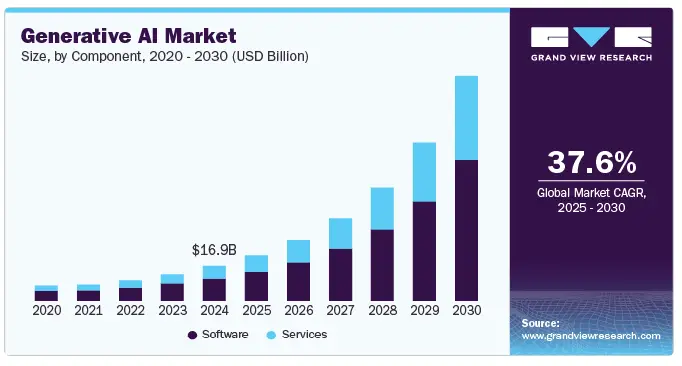
As per Grand View Research, the global generative AI market size was worth USD 16.87 billion in 2024 and will expand rapidly at a CAGR of 37.6% from 2026 to 2030. The increase is fueled by technologies such as text-to-image conversion, super-resolution and video generation. Companies are employing generative AI to transform processes and enhance creativity, and AI has become an integral aspect of day-to-day activity in sectors. 

generative ai market

Interestingly, software accounted for 64.2% of the generative AI market in 2024. Businesses are leveraging AI software to address fraud, data privacy concerns, and unpredictable outcomes. Sectors such as fashion and entertainment are embracing it rapidly. H&M and Adidas are some of the brands utilizing generative AI to design garments and create custom sneakers. These companies are expediting and streamlining the creative process for their staff.

This expanding application definitely demonstrates how generative AI trends are influencing the future of work and creation. As additional sectors turn to AI-powered solutions, demand for more intelligent, quicker, and more agile solutions will continue to increase. 

Also Read: Generative AI Use Case

Generative AI Predictions for 2026 That Will Reshape the Tech

As we enter 2026, generative AI will have an even larger impact on changing how we work, create, and interact with tech. These are some of the best generative AI predictions for 2026 that outline where this revolutionary technology is going next: 

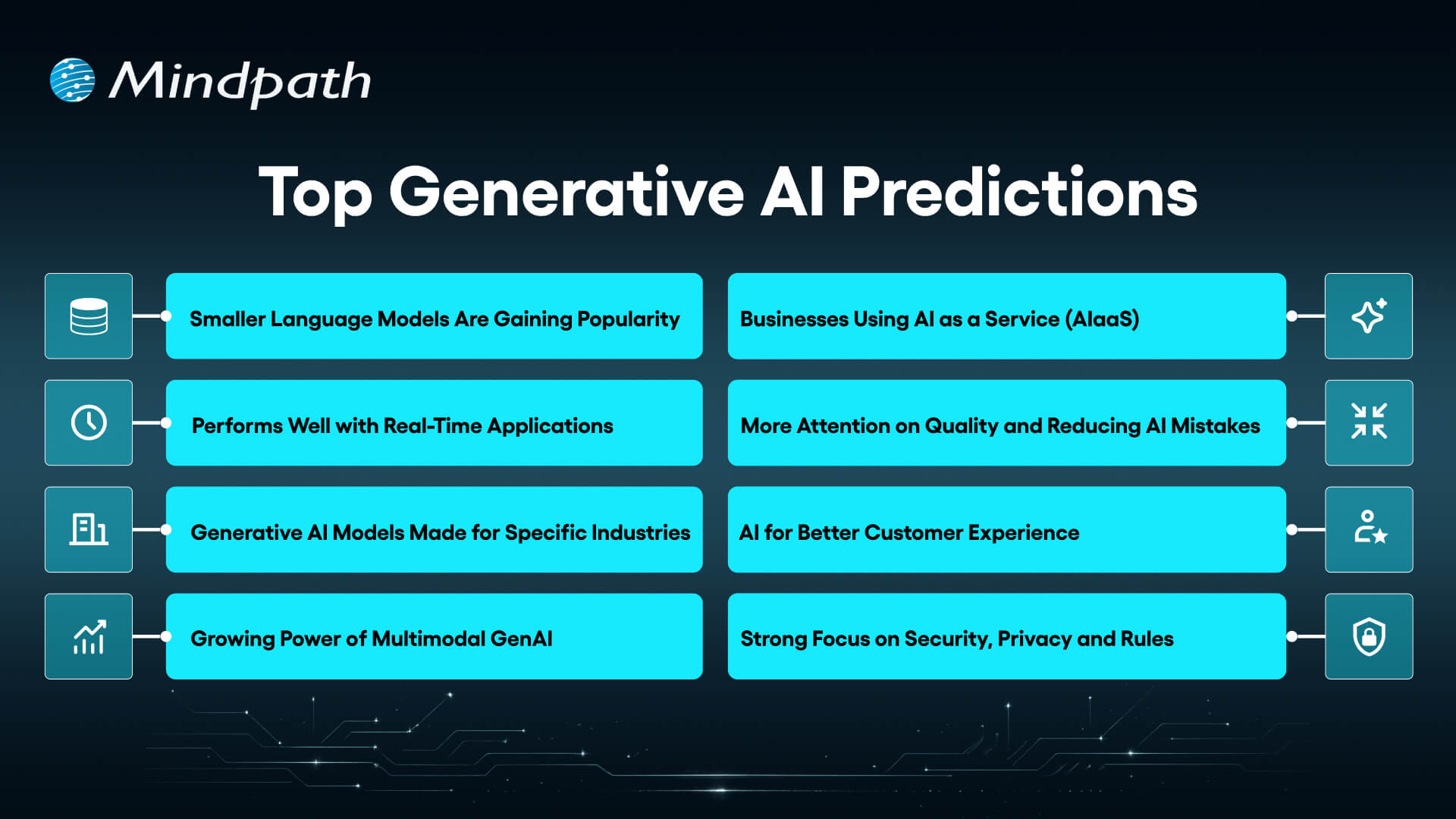
Top Generative AI Predictions

1. Smaller Language Models Are Gaining Popularity

The language model market is expanding rapidly, and now there’s a movement towards utilizing smaller models rather than larger ones. These smaller language models (SLMs) are more affordable, easier to implement, and can be used on devices such as phones and tablets. They still provide intelligent AI capabilities but require less power and data. Microsoft, Google, Meta, and Apple are at the forefront of driving this change, making AI more convenient and accessible for use in everyday life. 

2. Performs Well with Real-Time Applications

Generative AI is beginning to perform really well with real-time applications. That is, it will be able to generate content, images, or answers instantly while things are unfolding. This development is a major example of generative AI changing the creative industry, as it allows for rapid creation and adaptation of content. During live chat, it will generate custom visuals on the spot, and adjust to changing circumstances in real-time. It will enhance customer support, e-learning, and entertainment by making them more interactive and seamless, allowing users to receive speedier, more customized results in real time. 

3. Generative AI Models Made for Specific Industries

A growing trend in generative AI is building models that focus on one specific industry, like healthcare, law, or marketing. These models understand the special terms and needs of that field, so they create more accurate and useful content. Instead of trying to do everything, they do one thing really well. For example, they can write medical reports or legal documents with more detail and clarity. This makes generative AI more helpful and reliable for professional use. 

4. Growing Power of Multimodal GenAI

Multimodal generative AI means AI that can understand and create different types of content like text, images, and voice all together. OpenAI’s GPT-4 started this trend, and now Google’s Gemini and Anthropic’s Claude 3 are joining in. Soon, users will expect these features as a standard, especially in paid AI tools. As the technology improves, AI will create better images, videos, and other media, making interactions more natural and helpful for everyday use. 

Want to stay ahead in the AI-driven market? Learn how AI programming languages power intelligent solutions, from data processing to smart apps tailored for modern business needs.

5. Businesses Using AI as a Service (AIaaS)

AI as a Service (AIaaS) is becoming popular in generative AI. Instead of building AI systems from scratch, many businesses will use outside experts to help them. These consulting firms guide companies on the best AI solutions without big upfront costs. AI Modeling as a Service (AIMaaS) will grow too, offering flexible models for different needs. These services also focus on security, rules, and easy setup, making it simpler and safer for companies to use AI without having experts on their own team. 

6. More Attention on Quality and Reducing AI Mistakes

As people notice wrong or misleading info from AI, companies are working harder to improve quality and reduce errors called hallucinations. OpenAI leads by making its models more accurate and sharing clear research to build trust. Google’s Gemini lets users give feedback and compare answers with real-time internet sources, helping improve results. More AI companies will follow this approach, using user feedback and being open to make AI safer, more reliable, and trustworthy for everyone. 

7. AI for Better Customer Experience

More companies are adding generative AI into their everyday work and customer tools to make things smoother and faster. Models like GPT-3.5 and GPT-4 are used in websites, apps, and chatbots to help customers with personalized answers and recommendations. Soon, AI-powered tools will be expected by users during shopping or research. Businesses that don’t use AI this way may fall behind, as customers prefer easier, smarter, and faster experiences powered by AI. 

8. Strong Focus on Security, Privacy and Rules

With new AI laws and growing public attention, businesses and AI companies must pay more attention to AI safety, privacy, and rules. Right now, few focus on AI governance, but this will change as concerns about AI risks grow. Soon, companies will use special tools and human checks to make sure AI works responsibly and safely. Clear AI policies will help protect businesses from problems. Keeping AI secure will be very important as it becomes part of everyday work.  

If you’re exploring smarter ways to deliver customer support. Read our blog on AI for Customer Service, where we highlight how chatbots and virtual assistants can improve customer satisfaction and drive measurable business growth

Preparing for the Generative AI Shift?

The future of generative AI in 2026 looks incredibly promising. Advancements are making AI smarter, faster, and more tailored to specific industries and real-time needs. As AI becomes more integrated into everyday business and consumer experiences, the focus on quality, security, and ease of use will drive widespread adoption. These generative AI predictions highlight a transformative shift in how industries operate, innovate, and engage with technology, setting the stage for smarter, more creative, and efficient solutions. 

At Mindpath, we are committed to helping businesses harness the full potential of generative AI. Our cutting-edge generative AI solutions are designed to deliver customized, secure, and scalable AI-powered tools that boost productivity and enhance user experiences. With expertise in deploying industry-specific models, real-time applications, and AI governance, Mindpath ensures your business stays ahead in this rapidly evolving Gen AI landscape. 

Frequently Asked Questions

1. What do generative AI predictions say about how businesses will use AI by 2026?

Generative AI predictions suggest that businesses will use AI more deeply in daily operations, from automating tasks to improving customer interactions. Instead of being optional, AI tools will become a regular part of workflows across industries to increase speed, efficiency, and personalization.

2. How will smaller AI models change the way technology is used?

Smaller AI models are expected to make technology more accessible by running directly on devices like phones and laptops. This reduces dependency on heavy systems and allows faster responses, better privacy, and easier use of AI in everyday applications.

3. Why are industry-specific AI models becoming more important?

Industry-specific models focus on one field, which helps them deliver more accurate and relevant results. For example, a healthcare model understands medical terms better than a general one, making AI more reliable and useful for professional and specialized tasks.

4. How are generative AI predictions shaping real-time applications?

Generative AI predictions show a strong shift toward real-time responses, where AI can generate content, suggestions, or solutions instantly. This is especially useful in areas like customer support, live content creation, and interactive learning, where speed and accuracy matter.

5. What changes can be expected in AI security and privacy in the future?

As AI adoption grows, there will be stronger focus on data protection, transparency, and responsible use. Businesses will need better systems to manage risks, ensure compliance, and maintain user trust while using AI in their everyday operations.