Home

Offshore Software Development: What You Need to Know

Offshore Software Development: What You Need to Know

Join our Newsletter!

offshore software development

Offshore software development is redefining how businesses are developing digital solutions. Are you still wondering what we mean by offshore? It means working with teams or services located in another country, often to obtain cost-effective expertise and accelerate delivery. In the world of software, this approach opens doors to global talent, allowing companies to develop high-quality products without the high expenses of local hiring

To elaborate, what we are referring to is outsourcing software development tasks to overseas teams that specialize in the technology and services. These teams are often found in areas with proven traditional IT qualifications and strong pricing competitiveness such India, eastern Europe, and southeast Asia. Do you want to learn more about this development? Don’t worry, in this blog we will be going into all you need to know about offshore software development. 

Ready to take your business to the next level? Partner with Mindpath for expert offshore development services that drive innovation, efficiency, and growth. Contact Us!

What is Offshore Software Development?

Offshore software development refers to collaborating with a software team that is located in a different country to manage your tech initiatives. An example for it can be a UK-based company that hires a Philippine development team to build a website or software tool. This helps reduce costs and makes it easier to find the right talent. Businesses prefer this model because they get quality work without spending too much money. The Philippines, for instance, offers skilled developers who are experienced and reliable. While there might be challenges like time zone gaps or communication styles, this kind of software development still helps companies finish projects faster and focus on their main goals. 

Fascinatingly, according to a Business Research Insights survey, the software offshore market was worth roughly USD 160.9 billion in 2024, and is on track to reach USD 413 billion by 2033, with a CAGR of 11.04%. Factors for this growth in the offshore software market include the affordable technology needs to increase usage, the demand for tech solutions to better connect with the global community, and also the need for talented developers. Countries such as India, China, and parts of Eastern Europe have emerged as preferred locations, because they provide access to talent, sufficient infrastructure, and a business-friendly environment.  

What is the Offshore Development Process?

Offshore software development is the development of software with teams in other countries that help you in the efficient building and maintenance of your software. Here is a simple set of steps that companies tend to go through when working with offshore developers: 

offshore software development process

1. Recognizing the Need

The organization recognizes it has additional skills or resources requirements, and they must determine what to outsource like coding, testing, or support work.  

2. Finding an Offshore Partner

They seek a trusted team in another country with a solid skill set and experience, often in a region well known for technology. 

3. Beginning the Project

Both teams establish project goals, working timelines, and methods to communicate, likely via video calls or project tracking software. 

4. Developing and Coding

The offshore team will begin the project and communicate updates consistently, using project tracking and collaboration tools online 

5. Testing and Quality Assurance

The teams will thoroughly test the software to resolve any challenges, ensuring it all works before launching. 

6. Deployment of the Software Solution

The completed software solution will be deployed and the team will continue to provide services or updates according to demand. 

7. Continued Collaboration

The firm will still do business with the offshore team in terms of updating and improving and developing future work. 

While offshore development gives you access to global talent and cost advantages, you may also explore custom software development to better understand when tailor-made solutions are the right choice.

Benefits of Offshore Software Development

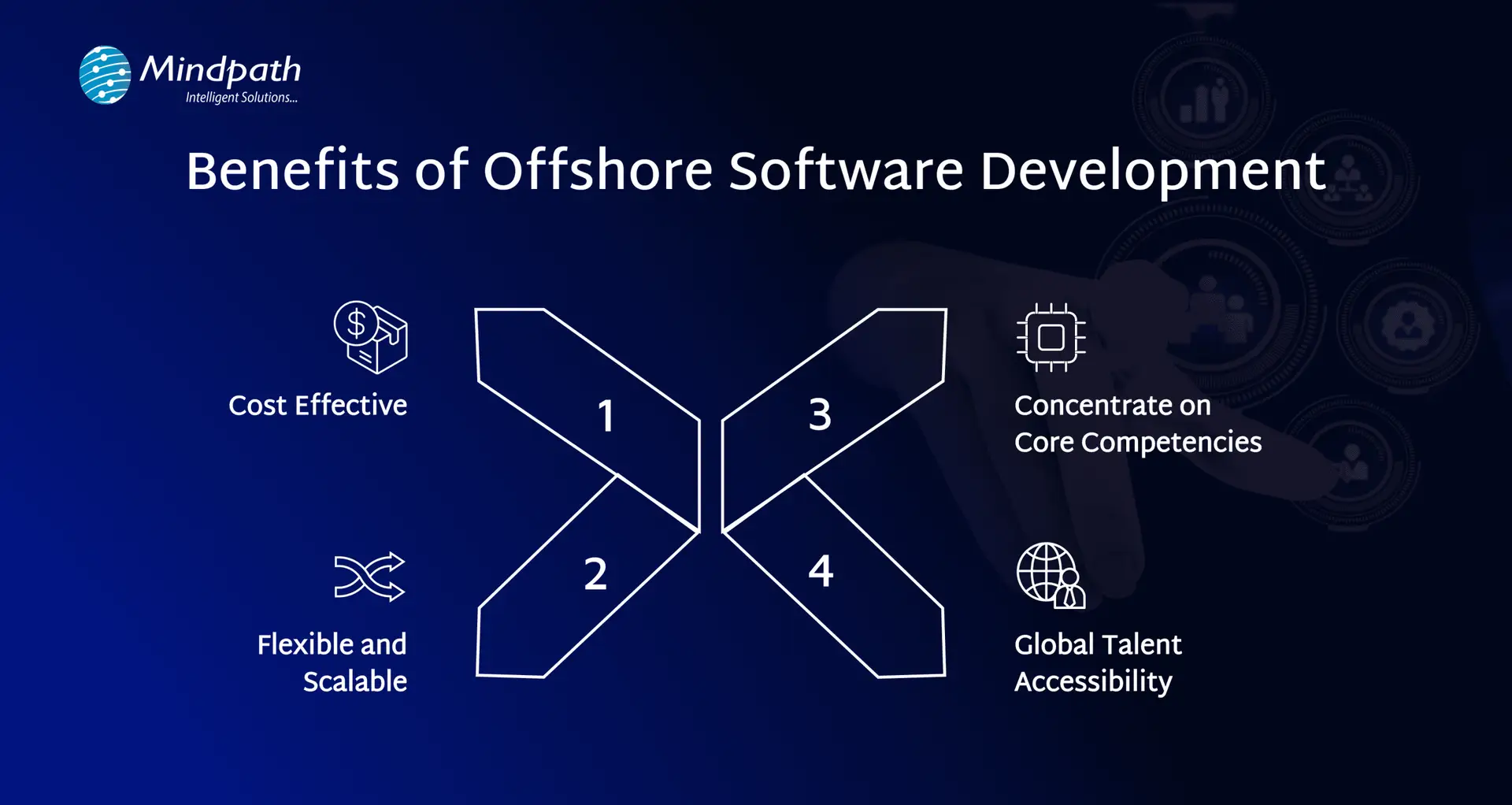
Development of offshore software is now a common approach for businesses that want to increase their tech potential. It fosters sustainable growth by providing a more intelligent way of managing development requirements across countries. Let us examine its benefits: 
benefits of offshore software development

1. Cost-Effective

Sometimes, hiring developers from other countries can cost less than building a local team. This could help companies save money without sacrificing quality. The additional budget can be utilized to help grow the business, such as marketing or product upgrades. It is a more resourceful approach to balancing costs while remaining competitive.

2. Flexible and Scalable

Offshore development services easily allow you to adapt team sizes and add or downsize developers based on project needs. There is ease of access to add a number of developers to your team when your workload increases, or to scale down easily as workload begins to slow down. This provides operations with greater flexibility, gives you quicker access to talent while avoiding lengthy hiring processes. This engagement allows quicker delivery for your clients and provides a smoother operating working relationship for your offshore team.

3. Concentrate on Core Competencies

Future-proofing by outsourcing software work allows companies to turn their attention back to what they do best. They can manage just the right amount of technical detail, and spend more time on strategy, customer service, or new product growth. While offshore teams will take care of the technical detail while being very diligent and skilled in doing this work, allowing companies to focus on even bigger parts of the operation like overall performance

4. Global Talent Accessibility

Offshore teams also allow companies to expand their access to the world’s best talent. Instead of only hiring locally, your teams have access to experts from around the globe, which can be a huge advantage for partnerships and companies looking for the exact skills they need. Skilled and knowledgeable individuals will lead to improved, more diverse ideas, a wider range of perspectives, and improved quality assurance, all of which will lead to improved and better-quality results. It is a great opportunity to be more intentional about building and fine-tuning more creative teams. 

If reducing onboarding time and accessing a wider talent pool are priorities, our article on the key benefits of hiring remote developers shows how remote hires can complement offshore strategies.

Ready to Work with an Offshore Software Development Company?

Offshore software development has become a powerful strategy for companies looking to build high-quality digital products without stretching their budgets. By working with skilled teams from other countries, businesses can meet deadlines faster, access a wide talent pool, and stay focused on their core goals. While it may come with a few challenges like time zone gaps, the right planning and communication make it a highly effective and scalable approach for long-term success. 

At Mindpath, we provide reliable offshore software development services tailored to your business needs. Our global teams bring technical expertise, timely delivery, and smooth collaboration to every project. Whether you need help with custom software, mobile apps, or support and maintenance, we’re here to support your goals with cost-effective solutions. With clear communication and dedicated teams, Mindpath makes offshore development simple, efficient, and successful for companies of all sizes. 

Frequently Asked Questions

1. How can communication gaps be managed effectively in offshore software development?

Clear communication channels, regular meetings, and proper documentation help reduce misunderstandings. Using collaboration tools and setting overlapping working hours can improve coordination. A structured communication plan ensures both teams stay aligned, even when working across different time zones and cultural contexts.

2. What should businesses check before signing a contract with an offshore team?

It is important to review technical expertise, past projects, client feedback, and security practices. Clear agreements on timelines, deliverables, and communication methods should be defined. This helps avoid confusion later and ensures the partnership is built on transparency and mutual understanding from the start.

3. How does offshore development impact project timelines and delivery speed?

Offshore teams can often accelerate delivery by working in different time zones, enabling near round-the-clock progress. However, proper planning is essential to avoid delays caused by coordination issues. When managed well, it can significantly improve turnaround time and overall project efficiency.

4. Is offshore software development suitable for small and mid-sized businesses?

Yes, it is often a practical choice for smaller businesses looking to access skilled talent without high hiring costs. It allows them to build quality software within budget while focusing internal resources on growth, operations, and customer engagement.

5. How can businesses maintain quality control when working with offshore teams?

Quality can be maintained by setting clear standards, conducting regular reviews, and using testing frameworks throughout the project. Continuous monitoring, feedback loops, and defined performance metrics help ensure the final product meets expectations and aligns with business requirements.
Support Is One Click Away

Featured Posts

Related Post

scalable web development with react

Talking about modern web development, scalability has turned out to be a major concern. With the growing complexities and size of your application, its architecture and inclusive technologies should match the pace. This is where React has come out as a famous JavaScript library for creating user interfaces that remain robust. Scalable web development with React is highly adopted due to its ingenious performance and flexibility. As per the recent trends, there are around 2 billion websites available on the internet, and out of these, more than 1.3 million sites have been designed through React. (Source: Click)

However, creating a scalable React app requires knowledge beyond basic elements related to the library. You are required to stick to the best practices to ensure your app’s efficiency with its growing customer base. Let us unveil how you can master such abilities in this blog.

Looking to build scalable and user-friendly web applications that keep your business ahead of the competition? At Mindpath, we offers expert ReactJS development services designed to deliver high-performance and future-ready digital solutions.

What Does Scalable Web Development Actually Mean?

Scalable web development ensures your developed app is handling growth without hampering its quality and performance values. In order to do this, your application might encounter growth in many forms, as given below.

  • Expansion of your site into new market domains.
  • A sudden increase in users to try your services.
  • Inclusion of complex features and integration with third-party applications.

So, scalable web applications can easily adapt to such changes seamlessly instead of complete new code rewriting. This is exceptionally necessary in today’s competitive digital environments where speed and reliability directly affect customer experience and retention.

Wondering which React trends are shaping modern web development? Explore emerging ReactJS trends that are shaping the future of scalable web solutions.

Why is ReactJS Development Viable for Scalable Web Applications?

React has emerged as a practical library instead of only being popular. Its effective ecosystem and architecture make it a viable preference for creating scalable web applications.

1. Component-Driven Architecture

ReactJS comes with a component-driven architecture. So, you can easily get its reusability features and independent parts. Each part of the component prioritizes specific functions, which enables you to effortlessly integrate React integrations. With such an approach, the more evolving your application gets, React will ensure the code of your application is intact.

Your team of developers can make necessary changes to the functionalities without redesigning the whole structure of the application. You can also enhance the quality of the code through interactive components. For more goal-oriented elements, you can hire ReactJS developers with years of experience.

2. State Management Along with the Inclusion of Context API and Redux

It is very seamless to maintain state management in React with the usage of tools like Context API and Redux. Due to the state management, you can ensure that your developers keep data consistency on large-scale apps. ReactJS, along with Redux for state management, can minimize code repetition.

This makes the app more manageable and scalable. Moreover, the environment of React ensures the UI components have exclusive data flow. So, with tools like this, your scaling efforts can be easier to handle while keeping the app clean and ready for scaling up.

3. Efficient Performance through Virtual DOM

React uses a virtual DOM to update the parts of the interface that actually change. So, instead of reloading the whole page, ReactJS development ensures updating specific components. Accordingly, it results in faster rendering and incredible performance, even if your application becomes more complex.

This valuable performance optimization plays a critical role in scalable web development with React. This is important for applications that require higher user retention.

4. Exclusive Tools and Ecosystem

Some apps come with built-in server-side rendering that easily improves the performance of your React app. Further, this has safeguarded the flexibility to suit the present development of the app. So, you can easily extend the structure of your application without making any major changes to your current app.

Most importantly, React is backed by a major global community and continuously diversifies its tools. So, starting from routing to performance optimization, the ReactJS development services support long-term growth. This also makes React a safe and future-proof library for developers.

How does Create React App Leverage Scalability?

If you want to create React app projects efficiently, CRA offers a seamless starting point. Moreover, it removes configuration risks and sets up a modern development environment quickly. With CRA, you can discover pre-built tools and dedicated development workflows. So, along with your growth needs, you can easily make changes within your projects.

While CRA is specifically designed for small projects, it can also offer an exclusive foundation for large applications when combined with authentic architecture.

Essential Elements to Create Scalable Web Development with React

Scalability is not automatic at all. You need proper planning to execute it. Below, you can go through some proven principles that can offer you long-term success when using React.

1. Target for Growth from the Initial Phase

Many scalability issues happen because applications were built to satisfy immediate requirements. However, they fail to meet the future growth. So, it becomes necessary to plan ahead. You can hire ReactJS developers who can help you structure your folders and define the reusable components. With better knowledge of the concerns, you can make future expansion easier. A well-structured React application grows naturally instead of becoming challenging to maintain.

2. Manage State Smartly

State management becomes more complicated with the scaling up of the application. So, improper handling can give rise to performance issues and unpredictable risks. With structured state management, you can be assured of predictable data flow and reduced unnecessary re-renders. Further, it will be easier for you to debug and make changes as per the requirements of your business. This is very important for scalable web application development with React.

3. Segment the Application into Logical Modules

Your large applications should not feel like one major block of code. With feature-based and module-based structuring, your team can independently work on multiple parts of the app without any conflicts.

4. Enhance Load Times

Your scalable app should adopt the relevance of loading faster, even as it grows with more users. Lazy loading ensures that users download only the code they require at a given moment. This incorporates load speed in the initial phase and user experiences, along with overall performance. Further, scalable web development with React adopts the built-in efficiency of lazy loading. 

5. Be Prepared for Testing

With your application growth, it might give rise to undeniable bugs.  So, automated testing ensures that new features and elements don’t hamper your existing functionality.

Ready to elevate your React projects with intelligent, user-centric features? Explore the powerful synergy of ReactJS and AI in this in-depth guide.

Why Are Businesses Consistently Investing in Quality ReactJS Development Services?

React is no doubt accessible, but creating a truly scalable system requires extensive knowledge and years of dedicated experience. This is why many businesses are turning to professional ReactJS development services instead of handling everything on their own.

The expert team always offers strategic architecture planning and has great performance optimization knowledge. Further, professionals include industry best practices to ensure your project meets the requirements while assuring faster time to market. This level of expertise ensures your application is built for growth and not just for the launch. Many companies can’t decide when they should hire ReactJS developers. So, you should prefer hiring experts if your demand is long-term growth, frequent updates, or complex workflows.

  • Skilled developers can help you stay away from costly rewrites.
  • They can design systems that scale seamlessly.
  • Professionals offer consistent user experiences and maintain high performance with the demand increase.

Common Challenges You Might Face in Scaling React Applications

Your scaling might come across certain challenges, even with the right tools. Some common issues include poor state management decisions and overly complex component structures. Further, performance issues and impractical coding efforts can also be a risk. These challenges highlight why experienced developers and structured workflows are necessary to be successful with your ReactJS development.

Struggling to find the right ReactJS developers who can scale your web applications efficiently? Explore factors to consider while hiring ReactJS developers for your project to ensure your team is equipped for scalable development.

Conclusion

Choosing the right technology is not enough for you to give rise to a scalable web development with React. It requires smart decision-making abilities and best practices to understand your growth. The flexibility and the robust ecosystem of React make it an excellent choice for creating scalable web applications that adapt to changing business requirements.

So, if you are ready to take a step ahead towards React web development, Mindpath can serve you the values. Here, you can get thoughtful and performance-driven ReactJS development solutions that prioritize usability and scalability. The team approaches every project with a clear understanding and utmost dedication to unique results. So, get ready to support your growth without compromising user experience. 

Learn how web development with ReactJS is flexible, component-based structure and advanced features ensure seamless growth.
Cyber Security for business 

You depend on computer systems to manage business, data storage, and customer services on a daily basis, isn’t it? Cyber security for business now plays a critical role in keeping everything stable and secure. Nevertheless, not every organization realizes how rapidly risks develop and to what extent they could influence development. In that case, is your business ready to face the threats that continuously evolve in size and complexity?

Simultaneously, companies seek to develop, innovate, and remain competitive continuously. Thus, security can no longer remain in the background as a fundamental role. It requires a more agile, responsive strategy that complies with the business objectives. In this blog, you will discover how the contemporary strategies are defining the tougher protection and smarter decision-making. So, let’s dive in!

Planning to build a security infrastructure that’s monitored, maintained, and always ready for emerging threats? Mindpath offers end-to-end managed IT services that cover security protocols and 360-degree infrastructure monitoring for businesses of every size.

What is Cyber Security?

Cyber security for business focuses on protecting systems, networks, and critical data from digital threats. It assists organizations to avoid unauthorized entry, loss of data and disruption of operations. Businesses today are dependent on effective security measures to protect sensitive data, uphold trust, and guarantee a smooth business process in an increasingly interconnected and risk-based world.

Concurrently, business cyber security requires a multi-layered structure that incorporates people, procedures, and high-tech systems. Companies enhance greater security defenses in instances where they integrate security measures with business operations. With the increasing complexity of threats, businesses should remain vigilant, operate fast and provide a higher level of protection to ensure long-term stability and ensure growth that is safe.

What is the Importance of Cyber Security for Businesses?

There is an increasing trend in cyber risks as companies increase the reliance on digital systems and data. Everyorganization requires high levels of protection to prevent disruption and retain confidence. The following are the main reasons why cyber security is one of the most important aspects of growth and stability protection.

1. Securing Critical Business Data

Companies need to secure confidential data including personal information and financial data of customers. Strong Business data security helps prevent breaches that lead to losses and damage. A focused approach to data protection in cyber security keeps valuable assets safe and reliable.

2. Ensuring Smooth Business Continuity

Cyber threats have the potential to disrupt day-to-day activities and reduce productivity. A strong cyber security for business strategy helps avoid downtime and keeps systems running. This enables teams to operate without interruption and be able to remain on a steady performance.

3. Meeting Compliance Requirements

Companies have to take stringent measures on keeping their customer and company data secure. Security practices can be used to address these standards and mitigate legal risks. This will guarantee easier operations without fines and legal regulations.

4. Strengthening Customer Confidence

Customers want businesses to ensure that their personal information is always safeguarded. Good security administration develops trust and is responsible. This results in long-term relationships and an improved customer loyalty.

5. Gaining a Competitive Edge

Organizations having high levels of security are distinguished in the competitive market. They minimize risks and emphasize more on growth and innovation. This brings a stable situation where long-term business success can occur.

Modern Cyber Security Approaches for Businesses

Cyber threats keep changing and pushing the conventional security measures. Organizations can no longer afford to rely on passive methods of protection. Here are the modern approaches that strengthen cyber security for business.

1. Building Employee Awareness

The employees are important to recognize the risks and avoid threats. Frequent training enhances the quality of decision-making and minimizes errors. This directly strengthens Cyber Security for business by minimizing human-related risks.

2. Applying Strong Access Controls

Companies need to restrict the access to sensitive data in accordance with the roles. Implementation of controlled access minimizes the possibilities of misuse both internal and external. This approach builds a stronger foundation for IT Security across systems.

3. Using Strong Passwords and Authentication

Secure passwords are used to secure systems against intrusion. Multi-factor authentication involves an additional authentication process. These steps follow essential cybersecurity best practices and improve overall protection.

4. Keeping Systems Updated and Backed Up

Periodic fixes address the security lapses and enhance performance of the system. Important data is safeguarded through backups in case of unforeseen circumstances. They assist one another to ensure uniform and stable operations.

5. Creating Adaptive Security Policies

The security policies should be modified with the varying technologies and threats. Exceptional guidelines make the employees stick to the proper practices. This guarantees greater organization and discipline in the organization.

6. Working Closely with IT Teams

Business executives have to collaborate with IT departments to control risks. Teamwork enhances the speed of response in case of security situation. This further supports Cyber Security for business in a structured way.

7. Monitoring Third-Party Access

Third-party users may bring risks to business systems. Tracking their activity assists in detection of abnormal behavior at an early stage. This limits possibility of data breach and misuse of the systems.

8. Conducting Regular Security Audits

Audits in security assist in determining the loopholes in the systems. They offer precise lessons in order to enhance protection initiatives. Frequent audits help businesses to remain safe and legal.

9. Promoting Continuous Security Training

Constant learning ensures that employees are kept abreast of the emerging threats. It creates awareness and enhances security practices. This develops a powerful and insecure working culture.

Ready to Strengthen Your Business Security Today?

Cyber threats are constantly increasing and weighing down on all organizations. Organizations need to take decisive and concrete measures to remain secure. An excellent Cyber security solution can minimize the risks and enhance stability. It also helps in improved decision making and long-term development. Companies can secure data, preserve trust, and run their operations without challenges in an evolving rapid digital environment with the right approach.

At Mindpath, we provide quality cybersecurity services to meet the needs of current business. Our specialists aim at developing powerful strategies that safeguard systems and information. We assist companies in enhancing security, minimizing risks, and remaining ready against the changing threats. Having a pragmatic and outcome-driven strategy, Mindpath can help organizations create a secure and confident future.

Frequently Asked Questions

1. Why is Cyber Security for business becoming more important now?

Businesses rely heavily on digital tools and data, which increases exposure to risks. Cyber threats evolve quickly and target organizations of all sizes. Strong security helps prevent financial loss, protects sensitive information, and ensures smooth operations without unexpected disruptions.

2. What are the first steps to improve Cyber Security for business?

Start by identifying key assets and understanding potential risks. Implement strong passwords, update systems regularly, and train employees on basic security practices. A clear and simple security plan builds a strong foundation and helps prevent common threats effectively.

3. How can small businesses handle cybersecurity without a large budget?

Small businesses can focus on simple and cost-effective steps like using secure passwords, enabling multi-factor authentication, and keeping software updated. Employee awareness also plays a major role. Even basic measures can reduce risks and improve overall protection.

4. How often should businesses review their cybersecurity strategy?

Businesses should review their cybersecurity strategy regularly to stay aligned with new threats. Quarterly checks work well for most organizations, while high-risk industries may need more frequent reviews. Regular updates help identify gaps and keep systems secure.

5. What role do employees play in maintaining business security?

Employees act as the first line of defense against cyber threats. Their daily actions, such as handling emails and accessing systems, directly impact security. Regular training and clear guidelines help them identify risks and follow safe practices consistently.

trends in education

The transformative changes in the world of education have been fuelled by a wave of technological innovation. Just like other big sectors like finance, technology has had a formidable impact on the education industry. The emphasis on trends in education technology is gradually increasing as education has moved beyond the boundaries of classrooms. Education is becoming more personalized and dynamic with the help of different technologies, thereby establishing the foundations of EdTech. It is important to understand that EdTech is no longer another emerging trend. Educational technology, or EdTech, is now an integral element in the basic approach for acquiring knowledge. Let us find out the most notable trends that will dominate educational technology in 2026 and beyond.

Not sure how to move forward with education technology for your business? Contact us, we support organisations in building reliable and future-ready solutions.

Existing State of Education Technology

Before you learn more about the emerging education trends, you must understand the existing state of education technology or EdTech. The future of educational technology can revolutionize education on a global scale and create opportunities for students and educators. The EdTech industry is expected to become a $400 billion market by 2026 with new technologies redefining leaning experiences. Educational technology has the potential to address long-standing challenges in education alongside introducing the benefits of inclusivity, adaptability and accessibility.

As education gears up to become a $10 trillion industry by 2030, it is important to understand the scope of education technology. The integration of EdTech solutions has helped in creating ecosystems where learners can access knowledge anytime, anywhere. According to the World Economic Forum, the EdTech industry will serve more than 350 million post-secondary graduates and 800 million K-12 graduates worldwide in 2026. With such impressive numbers expected from the EdTech industry, you have strong reasons to believe that the industry will foster new trends.

Want to explore how AI can enhance teaching and learning experiences? Check out chatbots in education to discover how intelligent assistants provide real-time guidance and improve knowledge retention.

Unraveling the Big Trends for EdTech in 2026 and Beyond

The digital transformation of education with EdTech has been nothing short of a revolutionary experience for educators, learners and management. If you take a look at current educational trends, you will discover the significance of EdTech in transforming classrooms. Innovative technologies like artificial intelligence, virtual reality and other adaptive technologies have served as powerful tools for learners. The following sections will introduce you to some of the emerging trends in EdTech for 2026 and beyond.

1. Hyper-personalized Learning

The future of learning will rely a lot on artificial intelligence and there is no doubt in it. With the rising use of generative AI in education, learners and educators can capitalize on multiple advantages for better learning. Artificial intelligence plays a major role in adapting the learning experience to unique strengths, weaknesses and learning styles. Generative AI is shaping a new reality of education where personalized learning systems will ensure efficient learning experiences for every learner.

AI-powered learning systems can review the performance of learners, identify their knowledge gaps and also understand their individual learning styles. The systems can use the data to generate customized lessons, learning paths or adjust the difficulty of lessons. As a result, no student will be left behind in the learning journey and everyone will find equal opportunity to grow further.

2. New Role of Blockchain

Blockchain technology has been associated frequently with transformation of the education sector for its distinctive traits like cryptography or immutability. Blockchain is one of the biggest tech trends in education that can provide a completely new and efficient solution to verification of academic achievements. The concerns of fake certificates create troubles for deserving candidates who miss out on opportunities due to lack of verifiable credentials.

Blockchain can help in secure storage and verification of academic credentials like diplomas, degrees and certifications. As a result, learners will have more control over their academic records while enjoying the flexibility of distributing their credentials without the fear of copyright infringement. Blockchain can provide tamper-proof or immutable digital identities on a public ledger, thereby reducing the possibilities of fraud.

3. Adaptive Learning

Most of the discussions about the use of artificial intelligence in the education sector revolve around personalized learning. You can find many applications of AI in the field of education such as education chatbot apps that can solve learner queries at different stages. Adaptive learning through chatbot apps will emerge as one of the biggest trends in EdTech in 2026 and beyond. The primary goal of adaptive learning will focus on dynamic modification of lessons and content difficulty according to real-time assessment of student performance and engagement.

Adaptive learning systems will measure the progress of learners, identify their weaknesses and prepare learning paths that can guarantee success. The emphasis on lifelong learning along with growth of the online learning market creates more opportunities for adoption of adaptive learning systems. With the combination of predictive analytics, educators can use adaptive learning systems to create refined learning paths for truly personalized experiences.

4. Mix of Virtual and Augmented Reality

The list of top EdTech trends for 2026 and beyond will be incomplete without mentioning virtual and augmented reality. VR and AR have been implemented as solutions to create immersive learning experiences by transforming learners to places and situations that were previously unimaginable. For instance, VR can help learners visit historical sites in the classroom while AR displays overlay of digital information on the real-world objects.

The growing demand for immersive learning is one of the notable indicators of the rise of VR in education. At the same time, you must know that AR and VR encourage motivation, foster collaboration and improve comprehension. Virtual lessons have proved useful in enhancing the understanding of abstract concepts. Most important of all, VR and AR also present new opportunities for encouraging collaboration between learners and educators.

5. Bridging the Accessibility Gaps

As the world ushers in a new era of education, the primary use of IT in education will become more about making education accessible to everyone. The innovative use of technology in education with new EdTech solutions helps in achieving digital equity and accessibility. Learners can rely on EdTech to access education irrespective of their socio-economic background, physical abilities or geographic location.

Big organizations such as UNESCO recommend that local solutions will play a crucial role in transforming digital learning. One of the prominent emerging trends in educational technology will focus on creating infrastructure for digital literacy training, especially in low availability of resources. The only goal behind reducing the accessibility gaps will be about ensuring that every learner gets the opportunity to achieve their dreams.

Final Thoughts

The most noticeable trends for the domain of EdTech in 2026 and beyond include AI, blockchain and adaptive learning. VR and AR will also be the most prominent technology trends in education in future. You should know that these technologies will define future trends in education in 2026 and beyond with their transformative potential. For instance, AI can not only provide the foundation for hyper-personalized learning experiences but also create adaptive learning systems. You should also remember that data privacy and security will be prominent areas of concern in the future of EdTech. The challenges of potential biases in algorithms and the cost of implementing EdTech solutions will also create obstacles in future.

One of the crucial highlights that you should know about the higher education industry trends and EdTech focuses on opportunities. Educational technology will provide more productive and engaging learning experiences to every learner without any boundaries. At the same time, EdTech will also empower educators with resources that make them focus more on meaningful interactions. At Mindpath, we help organizations adapt to these evolving trends by building scalable and future-ready EdTech solutions.