Hire Expert NodeJS Developers for High-Performance Apps

Join our Newsletter!

Featured Posts

Support Is One Click Away

Home

Hire Expert NodeJS Developers for High-Performance Apps

Hire node js developers

Hire Expert NodeJS Developers for High-Performance Apps

Recruiting the right talent is the backbone of every successful digital project. That is why many businesses hire Node.js developers to build fast, scalable, and modern applications. Node.js is so popular right now that it’s powering websites and apps around the world, which is a great sign of how trusted and reliable it has become in the tech marketplace. According to recent report by W3Techs, Node.js powers 4.9% of all known websites that are identifiable as running on a web server. Isn’t it exciting to see how the runtime continues to evolve while we get more adoption and verified efficiencies in performance-centric applications?

The gradual rise in Node.js usage clearly indicates just how much impact it makes in the current web development landscape. The capacity to provide reliable and fast applications while being able to handle high volumes of traffic is a strong source of support for businesses looking to grow sustainably. With the right Node.js developers, organizations can convert ideas into reality and create valuable experiences for users. In this blog, we will explore why this is a meaningful choice.

Want to leverage the power of a fast and scalable web application in your next project? Mindpath’s Node.js development services focus on developing reliable and future-ready applications to acheive considerable business growth.

Why Choose Node.js for Your Dream Project?

Node.js is an open-source, cross-platform JavaScript runtime environment that enables developers to run JavaScript on the server-side. It is extremely fast and efficient, and it is a popular way to build modern applications that require high performance. When companies look to hire Node.js developers, they probably need a scalable, reliable, future-ready solution; one that could meet a growing user base with a fast and seamless digital experience.

Node.js delivers strong benefits through its powerful features. Based on Google’s V8 engine, it can deliver real-time, high-performance applications, such as chats, live updates, and streaming. It offers scalability to allow you to handle large amounts of traffic as well as ease of use so that cross-team members can collaborate using the same language, JavaScript. With npm’s large ecosystem, ease of development, and support for microservices, Node.js services provide plenty of flexibility for companies to enable faster innovation and faster time to market with reliable applications.

Want to take your Node.js application to the next level, but don’t know how? Learn how AI can help you transform your app with our ultimate guide to Node.js Libraries for AI Integration.

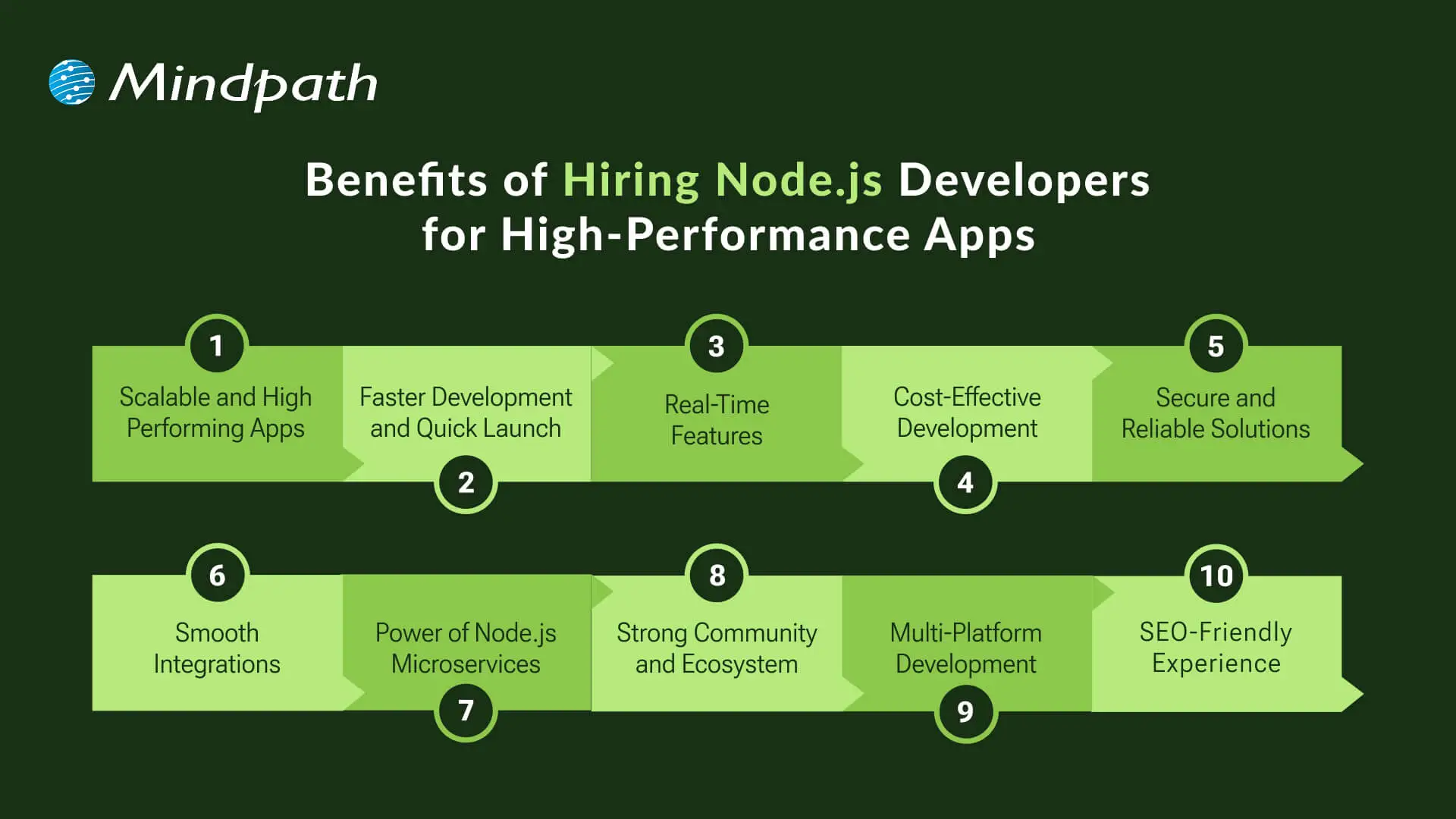
Benefits of Hiring Node.js Developers for High-Performance Apps

To build high-performance applications, developers need expertise, and Node.js has emerged as a top choice for today’s development projects for many reasons. Here are some principal reasons why businesses choose to hire dedicated Node.js developers for their projects.
Benefits of Hiring Node.js Developers for High-Performance Apps

1. Scalable and High-Performing Apps

Node.js is able to process multiple requests at once using an event-driven and non-blocking model. This makes applications fast and reliable, while also ensuring that they can support high traffic without losing speed. Businesses that hire Node.js developers will be able to make sure that their apps can scale with user demand.

2. Faster Development and Quick Launch

The lightweight structure of Node.js gives the programmer the option of using reusable modules, which allows them to code faster. With npm, programmers have access to thousands of open-source libraries ready to use for database, authentication, and security. Companies that hire expert Node.js developers save time and get products to market faster.

3. Real-Time Features

Node.js makes building real-time applications easy, including chat, notifications, and live updates. With WebSockets, developers can create real-time movement of data between users and servers. When businesses bring in Node.js Developers with some real-time experience, they can provide users with more interactive and engaging experiences.

4. Cost-Effective Development

Because Node.js employs JavaScript on both the front end and back end, one developer can support the entire application with relative ease. Since Node.js applications run easily on a single server, there is less reliance on costly infrastructure. Startups and small businesses benefit the most when they hire Node.js developers to build their applications and grow within a budget.

5. Secure and Reliable Solutions

Node.js can provide a strong security practice, encryption, and authentication for applications and safe API functionality. Skilled coders also work to update applications constantly to protect against breaches and unauthorized development. By getting the right group together, a company will be able to sustain and protect applications over time.

Also Read: Advantages of NodeJS for Your Business

6. Smooth Integrations

Node.js integrates seamlessly with databases like MongoDB, MySQL, and PostgreSQL. It can also easily integrate with front-end frameworks such as MongoDB, MySQL, and Postgres. Cloud makes it easy for Node.js to integrate into AWS or Azure. Node.js removes the technical barriers, allowing developers to develop powerful solutions.

7. Power of Node.js Microservices

Node.js is ideal for modular architectures, where a service operates independently from others. Therefore, developers can scale or upgrade a part of their application independently. With a Node.js microservices approach, businesses benefit from speed, flexibility, and easier maintenance. 8

8. Strong Community and Ecosystem

Node.js is a development community that is increasingly active and improving its ecosystem with more updates and tools. Developers can find quick solutions through community-shared libraries, tutorials, and forums. This means that companies that hire Node.js developers are always relevant and evolving according to modern trends and practices.

9. Multi-Platform Development

Node.js is used by developers to build web, desktop, and mobile application projects (from the same codebase). For instance, Electron is a simple and easy-to-use Node.js-based framework that can run the same code in the same runtime performance consistently across web, desktop, and mobile applications.

10. SEO-Friendly Experience

Node.js, through server-side rendering, allows applications to load faster and be searchable. Improvements in load speed improve user experience and increase visibility on the web. Server-side rendering makes it easier for developers to enjoy the performance and increases search visibility for their applications.

Not sure which development partner is right for your project? Explore our expert insights on choosing NodeJS Development Company to make the right decision with confidence.

Ready to Build High-Performance Apps with Node.js?

Node.js is still emerging as a dependable technology for building fast, scalable, and modern applications. Given its strong features, flexibility, and vast ecosystem, Node.js is undoubtedly one of the top choices in the market for companies that want to provide high-performing digital solutions. By hiring professional Node.js developers, companies get the expertise required to enable developers to bring ideas to life while considering user experience and developing sustainable applications.

Partnering with Mindpath gives you access to trusted Node.js development services tailored to your business goals. You can easily hire remote Node.js developer teams who bring proven expertise and adaptability to every project. With the right talent by your side, you gain the power to innovate faster, scale smarter, and deliver applications that perform at every level.
Related Post

Discover how AR and VR are transforming education with immersive, cost-effective, and tailored training solutions that enhance learning.

Related Post

types of software development

Picture a scenario in which you are running a growing business, and things are moving at a fast pace. At this point, your customers will expect more; teams will need better tools, and competition will just be a click away. You must keep in mind that the real game changer isn’t just having software but rather, its choosing the right kind of software. For this, understanding the types of software development can make a huge difference.  

Behind every great digital solution, there lies a specific type of development which is tailored to a specific need. Understanding the key categories of software development enables businesses to make smarter, confident investments while choosing the right technology teams to partner with for the future. So, if you are interested in knowing about the software development types, then this blog will guide you perfectly. We will explore the major kinds of software development, which every business should know to make smarter investments and drive meaningful growth. 

To begin with, let us first have a basic understanding of software development. 

Are manual operations draining time and resources from your business growth? At Mindpath, we offer end-to-end software development services to automate processes and enhance efficiency.

What is Software Development?

Software development refers to the act of creating, designing, testing, and maintaining applications or systems that run on devices or computers. It combines the imaginative and creative process with the technical process of building software that can help your business work smarter and serve your clients better. Developers take your ideas and combine programming languages, libraries and frameworks to develop working software that solves real problems. 

There are many benefits of custom software development for businesses. It can increase productivity via automation and lower costs by streamlining processes. It also increases customer satisfaction through user-friendly overall features and allows companies to stay ahead of competitors by providing innovative solutions. Software can also be customized to provide better management of growth within the business and can enhance data cybersecurity protocols and processes while supporting better collaboration across teams.  

What are the 5 Principles of Software Development?

Strong software development relies on key principles that guide the process and ensure reliable, high-quality results. These principles help teams build software that is efficient, adaptable, and easy to maintain over time. 

1. Working in Iterations

Working in short cycles allows teams to test, adjust, and improve regularly. This keeps the software flexible and ready for change. 

2. Reuse Components

Building with ready-to-use parts speeds up development and keeps the software consistent. It also makes updates and maintenance much easier. 

3. Set Quality Standards

Setting clear quality standards from the start helps catch problems early. It ensures the final product meets expectations and works reliably. 

4. Plan Architecture First

A strong foundation starts with early architectural planning. It helps avoid confusion, improves decisions, and sets the direction for smooth development. 

5. Control Changes Effectively

A clear system for handling changes keeps the project stable. It helps teams adapt without causing confusion or risk to the software. 

Curious why software development prices can vary so much? Explore the factors behind software development costs before your next project and avoid common budgeting mistakes.

What are the Different Types of Software Development?

Software development comes in many forms, each designed to meet specific business or user needs. Understanding these different types helps businesses choose the right solutions for their goals and growth. 

1. Frontend Development

Frontend development is a software development type that focuses on the part of an application users see and interact with. It involves creating user interfaces that are smooth, responsive, and visually clear. Frontend developers work with tools and technologies like React, CSS, JavaScript, and Flutter. Their goal is to ensure a great user experience on both web and mobile platforms. 

2. Backend Development

Backend development focuses on the parts of an application that users don’t see. It includes building servers, databases, and the internal logic that powers the software. Backend developers use technologies like Java, Python, and Django to make sure everything runs smoothly. They connect the front end with data and functions to keep the application working behind the scenes. 

Must Read: Role of Front-end and Back-end

3. API Development

API development is about creating connections that let different software systems talk to each other. Developers build APIs to help applications share data and work together more easily. This is useful for adding features like payment systems, login tools, or maps from other services. API development makes software more flexible and able to work with a wide range of platforms. 

4. Cloud Computing Development

Cloud computing development is the software development process of building applications that run on platforms like AWS, Microsoft Azure, or Google Cloud. It helps businesses store data, manage services, and scale their systems more easily. Cloud developers set up secure and flexible environments tailored to company needs. This process supports smooth operations and better performance without relying on local servers. 

5. Database Development

Database development focuses on building systems to store, manage, and organize data. Developers work with different types like SQL for structured data and NoSQL for more flexible, unstructured data. Some databases are made to handle huge amounts of information, often used for big data and real-time analytics. The goal is to keep data accurate, secure, and easy to access when needed. 

6. DevOps

DevOps engineering combines development and operations to build and deliver software more efficiently. It focuses on teamwork, automation, and continuous improvement throughout the project. DevOps engineers use skills like coding, testing, and scripting with languages such as Python, Java, and PHP. One big advantage is that quality checks continue even after the software is launched. 

7. Full-Stack Development

Full-stack development covers both front-end and back-end work to create complete, user-friendly software. A full-stack developer understands how to build smooth interfaces and also manage server-side systems that power the application. They often use a wide range of software development tools to deliver reliable and efficient results. Teams can also achieve this by having front-end and back-end developers work closely together. 

8. Mobile Development

Mobile development focuses on creating apps for smartphones and tablets. Developers may specialize in building for Android using Kotlin or Java, or for Apple devices using Swift or Objective C. Some also work on hybrid apps that run on multiple platforms, which need special skills. Mobile developers handle coding, design, and maintenance to make sure apps work well on different screen sizes and devices. 

Wondering what makes a software engineer truly effective in driving business success? Discover and understand the top qualities of a good software engineer that set top developers apart.

Which Type of Software Development Fits Best for Your Business Needs?

Understanding the various types of software development helps businesses choose the right solutions to grow and succeed. Each type plays a unique role in creating software that meets specific goals, improves efficiency, and enhances user experience. Knowing these types allows smarter decisions and better investments in technology. 

At Mindpath, we provide expert software development services tailored to your business goals. Our skilled team works with you to build reliable, efficient, and user-friendly software solutions. Partner with us to get the right development support and technology expertise for your next project. 

Frequently Asked Questions

1. How can a business decide which type of software development it actually needs?

The right choice depends on business goals, user needs, and the type of problem being solved. For example, customer-facing platforms may require strong frontend development, while data-heavy systems need robust backend and database support. A clear understanding of priorities helps in making the right decision.

2. Is it necessary to invest in multiple types of software development for one project?

In most real-world projects, multiple types of development work together. For example, a mobile app may need frontend, backend, API, and database development. Combining these ensures the software functions smoothly, delivers a good user experience, and supports long-term scalability and performance.

3. How does choosing the wrong type of development impact a business?

Selecting the wrong approach can lead to performance issues, higher costs, and delays in delivery. It may also limit scalability or create integration challenges later. Making an informed choice early helps avoid rework and ensures the software aligns with long-term business goals.

4. Can a business switch to a different type of software development later?

Yes, but it often requires time, effort, and additional cost. Migrating systems or restructuring architecture can be complex depending on the existing setup. Planning the right development approach from the beginning reduces the need for major changes later and ensures smoother growth.

5. How important is scalability when choosing a type of software development?

Scalability is critical, especially for growing businesses. The chosen development approach should support increasing users, data, and features without affecting performance. Considering scalability early ensures the software remains reliable and efficient as business demands evolve over time.

Discover how AI is transforming the world. Explore the top 10 benefits of artificial intelligence, from solving complex problems to enhancing customer experiences.
Hiring a Node.js developer in California necessitates assessing their technical skills and abilities to operate in a fast-paced development environment. An experienced Node.js developer should be well-versed in JavaScript, capable of asynchronous programming, and have firsthand knowledge with Node.js frameworks, databases, and API development. Furthermore, experience with version control and optimal coding standards allows easy communication. Here are the main abilities to look for when hiring a Node.js developer for your company.

1. Strong JavaScript Fundamentals

A Node.js developer must be well-versed in JavaScript, which serves as the foundation for Node.js applications. Proficiency with ES6+ features, closures, prototypes, event handling, and object-oriented programming is required. Since JavaScript is essential for backend development with Node.js, excellent coding abilities ensure developers can create efficient, maintainable, and scalable apps. A thorough understanding of error handling, debugging, and performance optimization also contributes to application dependability.

2. Experience with Asynchronous Programming

Since Node.js is based on a non-blocking, event-driven design, developers must be familiar with asynchronous programming. Mastery of callbacks, Promises, and async/await is required to handle concurrent requests efficiently. Asynchronous operations are properly implemented to provide smooth performance, decrease latency, and avoid difficulties such as callback hell. Understanding event loops and dealing with tools like Bluebird or RxJS can help improve speed in Node.js apps.

3. Proficiency with NodeJS Frameworks

A skilled Node.js developer should be conversant with popular frameworks such as Express.js, NestJS, and Koa in order to quickly construct online applications. These frameworks make routing, middleware management, and API creation easier, allowing developers to build strong apps faster. A thorough grasp of middleware, authentication mechanisms, and scaling approaches inside these frameworks leads to improved speed and security in Node.js applications.

4. Database Management Skills

A Node.js developer must be capable of dealing with both SQL (MySQL, PostgreSQL) and NoSQL (MongoDB, Firebase) databases. Understanding database design, performing optimized queries, and managing data effectively are critical to application performance. Knowledge of ORMs (Sequelize, TypeORM) and ODMs (Mongoose) facilitates database interfaces and increases development efficiency. Developers should also be able to use database indexing, caching, and security best practices.

5. API Development and Integration

Building and integrating RESTful APIs is an important skill for Node.js developers. They should be able to create safe, scalable, and well-organized APIs with Node.js and Express.js. Knowledge of GraphQL, WebSockets, and API authentication techniques (OAuth, JWT) is also useful. Strong API development abilities guarantee that frontend apps and third-party services integrate seamlessly, allowing for effective cross-platform data transmission.

Looking for expert Node.js developers to build high-performance applications? Mindpath connects you with top Node.js talent skilled in JavaScript, API development, databases, and scalable backend solutions. Whether you need a custom web application, API integration, or real-time features, our experienced developers ensure seamless project execution.
Boost your development team with the best Node.js experts! Contact Mindpath today to find the right developer for your project.

Discover the ultimate guide to hiring Node.js developers in London. Learn about the skills, benefits, and cost factors involved in finding the right talent for your project.
role of vector database in ai application

Have you ever thought to yourself about how AI can interpret images, voices, or texts so accurately? Well, it is due to the rapid growth of the role of vector databases in AI applications. Standard databases do a good job of storing structured data, while much of AI work involves dealing with complex and unstructured information. Vector databases provide methods for storing and comparing information which allow machines to recognize patterns, context, and meaning much faster and with higher accuracy.

As AI systems become more intelligent, the demand for methods to support thinking beyond the simple data is also increasing. Vector databases provide that opportunity for AI to correlate information, learn from it, and generate more impactful results. They are quickly becoming the framework of modern AI innovation. In this blog, we will take a look at the power of vector databases in AI applications and why they are a necessary future element of intelligent systems.

Looking for a way to enhance personalization with the help of AI in your apps using a vector database? Explore Mindpath’s AI development services, which provide expert guidance and knowledge on how to maximize the value of the vector database to elevate your AI capabilities.

What is a Vector Database for AI?

A vector database is a specific type of database that enables storing and searching for data represented as vectors. Vectors are sets of numbers that represent the meaning or features of data such as text, images, and audio. Instead of searching for exact matches of data, a vector database searches for similar items, based on the context, illuminating AI’s capacity to perform at a more intelligent level based on context.

In basic terms, it works like the brain of AI systems that require memory and comparison. A vector database in AI enables quick and accurate data searches among very large and complex datasets. They are often used in applications such as chatbots, recommendation engines, and image searches where the response time and clearly related results mean everything.

Curious how AI chatbots can boost engagement and revenue? Discover AI Chatbot examples to learn how vector database-driven intelligence improves customer interactions.

How Does a Vector Database Work?

Vector databases assist artificial intelligence to comprehend and look through data in terms of meaning rather than precise words. Data is stored as numbers that illustrate what the data depicts. This helps AI connect ideas, find similarities, and give more accurate and useful results.

1. Creating vector embeddings

AI models process raw data to create vectors, which are sets of numbers that represent the meaning of the data. Vectors are mechanisms for AI to understand the connections among different data points.

2. Storing and indexing vectors

The vectors are kept within a vector database, which can be indexed with smart indexing methods, such as HNSW (Hierarchical Navigable Small World) or IVF (Inverted File Index). The role of vector databases in AI applications here is to store, group, and quickly find similar data when needed.

3. Performing similarity search

When the search begins, it will convert the query into a vector, which it begins to compare to other stored vectors. The database returns the closest elements based on meaning, so the AI can accurately and relevantly respond to the user.

Looking to optimize AI models without heavy computational costs? Explore Low-Rank Adaptation (LoRA) to discover techniques that improve vector database-powered AI efficiently.

Role of Vector Database in AI Application

The importance of the vector database for the AI application is becoming more necessary and prevalent as AI works with larger and more complicated data. Below are the main ways in which it helps and enhances the AI systems.

1. Smarter Search with Meaning

An AI application that utilizes a vector database can perform searches on meaning, rather than just a specific word. It finds things that are contextually similar in vector space; this is a lot more precise and much more human-like. This is incredibly useful, because the AI system can determine what users mean, not simply what they type.

2. Supporting Retrieval-Augmented Generation (RAG)

Vector databases provide large language models with access to current facts, knowledge, and data points from the public domain. The user’s inquiry is converted to a vector, which retrieves information from data similar to that represented in the user’s question. The information and materials retrieved help the AI provide responses that are elevated in relevance and made to be factually accurate.

3. Managing Complex Data Types

The role of vector database in AI application is to be able to manage unstructured data including images, text, and audio. A vector database does this by representing the unstructured data as numerical vectors that convey meaning. This allows AI to be able to compare unstructured data types more easily.

4. Enabling Fast Similarity Search

Vector databases leverage novel algorithms to identify similar items quickly, even among massive datasets. This capability is crucial for a number of artificial intelligence (AI) applications that depend on real-time results. The vector database in the AI application in this case is to return results quickly and still maintain precision.

 Also Read: AI Models

5. Improving Recommendations

Recommendation systems utilized vector databases to recommend similar attributes to items or products that users had liked before. AI uses patterns in the vectors and can customize content for each individual. This leads to a more meaningful and engaging experience for the user.

6. Powering Computer Vision

In computer vision, a vector database in AI helps identify and compare images or videos efficiently. It supports tasks like face recognition, image search, and visual content filtering. By finding visually similar vectors in AI systems it improves speed and accuracy.

7. Building AI Memory

The role of the vector database in AI applications is that it is a dependable memory mechanism for the AI agents. It strengthens the AI agent’s ability to store and retrieve information in support of reasoning and decision-making. Thus, vector capacity increases the multi-step capabilities of AI agents when solving complex tasks.

8. Hybrid and Refined Search

Vector databases have the ability to merge traditional filters like date or category with similarity search. This hybrid effort increases the precision and relevance of a search result. Users can quickly and clearly find exactly what they are looking for.

Wondering how AI systems focus on the most important information in complex datasets? Discover the Attention Mechanism to learn how it enhances AI performance in combination with vector databases.

Ready to Build Smarter AI Solutions with Vector Databases?

Vector databases are transforming how AI systems process and understand information. They enable faster searches, handle complex data, and make AI responses more meaningful and accurate. As technology continues to advance, the role of vector databases in AI applications will remain central to building intelligent and scalable solutions across industries.

At Mindpath, our AI development services combine the power of vector databases with advanced machine learning models to build smarter and more efficient systems. We help businesses create intelligent applications that learn, adapt, and deliver real results. Partner with us to design AI solutions that drive innovation and long-term success.