Factors to Consider While Hiring NodeJS Developers

Join our Newsletter!

Featured Posts

Support Is One Click Away

Home

Factors to Consider While Hiring NodeJS Developers

Hire nodejs developers

Factors to Consider While Hiring NodeJS Developers

As a result of the rapid evolution of the digital landscape, businesses nowadays want faster, efficient, and more scalable options. This is why many companies choose to hire NodeJS developers who are able to develop high-performing applications without limitations of real-time responsiveness. As businesses compete for efficiency and seamless digital offerings, the demand for NodeJS expertise is increasing. But when hiring a NodeJS Developer, it isn’t just about technical knowledge; it’s about a deeper understanding of your business aims and objectives.

So, how do you make the right choice when the market is filled with so many options? This is the point where many decision-makers stop and consider. With numerous talented developers available, knowing what differentiates the right developer can be a challenge. Filling a role quickly is easy, but finding a developer who contributes positively to your long-term growth is different. Before proceeding to the next step, you should slow down and investigate the key factors to consider in making the right decision.

Looking for a Node.js developer who ensures your app performs at scale without compromising speed and security. Hire Node JS developers from Mindpath who strive to provide you the best, world-class solutions.

Who is a NodeJS Developer?

A NodeJS developer is a technical professional who uses Node.js to create fast, scalable applications server-side. They’re responsible for everything from building prototypes to writing clean code that supports applications that power our world. Their responsibilities also include connecting back-end services with front-end systems to provide users with maximum efficiency and reliability.

Node.js developers are crucial for contemporary software projects because Node.js enables developers to utilize one programming language, JavaScript, for both the client side and server side. They develop great solutions thanks to the ability to do it quickly. They also have strong problem-solving skills and know how to utilize this technology to further enhance an application and prepare it for scale.

What are the Responsibilities of a NodeJS Developer?

Companies wanting to grow often look to hire dedicated Node.js developers as part of their technology teams. Node.js developers do more than code; they are an integral part of delivering solutions that will amplify your digital products.
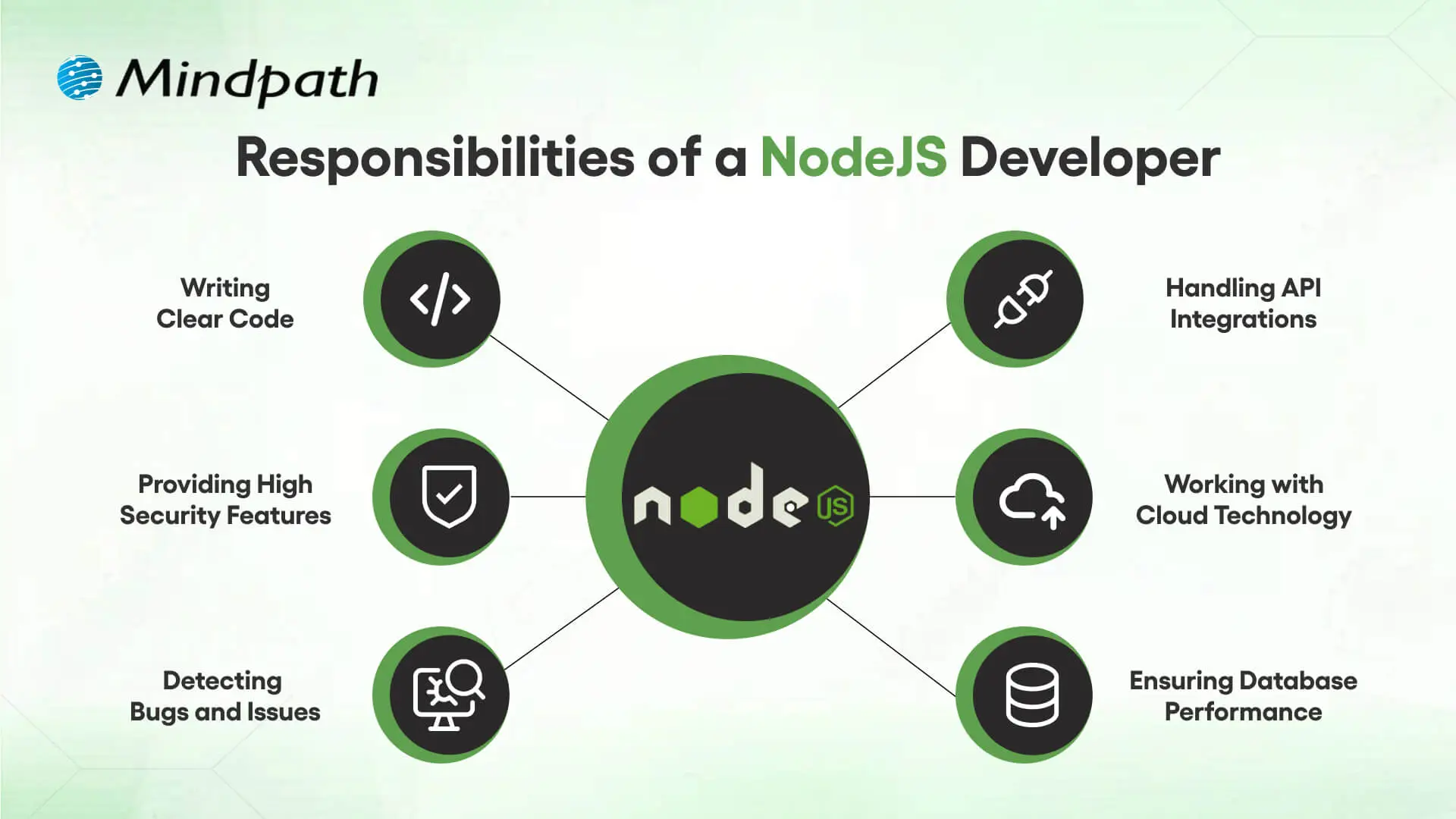
1. Writing Clear Code

When you hire Node.js developers, their job is to write clean and readable code. This will make it easier for other developers to maintain and grow the application.

2. Providing High-Security Features

Security is also a core part of a Node.js developer’s job. Developers need to identify their risks and add features that protect data and users.

3. Detecting Bugs and Issues

Bugs can give rise to slowed-down applications and degradation of performance. NodeJS developers are then also able to quickly identify and fix bugs to maintain stability on the systems.

4. Handling API Integrations

Most modern applications require API integration to add some functionality. Proficient NodeJS developers know how to use API integrations such as HTTP, buffers, and simple file handling.

6. Working with Cloud Technology

When you hire Node.js developers, it is common for these developers to work on the backend and, therefore, will work with cloud deployment. They will configure a cloud platform (such as AWS or Azure) to run the application to ensure it runs properly.

7. Ensuring Database Performance

A Node.js developer will oversee your databases so that the responses are quick. They ensure the back-end interacts with your front-end requests appropriately.

Unlock the new opportunities by Full-Stack Development with Node.js, the key to building a reliable application. Explore now and elevate your business to the next level.

Key Factors to Consider While Hiring Node.js Developers

Choosing the right talent can dictate whether or not your digital projects achieve ultimate success. If you are going to hire a Node.js developer, here are the important things to keep in mind before you do.
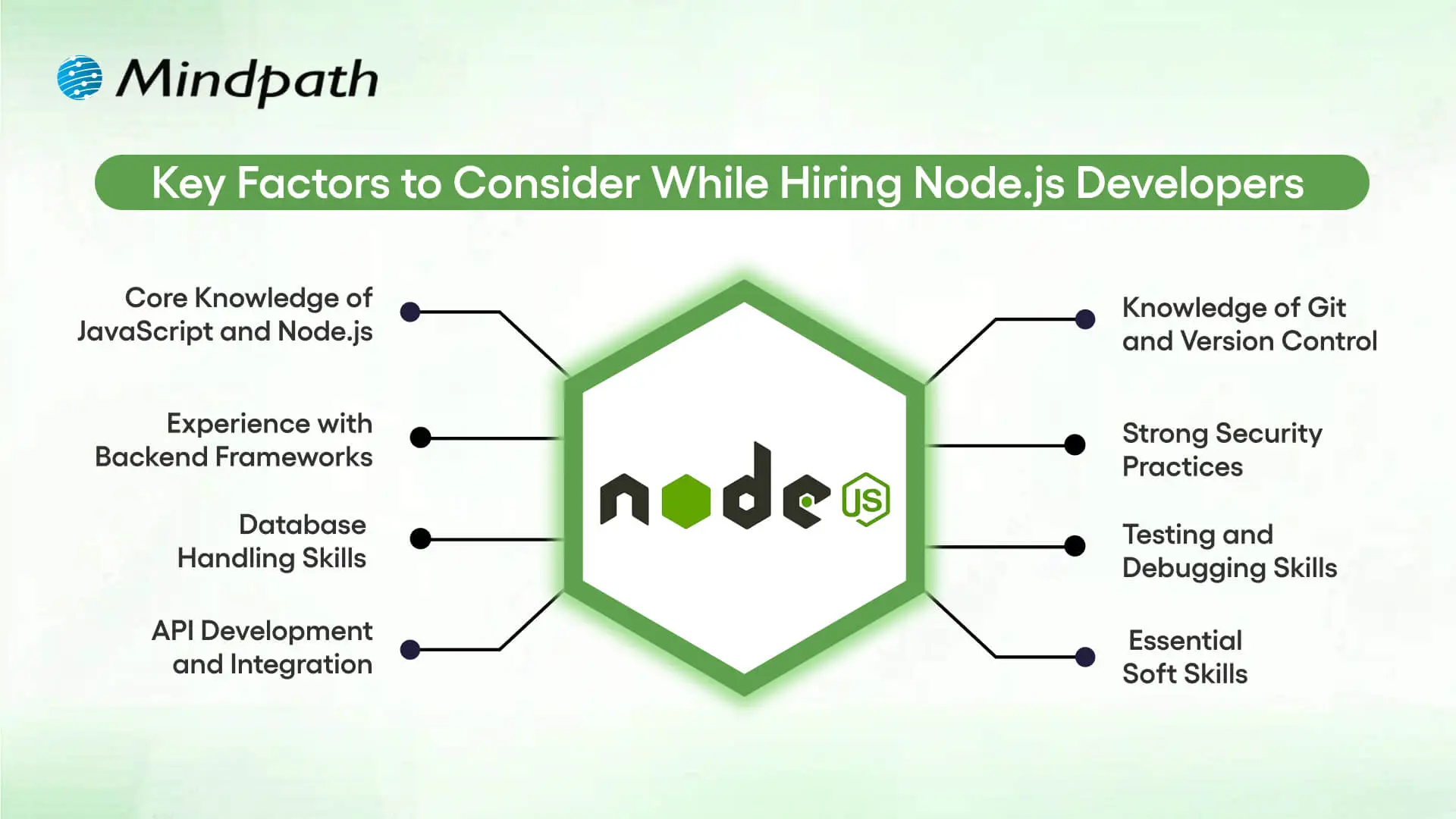
1. Core Knowledge of JavaScript and Node.js

When hiring Node.js developers, the first thing is to check their understanding of the basics of JavaScript and Node.js foundations. They should understand asynchronous programming, Node event loop, and code management through NPM, as well as managing dependencies, which is a large part of the Node.js developer roadmap related to developing scalable applications.

2. Experience with Backend Frameworks

A top-notch developer should really have practical experience with frameworks like Express.js, Koa.js, or Nest.js. The key benefit of these frameworks is that they make projects faster, and framework-less projects have no organization. If you’re hiring Node.js developers, you can easily test their framework knowledge with some simple tasks or some Node.js developer interview questions.

3. Database Handling Skills

All applications require databases, so any competent developer must know their databases MySQL, PostgreSQL, and they must know some NoSQL databases such as MongoDB. They need to understand caching as well as real-time data processing by having basic knowledge of tools like Redis. If you hire a Node.js developer with good database skills, your application will respond faster and stay robust.

4. API Development and Integration

APIs connect applications to additional services, and Node.js is often a popular choice to build those APIs as well. Developers must be familiar with RESTful APIs, GraphQL, and secure protocols like OAuth. Before you hire Node.js developers, be sure to ask them how they create APIs and manage API integration.

5. Knowledge of Git and Version Control

Git is an everyday tool for every developer, and they should be able to manage branches, pull requests, and conflicts without hindering the development. The knowledge of Git is a prerequisite for hiring Node.js developers for teamwork purposes.

6. Strong Security Practices

Security is always a primary concern. Developers need to understand encryption, input validation, and token-based authentication. When employing Node.js developers, look at how they implement these practices to protect applications and sensitive information.

7. Testing and Debugging Skills

Reliable applications need effective debugging and testing. Developers can leverage tools (such as Mocha, Jest, or Cypress) to find bugs early in application development. Knowledge of testing is a vital skill if you are planning to hire Node.js developers to help with long-term applications.

8. Essential Soft Skills

Technical skills are not enough to qualify for Node.js Developer jobs. Communication, collaboration, and problem-solving all make progress much easier on a project. These skills are equally important each time employers hire Node.js developers, as many projects will have challenging aspects.

As user experiences is evolving day by day, businesses need to adopt technologies that ensure speed, scalability, and reliability. Discover how Hiring Expert NodeJS Developers can help you deliver high-performance digital solutions.

Steps to Hire a Node.js Developer

While the search for the perfect talent can seem daunting, breaking the process down into clear steps makes it much easier. Below are the key steps to take when hiring a Node.js developer for your project.
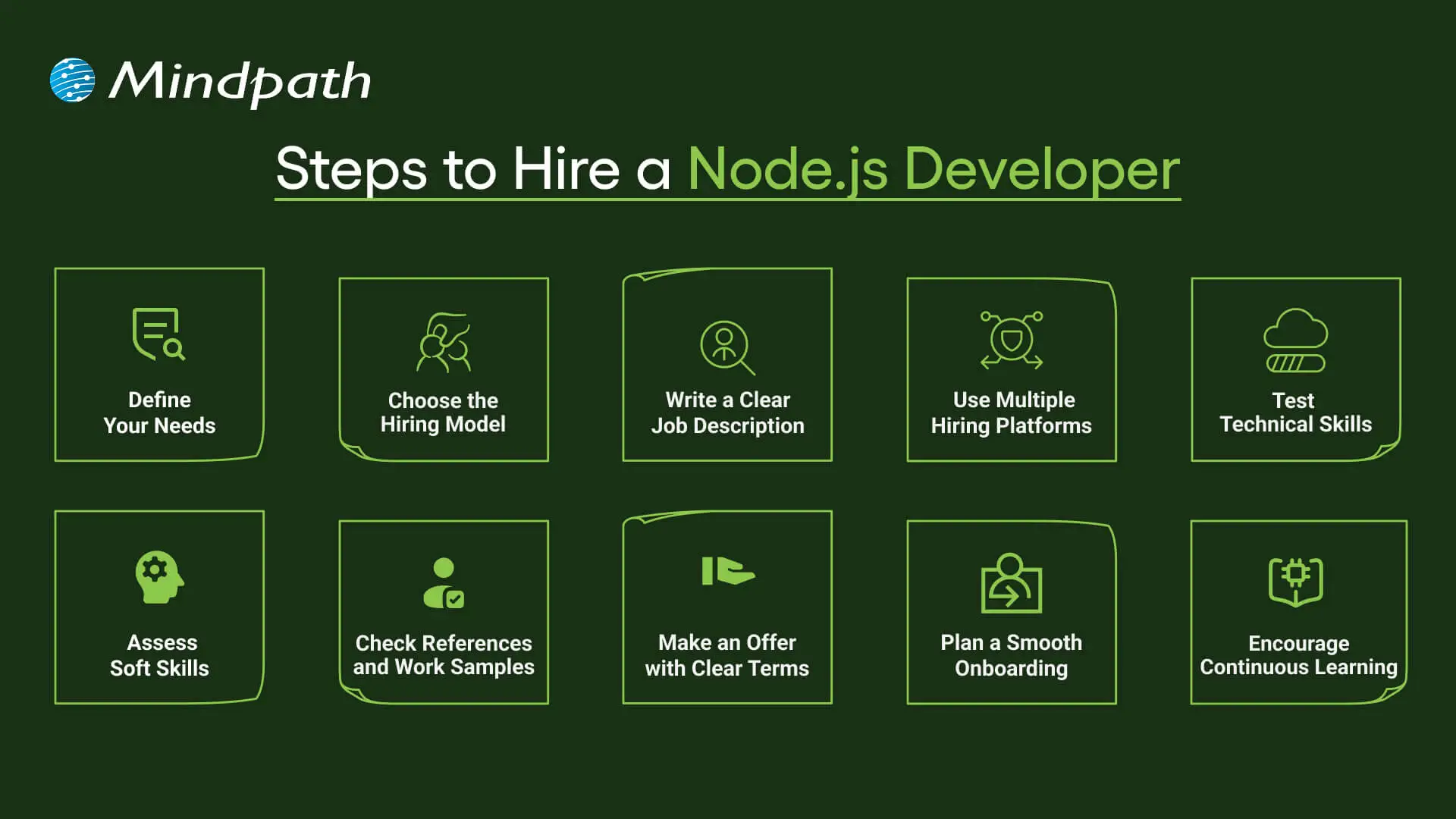
Steps to Hire a Node.js Developer

1. Define Your Needs

Start by defining your project scope, features, and tech stack. When you hire NodeJS developers, identifying clear requirements can save time and attract the right candidates.

2. Choose the Hiring Model

Determine whether you need in-house, remote, or offshore developers. Many companies hire NodeJS developers offshore for more flexibility and lower costs.

3. Write a Clear Job Description

A well-written job description allows candidates to know what they are applying for. Include as much as possible in the description, who you want, including the skills, the experience you expect, and if you are looking for a full-stack Node.js developer.

4. Use Multiple Hiring Platforms

Search for talent on LinkedIn, GitHub, and job boards that identify talented developers. These platforms enable developers to connect because of their special skill set.

5. Test Technical Skills

Evaluate coding expertise with tasks, interviews, or online coding challenges. This evaluates whether the developer can work with Node.js concepts properly.

6. Assess Soft Skills

Good communication and teamwork are as essential as coding, because they also allow the project to flow without delay.

7. Check References and Work Samples

It’s important to understand what the developer has done in the past, so it is good to check references and speak to previous clients or employers. This develops an understanding of the developer’s reliability and quality of effects.

8. Make an Offer with Clear Terms

Discuss salary, benefits, and expectations openly. Transparency builds trust and helps retain the developer.

9. Plan a Smooth Onboarding

Provide tools, resources, and guidance to new hires. A structured onboarding makes developers productive faster.

10. Encourage Continuous Learning

Support your team in learning new Node.js updates and practices. This keeps skills sharp and projects future-ready.

Want to enhance your website presence in today’s fast-paced digital world? Explore our detailed blog on how you can Increase Web Performance with Node.js Development Services.

Looking to Hire Expert Node.js Developers for Your Next Project?

Hiring the right Node.js talent can define the success of your digital projects. Skilled developers bring more than technical expertise; they align with business goals and deliver scalable, secure, and high-performing applications. By following clear steps and evaluating both technical and soft skills, you ensure your projects are built for long-term growth and innovation.

Mindpath stands out as a trusted Node.js development company offering top-tier Node.js development services. With a team of skilled developers, we help businesses build scalable applications tailored to their unique needs. By choosing Mindpath, you gain a partner focused on delivering secure, efficient, and future-ready solutions that accelerate your digital success.

Related Post

Discover how AI can revolutionize your business with predictive analytics, machine learning, and conversational AI for smarter decisions and improved efficiency.
Discover the basics of Large Language Models (LLMs) and how Mindpath can help you build a customized AI solution to enhance efficiency and drive innovation.
Discover how edge computing enhances data processing, helping businesses make real-time decisions and optimize operations.

Related Post

top AI models

The world is experiencing a huge technological transition, driven by emerging AI trends. This shift is justified by the active development of Artificial Intelligence and powerful AI models. They are high-end neural networks that have the capability to generate code, pictures, videos, and text. The selection of the top AI models can be a breakthrough for a company.

Whether you are launching new products or developing your strategy of content, the best AI models can make all the difference. However, which is the most appropriate one to meet your business requirements? Well, there is no need to fret about it, as this best AI models list contains the top 10 options that are dominating the AI arena. Let’s have a look.

Ready to implement advanced AI models but unsure which ones can truly move your business forward? Mindpath offers expert AI development services that help you build customised, high-performance AI solutions tailored to your goals.

AI Models – Understand the Basics

Before we dive deep into the list of most popular AI models, let’s understand what AI models actually are. 

AI models refer to complex computer programs that are used to interpret different patterns and provide results depending on the data. These models power modern tools that code, comprehend languages, and create images.

While certain top AI models are built to perform simple tasks, others focus on domain-specific tasks. The use of AI tools and models is growing with time. In fact, more than 88% of businesses are now using AI tools, and in 2004, it was 78% (Source: McKinsey). 

Another report for Gartner informs that total spending on generative AI is projected to cross USD 644 billion in 2026, around a 76% increase from 2025. These numbers clearly prove the rising importance of AI for today’s business. 

Want to understand the different kinds of artificial intelligence? Explore types of AI to learn about ANI, AGI, and ASI, and how each is applied in real-world scenarios.

Now, let’s talk about the top AI models you can opt for in 2026 that can support your workflows and business growth.

Top 10 AI Models for Modern Businesses

The best AI models are not just designed to process data. In fact, they have the ability to think and create. Some models can interact like humans, and some can easily explain complex logic. Here are the 10 most popular AI models that define innovation and power. 

1. GPT-5

When talking about which AI models are the most popular right now, we can’t ignore GPT-5. Developed by OpenAI, this is the most powerful AI model available to all. It can handle multiple tasks, including code generation, audio, images and text creation. GPT-5 is now powering tools like ChatGPT and Microsoft Copilot. 

This model helps users plan, write and solve issues with ease. Besides, it supports ultra-long conversations. That means when you use it, you will feel like interacting with an intelligent assistant. GPT-5 is a versatile model and can be used for personal productivity apps or enterprise tools. 

Want to customise AI models for your specific needs? Check out our OpenAI Fine-Tuning API tutorial to learn step-by-step how to fine-tune models for better performance and accuracy.

2. Claude Sonnet 4.5

It is one of the most advanced AI models by Anthropic. Claude Sonnet is developed for power users looking for deep reasoning, speed and precision. This model offers impressive results on maths, long-running tasks and coding.  

It is an excellent option for businesses that prioritize ethical AI, reliable automation and compliance. With a 200K token input and powerful tools like content editing, it can handle various complex workflows easily. 

3. Gemini 3

Searching for top AI models that can help you bring your ideas to life? Gemini 3 can be a top choice. Developed by Google DeepMind, this model supports sophisticated reasoning and helps users learn and create anything they want. 

People like to use Gemini, as it is smart and feels intuitive. Whether you want to analyze complex data, summarize documents, or brainstorm new ideas, Gemini can be your reliable assistant. 

4. DeepL

Another popular AI model you can consider is DeepL. It offers quick and accurate translation services. It is popular for its amazing human-like output and impressive accuracy. The model supports multiple languages, more than 30 languages. 

Content creators, businesses, and professionals use it for translating documents, emails, and websites. Recently, the company introduced DeepL Write, which helps users with spelling, grammar, and more.

5. Grok 4.1

It is xAI’s most powerful and intelligent AI model and is integrated into X. The model is designed for collaborative, creative, and emotionally intelligent interactions. As a result, all conversations feel more engaging and natural. 

The model is generally trained on social media data and can be easily adapted to evolving internet culture. Built on a large-scale reinforcement learning infrastructure, it offers a more compelling and perceptive experience. 

Also Read: Benefits of AI

6. Mistral AI’s Mistral Large 2

Mistral Large is an advanced and high-performance language model introduced by Mistral AI. The model is capable enough to handle advanced reasoning and multilingual tasks. It is optimized for accuracy and speed. If you are developing chatbots or want to optimize technical workflows, you can give it a try.

Different from other Mistral models, it activates all parameters and offers consistent results. It can achieve an accuracy rate of 84 percent for code generation (Source: Mistral AI). 

7. DeepSeek VL

The AI models list will remain incomplete without covering this particular AI model. This open-source Vision Language model is quite efficient for real-world language and vision applications. It can understand logical diagrams, scientific literature, charts, diagrams, web pages, and more. 

Educators and researchers utilize it to analyze scientific papers and make complex concepts easy to understand. The company is now working on a new model that can perform multi-step and complex actions with less human input. 

8. Llama

Introduced by Meta, Llama models are developed based on an open-source approach. The latest model released by the company is Llama 4, and it includes two multimodal models, such as Llama 4 Maverick and Llama 4 Scout. 

All these models can process short videos, images, and text. As these are based on a MoE- Mixture-of-Experts architecture, they demonstrate increased efficiency. Its open-source nature provides developers with better control and flexibility. You can fine-tune it as per your requirements. 

9. Stable Diffusion

It is an open-source AI image creation model based on the Stable Diffusion XL model. The model is popular for generating high-quality images using various text inputs such as frame, presets or style. 

Besides, it can also replace or add parts of any images through “outpainting”. Whether you need help for digital storytelling, concept art or marketing, Stable Diffusion can offer you a perfect kickstart. Its speed, community-driven ecosystem and flexibility make it one of the top AI models among designers, artists and content creators. 

Wondering how AI can understand and generate human-like text? Check out our Large Language Model (LLM) blog to learn how LLMs power smarter applications and chatbots.

10. Cohere Command R+

This powerful large-language model is built for accuracy, speed and smooth private deployment. It is developed for enterprise-grade search and document analysis. By combining real-time document processing with large language models, it offers accurate question answering and summarization. 

Thanks to its API-first design, you can easily integrate it into your existing system. Most businesses are using it for customer support, legal discovery and knowledge management. In an environment where context and accuracy are vital, this model offers reliable performance. 

Tips to Choose the Right AI Models

Well, it is common to feel overwhelmed as the options are more. However, by considering these simple tips, you can come up with an informed decision. 

1. Understand how you want to use an AI model, for content creation or other purposes.

2. Now, consider your budget as well as your technical skills. If you are using a model for the first time, you can go for GPT 5 or Gemini. Mistral and Llama require technical skills.

3. Don’t forget to check context length. Longer context windows are good for performing multi-step tasks.

4. Go for the free web version and test models properly. Compare the results before making your final decision. 

Want to know how AI models focus on important information? Read our attention mechanism explained blog to understand this key concept behind modern AI and LLMs.

Let the Experts Help You Choose the Best AI Models

The AI model arena is evolving rapidly. Some top AI models such as GPT-5 and Gemini, are establishing a new level of accuracy and performance. Specialised models, such as Cohere and Stable Diffusion, on the other hand, are dominating their niches.

Still don’t know which top AI models to use for your business? Allow Mindpath to help to make the right decision. Our team can help you identify, deploy, and fine-tune AI models best suited for you. We also help businesses with AI development services, which guarantee scalability and performance.

Generative AI Use Cases
Have you ever wondered how generative AI is reshaping various industries right before our eyes? How is it enhancing creativity in art and design? What role does it play in streamlining business operations? In this blog, we’ll explore fascinating use cases of generative AI across different sectors.   Generative AI is a sort of artificial intelligence that is intended to generate fresh and unique content, such as images, writing, or music, without being constrained by precise rules. Instead of just obeying predefined instructions, generative AI learns from enormous volumes of data and applies this knowledge to develop solutions that are both creative and humanlike. It can develop material based on patterns that it recognizes, making it more adaptable and inventive than standard AI.  The significance of generative AI is enormous since it is altering several sectors. From automating content production to accelerating software development, these technologies make tasks quicker and more creative.   So, let’s dive in to explore the generative AI use cases in diverse industries! 

Generative AI Use Cases Across Different Industries

1. Finance And Trading

Generative AI is revolutionizing the financial and manufacturing industries by increasing efficiency and optimizing operations. In finance, it creates algorithmic trading strategies by analyzing past market data and executing exact trades.

It also offers predictive market analysis, which assists specialists in forecasting trends, as well as high-frequency trading by developing rapid algorithms for swift order execution. It also enhances risk management and fraud detection by monitoring transactions for unusual trends, therefore safeguarding customers from identity theft. In manufacturing, generative AI improves efficiency by finding bottlenecks and lowering costs. It provides predictive maintenance by anticipating equipment breakdowns and reducing downtime.

AI also improves supply chain management by analyzing logistics and inventory data to ensure timely delivery and optimal resource utilization 

2. Healthcare

Generative AI is transforming the healthcare industry by improving diagnostics, medication development, and personalized treatment strategies. In medical imaging, AI aids in the creation of synthetic MRI, CT, and X-ray pictures, allowing for more precise diagnosis and treatment planning. It improves image quality and detail, allowing medical experts to more accurately spot abnormalities. 

Generative AI speeds up drug discovery by optimizing chemical structures and anticipating medication interactions, allowing researchers to better understand potential adverse effects. It also creates customized drug delivery systems to guarantee that drugs reach their intended targets with minimal adverse effects. 

Furthermore, generative AI promotes personalized medicine by analyzing genetic data to find genetic markers, allowing healthcare practitioners to customize treatment programs for patients. By anticipating therapy responses based on previous patient data, AI enables clinicians to optimize methods for better results and recommend patient-specific medicine compositions. 

3. Gaming and Virtual Reality

Generative AI is transforming the gaming and virtual reality landscape by making games more interesting and immersive. In gaming, AI contributes to the creation of engaging game material by analyzing how people play and what they enjoy, ensuring that each player’s experience is unique and suited to their tastes. AI also aids in the creation of enormous gaming worlds that change with each play session, providing players with fresh experiences.

Non-player characters (NPCs) in video games are becoming smarter, acting more like real people and responding to how players interact with them. This enhances the game experience and makes it seem more realistic. 

Furthermore, Artificial Intelligence may adapt game stories based on player decisions, resulting in a personalized storytelling experience that keeps players engaged. AI is used in virtual reality (VR) to build realistic and engaging worlds, making VR experiences more pleasurable, whether for gaming or teaching. AI even creates virtual landscapes and interactive features, resulting in spectacular and responsive VR content.

4. Cybersecurity

Generative AI is helping to strengthen cybersecurity by enhancing how we detect and avoid threats. It analyses large amounts of data, such as network traffic and user behavior, to swiftly identify potential security concerns. This implies that risks can be addressed before causing harm. 

Intrusion Detection Systems (IDS) driven by artificial intelligence (AI) monitor networks and systems for suspicious activity. They notify security professionals in real time if they discover something strange, therefore keeping systems safe.

Another key use of AI is behavioral analysis, which involves learning what normal behavior looks like. If it notices anything unexpected, such as abnormal patterns from a person or system, it might alert you to a potential problem.

Generative AI is also beneficial for detecting advanced dangers that are difficult to spot. It searches through previous data and network behavior to detect these clever attacks. AI can detect irregularities in network traffic, allowing organizations to respond to possible breaches before they get worse. AI can also assist identify insider threats, which are security dangers posed by persons within an organization. By analyzing how people interact and access information, it can detect odd behavior that may suggest a problem. 

5. Autonomous Vehicles

Generative AI is transforming autonomous vehicles by improving their safety and efficiency. AI uses real-time data from sensors and traffic to assist autonomous vehicles make speedy choices. It recognizes items such as pedestrians and other cars, assuring appropriate reactions. Adaptive cruise control systems adjust speed in response to traffic, whereas collision avoidance systems forecast and prevent accidents. 

AI also generates virtual surroundings for testing, allowing engineers to replicate various driving situations, including bad weather. This guarantees that vehicles perform reliably in real-world circumstances. Additionally, AI simulates interactions with pedestrians and bicycles, assisting vehicles in securely engaging with road users.  

6. Robotics

Generative AI is improving robotics by making them smarter and more adaptive. It lets robots learn from their environment and adapt to changes, allowing them to deal with unforeseen events. AI enables robots to interpret human motions and expressions, resulting in improved communication and collaboration. This means they can operate comfortably among others in common settings like factories or houses. 

In manufacturing, for example, generative AI optimizes how machines and people collaborate, increasing productivity by coordinating jobs and motions. This collaboration increases efficiency while also making it easier for robots to assist human workers.

7. Fashion Industry

Generative AI is transforming the fashion industry by enhancing the way designers and businesses produce, promote, and sell garments. AI helps designers produce original fashion ideas by analyzing trends and styles, making it easier for them to experiment with new looks. For marketing purposes, AI can generate blog entries and social media material that engage customers, keeping companies new and relevant. It also helps you write appealing advertisements for certain audiences. 

Additionally, generative AI assists companies in understanding what customers think of their products through sentiment analysis, predicting which things will be popular, and forecasting future trends. It can also power virtual fashion advisers who suggest clothing based on a person’s style and preferences, making shopping more personal.  

Generative AI Services at Mindpath

Mindpath uses the potential of generative AI to accelerate innovation and improve business operations. We create unique AI models that optimize workflows, enhance decision-making, and increase productivity in a variety of sectors.

Our artificial intelligence solutions automate content production for blogs, social media, and marketing materials, ensuring that your outputs are both engaging and relevant. We also use generative AI for intelligent data analysis, which allows organizations to foresee trends, comprehend attitudes among customers, and make intelligent choices.

Furthermore, our AI-powered virtual assistants improve client interactions by offering personalized advice and help, resulting in a better overall user experience. We also provide generative AI in design, which creates unique concepts for goods, marketing campaigns, and branding that stand out in a competitive market. 

Wrapping Notes

Generative AI is changing the way businesses function, increasing innovation and efficiency across several industries. Its potential ranges from increasing innovation in fashion to revolutionizing safety in autonomous vehicles. Businesses that adopt cutting-edge technology find new ways to improve operations, enhance consumer experiences, and stay ahead of market trends. Mindpath is devoted to using the potential of generative AI to provide organizations with bespoke solutions that drive growth, optimize operations, and generate creativity. The future has arrived, and with generative AI, the possibilities are endless. 

Wondering how generative AI can reshape your industry?

Mindpath specializes in AI-driven solutions that unlock new possibilities.

Explore top generative AI use cases transforming industries like finance, healthcare, fashion, and more, driving innovation, efficiency, and creativity across sectors.
ReactJS Developers in London

Are you looking for skilled ReactJS developers in London to build fast and reliable web applications? Do you need experts who can turn your ideas into seamless user experience? Finding the right developers can be challenging, but the good news is that London has a strong pool of ReactJS talent. In this guide, we’ll help you understand how to hire the best ReactJS developers in London and what to look for in a top-tier developer. 

Hiring ReactJS developers in London offers several benefits for firms trying to create modern, high-performance web applications. London has a highly skilled tech talent pool, so you’ll have access to seasoned engineers who are up to speed on the newest ReactJS developments. These specialists can develop apps that are quick, scalable, and easy to use, hence increasing client engagement. Furthermore, collaborating with local developers improves communication, cooperation, and alignment with UK corporate norms.

London’s thriving digital sector also connects firms to a network of innovation, ranging from startups to established organizations, encouraging cooperation and information exchange. ReactJS developers in London have expertise working with a variety of sectors, allowing them to create solutions that are suited to unique company requirements. Furthermore, they use the best coding techniques to create secure, high-performance apps that stand out in a competitive digital market. Whether you’re a startup or an established business, hiring ReactJS developers in London guarantees that your project will benefit from innovation, efficiency, and high-quality development techniques.

Let’s explore the steps to hire ReactJS Developers in London!

Steps to Hire ReactJS Developers in London

ReactJS is an open-source JavaScript library that was developed by Facebook to create complex and interactive user interfaces for web applications. Since its inception, React has gained massive popularity due to its flexibility, efficiency, and ease of use. By breaking down applications into smaller, manageable components, React enables faster and more streamlined development. 

ReactJS is favored by developers because of its modularity, speed, and ability to build scalable, maintainable applications. Whether you’re building a simple landing page or a complex web application, ReactJS offers the tools and functionality to create high-quality, responsive applications. So, why should you hire ReactJS developers? Let’s explore. 

1. Define Your Project Needs

Before hiring a ReactJS developer in London, you need to describe your project’s requirements. Begin by determining if you require a developer for a basic website, a large web application, or a comprehensive platform. This aids in the establishment of defined objectives as well as the identification of suitable talent. Once you’ve determined the scope of the project, make a list of the necessary talents. If your project solely requires front-end development, search for people with experience in React, JavaScript, and UI/UX design. If you need full-stack knowledge, make sure they are also familiar with back-end technologies such as Node.js and databases. You can hire the top ReactJS developers in London by clearly describing your project’s requirements. This step guarantees that you recruit someone with the right skills, experience, and understanding to build a high-quality application for your business.

2. Craft a Clear Job Description

When recruiting a ReactJS developer in London, it is essential to provide a clear job description. It helps to attract the ideal candidates by giving crucial facts about the position. Begin by defining the job title and the developer’s tasks, such as creating user interfaces, maintaining state, and integrating APIs. Next, provide the necessary qualifications, such as familiarity with ReactJS, JavaScript, and other similar technologies. If your project requires extra abilities, such as Redux, TypeScript, or Next.js, make them explicit. Also, describe the type of project—whether it’s a web application, mobile app, or enterprise solution—so candidates understand what they will be working on. A well-structured job description not only attracts skilled developers but also ensures they align with your project’s needs, making the hiring process smoother and more efficient.

3. Find Talent Through Multiple Channels

You can look into numerous employment platforms and networks. Begin by using professional networks such as LinkedIn, where you can interact with developers directly, post job vacancies, and participate in relevant tech communities. Networking events and local gatherings can also help you connect with experienced professionals. Use prominent employment portals such as Indeed, Monster, and Hubstaff Talent to reach a larger pool of applicants. These platforms allow you to post thorough job descriptions and screen applicants based on their abilities and expertise. If you require flexible or short-term developers, consider using freelancing markets such as Upwork or Toptal. By utilizing numerous hiring channels, you boost your chances of finding a ReactJS specialist that fulfills your project’s requirements and can deliver high-quality results.

4. Evaluate Technical and Soft Skills

Finding the appropriate ReactJS developer in London involves a thorough screening procedure. Begin by checking resumes and portfolios to determine their experience with React applications. Look for projects that showcase excellent coding abilities, fast UI creation, and a thorough grasp of contemporary frameworks. Next, do technical interviews to determine their understanding of React topics like as components, state management, and hooks. You can also offer real-world coding tasks to watch how they solve difficulties and improve performance. Aside from technical competence, soft skills are also vital. A skilled developer should be able to properly convey ideas, work in teams, and adapt to project needs. Strong cooperation and problem-solving skills guarantee that they can operate effectively in a professional situation. By considering both technical and soft qualities, you can locate a ReactJS developer that not only codes well but also fit well with your team.

5. Offer Competitive Compensation

To recruit the top ReactJS developers in London, you must provide competitive compensation based on market trends and experience levels. Skilled developers are in great demand, therefore offering a reasonable wage can help you stand out from competition. In addition to compensation, consider adding advantages such as remote work choices, incentives, and opportunity for professional advancement. Developers like employment that promote professional development, thus offering training or mentoring can make your offer more enticing. Also, consider the complexity of your project—senior developers may anticipate higher remuneration for complicated applications. A well-balanced pay plan can help you acquire and retain top individuals capable of producing high-quality results.

Looking for skilled ReactJS developers in London? Mindpath connects you with top-tier professionals who can build high-performance web applications tailored to your needs. With expertise in modern React development, our developers ensure fast, scalable, and user-friendly solutions. Let’s bring your project to life—Get in touch with us today!

Want to make the right hiring decision? Check out our next blog on Factors to Consider While Hiring Expert ReactJS Developers in London to ensure you find the perfect fit for your project!
How much does hiring a ReactJS developer cost? Learn about factors affecting rates, and how to find the best talent within your budget.