Home

Factors to Consider While Hiring NodeJS Developers in Canada

Factors to Consider While Hiring NodeJS Developers in Canada

Lorem ipsum dolor sit amet, consectetur adipiscing elit. Ut elit tellus, luctus nec ullamcorper mattis, pulvinar dapibus leo.

Join our Newsletter!

Hire NodeJS Developers in Canada
Hiring a Node.js developer in Canada requires assessing both technical and soft skills while ensuring they fit within the local business environment. A strong candidate must be proficient in Node.js, JavaScript, and frameworks like Express.js while also demonstrating problem-solving abilities and adaptability. Additionally, understanding Canadian regulations such as PIPEDA is essential for compliance. Ensuring a cultural fit within your team can improve collaboration and efficiency. Below are four key considerations to help you hire the best Node.js developer for your business in Canada.

1. Strong Technical Expertise

A skilled Node.js developer should have a deep understanding of asynchronous programming, event-driven architecture, and error handling. Proficiency in JavaScript fundamentals, including object-oriented programming and closures, is essential. Experience with Express.js, NestJS, or Koa is valuable for building efficient applications. Database management using MongoDB, PostgreSQL, or MySQL ensures proper data handling. Familiarity with RESTful API development is crucial for smooth application interactions. Candidates with expertise in microservices architecture and serverless computing can help build scalable and high-performance applications for your business. 

2. Essential Soft Skills

Beyond technical expertise, soft skills play a crucial role in a developer’s success. A Node.js developer must have excellent communication skills to collaborate effectively with teams. Their ability to explain complex concepts clearly ensures smoother teamwork. Problem-solving skills are essential for debugging and optimizing applications efficiently. Adaptability helps developers stay updated with new technologies. Additionally, strong teamwork and collaboration skills ensure they work well within a team. Assessing these qualities through behavioral interviews can help you find a candidate who fits your company’s culture and work environment. 

3. Project-Specific Requirements

Every Node.js project has unique requirements, so hiring developers with relevant experience is essential. If your application needs to handle high traffic or large datasets, ensure candidates understand scalability concepts like load balancing and caching. Security is another key factor—look for experience in data encryption, authentication, and cyber threat protection. Familiarity with DevOps tools and CI/CD pipelines can streamline deployment and monitoring. Hiring a developer who has worked on similar industry projects ensures they understand challenges and can deliver optimized solutions for your business. 

4. Understanding of Canadian Business Practices

Hiring a Node.js developer in Canada requires awareness of local regulations and workplace culture. Ensure your candidate understands Canadian privacy laws like PIPEDA if handling user data. Compliance with these laws is essential for protecting user information and avoiding legal issues. Additionally, consider cultural fit—a developer should be able to adapt to Canadian work environments, follow industry best practices, and align with your company’s values. Time zone compatibility and remote work experience are also factors when hiring internationally. These considerations ensure a smooth hiring process and long-term success. 

Looking to hire top Node.js developers in Canada? Mindpath provides expert developers skilled in building scalable, secure, and high-performance applications. Our team understands Canadian regulations, modern frameworks, and best practices to ensure project success. Whether you need custom development, API integration, or full-stack solutions, we have the right talent for you.  

Partner with Mindpath today and take your Node.js development to the next level!  

Read out next blog:  What Skills to Look for while hiring a NodeJS Developer in Canada? 
Support Is One Click Away

Featured Posts

Related Post

Custom mobile application development

Businesses today, in a fast-moving digital world, are always trying to innovate so they can stay ahead. Custom mobile application development helps drive the change in how companies interact with their customers and improve internal operations. Try to imagine having a solution that is just for your business and will improve efficiency, engagement, and accelerate growth. Developing an app with a solution for the goals of your business has become a strategic need for any business wanting to be an industry leader.

As technology develops, the demand for personalized digital experiences grows, and the expectations of customers rise. If organizations want to provide authentic value, they can no longer select a generic approach. With custom mobile application development services, organizations gain the ability to adjust quickly, have deep functionality, and create seamless experiences that genuinely resonate. In this blog, we will discuss how those applications form the basis of digital transformation and change the way businesses are operating in a connected world.

Unlock new ways of connecting with users that help your business reach greater heights with Mindpath’s mobile app development services, which provide solutions according to the individual business demands.

Overview of Custom Mobile Application Development

Custom mobile app development means developing customized mobile applications that align with the company’s unique goals and workflow. A custom mobile app development company constructs your app from the ground up, giving you total control of features, design, and experience, while they supply the solutions to maximize efficiency and growth.

The process enables organizations to provide seamless integration of the app with their current systems with full confidence in security and scalability. Throughout the process, from planning and designing to developing and supporting, every phase of the app is managed to achieve business requirements and provide a smooth, entertaining experience for users.

How Does Custom Mobile Application Development Drive Digital Transformation?

Custom mobile app development is changing the way businesses think about tech and growth. It allows organizations to embrace newer solutions to replace their technologies that serve the company’s individual goals and strategies in this digital age.

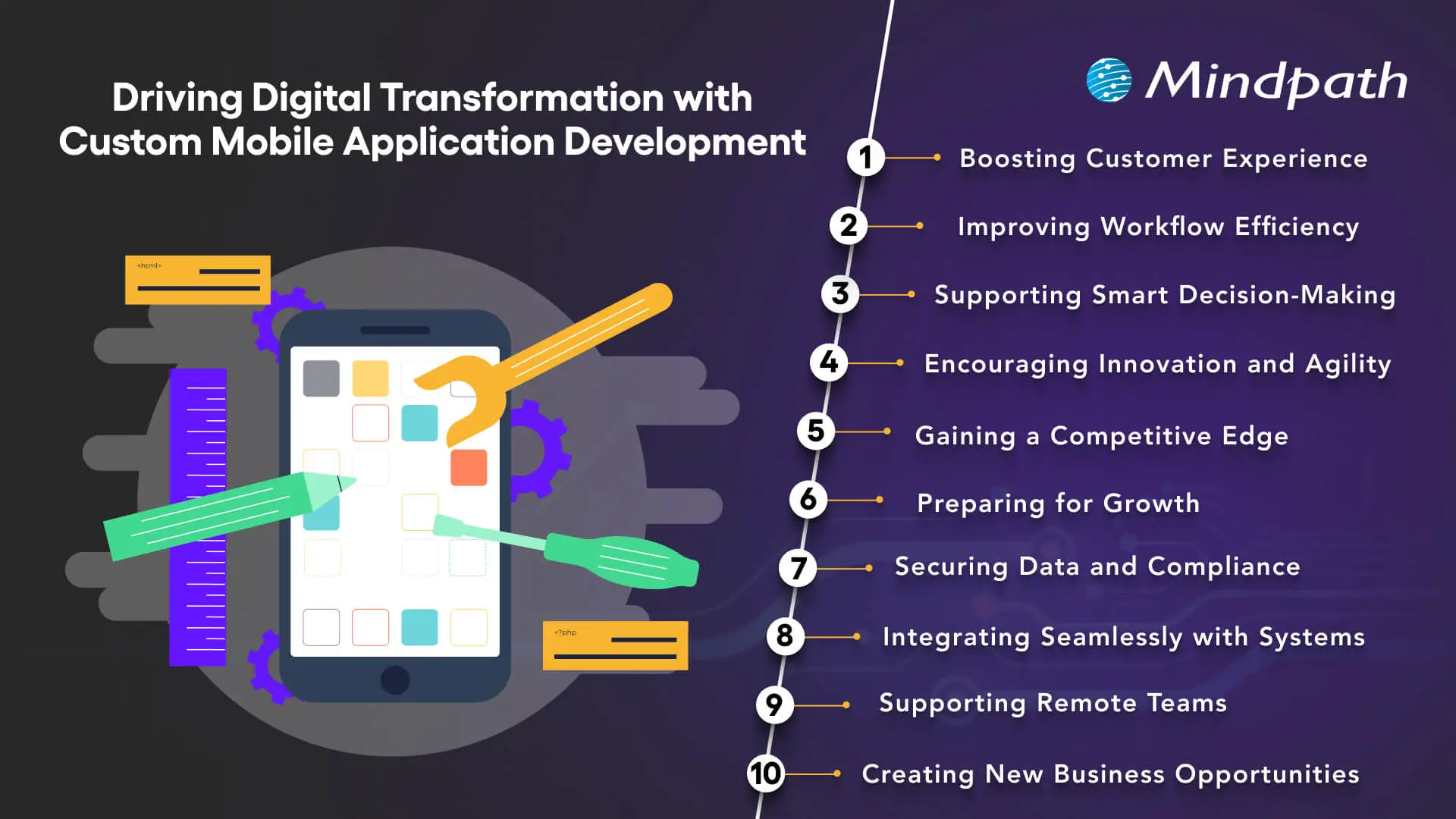
Driving Digital Transformation with Custom Mobile Application Development

1. Boosting Customer Experience

By using custom mobile application development, a company can have an app that is unique and offers a different experience for the users. These applications are the most convenient way for the customers to interact with the company, get a response, and receive the service. If a business adopts a user-centric design, it is only a matter of time before they will see their customers being more loyal and having a stronger bond with them.

2. Improving Workflow Efficiency

Personalized applications simplify core business operations through the automation of monotonous tasks and the minimization of errors. As a result, the company productivity is elevated and operational expenses are lowered. Enterprises thus become winners of facilitated work processes and a better structured system.

3. Supporting Smart Decision-Making

Custom app development enables real-time data collection and analysis. Companies have the ability to monitor consumer behavior, industry trends, and their own performance in an easy way. Such a data-driven strategy is a great source of power for decision-makers, as it enables them to take correct and prompt decisions.

Want to understand which tools and frameworks power successful mobile apps and accelerate digital transformation? Explore our detailed guide on mobile app development technologies to discover the platforms and tech stacks driving innovation.

4. Encouraging Innovation and Agility

By using tailored solutions, businesses have the possibility to create exclusive features that tackle issues directly. Such freedom from constraints promotes creativity and makes it possible for the company to adjust to the changes in the market swiftly. In other words, companies have the opportunity to be ahead of their competitors in the sense that they can try out new things and make their moves faster.

5. Gaining a Competitive Edge

Custom applications are a great way for companies to be different from the rest of the businesses by giving them exclusive features and a better user experience. Such differentiation leads to a powerful market presence. A good app is the company’s strongest weapon in the battle for customers against competitors.

6. Preparing for Growth

Custom mobile application development is a wise decision when considering business growth because it guarantees that the app will be scalable. It is very easy to add new features or make a service available to more users. The company can grow with no problem of performance or user experience being compromised.

7. Securing Data and Compliance

Custom apps may have the most sophisticated security features that are specifically tailored to meet the needs of different industries. Such features not only secure sensitive information but also help in maintaining compliance with the set regulations. Companies can go about their operations without any worries that their data is secure.

8. Integrating Seamlessly with Systems

Custom apps built using the right mobile app development tools can be linked to existing corporate software and platforms without any problems. As a result, this leads to the creation of a single digital ecosystem that spans across different tools. Information exchange between various systems becomes very easy. Hence, the mistake rate is reduced, and the speed of work is increased.

9. Supporting Remote Teams

With the help of mobile application development platforms, employees get access to tools and information from anywhere. This provision of remote access is a great boost to collaboration, which can now happen across different locations. It also allows work arrangements to be flexible. Teams are thus not being unproductive as they are not bound to a single office.

10. Creating New Business Opportunities

The creation of custom apps may result in a business gaining revenue streams through subscription fees, in-app purchases, or new digital models. Companies can now dig into newer ways of monetizing their services. By means of website and mobile app development, the business can ensure that these opportunities are indeed going in line with their overall strategy.

Looking to future-proof your mobile app strategy? Discover the latest insights in our blog on mobile app development trends to see how emerging technologies are redefining digital experiences.

Want to Drive Growth with Custom Mobile Apps?

Custom mobile application development is a powerful tool for businesses looking to innovate and stay competitive. Tailored apps improve efficiency, enhance customer experience, and provide data-driven insights that guide smarter decisions. By adopting custom solutions, organizations can drive growth, strengthen their market presence, and create seamless digital experiences that truly align with their goals.

At Mindpath, we offer professional custom mobile application development services to help businesses achieve these results. Our team builds scalable, secure, and feature-rich mobile applications that integrate smoothly with existing systems. We focus on delivering solutions that match your business needs and foster innovation. We provide a superior user experience across all platforms.

generative AI in retail

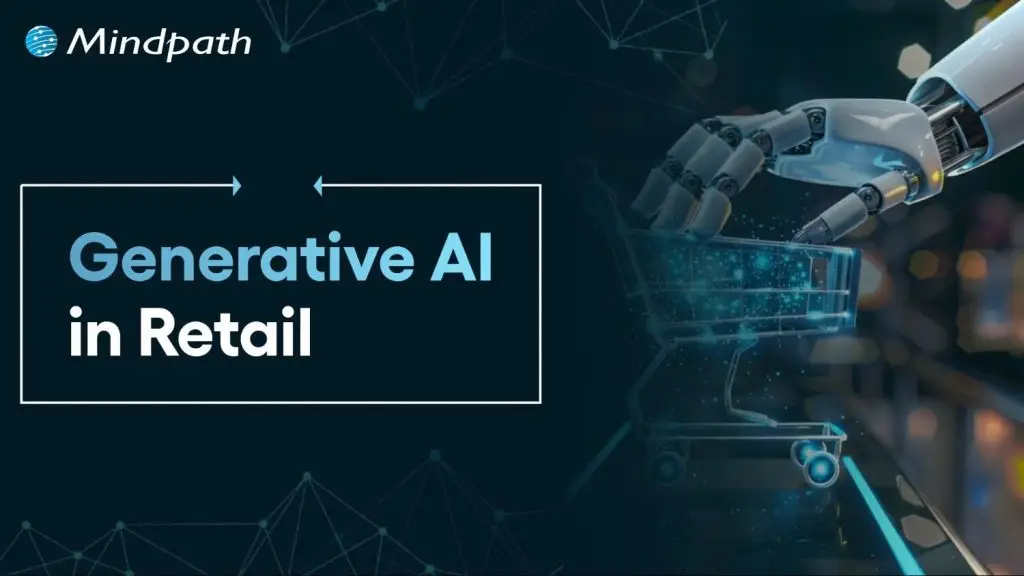
Every business in any industry you can think of depends heavily on their customers and how well they engage with the business. The two most prominent sectors that cannot compromise with customer engagement are retail and ecommerce. With the growing adoption of generative AI in retail and ecommerce, business leaders have been trying to figure out ways to leverage generative AI to enhance customer engagement.

According to a report by McKinsey, generative AI can add almost $4.4 trillion to the global economy in different use cases (Source). On top of it, around 75% of the value delivered by generative AI will be focused on four areas, which also include marketing. This is where retail and ecommerce businesses can look for an opportunity as generative AI can transform interactions with customers.

Looking to transform your business with intelligent automation and creative AI insights? At Mindpath, we implement Generative AI developement services strategies that empower companies to innovate faster and make smarter decisions.

Understanding the Rise of Generative AI in Retail and Ecommerce

Few years ago, no one would have believed that artificial intelligence will become a part of everyday lives of people. The arrival of generative AI changed the narrative and you can witness generative AI use cases in retail and ecommerce transforming how brands engage with customers. Generative AI can not only help in generating text and images but also offers the opportunity to extract valuable insights.

You can witness the growing influence of generative AI in the domain of retail and ecommerce through some statistics about generative AI.

  • McKinsey has predicted that generative AI could add value of $400 billion to $660 billion annually in the retail and consumer packaged goods sector (Source).
  • NVIDIA has pointed out that almost 90% of retail businesses have been actively using AI in different operations (Source).
  • The adoption of generative AI in the world of ecommerce can lead to 300% growth in revenue and a 150% rise in conversion rates (Source).

All these numbers showcase exactly why business leaders in retail and ecommerce want to discover the true potential of generative AI. The estimates of value derived from generative AI create curiosity regarding the different ways in which retail and ecommerce businesses can leverage generative AI.

Wondering how AI can do more than just enhance customer experiences in retail? Discover the real-world applications of generative AI in business in this detailed guide.

How Does Generative Improve Customer Engagement?

A major share of the impact of generative AI applications in retail and ecommerce will revolve around customer engagement. Many people will believe that the use cases of gen AI in retail and e-commerce focus on automation alone. However, generative AI brings a novel blend of automation, automated content generation, and deep analysis, enabling hyper-personalized interactions, 24/7 intelligent self-service, and the ability to anticipate customer needs before they arise. This combination introduces benefits for both consumers and marketers.

The ideal approach to understand how retail and ecommerce businesses can leverage gen AI will involve a review of its use cases.

1. Making Every Customer Experience Feel Personal

All brands in the retail and ecommerce space consider personalization as their top priority to grow their market share. You must have noticed how digital retail and ecommerce platforms provide the “You May Also Like” sections below product pages. However, the problem arises when the products recommended in those sections are completely irrelevant. Would you buy an electric bulb when you are purchasing wires to repair a circuit box?

The first step to harnessing generative AI for improvement in customer engagement begins with improving personalization. Generative AI can help with comprehensive analysis of browsing history and purchasing patterns of customer to find valuable insights. In addition, the utility of generative AI in sentiment analysis can also help in identifying what customers actually want.

The power of generative AI can enhance personalization and makes every customer feel that the brand thinks about them. With the help of generative AI, brands can present more accurate product suggestions and use targeted promotions for relevant audience. The improvements in customer experience through personalization play a vital role in enhancing customer engagement.

2. Transforming Supply Chain Operations with Smart Decisions

Ask any retailer about their biggest concerns and they will obviously speak of supply chain management. Can you imagine the plight of a business owner who has a lot of stock or runs low on stock? In both cases, the business is suffering from ineffective supply chain management. The introduction of generative AI in ecommerce turned things around by providing a powerful tool for data analysis. Generative AI can easily facilitate comprehensive analysis of historical sales data and trends along with external factors to draw accurate demand forecasts.

How does the analysis of historical sales data and external sales factors improve customer engagement? You can think of a retail or ecommerce business that uses generative AI to predict if the demand will increase before the holiday season. As a result, it can avoid scenarios where it has run out of stock in the middle of the holiday season.

Generative AI also makes supply chain operations a lot smarter with accurate predictions for deliver times. In ecommerce, customers can get real-time updates on shipping status and delivery dates with better transparency. You can clearly notice how generative AI enhances customer engagement by streamlining supply chain management and enhancing transparency.

3. Turning Customer Interactions into Productive Conversations

The endless wait for replies from customer service representatives has come to an end with the arrival of generative AI. You can notice generative AI use cases in ecommerce evolving beyond the benefits of automated customer service. Generative AI serves as the driving force behind creation of virtual assistants and conversational AI chatbots that make online shopping more seamless. The AI-powered assistants can simulate conversations that customers are likely to have with in-store sales executives.

Big brands in the retail and ecommerce space like Walmart and Amazon have introduced AI chatbots to provide customer assistance. How are these chatbots assisting customers in their shopping experiences? Customers can use them to track prices during peak shopping seasons, such as during Black Friday sales. The chatbots also help customers in comparing products and creating shopping lists without any complaints.

The AI-powered virtual assistants bridge the customer experience gap between shopping online and in-store purchases. Generative AI empowers chatbots to use customer data and find out what exactly customers are looking for. The personalized guidance in their interactions with customers gets better as the virtual assistants learn continuously and offer accurate recommendations.

4. Supercharging Marketing Efforts with Generative AI Content

The search for top use cases of generative AI in online commerce and digital retail spaces will also lead you to marketing. Without targeted marketing, brands cannot retain customers and lose a major share of customer engagement. The larger generative AI market sheds light on how generative AI applications enhance the work of marketing professionals. Generative AI works like the young marketing intern who can work endlessly for hours while churning out creative ideas.

Retail and ecommerce brands have been using generative AI to craft compelling product descriptions, social media posts and ad copies. The best thing about leveraging generative AI to supercharge your marketing efforts is the opportunity to use genuinely out-of-the-box content. For instance, some retail companies use generative AI to create multiple versions of ad copies and test them.

Generative AI also opens the doors for creating highly personalized marketing content, including personalized email and SMS campaigns. Brands can design product descriptions that offer the highest conversion rates. Tailoring your marketing content to the target audience ensures that the content appeals to the audience and improves engagement.

Want to know which AI solutions are truly transforming customer experiences in retail? Explore actionable agentic AI examples here to enhance your customer engagement.

Ready to Transform Customer Engagement With Generative AI?

The ability to leverage generative AI in retail and ecommerce has offered a new ray of hope for customer engagement. You can witness the use cases of generative AI transform different aspects of how brands engage with their customers. For example, you can witness generative AI revolutionizing marketing with automated content generation. At the same time, generative AI drives virtual assistants and also reviews the sentiment in customer reviews.

Mindpath is your reliable partner in developing generative AI solutions tailored for the retail and ecommerce spaces. We have helped many brands establish strong foundations in customer engagement performance by providing the best-in-class generative AI solutions. You can consult with our experts and discover the ideal ways to incorporate generative AI and increase customer engagement.

Frequently Asked Questions

AI in finance

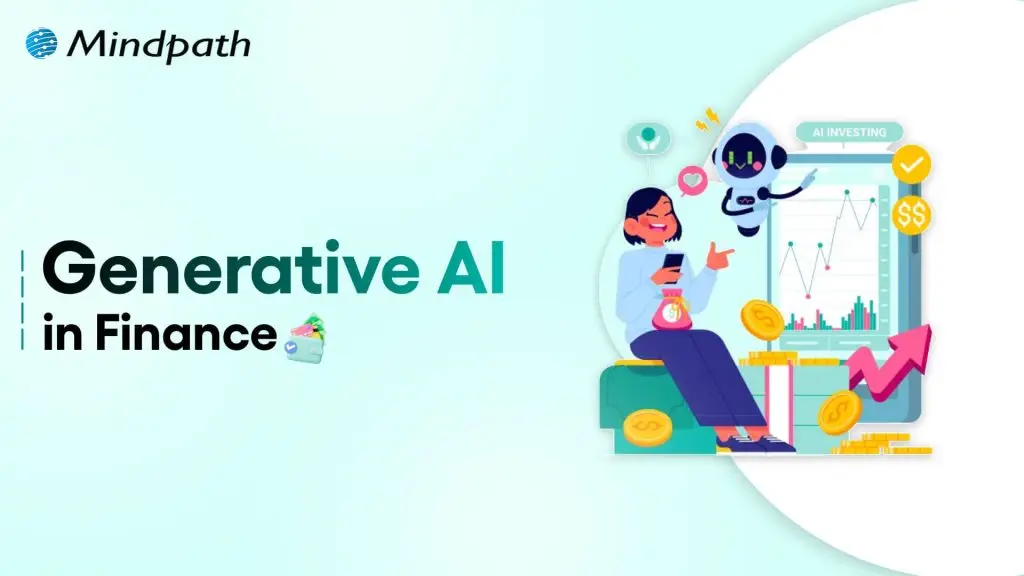
Generative AI in finance transforms raw data into actionable insights, automates complex reporting, and models dynamic scenarios using large language models (LLMs). This revolution is the biggest force of transformation in the financial services industry right now, marking a significant leap for practical applications of AI across various sectors. You can find different examples of AI in finance that have been setting new benchmarks for innovation. Banking and financial services companies perceive generative AI as something more than a prevailing technology trend.

A report by McKinsey reveals that generative AI will have a significant impact on the banking and financial services sector. The report mentions that generative AI can deliver additional value of almost $240 billion to $340 billion every year in the banking industry. Companies in the financial services industry must know how generative AI can unlock new opportunities and prepare the foundation for innovation in finance.

Planning to integrate AI into your finance strategy to drive smarter decisions and growth? Mindpath’s AI Development Services provides customized AI solutions that turn data into actionable insights and innovation.

Is Generative AI Right for the Financial Services Sector?

Business leaders in the financial services industry know the challenges and complexities that come in the way of business growth. Starting from the intricacies of digital transformation to the continuous changes in customer habits, finance leaders have to deal with multiple responsibilities. You must know that the adoption of Generative AI for Business in finance creates new opportunities to achieve better efficiency.

You will find many examples of banking and finance companies that have adopted AI and transformed the way they work. Financial service providers have achieved faster budget cycle times and reduction in uncollectible balances with artificial intelligence. As the complexity of financial operations continues growing, companies look up to generative AI for various reasons. Companies in the banking and finance industry can use generative AI to find new opportunities for streamlining workflows with automation.

Planning to deliver highly customized financial services using AI? Learn about AI in personalized banking experiences to discover strategies that improve customer satisfaction and operational efficiency.

Key Benefits of Generative AI in Financial Services

The interplay between AI and finance has created the foundation to achieve many new benchmarks in the industry. With the help of AI, financial institutions can meet emerging expectations of customers and resolve inefficiencies across various financial operations. The applications of generative AI in the domain of financial services offer more than just automation.

1. Enhancing Accuracy

One of the prominent reasons to rely on AI revolves around the assurance of freedom from human errors. The use cases of AI in compliance checks, financial reporting and audits provide the advantage of reduced errors. Artificial intelligence takes care of such tasks where attention to detail is extremely crucial and helps in reducing inconsistencies that may manifest due to human error. AI models can analyze large datasets and find anomalies to ensure strict regulatory compliance. As a result, all stakeholders can fulfill compliance requirements while ensuring better performance.

2. Introducing Hyper-Personalization

Personalization of products and services is one of the crucial measures to improve customer engagement in any industry. Generative AI finance applications can provide hyper-personalized solutions that deliver exactly what customers want. Generative AI can help in obtaining valuable and relevant insights from the financial history, spending patterns and risk profiles of customers. With the help of those insights, financial institutions can offer highly personalized recommendations to customers. For example, AI systems can recommend the ideal investment strategy depending on the portfolio and risk appetite of customers.

The biggest strength of artificial intelligence is the capability for real-time data analysis. Financial institutions can leverage this facility to make well informed decisions at a faster pace, using AI in decision making to guide strategy and reduce errors. The use of artificial intelligence for finance helps in navigating volatile markets with more efficiency, where companies have to respond to sudden changes and take decisions instantly. You can find the best example of using AI for improved decision-making in systems that identify early signals of market instability. The ability to identify flaws earlier helps financial institutions follow preventive measures without discrepancies.

3. Optimizing Operational Costs

Cost optimization is a major advantage of applying artificial intelligence in the financial services sector. By automating repetitive and time-consuming tasks, generative AI offers the ideal instrument for cutting operating costs. Generative AI can be used by financial institutions to generate documents, answers common customer service questions and process insurance claims. AI systems also help in reducing costs through automation of mundane tasks that can be completed without human intervention. One of the best examples of cost optimization with AI is visible in the use of AI chatbots for customer service.

Ready to upgrade customer interactions using AI in finance? Discover conversational AI chatbot to learn how intelligent assistants improve efficiency and deliver tailored support.

Unraveling the Use Cases of AI in Financial Services

Many organizations believe that adopting artificial intelligence in financial services is a daunting challenge. Generative AI is a game-changer for many functions in financial institutions with proven and tested use cases. Understanding the use cases of generative AI across different financial operations can help you get a better idea of how to make the most of the technology in practical scenarios.

1. Risk Management

Artificial intelligence delivers the power to create tools that can evaluate market volatility, operational threats and credit risks. The ability to simulate various scenarios with artificial intelligence can help in creating synthetic datasets which provide the foundation for robust risk management strategies.

2. Customer Experience

Generative AI is already playing a vital role in transforming customer experiences with the help of virtual assistants. These assistants leverage artificial intelligence to provide personalized financial advice and resolve the queries of customers. Artificial intelligence is capable of analyzing customer profiles in real-time and offering personalized solutions that guarantee seamless service delivery.

3. Portfolio Optimization

You can also notice the growing influence of AI in financial industry for the use cases in investment. Generative AI can help you created advanced predictive models that provide asset performance analysis and portfolio diversification. Financial advisors can use generative AI to draw simulations of investment outcomes, thereby offering better and more accurate recommendations.

4. Fraud Prevention

The financial services industry is plagued by cases of fraud that lead to losses worth billions of dollars annually. Financial institutions can leverage generative AI to learn from large datasets of transactions to identify anomalies in transaction patterns. It provides the ideal tool for real-time fraud detection, thereby providing a heads up before malicious agents make their move. Generative AI also helps in simulation of different fraud scenarios and fine-tuning algorithms to detect emerging threats.

Want to stay ahead of the curve in AI-driven finance? Discover Gen AI trends to learn how emerging technologies are shaping smarter strategies and innovative solutions.

Success Stories of Generative AI in the World of Finance

The best way to learn how artificial intelligence has revolutionized finance would involve a review of some success stories. The advantages of AI in financial services have garnered the attention of numerous top companies. Companies in the domain of banking and finance need to take inspiration from institutions that have successfully used generative AI to address critical concerns.

Quest IndexGPT, an innovative generative AI solution developed by JP Morgan, has revolutionized the creation of investment indices.

JP Morgan created Quest IndexGPT, a revolutionary tool for creating investment indices by using generative AI. On the other hand, MasterCard leveraged generative AI for creating a proactive fraud detection system. The fraud detection technology helped MasterCard reduce false positives, thereby ensuring seamless customer experiences.

Ready to adopt the latest AI technologies for finance innovation? Explore Generative AI tools to check out how these platforms are reshaping analytics, automation, and personalized services.

Final Thoughts

You can notice the transformative impact of artificial intelligence in the domain of financial services across various areas. The growing use of AI in banking and finance has created new opportunities for transforming the way financial institutions work. In addition, artificial intelligence revolutionizes customer experience and risk management in the finance industry.

Mindpath is one of the leading providers of AI solutions tailored to client expectations. We have been delivering end-to-end generative AI development services for different industries, including the financial services sector. Our experience speaks for itself in the success stories shared by our clients. Book your first consultation with us and achieve new levels of efficiency in the financial services industry.

Frequently Asked Questions