Benefits of DevOps – Transform Your Development Process in 2026

Home

Benefits of DevOps – Transform Your Development Process in 2026

Benefits of DevOps – Transform Your Development Process in 2026

Join our Newsletter!

benefits of devops

While building software, just think that the developers and the operations teams are working like a well-coordinated crew, being fast, smooth and always on the same page. Isn’t it an interesting combination? Well, that’s the power behind embracing the benefits of DevOps. It is a new method to simplify your software process, in a way that will help teams work more effectively in an increasingly fast-paced digital world.

As we approach 2026, DevOps continues to evolve the way businesses build and run software. DevOps is not just a fast way to deliver software; it is a cultural approach that allows for speed, scale, agility, and reliability. This blog will look at how DevOps is rewriting the development process and why it is now essential for progressive teams. 

Are you looking to implement DevOps in your organization? Mindpath provides customized solutions to help teams speed up the development process and reach quantifiable goals.

What is DevOps?

DevOps refers to the collaboration of development and IT operations teams working together for the software development processes. It helps them to build, test as well as launch software faster and smoother. The major idea behind DevOps is better teamwork, faster delivery, and fewer problems during the software process. 

Even though it is not a tool or a product, it often includes using helpful technologies such as cloud platforms, containers and real-time communication tools. A big part of it is CI/CD, which stands for continuous integration and continuous delivery. This helps teams update software more often without slowing down. With DevOps, both developers and operations teams can share tasks, improve quality, and make sure the final product reaches users quickly and safely. 

How Does DevOps Work?

DevOps works by bringing development and operations teams together to make software faster and more reliable. The process follows a cycle that includes planning, coding, building, testing, releasing, deploying, operating, monitoring, and collecting feedback. Each step is connected to keep the work smooth and continuous. What is the main purpose of DevOps? It is to create software that meets user needs, runs well from the start, and is delivered without delays. 

To support this, teams use DevOps tools like automation platforms, monitoring systems, and CI/CD pipelines. These tools help developers work independently and speed up tasks that used to take longer. For example, with continuous integration, developers can update shared code several times a day and quickly catch bugs. Teams also follow shared rules for testing and quality, so everyone stays on the same page. 

Planning to modernize your DevOps approach using automation and stronger safeguards? Check out our blog on DevSecOps to learn why automated security integration is essential for speed, stability, and resilience.

What are the Key Benefits of DevOps?

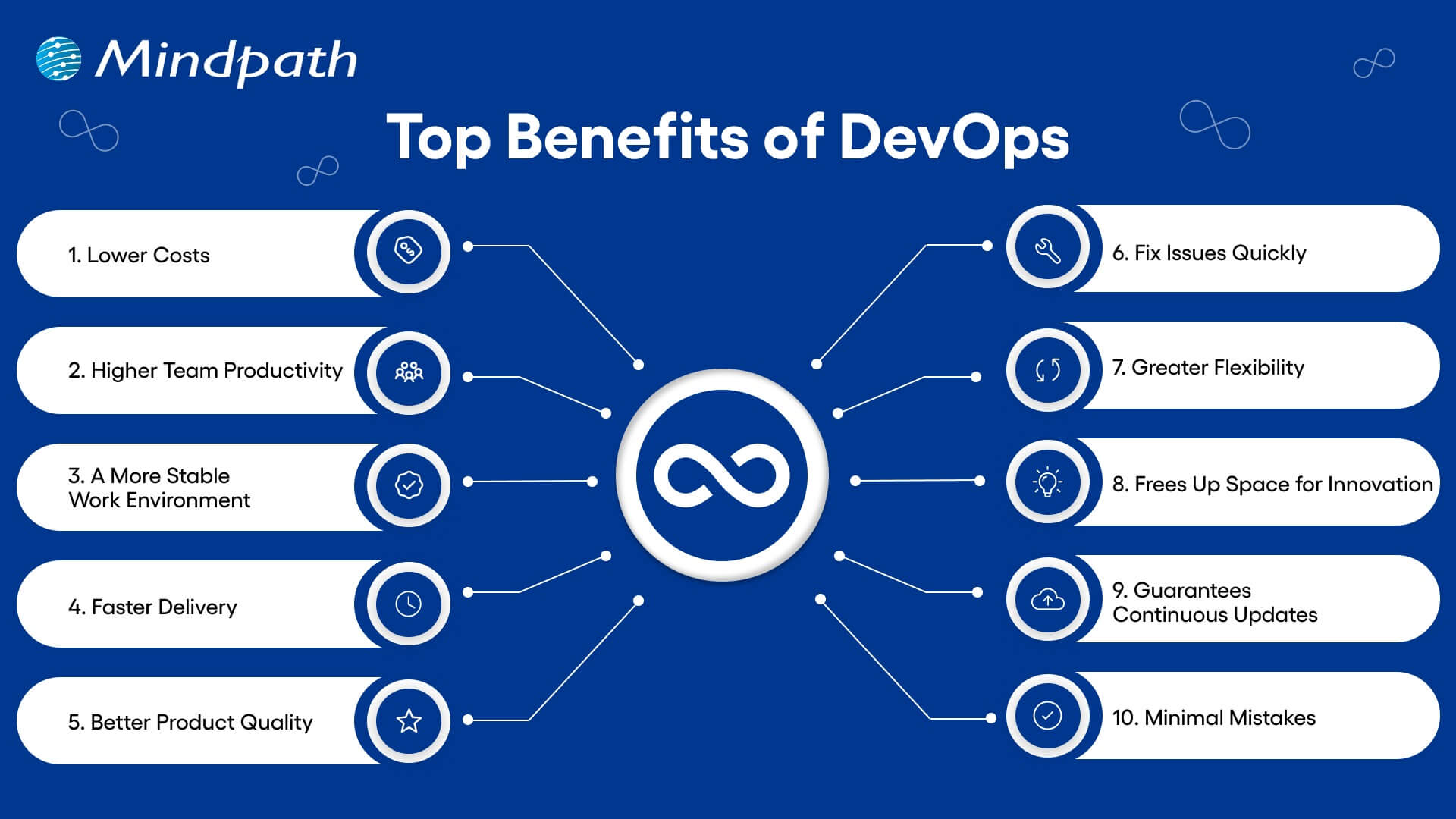
Adopting DevOps brings real improvements to how teams build and deliver software. The DevOps benefits focus on making the development process more efficient, reliable, and easier to manage. Let’s have a look at some of it: 
top benefits of devops

1. Lower Costs

Combining updates and maintenance in one process helps teams work more efficiently. DevOps reduces the need for last-minute fixes and wasted effort. This saves money and helps teams do more with the same resources.  

2. Higher Team Productivity

Open communication and fewer repeated tasks let teams focus on real progress. Everyone knows what to do and can work on high-value goals. As a result, productivity rises, and team members feel more involved.  

3. A More Stable Work Environment

DevOps helps create a calmer and more organized workplace by reducing the pressure of constant changes. Teams can handle updates with ease, due to smoother processes and clear communication. This balance helps everyone stay focused and productive. 

4. Faster Delivery

With DevOps, updates and new features can be launched more quickly. DevOps for business helps in meeting customer needs faster and staying ahead of the competition. Streamlined deployment also helps with fewer delays and more consistent results. 

5. Better Product Quality

Frequent feedback and testing throughout development help improve the final product. DevOps uses automation to catch up on problems early, before they grow. This keeps the focus on delivering quality and reduces the need for rework. 

Must Read: DevOps Trends 

6. Fix Issues Quickly

DevOps makes it easier to detect and solve issues early. Smaller releases and constant monitoring help teams act fast when something goes wrong. This keeps systems running smoothly and reduces downtime. 

7. Greater Flexibility

DevOps supports teamwork across different departments, helping companies respond quickly to change. Breaking down barriers between teams encourages flexibility in how work gets done. This leads to quicker decisions and faster progress. 

8. Frees Up Space for Innovation

When tasks like testing and deployment are automated, teams have more time for creative thinking. Developers can focus on building new ideas instead of repeating the same steps. This makes work more exciting and leads to better solutions. 

9. Guarantees Continuous Updates

DevOps supports a smooth flow of updates and new features with every release. Automation and teamwork make sure each change is tested and delivered quickly. This gives users regular improvements while keeping everything stable. 

10. Minimal Mistakes

Frequent code releases and testing help teams catch up with problems early. This keeps software quality high and prevents bigger issues later on. It’s a key benefit of DevOps that helps teams move forward with confidence. 

Aiming to enhance operational efficiency and reduce development risks? Check out our blog on DevOps Challenges and Solutions to discover proven approaches that improve performance, stability, and cross-team cooperation.

DevOps Best Practices

Following the right approach is key to getting the most out of DevOps. It helps teams collaborate better, improve software quality, and speed up delivery. Here are some of the most effective DevOps best practices to consider: 

1. Build a Culture of Trust and Teamwork

To make DevOps work well, teams need to feel safe to share ideas and learn from mistakes. When there is trust and open communication, collaboration becomes much easier. Breaking down walls between departments helps everyone work toward a shared goal. A culture of trust and empathy makes it easier to adopt DevOps smoothly.

2. Continuous Integration and Delivery

CI/CD DevOps practices involve adding small code changes frequently to a shared space. This helps teams spot issues early and keep the code clean. Once the code is tested, it moves into production smoothly through continuous delivery. This process saves time and gives developers confidence when releasing updates.

3. Automate Testing Early On

Automated testing is a key part of a strong CI/CD pipeline. Instead of waiting for manual tests, automated tests run every time a change is made. These tests can include everything from unit to load testing, depending on your needs. This helps reduce bugs and makes sure the software stays reliable.

4. Track the Right Metrics

To keep improving, teams need to measure what matters. Metrics like deployment speed, failure rates, and time to fix issues give a clear picture of performance. Each team may focus on different metrics based on their goals. It’s also important to collect logs and monitor systems to quickly fix problems and improve how everything runs.

5. Automate Repetitive Tasks

Manual tasks can slow down development and lead to mistakes. Automating these tasks speeds things up and keeps results consistent. It also frees up teams to focus on more valuable work. A reliable automation process adds confidence and improves overall efficiency.

Planning to strengthen your software delivery lifecycle? Explore our blog on DevOps vs DevSecOps to understand how shifting from simple automation to integrated security can elevate speed, reliability, and protection.

Ready To See How DevOps Can Boost Your Business?

The benefits of DevOps include enhanced collaboration, faster software delivery, and improved product quality. It also reduces costs while fostering a stable and efficient work environment. Through automation and continuous feedback, teams can quickly adapt and respond to changes, making DevOps a vital approach for building reliable software in today’s dynamic digital landscape. 

At Mindpath, we specialize in helping organizations successfully implement DevOps practices. We focus on automating processes, strengthening team collaboration, and accelerating software delivery with quality and security. Our expert guidance ensures your DevOps transformation aligns with your business objectives, enabling smoother and more efficient software development. 

Frequently Asked Questions

1. How can DevOps help a business recover faster from unexpected failures?

DevOps practices, like automated testing, monitoring, and CI/CD pipelines, allow teams to detect and fix issues early. Quick rollback mechanisms and real-time alerts reduce downtime, ensuring the business can recover faster while maintaining service continuity for customers.

2. Can adopting DevOps change the way teams collaborate beyond development and operations?

Yes. DevOps fosters cross-functional collaboration, breaking silos between teams like QA, security, and product management. Shared responsibility, transparent workflows, and continuous feedback enhance coordination, resulting in faster decision-making and smoother project delivery across the organization.

3. How do the benefits of DevOps extend to customer experience?

DevOps accelerates release cycles, enabling frequent updates and faster bug fixes. Continuous monitoring ensures software stability, while automation reduces errors. Together, these practices deliver a reliable, responsive, and high-quality user experience that aligns with evolving customer expectations.

4. What is the role of automation in reducing operational risks within DevOps?

Automation handles repetitive and error-prone tasks such as deployments, configuration management, and testing. By minimizing human intervention, it lowers the risk of mistakes, ensures consistency across environments, and enhances overall system reliability, even under high-demand scenarios.

5. How can DevOps support businesses preparing for rapid growth or scaling?

DevOps enables scalable infrastructure through containerization, microservices, and cloud integration. Continuous monitoring and automated deployment pipelines allow applications to handle increasing traffic without performance degradation, making growth smoother and reducing technical bottlenecks as demand rises.
Related Post

Legacy modernization roadmap 

Enterprise systems drive day to day operations but most leaders experience the burden of old platforms. You want speed, security and scale, and the legacy complexity is slowing all of your moves. A clear legacy modernization roadmap brings direction and control to this shift. It assists you in matching the technology to the business objectives and make measurable change with certainty.

Nevertheless, modernization does not only require upgrades. You require clarity, leadership focus, and effective execution at all levels. That is why the enterprise leaders need to consider modernization as one of the strategic priorities rather than a side project. The right roadmap takes vision and action through the right path and mitigates risk. In this blog, we deconstruct one of the practical structures that were established with the enterprise decision makers in mind. So, let’s dive in!

Looking to align technology upgrades with your overall business strategy? Mindpath’s legacy modernization services ensure your systems support growth and deliver better ROI.

What is Legacy Modernization Roadmap?

A legacy modernization roadmap gives enterprises a clear, structured plan to upgrade outdated IT systems. It successfully takes leaders on the path of evaluation, objective creation and strategy choice with good business fit. Consequently, organizations decrease technical debt levels, enhance their performance and develop secure, cloud-ready systems that accommodate long term development.

Legacy system transformation focuses on turning rigid, high maintenance platforms into agile and scalable architectures. Teams subdivide large systems into small stages and embrace cloud, microservices, and automation. This will enhance flexibility, enhance security, and enable the enterprises to respond more swiftly to market needs with confidence.

Want to understand how modernizing legacy systems can transform your business operations? Explore the benefits of modernizing legacy systems to drive efficiency and growth.

Why Enterprises Need a Legacy Modernization Roadmap?

Companies are faced with sluggish systems and increased maintenance expenses. A clear legacy modernization roadmap, backed by strong legacy modernization strategy, helps leaders improve performance and drive steady business growth.

1. Strong Business Alignment

Businesses require a sense of direction which links technology with expansion strategies. A clear road map converts the IT initiatives into the business goals in the long run and makes the systems growth enablers.

2. Lower Costs and Better Returns

Systems of the past are very demanding in terms of maintenance and repair. New platforms lower the operating expenses and provide more potent returns by being efficient and using smart resources.

3. Better Security and Compliance

Obsolete software exposes the businesses to security risks and compliance lapses. The modern systems enhance the security of data and assist companies in complying with the industry requirements with ease.

Must Read: Application Security Best Practices

4. Greater Agility and Scalability

Companies have to react fast to market changes, shifts and customer needs. A legacy modernization roadmap builds flexible architectures that support faster releases and seamless scaling.

5. Smarter Technology Adoption

Businesses would prefer to exploit innovation without conflict in the system. The application of AI in legacy modernization enables the incorporation of smart tools that enhance insights, automation, and decision making.

6. Reduced Operational Risk

Changing fundamental systems without a strategy brings about discontinuity and chaos. A transformational roadmap keeps transition risks under control and makes the business survive in the process of transformation.

Looking to modernize your systems with the help of advanced AI technologies? Learn from AI-driven legacy system modernization to accelerate your transformation journey.

A Step-by-Step Guide for Legacy Modernization Roadmap

A good plan makes modernization objectives measurable. This step-by-step method can assist Intrapreneurship leaders of an enterprise to progress with organization, management, and certainty.

1. System Discovery and Assessment

Teams draw out existing systems and find out the dependencies. They check-up technical health and flag bottlenecks in the performance. They also use legacy modernization tools to uncover hidden risks and code issues.

2. Strategy and Value Definition

Leaders establish the future architecture and business results. They select the appropriate modernization strategy depending on objectives and complexity of the system. A legacy modernization roadmap helps align technical decisions with measurable ROI targets.

3. Planning and Risk Readiness

Work teams develop a clear plan of execution using milestones. They describe the process of data migration, compliance processes, and security controls. The legacy application modernization roadmap ensures teams reduce risk before execution begins.

Must Read: Monolith to Microservices

4. Phased Execution and Deployment

Professionals upgrade the systems through stages that are manageable. They do not disrupt and update in controlled cycles. A legacy modernization roadmap keeps teams focused on stability and steady progress.

5. Testing and Quality Validation

Automated and performance tests are done on teams at each stage. They measure functionality to stipulated KPIs and business objectives. The step will guarantee reliable performance of the new system with real workloads.

6. Optimization and Continuous Monitoring

Post-deployment, the leaders observe health of the system. Teams monitor the performance metrics and feedback. They streamline procedures that facilitate scaling and expansion in the long run.

Wondering how SaaS can reduce the complexity of legacy systems? Explore SaaS trends to streamline your transformation process.

Ready to Build a Future Ready Enterprise with a Clear Roadmap?

A strong legacy modernization roadmap gives enterprise leaders clarity and control. It relates business objectives and technology action systematically. Phased execution helps organizations to reduce risk, cut costs, and improve performance. Teams empower long term digital growth and invest in it with the certainty of the proper planning and governance.

At Mindpath, we provide legacy modernization services that help you achieve outcomes using a successful legacy modernization framework, adaptable to your enterprise-specific needs. Our specialists evaluate systems, establish strategy, and make modernization accurate. Our priorities are on security, scalability, and quantifiable value at all levels. Collaborate with Mindpath to modernize key systems and speed up sustainable business change.

FAQs

1. Why should enterprise leaders prioritize a legacy modernization roadmap now?

Competitive pressure and rising maintenance costs demand faster innovation. A legacy modernization roadmap helps leaders align technology with strategic growth goals. It creates clarity, reduces operational risk, and strengthens long term scalability in an increasingly digital business environment.

2. How long does a legacy modernization roadmap typically take?

Timelines depend on system complexity, data volume, and business readiness. Some initiatives move quickly with focused scope, while large transformations require phased execution. A well structured legacy modernization roadmap defines milestones early and keeps teams aligned with realistic delivery targets.

3. How do we measure success during modernization?

Enterprises should measure improvements in performance, cost efficiency, uptime, and user experience. Business impact should guide every technical decision. A clear legacy modernization roadmap establishes KPIs at the start and tracks measurable outcomes throughout the transformation journey.

4. Which architecture approach suits complex legacy systems?

Enterprises often evaluate cloud native, microservices, or hybrid models based on workload demands. Technical audits help identify system dependencies and scalability limits. A legacy modernization roadmap supports informed architecture decisions that balance innovation, risk control, and operational stability.

5. How can we manage data and compliance risks during modernization?

Data migration requires strong governance and phased validation. Teams should conduct security reviews and compliance checks before execution. A structured Legacy modernization roadmap reduces exposure to data loss and regulatory gaps. Mindpath’s legacy modernization services provide expert guidance for secure and compliant transitions.

prevent Cloud Computing Attacks

The current cloud landscape challenges business organizations to reconsider security on a daily basis. Organizations are currently concerned about ways to prevent cloud computing attacks in distributed systems. Attack patterns are becoming smarter and defenders need to think quicker with greater visibility. Lots of teams cannot find the balance between speed, access and protection in cloud operations. This change requires a more profound insight into the changing risks and response plans.

The old fashioned perimeter defenses are no longer applicable to cloud environments. They are now able to align identity controls, monitoring and configuration practices accurately. Each tier of cloud infrastructure needs constant consideration and more intelligent decision making. Organizations also require regular awareness of the adaptation of threats across services. This blog discusses the practical methods used to enhance the cloud security posture. So, let’s begin!

Ready to keep your cloud environment safe without constantly worrying about hidden risks? Mindpath offers cloud-managed services to handle security, monitoring, and performance so you can focus on growing your business.

What are Cloud Computing Attacks?

Cloud computing attacks refer to security attacks that are directed at cloud systems, data, and services. The attackers aim at stealing, destroying, or abusing the information stored in the cloud platforms. They frequently take advantage of weak access controls, system vulnerabilities or human error. These attacks interfere with a regular business and reveal sensitive information.

Organizations are at risk of things such as unauthorized access, data leaks, and spreading malware in cloud environments. Good cloud security will help a company figure out if there is any suspicious activity and how to reduce the damage. To prevent cloud computing attacks from happening, a business must improve its capability of supervision and control. In turn, it leads to the building of trust and safety of the cloud systems.

Wondering how businesses adapt to rising cloud threats and changing attack patterns? Discover the latest insights on cloud computing trends shaping modern security strategies.

Why is Cloud Computing Security Important for Businesses?

Most companies nowadays use cloud systems to run their business and operate with sensitive data all the time. This turns the security against cyber security attacks into a must-have for any organization. These are the main reasons why security is a key factor in the success of a business.

1. Protection of Sensitive Information

Cloud security solutions safeguard workers, clients, and company data from being inadvertently accessed or stolen. They play a major role in helping organizations avoid or minimize their risk to various digital threats.

2. Data Breach Prevention

Strong controls prevent attackers from leveraging weak cloud configurations. This method also helps prevent cloud computing attacks effectively.

3. Regulatory Compliance

Security measures guide companies in complying with regulations such as GDPR and HIPAA. As a result, not only do these practices make a company’s situation legally safe but they also enhance their clients’ confidence in them.

4. Business Continuity and Data Recovery

Backup systems and recovery tools are really the backbone of a company; they keep operations going when failures happen.

5. Insider Threat Protection

Implementing a good access control system can help greatly reduce the risk of employees or other internal users misusing their privileges. This way, the security risks, whether accidental or deliberate, are significantly lowered.

6. Stronger Security Systems

With intelligent monitoring, advanced tools can detect threats at an early stage. In fact, businesses can raise their level of overall protection by implementing proactive defense systems.

Looking to better understand hidden risks in cloud environments? Explore powerful cloud security tools that help protect your business systems effectively.

How to Prevent Cloud Computing Attacks?

Cloud is the constant target of cyber attackers since it is the platform where businesses operate and store their data. Organizations will have to keep their guard up and fortify their security measures against emerging threats.

Here are some ways to prevent cyber-attacks in cloud computing:

1. Secure API Access

Access to cloud applications should be granted only through reliable and secure APIs. This will help curb the chances of misuse and lower the vulnerability to the cyber threats.

2. Data Encryption Protection

Data ‍has to be encrypted during its transfer, storage, and use. Not only does this step prevent hacker from decrypting or harming any stolen data, but also it works as a major way to prevent cloud computing ‌‌‍ ‍‌attacks.

3. Identity Verification Control

Users are required to prove their identity through identity management prior to gaining access to the system. As a result, it lowers the chances of risks arising due to stolen credentials and unauthorized logins.

Looking to identify weak points in your cloud infrastructure before attackers do? Explore how cloud computing vulnerabilities can affect your systems and data.

4. Access Control Management

Users should have only the access, which is necessary/required for their work role. This drastically reduces the scope of damage from the insider threats and also from the compromised user accounts.

5. Cybersecurity Audits

Periodic evaluations are key to identifying misconfigured settings and security loopholes. They not only reinforce the protection capabilities of the entire system but also enhance security in the cloud.

6. Intrusion Detection Systems

Detection systems watch computer systems for unusual activities and attacks. These can be crucial to locate a threat as soon as possible and limit the scare and damage.

Planning to scale your infrastructure without increasing security gaps? Read about the key benefits of cloud migration for safer and smarter growth.

Cloud Computing Security Best Practices

Clouds are used in business processes and in the storage of sensitive information on a daily basis. Effective cloud computing attacks and security threats prevention require powerful practices.

  • Understand shared responsibility model and secure your own cloud data properly.
  • Test security, compliance, and incident response of cloud providers.
  • Implement identity and access control on strict least privilege and multifactor authentication.
  • Create explicit cloud security policies and implement zero trust architecture between systems.
  • Secure data transmission and storage to prevent unauthorized access.
  • Conduct regular audits and penetration testing to identify and fix vulnerabilities quickly.

Curious how modern technology is improving threat detection and response? Check out how AI in cybersecurity is transforming cloud protection.

Ready to Strengthen Your Cloud Security Strategy?

Cloud security requires consistent effort, smart planning, and strong controls across every layer of infrastructure. Businesses must stay proactive to prevent cloud computing attacks and protect data, systems, and users from evolving digital risks.

At Mindpath, we provide cloud security solutions that help businesses build safer and scalable cloud environments. Our team focuses on strong protection, monitoring, and compliance to keep your systems secure and reliable.

Frequently Asked Questions

1. What are the early signs of cloud security risks that businesses often ignore?

Unusual login attempts, unexpected data transfers, and sudden system slowdowns often signal security risks. Weak access control or misconfigured settings can quietly expose data before detection, increasing the chance of attacks and operational disruptions.

2. How often should cloud security settings be reviewed in a business environment?

Security settings should be reviewed regularly, especially after system updates or team changes. Frequent checks help maintain proper configurations, reduce vulnerabilities, and ensure cloud systems remain aligned with security policies and evolving threat landscapes.

3. What role does employee behavior play in cloud security protection?

Human actions significantly impact cloud safety, especially when handling passwords or access permissions. Simple mistakes like sharing credentials or ignoring alerts can expose systems to threats, making awareness and training essential for stronger protection.

4. Why do businesses struggle to prevent cloud computing attacks even with security tools?

Even with tools in place, misconfigurations and poor monitoring often create gaps. Without proper strategy and continuous oversight, attackers can still exploit weak points, making it harder to prevent cloud computing attacks effectively.

5. Can small businesses also face advanced cloud security threats like large enterprises?

Small businesses often face similar threats as larger companies because attackers target any vulnerable system. Limited resources and weaker configurations can increase risks, making cloud security essential for organizations of all sizes.

Learn how to prevent cloud computing attacks with practical tips on security, API protection, and IAM to safeguard your business and data.

Support Is One Click Away

Featured Posts

Related Post