
Top Benefits of Converting HTML to WordPress

Join our Newsletter!

Featured Posts

Support Is One Click Away

Home

Top Benefits of Converting HTML to WordPress

Html to Wordpress

Top Benefits of Converting HTML to WordPress

Anyone who has a HTML website might feel left out in the era of websites that load within seconds. Did you know that HTML websites were a thing when there was not content management system in the market? The transition from HTML to WordPress is no longer an option in an extremely competitive digital market. With static HTML pages, you would have to struggle to get the top ranks in search engine results.

The biggest problem with HTML websites is that they come with duplicate code on every page, thereby making them slow. On the other hand, WordPress is faster, more secure and offers more flexibility to build any type of website. As a matter of fact, more than 43% of websites in the world run on WordPress. Let us find out why you should ditch HTML and switch to WordPress now.

Want to convert your static HTML site into a fully functional WordPress site with enhanced features and performance? Mindpath offers WordPress development services to help you build a custom website according to your business demands.

The Rise of WordPress in Website Building

WordPress started off as a blogging platform and the open source nature empowered it to transform into a website builder. Before WordPress, you would need a technical team to create a website and manage it. The search for a HTML to WordPress converter tool has been growing because WordPress has made it easier to build websites. You can now install the WordPress software and use the desired themes or plugins to develop websites with sophisticated functionalities and updated designs.

If you have been wondering whether switching to WordPress is a good decision, then you must take a look at websites powered by WordPress. Big names in the world of business such as Disney, Times Magazine, Sony Music and many others use WordPress. The versatile mix of power and simplicity with WordPress has been one of the biggest reasons for its widespread adoption.      

Is WordPress a Reliable CMS for Website Building?

Giving up on HTML, which has been a trusted ally of website developers for a long time, can be difficult. However, the need to convert HTML to WordPress is growing as WordPress is the top content management system in the world right now. It works as an open-source ecosystem that offers benefits for beginners as well as experienced developers.

WordPress offers a user-friendly interface in its dashboard, which you can use to create websites from scratch. The best thing about the WordPress dashboard is that you don’t need advanced technical expertise to use it. In addition, you can also find thousands of themes and plugins in WordPress that help you customize your website the way you want.

Want to build a website that truly reflects your brand’s unique identity and goals? Explore our guide to custom WordPress development to discover how tailored solutions can enhance your site’s performance and impact.

Why Should You Choose WordPress Over HTML?

With so many powerful features, it is hard to ignore the urge to switch to WordPress right away. You should search for a HTML website to WordPress converter that makes it easier to embrace the benefits of WordPress. Don’t you know how WordPress will enhance your HTML website? An overview of the advantages of transitioning to WordPress can offer some help in finding the answer to such questions.
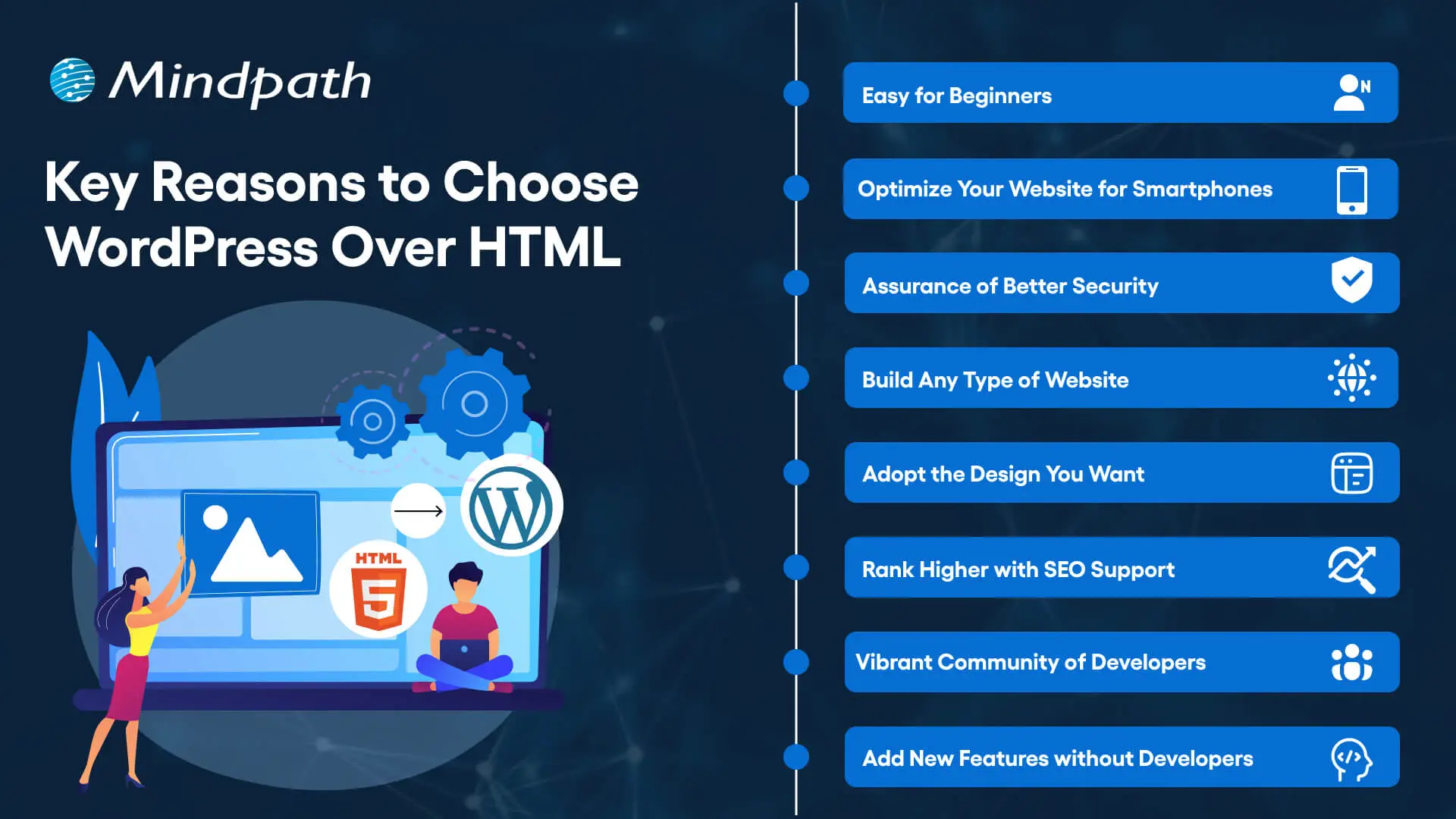
Key Reasons to Choose WordPress Over HTML

1. Easy for Beginners

The best thing about WordPress is that beginners will find it easy to use without any technical complexities. You don’t need coding skills to create your website and manage it on WordPress. The intuitive dashboard of WordPress allows you to create customized layouts, add more pages and update menus at one place. 

WordPress offers better flexibility than traditional website development approaches with more control over design, content management and functionality. Furthermore, the themes and plugins offered by WordPress help you add new features without waiting for developers. In other words, anyone can build a website without technical skills when they know how to use WordPress.   

2. Optimize Your Website for Smartphones

Do you know that most of the traffic to your business will come from mobile users? Many of you would need a HTML to WordPress converter online when you discover that WordPress offers mobile responsiveness. Most of the WordPress themes are tailored to function seamlessly on different screen sizes and device types. 

The interesting part of mobile responsiveness with WordPress is that your website will have the same aesthetic appeal on all devices. Apart from the consistent user experience on different devices, mobile responsiveness also makes your website rank higher on Google. With a few modifications to theme files and some new WordPress plugins, your static HTML website will run seamlessly on all mobile devices.

3. Assurance of Better Security

Businesses should also trust WordPress for its commitment to safeguarding any website hosted on the platform. You will get regular security updates on WordPress, which help in combating new security threats. On top of it, WordPress also offers additional security plugins and SSL certificates to enhance your website’s security. The biggest benefit of converting HTML to WordPress is visible in the efforts made by WordPress to address emerging vulnerabilities.

You must understand that modern approaches to website security need multiple layers of protection. For instance, you will need data encryption, backup systems and malware scanning to maintain the security of your website. WordPress offers the complete package to safeguard your website from hackers and unprecedented security breaches.

4. Build Any Type of Website

In its initial days, WordPress served as a useful tool for blogging alone. The transition of WordPress to a powerful driving force behind some of the biggest websites shows how it has evolved over the course of time. You should know how to add HTML to WordPress for switching from an outdated format to a versatile toolset. You can use WordPress for any type of website, whether it is for a small business or a large corporation.

WordPress is capable of hosting e-commerce websites, communities or social media networks. Businesses can always find WordPress plugins that will make their website better. Most important of all, you don’t have to worry about adaptability when your website needs to grow alongside your business. It is definitely a huge advantage for websites in an extremely competitive business landscape.

Unsure whether your WordPress project is following the right development standards and best practices? Check out our WordPress developer checklist to make sure every essential step is covered for a smooth and successful build.

5. Adopt the Design You Want

The problem with a static HTML website is that you don’t have any control over the design once it’s published. WordPress does not let you worry about changing the design of your website according to emerging trends. When you convert a website to WordPress, you get the advantage of capitalizing on its extensive theme library. You can have a business site, blog or an ecommerce site and still ensure that their design matches with your needs and style. 

The theme library of WordPress offers free and premium themes that you can choose for your website. You can also find additional themes from third-party developers and design marketplaces that bring unique features and layouts. The live previews of each theme help you check each design without affecting website functionality or content.  

6. Rank Higher with SEO Support

WordPress stands out as the most popular option to create websites now because of its SEO support. What will you gain from a website that never shows up on the first page of search results? You can download WordPress and capitalize on its strong SEO foundation to ensure a higher rank on search engines. The advantages of WordPress for SEO revolve around its strict coding guidelines that call for clean and structured code.

The code is not the only thing that makes WordPress websites easier to rank on Google and other search engines. You will also find user-friendly URLs, meta-descriptions and titles to gain more visibility in search engines. On top of it, the SEO plugins on WordPress will provide a lot of support in optimizing your website.

7. Vibrant Community of Developers

The biggest strength of WordPress is its large and active community of developers. As an open-source platform, WordPress continues growing with the contributions of multiple users and developers. The community not only introduces updates to the source files but also makes WordPress more secure and updated along the lines of latest trends. 

Another promising reason to convert HTML to WordPress theme for your website is the accessibility to website creation tools offered by the community. It ensures that developers alone don’t have the exclusive rights to use WordPress tools. Even a blogger or business owner can be a part of the WordPress community and capitalize on its diverse offerings.

8. Add New Features without Developers

Websites have to evolve and add new features to accommodate the emerging requirements of users. WordPress allows you to add new features to your website without the intervention of developers. The collection of powerful plugins available with WordPress can help you introduced advanced features without code changes. 

Plugins are the ideal tools for adding shopping carts, contact forms and other features on WordPress websites. You can also explore custom WordPress plugins by third-party developers to enhance their websites. On top of it, you can activate or deactivate plugins as required, which offers the flexibility for customizing a website to your needs. 

Unsure if your current security measures are enough to protect your WordPress site? Our safeguarding WordPress vulnerabilities guide can help you strengthen your defenses and protect your business.

Final Thoughts

The decision to convert your website from HTML to WordPress should not be a difficult one, considering the benefits of WordPress. It allows anyone to create a website without technical knowledge alongside offering the flexibility to add new features. In addition, you cannot ignore the benefits of regular security updates, a supportive community and control over website design. 

Mindpath specializes in converting HTML websites to WordPress for any type of website. We have years of experience in WordPress development that brings more credibility to our services. Our services for switching your website to WordPress also offer the assurance of an easy conversion procedure. If you want a website that is easier to update and maintain, then Mindpath is here to help you.


Related Post

Discover the ultimate guide to hiring Node.js developers in London. Learn about the skills, benefits, and cost factors involved in finding the right talent for your project.

Related Post

Hire ReactJS developers in Canada

The pace of digital transformation makes every business think about the best ways to create intuitive, user-friendly, and visually appealing web applications. Thus, many businesses have been looking for the best ways to hire ReactJS developers in Canada and capitalize on the economies of scale. As one of the most business-friendly countries, Canada offers many reasons to choose it for any business venture.

ReactJS is the most powerful framework for frontend development, trusted by big companies such as Netflix. You can capitalize on the skills of ReactJS developers to create web apps that not only resonate with your values but also help you achieve business goals. Let us discover the notable aspects that you should keep in mind to find competent React developers for your next web project.

Want to take your web projects to new heights? Mindpath’s ReactJS developers in Canada deliver tailored solutions by creating responsive and engaging applications that will align with your business needs.

Tapping Into the Tech Scene in Canada

Many readers would have assumed that Canada is not the ideal destination for hosting technology-based businesses. On the contrary, hiring ReactJS developers in Canada might be easier than in other locations due to its tech-savvy workforce and innovative spirit. Canada has emerged as one of the prime destinations for top-tier tech talent for many reasons. Along with a highly educated workforce, the country also hosts a thriving startup ecosystem.

Canada has some of the most popular educational institutions in the world, such as the University of British Columbia and the University of Toronto. The institutions produce graduates with impeccable fluency in technical skills, and many institutions offer specialized programs for software engineering. As a result, the workforce in Canada boasts a significant number of developers who are fluent in ReactJS.

Another prominent reason to consider Canada as a prime tech hub is the growing ecosystem of tech companies. For instance, Toronto harbors the Silicon Valley of the North, while Vancouver is home to multiple startups. Businesses can look for options to hire React developers in Canada, as the country attracts top talent and also hosts events where React developers showcase their skills. Most important of all, the cost of hiring React developers in Canada is more competitive than the hiring costs in the USA or other major destinations.

Want to improve your application’s speed without increasing development time or infrastructure costs? Discover how optimizing React performance benefits business owners looking for efficiency and ROI.

Weighing the Relevance of ReactJS in 2025

New technologies and frameworks for web development can make old frameworks obsolete. However, ReactJS is still a powerhouse for web development even after more than a decade of its arrival. It was created by Meta, which still takes responsibility for its maintenance even after making it open-source. Apart from the fact that it was created by a tech giant, ReactJS is a powerful frontend development framework due to its distinctive features.

Business owners and hiring managers want to explore the React developer job market in Canada to capitalize on the utility of ReactJS. The component-based architecture of the framework helps in creating reusable UI components that ensure better speed and scalability in development. The other notable features of ReactJS include the virtual DOM and its declarative syntax, which make it easier for developers to develop high-performance web apps.

Virtual DOM is a revolutionary feature of ReactJS as it ensures code stability and better performance with the assurance of a limited number of direct modifications in the actual DOM of browsers. On top of it, the thriving ReactJS community also offers a collection of tools and learning resources that help developers address project complexities with ease.

Also Read: ReactJS Development Services Benefits

Skills Required in Top ReactJS Developers

Almost anyone in the tech landscape can become a ReactJS developer, as it is comparatively easier to learn than other frameworks. However, basic knowledge of ReactJS concepts does not make a developer the ideal pick for your web projects. The answers to “What skills should a ReactJS developer in New York have?” will help you understand that React developers’ skills must have a mix of technical and soft skills. In addition, companies searching for React developers in Canada will need developers who understand the local tech landscape.

1. Technical Skill Requirements from React Developers

Since ReactJS is a JavaScript framework, hiring managers should choose developers who have an in-depth understanding of JavaScript. It is important to ensure that ReactJS developers have a strong command of the latest ES6+ specifications of JavaScript. Fluency in functional and asynchronous programming is an essential skill that helps ReactJS developers in creating syntactically effective solutions. The important technical skills of ReactJS developers also include mastery of ReactJS concepts such as props, state management, hooks, and components. Professional ReactJS developers are also fluent in advanced features such as the React Router, Redux, and Context API.

The list of ReactJS developer skills to look for also focuses on knowledge of frontend development tools. For instance, developers must know how to work with build tools like npm and yarn. On top of it, proficiency in HTML and CSS makes a ReactJS developer capable of optimizing web apps for easier navigation. The other important skills required for ReactJS developers include the ability to understand API integration and testing. Recruiters should check whether candidates for React developer jobs know how to work with testing frameworks like the React Testing Library.

2. Soft Skill Requirements from ReactJS Developers

As a business owner, you must understand the importance of having ReactJS developers who know how to work in an organization. You cannot have technical experts who don’t know how to communicate or solve problems with innovative approaches. Most of the React developer hiring tips emphasize the necessity of having soft skills that help a developer navigate the business aspect of their job. The essential soft skills required from ReactJS developers include critical thinking, adaptability, communication, and attention to detail.

Developers without critical thinking abilities are likely to be stuck with emerging problems. Critical thinking skills can help ReactJS developers think of innovative solutions to problems from unconventional perspectives. React developers must also be adaptable to changes in the technological landscape and stay updated with new features of ReactJS. Furthermore, a React developer with attention to detail can ensure that a business gets the most efficient web apps without multiple reworks.

Want your app to be future-ready and easy to maintain? Learn how ReactJS for app development helps businesses create flexible, efficient, and scalable applications.

Ideal Hiring Model for ReactJS Developers

The hiring model defines the approach a business adopts to use the services of ReactJS developers. You can find different hiring models, such as in-house developers, freelancers, remote developers, or professional agencies. If you want to know ReactJS developer hourly rates, then you might need developers for short-term projects or to address specific skill requirements. Depending on the requirements, businesses can choose one of the following hiring models to tap into the expertise of ReactJS developers.

1. In-House Developer Teams

Many organizations have in-house developer teams to work on web development projects. However, organizations without a hefty budget for hiring developers, such as startups, will find it difficult to recruit in-house developers. In-house ReactJS developers can offer many advantages, such as direct control over how they work. On top of it, businesses can ensure that in-house developers align with the company culture in their work. In-house React developers are more likely to follow the company’s vision and values.

2. Remote ReactJS Developers

The next big option for any hiring manager to bring ReactJS developers on board is remote work. Recruiters can choose remote ReactJS developers in Canada from various platforms that offer access to pre-vetted talent. Remote developers can help a business avoid the trouble of hiring a full-time employee. The biggest advantage of choosing remote developers for ReactJS projects is the assurance of capitalizing on a global talent pool.

3. Professional ReactJS Development Services

Among the many options to add the most competent ReactJS developers to your organization, professional development services will stand tall. Why? Business owners don’t have to worry about how to hire ReactJS developers while working with professional development services. Professional ReactJS development agencies have teams of experienced developers who have worked on multiple web development projects. As a result, businesses can get the output of an in-house developer team from professional React development services without any concerns about managing resources.

Looking to scale your tech team without the overhead of traditional hiring? Read the key benefits of hiring remote developers to access global talent, reduce costs, and boost productivity.

Strategic Process for Hiring ReactJS Developers in Canada

The awareness of essential skills and hiring models to welcome ReactJS developers into your organization can provide a strong foundation to create the hiring process. You don’t have to think about ReactJS developer cost in Canada from the beginning. On the contrary, the following steps will help you with a strategic approach to pick the right talent for ReactJS web development projects.

1. Prepare a Job Description for Top-Tier Talent

The hiring process always starts with the creation of a job description that outlines key responsibilities, job title, and skills required for the job. Some hiring managers also choose to add the estimated salary in the job description. However, it is important to understand that the job description is the best resource to attract the top ReactJS talent in Canada to any company. Applicants for ReactJS developer jobs use the job description to understand what to expect from the job.

The job description helps in understanding the complexity of projects that developers have to work on and the level of experience required for the projects. As a result, the job description ensures that only qualified candidates apply for the ReactJS developer jobs.

2. Explore the Ideal Platforms to Find Talent

Hiring managers can use the job description to find the best talent only when published on the right platforms. The ideal platforms that can support your efforts to hire ReactJS developers in Canada include professional networking platforms and job boards. LinkedIn is one of the best examples of professional networking platforms to find skilled ReactJS developers. You can publish job listings on LinkedIn and also review the qualifications of candidates from their profiles directly.

The other notable places to find expert ReactJS developers include job boards like Glassdoor and Indeed. Businesses should also consider exploring online forums and visiting community meetings for ReactJS developers to pick the best talent for their web projects.

Also React: ReactJS Web development

3. Screening and Interview Process

The most crucial part of the hiring process deals with the screening of candidates and the interview process. The screening process must focus on the assessment of the job applications and resumes of applicants. Hiring managers can also call candidates to interact with them over the phone or via video calls. It will help in determining whether they will be an ideal fit for the job. The first call helps in finding a lot about the communication skills and technical fluency of candidates in React development.

Once you have completed the screening, the hiring process will shift towards interviews. The interviews for hiring ReactJS developers must include a comprehensive assessment of coding capabilities and understanding of React concepts. Live coding sessions, simulated coding challenges, and questions on core React concepts can help in testing the candidate’s practical skills.

4. Know the Hiring Costs

Another crucial aspect of hiring React developers is the hiring cost. Many people assume that hiring costs only focus on the salary of ReactJS developers. The answers to “What is the cost of hiring a ReactJS developer in Canada?” will also include the recruitment and onboarding costs. Recruitment costs include the costs of publishing job descriptions and the expenses for the screening and interview process. The onboarding costs include costs for training and the resources and equipment provided to qualified candidates after the interview.

The average annual salary of a ReactJS developer in Toronto is around CAD $68,000 for entry-level roles (Source). You can also find some platforms that predict that the average salary of React developers is almost $140,000 per year (Source). While the salary forms a major chunk of the hiring costs, it can vary according to location, experience, and responsibilities.

Do you want your web project to succeed with the right React development partner? Explore how choosing the right ReactJS development company can maximize ROI, speed, and long-term scalability.

Final Thoughts

The insights into the process of hiring professional React developers in Canada can help you recruit the best talent. With a tech-savvy workforce and thriving ecosystem of innovation, Canada is a promising destination for business growth. As businesses grow, they need proficient ReactJS developers to create engaging and intuitive web apps for their digital presence.

Mindpath offers Canada-based ReactJS development services to businesses of all sizes across various industries. Our reputation as an end-to-end IT solutions provider revolves around catering to the client’s vision and requirements. On every project, all our team members use their experience as well as insights to design elegant solutions. Connect with us and discover the ideal roadmap to create your next web project right now.

Discover the key factors influencing software development costs and how to optimize your budget. Learn how Mindpath can help.
AI in software engineering

Artificial intelligence is the biggest force of transformation in software development, with AI tools enhancing innovation and productivity. The applications of AI in software engineering also draw attention towards the utility of artificial intelligence in software maintenance. Artificial intelligence has been helping with automated code generation and optimizing the testing and deployment processes. Where does AI come into play in the maintenance of software applications?

AI technologies can contribute to software maintenance with automated debugging and testing to identify areas for improvement. Software engineers can also use advanced AI tools to avoid future issues with proactive maintenance strategies. Furthermore, artificial intelligence also expedites other maintenance tasks, such as resource allocation and real-time performance monitoring. As AI continues evolving, it may introduce fundamental changes in all aspects of software maintenance. 

Planning to use AI to optimise your software engineering workflows? Mindpath’s software maintenance and support services provide smart solutions that simplify maintenance and support growth.

Unraveling the Role of AI in Maintaining Software Applications

How do you ensure that software applications work exactly as you intended after launching them? Many people don’t understand how important maintenance in software applications can be, especially for critical apps. Traditional software maintenance practices involve identifying and fixing bugs, introducing updates and implementing new improvements like security patches. The other responsibilities involved in software maintenance include troubleshooting issues, understanding legacy code, analyzing logs and resolving user complaints.

Most of the work in software maintenance required manual effort, which led to many other problems. The biggest problems in traditional software maintenance approaches include the possibilities of human error, intensive resource allocation and extended response times. Artificial intelligence revolutionizes software maintenance by automating different tasks and improving overall efficiency. With the power of automation and predictive analytics, AI can provide a strong foundation for proactive software maintenance.

Want to understand what makes engineers thrive in AI-powered development environments? Check out our qualities of a good software engineer blog to discover the traits that set top professionals apart.

Why Should AI Be Your First Choice for Software Maintenance?

You can notice one of the prominent reasons to use AI for software application maintenance in how AI tools can analyze code and identify vulnerabilities. The utility of AI in software development extends beyond automated code generation or creation of test cases. Developers and engineers can rely on AI for automated bug detection for better advantages than manual code testing. Artificial intelligence also empowers developers with the capability for identifying trends and patterns that would have been impossible with manual methods. 

The primary reason to choose AI for more efficient software maintenance revolves around the assurance of multiple benefits. You can notice a significant reduction in time and effort required for software maintenance with artificial intelligence. AI-powered tools can help with automatic creation of code documentation, thereby saving the valuable time of maintenance teams. 

The applications of AI in software maintenance also help developers in focusing on the critical issues. With AI handling automatic bug detection and creation of bug reports, developers can achieve more effective software maintenance. For example, AI tools can use past instances of bug fixes to come up with solutions for similar issues. As a result, you can enjoy faster resolution along with access to knowledge that can help with future maintenance activities.

Want to better plan your project budget and avoid unexpected expenses? Discover our software development cost blog to learn the key factors that influence overall development pricing.

Understanding the Use Cases of AI for Software Maintenance

Artificial intelligence might seem like the omniscient computer systems from science fiction movies and novels. Have you ever wondered how AI is used in software development and maintenance? The use cases of AI for maintenance of software applications involve the use of machine learning, large language models, natural language processing and other AI technologies. The integration of these technologies in software maintenance services can improve accuracy and ensure seamless functionality of software applications. 

1. Predictive or Proactive Maintenance

One of the most noticeable applications of artificial intelligence in software maintenance points at predictive maintenance. It enables a proactive approach to software maintenance by identifying and resolving issues before they happen. AI tools can leverage machine learning to learn from historical data of bug repositories and version control systems. 

Artificial intelligence can predict potential areas in the code where you can find bugs and vulnerabilities. As a result, developers can rely on a proactive approach to software maintenance with artificial intelligence. Predictive analytics with AI can help with assessment of system health, prior incidents and usage patterns. Software maintenance teams can take preemptive action in situations where manual maintenance approaches would have failed.

2. Bug Detection and Resolution

Another common way in which IT software support teams can enhance maintenance with artificial intelligence is bug detection. AI algorithms can facilitate easier detection and classification of bugs in software applications. Artificial intelligence offers the power for analyzing logs, code repositories and telemetry data for faster bug detection. Machine learning algorithms in AI tools can identify recurring patterns, create bug reports and identify vulnerable aspects of the code. On top of it, AI tools can also recommend ways to resolve the bugs efficiently.

Also Read: Generative AI Tools for Content & Code Creation

3. Automatic Code Refactoring

Software developers and engineers can also leverage AI tools for automated code refactoring to achieve more efficient software maintenance. Automated code refactoring refers to the process of breaking down a code to discover potential areas for improvement. The significance of AI in software engineering is clearly evident in how AI algorithms can recommend improvements for performance, readability and ease of maintenance. As a result, developers can achieve easier code optimization alongside reducing technical complexity. 

4. Resolving Support Tickets

Internal teams also raise support tickets along with users, thereby making ticket resolution an important priority in software maintenance. NLP algorithms can help with automatic classification and prioritization of new maintenance support tickets according to urgency. You can also find some platforms with AI tools that recommend suggestions to resolve the support tickets. The use of AI in resolving maintenance support tickets reduces the burden on human support teams. 

Want to stay ahead of evolving development practices? Discover our software development trends blog to explore what’s shaping the future of software.

New Trends Expected in AI-Powered Software Maintenance

The evolution of artificial intelligence has brought many new enhancements across different industries. You can also expect the role of AI in software development and maintenance to grow bigger with the arrival of new AI capabilities. The latest developments in AI will play a major role in redefining software maintenance in the future.

1. Adoption of AI Agents in Software Maintenance

Agentic AI is one of the biggest trends that have been grabbing headlines everywhere in the domain of AI. Many businesses have embraced autonomous or semi-autonomous AI agents for software maintenance tasks, including software developers and technical support agents. AI agents can perform regular maintenance tasks, such as rolling out new updates, applying patches or restarting services without direct human intervention.

2. Using Generative AI to Improve Legacy Code

Legacy code is a formidable challenge in software maintenance as engineers have to check old codebases to identify errors and vulnerabilities. With the help of generative AI, software development teams can now analyze legacy codebases easily at a faster pace. On top of it, generative AI tools can help with detection of security issues and suggest patches. Some platforms also offer the advantage of rewriting old modules in new programming languages.

3. Reinforcement Learning in Software Maintenance

The next promising way in which AI can become a part of software maintenance involves the use of reinforcement learning. You can improve maintenance in software applications by using reinforcement learning algorithms to learn from feedback. The insights gained from feedback will help in improving performance, especially for complex software maintenance tasks. 

Ready to invest in technology built specifically around your goals? Check out our custom software development blog to learn why customization matters.

Final Thoughts

The reasons to adopt artificial intelligence in software maintenance revolve primarily around enhancing speed and efficiency. You can notice how AI improves software maintenance by facilitating automated detection and resolution of bugs. Artificial intelligence can empower software maintenance companies to adopt new trends like AI agents and generative AI for effective maintenance.

Mindpath is a trusted name for software maintenance and support services with tangible proof of expertise in artificial intelligence. Our software engineering services have been delivering excellence to all our clients with capabilities to leverage AI technologies in software maintenance. We have earned the love of clients with software maintenance and support services that deliver exactly what they want. Consult with our experts now and find the best ways to integrate artificial intelligence into your software maintenance workflows.              

benefits of devops

While building software, just think that the developers and the operations teams are working like a well-coordinated crew, being fast, smooth and always on the same page. Isn’t it an interesting combination? Well, that’s the power behind embracing the benefits of DevOps. It is a new method to simplify your software process, in a way that will help teams work more effectively in an increasingly fast-paced digital world.

As we approach 2026, DevOps continues to evolve the way businesses build and run software. DevOps is not just a fast way to deliver software; it is a cultural approach that allows for speed, scale, agility, and reliability. This blog will look at how DevOps is rewriting the development process and why it is now essential for progressive teams. 

Are you looking to implement DevOps in your organization? Mindpath provides customized solutions to help teams speed up the development process and reach quantifiable goals.

What is DevOps?

DevOps refers to the collaboration of development and IT operations teams working together for the software development processes. It helps them to build, test as well as launch software faster and smoother. The major idea behind DevOps is better teamwork, faster delivery, and fewer problems during the software process. 

Even though it is not a tool or a product, it often includes using helpful technologies such as cloud platforms, containers and real-time communication tools. A big part of it is CI/CD, which stands for continuous integration and continuous delivery. This helps teams update software more often without slowing down. With DevOps, both developers and operations teams can share tasks, improve quality, and make sure the final product reaches users quickly and safely. 

How Does DevOps Work?

DevOps works by bringing development and operations teams together to make software faster and more reliable. The process follows a cycle that includes planning, coding, building, testing, releasing, deploying, operating, monitoring, and collecting feedback. Each step is connected to keep the work smooth and continuous. What is the main purpose of DevOps? It is to create software that meets user needs, runs well from the start, and is delivered without delays. 

To support this, teams use DevOps tools like automation platforms, monitoring systems, and CI/CD pipelines. These tools help developers work independently and speed up tasks that used to take longer. For example, with continuous integration, developers can update shared code several times a day and quickly catch bugs. Teams also follow shared rules for testing and quality, so everyone stays on the same page. 

Planning to modernize your DevOps approach using automation and stronger safeguards? Check out our blog on DevSecOps to learn why automated security integration is essential for speed, stability, and resilience.

What are the Key Benefits of DevOps?

Adopting DevOps brings real improvements to how teams build and deliver software. The DevOps benefits focus on making the development process more efficient, reliable, and easier to manage. Let’s have a look at some of it: 

top benefits of devops

1. Lower Costs

Combining updates and maintenance in one process helps teams work more efficiently. DevOps reduces the need for last-minute fixes and wasted effort. This saves money and helps teams do more with the same resources.  

2. Higher Team Productivity

Open communication and fewer repeated tasks let teams focus on real progress. Everyone knows what to do and can work on high-value goals. As a result, productivity rises, and team members feel more involved.  

3. A More Stable Work Environment

DevOps helps create a calmer and more organized workplace by reducing the pressure of constant changes. Teams can handle updates with ease, due to smoother processes and clear communication. This balance helps everyone stay focused and productive. 

4. Faster Delivery

With DevOps, updates and new features can be launched more quickly. DevOps for business helps in meeting customer needs faster and staying ahead of the competition. Streamlined deployment also helps with fewer delays and more consistent results. 

5. Better Product Quality

Frequent feedback and testing throughout development help improve the final product. DevOps uses automation to catch up on problems early, before they grow. This keeps the focus on delivering quality and reduces the need for rework. 

Must Read: DevOps Trends 

6. Fix Issues Quickly

DevOps makes it easier to detect and solve issues early. Smaller releases and constant monitoring help teams act fast when something goes wrong. This keeps systems running smoothly and reduces downtime. 

7. Greater Flexibility

DevOps supports teamwork across different departments, helping companies respond quickly to change. Breaking down barriers between teams encourages flexibility in how work gets done. This leads to quicker decisions and faster progress. 

8. Frees Up Space for Innovation

When tasks like testing and deployment are automated, teams have more time for creative thinking. Developers can focus on building new ideas instead of repeating the same steps. This makes work more exciting and leads to better solutions. 

9. Guarantees Continuous Updates

DevOps supports a smooth flow of updates and new features with every release. Automation and teamwork make sure each change is tested and delivered quickly. This gives users regular improvements while keeping everything stable. 

10. Minimal Mistakes

Frequent code releases and testing help teams catch up with problems early. This keeps software quality high and prevents bigger issues later on. It’s a key benefit of DevOps that helps teams move forward with confidence. 

Aiming to enhance operational efficiency and reduce development risks? Check out our blog on DevOps Challenges and Solutions to discover proven approaches that improve performance, stability, and cross-team cooperation.

DevOps Best Practices

Following the right approach is key to getting the most out of DevOps. It helps teams collaborate better, improve software quality, and speed up delivery. Here are some of the most effective DevOps best practices to consider: 

1. Build a Culture of Trust and Teamwork

To make DevOps work well, teams need to feel safe to share ideas and learn from mistakes. When there is trust and open communication, collaboration becomes much easier. Breaking down walls between departments helps everyone work toward a shared goal. A culture of trust and empathy makes it easier to adopt DevOps smoothly.

2. Continuous Integration and Delivery

CI/CD DevOps practices involve adding small code changes frequently to a shared space. This helps teams spot issues early and keep the code clean. Once the code is tested, it moves into production smoothly through continuous delivery. This process saves time and gives developers confidence when releasing updates.

3. Automate Testing Early On

Automated testing is a key part of a strong CI/CD pipeline. Instead of waiting for manual tests, automated tests run every time a change is made. These tests can include everything from unit to load testing, depending on your needs. This helps reduce bugs and makes sure the software stays reliable.

4. Track the Right Metrics

To keep improving, teams need to measure what matters. Metrics like deployment speed, failure rates, and time to fix issues give a clear picture of performance. Each team may focus on different metrics based on their goals. It’s also important to collect logs and monitor systems to quickly fix problems and improve how everything runs.

5. Automate Repetitive Tasks

Manual tasks can slow down development and lead to mistakes. Automating these tasks speeds things up and keeps results consistent. It also frees up teams to focus on more valuable work. A reliable automation process adds confidence and improves overall efficiency.

Planning to strengthen your software delivery lifecycle? Explore our blog on DevOps vs DevSecOps to understand how shifting from simple automation to integrated security can elevate speed, reliability, and protection.

Ready To See How DevOps Can Boost Your Business?

The benefits of DevOps include enhanced collaboration, faster software delivery, and improved product quality. It also reduces costs while fostering a stable and efficient work environment. Through automation and continuous feedback, teams can quickly adapt and respond to changes, making DevOps a vital approach for building reliable software in today’s dynamic digital landscape. 

At Mindpath, we specialize in helping organizations successfully implement DevOps practices. We focus on automating processes, strengthening team collaboration, and accelerating software delivery with quality and security. Our expert guidance ensures your DevOps transformation aligns with your business objectives, enabling smoother and more efficient software development. 

Frequently Asked Questions

1. How can DevOps help a business recover faster from unexpected failures?

DevOps practices, like automated testing, monitoring, and CI/CD pipelines, allow teams to detect and fix issues early. Quick rollback mechanisms and real-time alerts reduce downtime, ensuring the business can recover faster while maintaining service continuity for customers.

2. Can adopting DevOps change the way teams collaborate beyond development and operations?

Yes. DevOps fosters cross-functional collaboration, breaking silos between teams like QA, security, and product management. Shared responsibility, transparent workflows, and continuous feedback enhance coordination, resulting in faster decision-making and smoother project delivery across the organization.

3. How do the benefits of DevOps extend to customer experience?

DevOps accelerates release cycles, enabling frequent updates and faster bug fixes. Continuous monitoring ensures software stability, while automation reduces errors. Together, these practices deliver a reliable, responsive, and high-quality user experience that aligns with evolving customer expectations.

4. What is the role of automation in reducing operational risks within DevOps?

Automation handles repetitive and error-prone tasks such as deployments, configuration management, and testing. By minimizing human intervention, it lowers the risk of mistakes, ensures consistency across environments, and enhances overall system reliability, even under high-demand scenarios.

5. How can DevOps support businesses preparing for rapid growth or scaling?

DevOps enables scalable infrastructure through containerization, microservices, and cloud integration. Continuous monitoring and automated deployment pipelines allow applications to handle increasing traffic without performance degradation, making growth smoother and reducing technical bottlenecks as demand rises.